LLM/Model & Papers
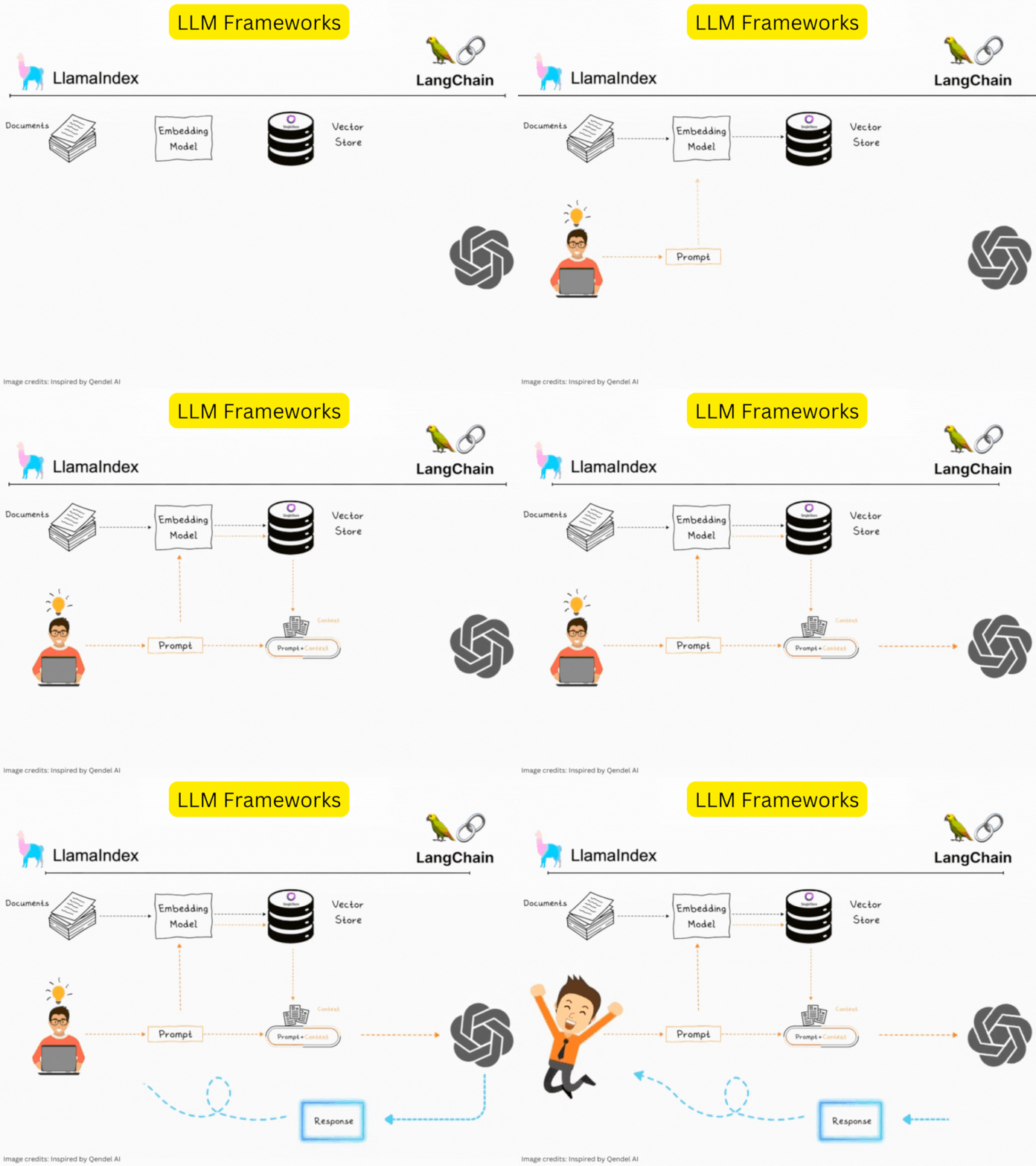
LangChain and LlamaIndex to LLM Frameworks
Curiosity: When should we use LangChain versus LlamaIndex? How do these frameworks differ in their approach to building LLM applications?
LangChain vs. LlamaIndex: Choosing the Right LLM Framework
Curiosity: When should we use LangChain versus LlamaIndex? How do these frameworks differ in their approach to building LLM applications?
LangChain and LlamaIndex are both powerful frameworks for building LLM applications, but they excel in different use cases. Understanding their strengths helps you choose the right tool for your project.
Framework Comparison Overview
graph TB
    A[LLM Application Need] --> B{Primary Use Case?}
    B -->|RAG/Retrieval| C[LlamaIndex]
    B -->|General Purpose| D[LangChain]
    B -->|Both| E[Hybrid Approach]

    C --> C1[Fast Indexing]
    C --> C2[Efficient Retrieval]
    C --> C3[Data Integration]

    D --> D1[Flexible Components]
    D --> D2[Complex Workflows]
    D --> D3[Prompt Management]

    style A fill:#e1f5ff
    style C fill:#fff3cd
    style D fill:#d4edda
    style E fill:#f8d7da
Key Differences
| Aspect | LangChain | LlamaIndex |
|---|---|---|
| Primary Focus | General-purpose LLM apps | Search & retrieval |
| RAG Applications | ⚠️ Good | ✅ Excellent |
| Complex Workflows | ✅ Excellent | ⚠️ Limited |
| Data Indexing | ⚠️ Manual | ✅ Optimized |
| Prompt Engineering | ✅ LangSmith | ⚠️ Basic |
| Component Library | ✅ Extensive | ⚠️ Focused |
| Learning Curve | ⚠️ Steeper | ✅ Gentler |
Use Case Analysis
1. Building RAG Applications
Retrieve: LlamaIndex excels at production-ready RAG due to optimized indexing and retrieval.
LlamaIndex Advantages:
- ⚡ Quick data retrieval
- 🔄 Seamless data indexing
- 📊 Optimized for vector embeddings
- 🎯 Production-ready out of the box
LangChain Approach:
- ⚙️ More granular control
- 🔧 Customizable components
- 📈 Flexible architecture
1
2
3
4
5
6
7
8
9
10
11
12
13
14
15
16
17
18
19
20
21
22
23
24
# LlamaIndex RAG Example
from llama_index import VectorStoreIndex, SimpleDirectoryReader

# Simple, optimized indexing
documents = SimpleDirectoryReader("data").load_data()
index = VectorStoreIndex.from_documents(documents)
query_engine = index.as_query_engine()

# Query
response = query_engine.query("What is the main topic?")
print(response)

# LangChain RAG Example
from langchain.vectorstores import Chroma
from langchain.embeddings import OpenAIEmbeddings
from langchain.chains import RetrievalQA

# More control, more setup
embeddings = OpenAIEmbeddings()
vectorstore = Chroma.from_documents(documents, embeddings)
qa_chain = RetrievalQA.from_chain_type(
    llm=llm,
    retriever=vectorstore.as_retriever()
)
2. Complex AI Workflows
Innovate: LangChain offers more out-of-the-box components for diverse architectures.
LangChain Strengths:
- 🔗 Chain composition
- 🛠️ Extensive tooling
- 🔄 Multi-step workflows
- 🎨 Customizable pipelines
Workflow Example:
graph LR
    A[Input] --> B[LangChain Chain]
    B --> C[Tool 1]
    B --> D[Tool 2]
    B --> E[LLM]
    C --> F[Output]
    D --> F
    E --> F

    style A fill:#e1f5ff
    style B fill:#fff3cd
    style F fill:#d4edda
3. Prompt Engineering
Retrieve: LangChain’s LangSmith provides advanced prompt management.
| Feature | LangChain (LangSmith) | LlamaIndex |
|---|---|---|
| Prompt Versioning | ✅ Yes | ❌ No |
| Prompt Organization | ✅ Advanced | ⚠️ Basic |
| A/B Testing | ✅ Supported | ❌ No |
| Monitoring | ✅ Comprehensive | ⚠️ Limited |
Decision Framework
graph TD
    A[Start] --> B{Need RAG?}
    B -->|Yes| C{Large Data Ingestion?}
    B -->|No| D{Complex Workflows?}

    C -->|Yes| E[LlamaIndex]
    C -->|No| F[Either Works]

    D -->|Yes| G[LangChain]
    D -->|No| H[LangChain]

    I{Need Prompt Management?} -->|Yes| G
    I -->|No| F

    style E fill:#fff3cd
    style G fill:#d4edda
    style F fill:#e1f5ff
When to Choose LlamaIndex
➤ Choose LlamaIndex if:
- Your application requires efficient indexing and retrieval
- You need to work with vector embeddings and large data ingestion
- You want a straightforward interface for connecting custom data sources
- You’re building production-ready RAG applications
- You need tools optimized for index querying
Best For:
- 📚 Document search systems
- 🔍 Information retrieval
- 📊 Data-heavy RAG applications
- 🚀 Quick RAG prototyping
When to Choose LangChain
➤ Choose LangChain if:
- You need a general-purpose framework for diverse applications
- You’re building complex, interactive LLM applications
- You require custom query processing pipelines
- You need multimodal integration
- You want granular control and performance tuning
- You need advanced prompt management (LangSmith)
Best For:
- 🤖 Complex AI agents
- 🔄 Multi-step workflows
- 🛠️ Custom architectures
- 📝 Advanced prompt engineering
- 🎯 Flexible application design
Hybrid Approach
Innovate: You can use both frameworks together, leveraging each for its strengths.
1
2
3
4
5
6
7
8
9
10
11
# Hybrid: LlamaIndex for indexing, LangChain for orchestration
from llama_index import VectorStoreIndex
from langchain.chains import LLMChain

# Use LlamaIndex for efficient retrieval
index = VectorStoreIndex.from_documents(documents)
retriever = index.as_retriever()

# Use LangChain for complex workflow
chain = LLMChain(llm=llm, prompt=prompt)
result = chain.run(retrieved_context=retriever.retrieve(query))
Vector Database Recommendation
Important: No matter which framework you choose, you’ll need a robust vector database.
SingleStore offers:
- ⚡ High-performance vector storage
- 🔄 Real-time updates
- 📈 Scalability
- 🛠️ Easy integration
Try SingleStore database for free: https://lnkd.in/gCAbwtTC
Key Takeaways
Retrieve: LangChain is a general-purpose framework excellent for complex workflows, while LlamaIndex specializes in efficient RAG and retrieval tasks.
Innovate: Choose based on your priorities: LlamaIndex for production-ready RAG with large data, LangChain for flexible, complex applications with advanced prompt management.
Curiosity → Retrieve → Innovation: Start with curiosity about framework differences, retrieve insights from use case analysis, and innovate by selecting or combining frameworks for optimal results.
Next Steps:
- Evaluate your specific use case
- Consider data volume and complexity
- Test both frameworks if needed
- Choose based on priorities