AI
Loops: What Every AI Engineer Needs to Know in 2026
The fastest-moving idea in AI dev tooling isn’t a model — it’s the loop around it. Why Boris Cherny, Peter Steinberger, and Addy Osmani stopped prompting agents and started designing loops, with runnable examples and a game-production lens.

Source breakdown of “Loops: What Every AI Engineer Needs to Know in 2026” by Rahul (@sairahul1), which amplifies Peter Steinberger’s “design the loops that prompt your agents” and Addy Osmani’s Loop Engineering post. Cover image is the article’s own card, pulled from the X preview. The inline diagrams in this write-up are the original figures from Osmani’s public post — the canonical source the X article summarizes — because the X article body itself sits behind a login wall and can’t be archived directly. Cross-checked against The New Stack’s reporting and Firecrawl’s loop-engineering guide. Everything below is my read as someone who has shipped AI systems into production games for eight years.
🤔 Curiosity: If You’re Still Typing Prompts, What Are You Actually Doing?
A single sentence from Rahul’s article stopped me mid-scroll. He quotes Boris Cherny — the person who built Claude Code at Anthropic — saying:
“I don’t prompt Claude anymore. I write loops, and the loops do the work. My job is to write loops.”
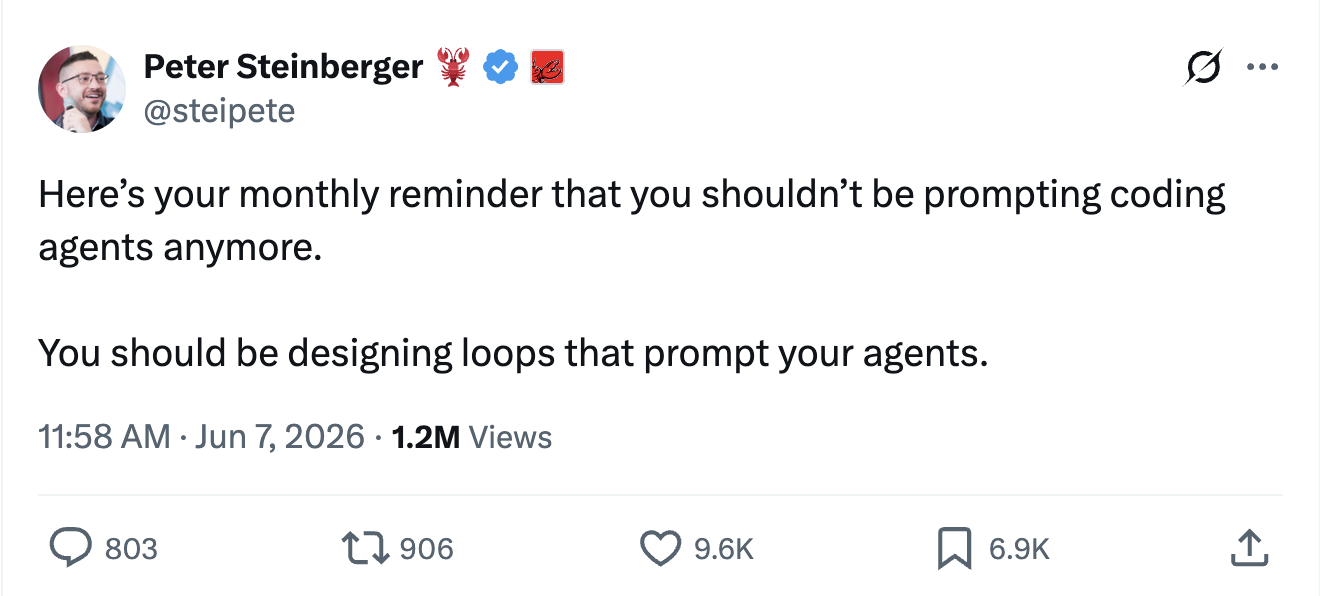 The opening figure from Addy Osmani’s “Loop Engineering” — the same image Rahul’s article leans on. The job moves from typing the prompt to designing the system that types it. (Source: addyo.substack.com/p/loop-engineering)
Peter Steinberger (creator of OpenClaw, now at OpenAI) put the same idea more bluntly the day before: “You shouldn’t be prompting coding agents anymore. You should be designing loops that prompt your agents.” By that weekend, Google’s Addy Osmani had given the pattern a name — loop engineering — and the whole AI-dev timeline lit up.
Here’s why this hit a nerve for me. In game production, I’ve watched the exact same migration happen with NPC AI. We started by scripting every behavior by hand (if player_near: attack). Then we moved to behavior trees — we stopped writing the actions and started designing the structure that selects actions. The designer’s job changed from “write what the guard does” to “write the loop the guard runs every tick.” Loop engineering is that same promotion, applied to coding agents.
Curiosity: Everyone clipped Cherny’s quote. Almost nobody built what he described. So what is a “loop,” concretely, and what does it actually take to make one that’s safe to leave running while you sleep?
Let me retrieve the actual machinery.
📚 Retrieve: What a “Loop” Actually Is
For two years, working with a coding agent meant typing one prompt, reading the result, typing the next prompt. You were the scheduler and you were the quality gate. A loop inverts that arrangement. Osmani’s framing is the cleanest: loop engineering is “replacing yourself as the person who prompts the agent.”
The closest analogy is moving from operating a lathe to designing the production line the lathe sits on. A loop:
- Discovers work on a schedule (instead of you noticing it),
- Executes in an isolated workspace,
- Verifies the result with a second agent,
- Persists state to a file so tomorrow’s run resumes where today’s stopped.
flowchart LR
    Cron["⏰ Trigger<br/>(cron / webhook / file change)"] --> Read["📖 Read state<br/>(CLAUDE.md, JSON, board)"]
    Read --> Discover["🔍 Discover work<br/>(triage, scan, query)"]
    Discover --> Plan["🧠 Plan next action<br/>(model reads state, decides)"]
    Plan --> Exec["🛠️ Execute<br/>(isolated git worktree)"]
    Exec --> Verify{"✅ Verifier sub-agent<br/>(different instructions)"}
    Verify -->|Pass| Commit["💾 Commit + append state"]
    Verify -->|Fail| Plan
    Commit --> Stop{"🎯 Stopping<br/>condition met?"}
    Stop -->|No| Discover
    Stop -->|Yes| Done["🏁 Exit"]

    style Verify fill:#4ecdc4,stroke:#0a9396,stroke-width:3px,color:#000
    style Plan fill:#ff6b6b,stroke:#c92a2a,stroke-width:2px,color:#fff
    style Stop fill:#ffe66d,stroke:#f4a261,stroke-width:2px,color:#000
The 18-month escalator
The thing that makes this feel inevitable is the trajectory. We went up a full abstraction ladder in under a year and a half:
| Era | The unit of work | What you tune | Who pulls the trigger |
|---|---|---|---|
| Prompt engineering | A single message | Wording, examples | You, every turn |
| Context engineering | The window | What’s in scope (RAG, files) | You, every turn |
| Harness engineering | The tool/permission surface | MCP, hooks, allow-lists | You, per session |
| Loop engineering | The whole run | Schedule, verifier, memory | The loop |
Retrieve: A cron job runs a fixed script. A loop runs a model that reads the current state and chooses its next action. That decision logic in the middle is the entire difference — and the reason a loop can’t just be replaced by a shell script.
Osmani’s six primitives (and why both vendors already shipped them)
The reason the conversation exploded in June 2026 is that the building blocks were already finished. Osmani maps six primitives onto both OpenAI Codex and Claude Code, and the mappings are nearly identical — the assembly was complete, someone just had to point it out.
| Primitive | Job in the loop | Codex | Claude Code |
|---|---|---|---|
| Automations | Scheduled discovery + triage | Automations tab / triage inbox | Scheduled tasks, /loop, hooks, GitHub Actions |
| Worktrees | Isolate parallel agents | Built-in worktree per thread | git worktree, subagent isolation |
| Skills | Codify project knowledge | SKILL.md agent skills | SKILL.md agent skills |
| Connectors | Reach external tools | MCP connectors + plugins | MCP servers + plugins |
| Sub-agents | Separate the maker from the checker | .codex/agents/ | .claude/agents/, agent teams |
| Memory | Persist state between runs | AGENTS.md, Memories, Linear | CLAUDE.md, auto memory, Linear |
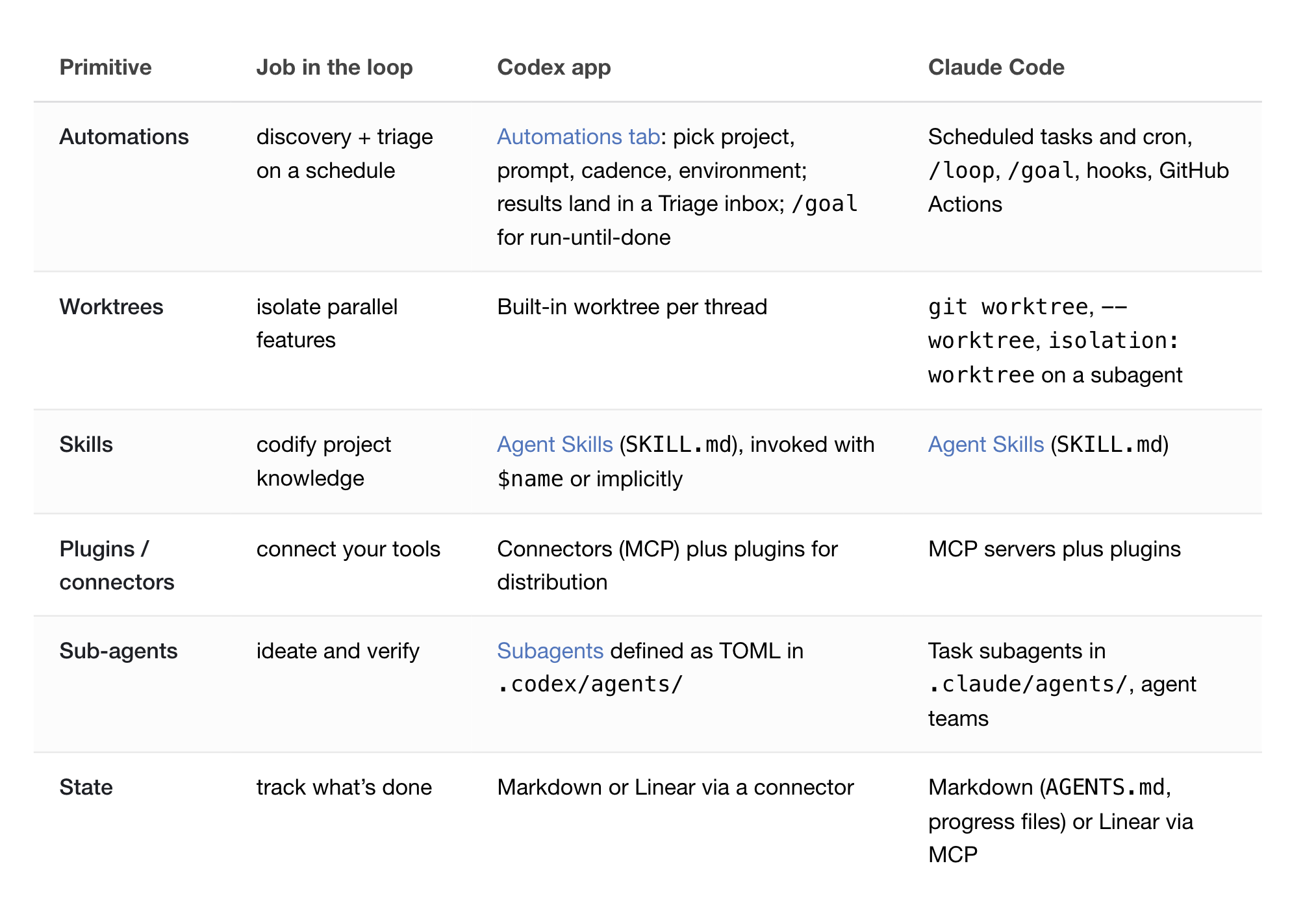 Osmani’s own figure: the same building blocks (automations, worktrees, skills, connectors/plugins, sub-agents) now ship in both Codex and Claude Code — “both products have all five now.” This is the assembly that was already finished; someone just had to name it. (Source: addyo.substack.com/p/loop-engineering)
Both products even expose a /goal command that keeps an agent working until a verifiable stopping condition holds — with Claude Code using a separate model to grade the result.
Open loop vs. closed loop — pick on purpose
This is the distinction Rahul’s article underweights and the one that will save your token budget:
| Open loop | Closed loop | |
|---|---|---|
| Constraints | Loose — a goal, wide latitude | Bounded — defined path + eval per step |
| Best for | Discovery, research, “find everything” | Production work, recurring maintenance |
| Cost | Brutal on tokens | Cheaper, predictable |
| Stopping | Rubric satisfied (fuzzy) | Hard check passes (crisp) |
| Default? | Only when you mean it | ✅ Yes |
The verifier is the part that earns trust
If you remember one thing: a model grading its own output is too generous. The single most consequential design choice in a loop is splitting the agent that writes the code from the agent that checks it. A second agent with different instructions catches the failures the first one reasoned itself into.
Osmani’s canonical example: a morning automation triages yesterday’s CI failures, dispatches one sub-agent to draft each fix in an isolated worktree, and a second sub-agent reviews each fix against the project’s tests. Ramp’s Inspect built exactly this shape as bespoke infrastructure six months earlier — now it’s a first-party feature in both ecosystems.
A minimal loop you can actually read
Here’s the skeleton stripped of vendor magic. The model is a subroutine inside your loop, not a chat partner. Note the four non-negotiables: a stopping condition, a no-progress guard, a budget cap, and a separate verifier.
1
2
3
4
5
6
7
8
9
10
11
12
13
14
15
16
17
18
19
20
21
22
23
24
25
26
27
28
29
30
31
32
33
34
35
36
37
38
39
40
41
42
43
44
45
46
47
48
49
50
51
52
53
54
55
56
57
58
59
60
61
62
63
# Curiosity: what's the smallest honest loop? Discover -> Act -> Verify -> Persist.
import json, subprocess, pathlib
from dataclasses import dataclass

STATE = pathlib.Path("loop_state.json")
MAX_ITERS = 8          # stopping condition: hard cap
TOKEN_BUDGET = 200_000 # stopping condition: dollars/tokens
NO_PROGRESS_LIMIT = 2  # stopping condition: bail if stuck

@dataclass
class LoopState:
    iteration: int = 0
    tokens_used: int = 0
    stale_rounds: int = 0
    done: bool = False
    last_signature: str = ""

def load() -> LoopState:
    # Memory: survive a crash, a context reset, a 3 a.m. process kill.
    if STATE.exists():
        return LoopState(**json.loads(STATE.read_text()))
    return LoopState()

def save(s: LoopState) -> None:
    STATE.write_text(json.dumps(s.__dict__, indent=2))

def maker(state: LoopState) -> dict:
    """Agent #1: read repo state, pick ONE unit of work, produce a patch."""
    # In practice: claude -p "..."  /  codex exec "..."  inside a git worktree.
    return run_agent(role="maker", instructions="Fix the top failing test. Output a diff.")

def verifier(patch: dict) -> bool:
    """Agent #2: DIFFERENT instructions. Never let the maker grade itself."""
    review = run_agent(role="verifier",
                       instructions="Run the suite against this diff. Pass only if all green.")
    return review["all_tests_pass"] and not review["touches_unrelated_files"]

def loop():
    s = load()
    while not s.done and s.iteration < MAX_ITERS and s.tokens_used < TOKEN_BUDGET:
        s.iteration += 1
        patch = maker(s)
        s.tokens_used += patch["tokens"]

        if verifier(patch):                 # the trust gate
            subprocess.run(["git", "apply", patch["diff_path"]], check=True)
            sig = patch["signature"]
            s.stale_rounds = 0 if sig != s.last_signature else s.stale_rounds + 1
            s.last_signature = sig
        else:
            s.stale_rounds += 1             # no-progress guard

        if s.stale_rounds >= NO_PROGRESS_LIMIT:
            print("No progress — exiting before we burn the budget.")
            break
        if patch["goal_satisfied"]:
            s.done = True
        save(s)                             # persist EVERY round

    print(f"Loop stopped at iter={s.iteration}, tokens={s.tokens_used}, done={s.done}")

if __name__ == "__main__":
    loop()
And the trigger is gloriously boring — a 2026 loop’s scheduling layer is just cron:
1
2
# Every weekday at 7am: triage overnight CI, let the loop draft + verify fixes.
0 7 * * 1-5  cd /repo && /usr/bin/python3 loop.py >> logs/loop.log 2>&1
💡 Innovation: What This Means If You Ship Games (or Anything Live)
Coding agents got the headlines, but the loop pattern is really about any system with recurring, verifiable work — which describes a live game almost perfectly. Here’s where I’d point it first.
Game-production loops worth building
flowchart TB
    subgraph LiveOps["🎮 Live-Ops Balance Loop"]
        A1["⏰ Nightly trigger"] --> A2["📊 Read yesterday's<br/>telemetry (win rates, churn)"]
        A2 --> A3["🧠 Maker: propose<br/>tuning deltas"]
        A3 --> A4["🤖 Verifier: re-sim<br/>10k matches"]
        A4 -->|Within guardrails| A5["📝 Draft PR for<br/>human sign-off"]
        A4 -->|Breaks guardrails| A3
    end

    style A4 fill:#4ecdc4,stroke:#0a9396,stroke-width:2px,color:#000
    style A3 fill:#ff6b6b,stroke:#c92a2a,stroke-width:2px,color:#fff
| Loop | Trigger | Maker does | Verifier checks | Stops when |
|---|---|---|---|---|
| Balance triage | Nightly telemetry | Propose tuning deltas | Re-simulate matches vs. guardrails | Win-rate band restored |
| Content QA | New asset committed | Generate edge-case test scenes | Render + diff against golden frames | Zero visual regressions |
| Crash-fix | Sentry spike webhook | Draft fix in a worktree | Repro test passes, no new crashes | Crash rate normalizes |
| Localization | String table change | Translate + lore-check | Back-translation + length-fit check | All locales pass |
The balance-tuning loop is the one I’d ship first, because it has a crisp verifier: re-running the match simulator is a closed, automatable eval. That’s the whole game — if you can’t write the check, you don’t have a loop, you have a runaway agent.
Innovation: In game AI we already trust self-running loops — that’s what a behavior tree tick is. Loop engineering just swaps the hand-authored selector for a model that reads state and chooses. The discipline that keeps NPCs from glitching — bounded ticks, clear transitions, a watchdog — is the same discipline that keeps an agent loop from burning your token budget at 3 a.m.
The honest tradeoffs
Osmani is more cautious than the hype he triggered, and so am I:
- Runaway cost. Without an iteration cap, a no-progress check, and a dollar budget, an open loop can burn a billing cycle over a weekend. All three guards are in the skeleton above for a reason.
- Comprehension debt. This is the sharp one. A loop ships code you never read. “Two engineers can run an identical loop and get opposite outcomes — one moving faster on work they understand, the other avoiding understanding altogether.” The verifier protects correctness; nothing protects comprehension except you reading the diffs.
- It might just be cron in a hat. The skeptics aren’t wrong about trivial loops. The value only appears when the middle step needs judgment — when a fixed script genuinely can’t decide what to do next.
 Osmani’s closing image says it best: “Build the loop. But build it like someone who intends to stay the engineer, not just the person who presses go.” The leverage point moved; the responsibility didn’t. (Source: addyo.substack.com/p/loop-engineering)
Key takeaways
| Insight | Implication | Next step |
|---|---|---|
| The model got demoted to a subroutine | Stop optimizing prompts; optimize the loop | Pick one recurring task with a crisp check |
| The verifier earns the trust | Never let the maker grade itself | Write the eval before the loop |
| Memory is boring on purpose | A markdown checklist or JSON file is enough | Have every run read at start, append at end |
| Closed loops are the default | Open loops are for funded exploration only | Add caps: iterations, no-progress, budget |
| Portability is the open question | Loop definitions aren’t standardized yet | Keep your loop logic vendor-agnostic |
New questions this raises
- The New Stack notes the vendor that makes loop definitions portable takes pole position. Will we get an
AGENTS.md-style standard for loops, or will each of us keep hand-rollingloop.py? - For games specifically: what’s the right human-in-the-loop checkpoint for a balance loop — sign off every PR, or only when deltas exceed a threshold? Where does autonomy stop being a feature and start being a liability to your players’ trust?
- If the verifier is what earns trust, who verifies the verifier? When the checker is also a model, the comprehension-debt problem just moves up one level.
References
Primary sources:
- Rahul (@sairahul1), “Loops: What Every AI Engineer Needs to Know in 2026” (X Article)
- Peter Steinberger — “design the loops that prompt your agents”
- Peter Steinberger’s blog (steipete.me)
Reporting & analysis:
- The New Stack — Loop Engineering (Janakiram MSV)
- Firecrawl — Loop Engineering: Should You Stop Prompting Agents?
Tooling & docs:
- Claude Code documentation
- OpenAI Codex
- Agent skills (
SKILL.md) reference - Anthropic — building effective agents / harnesses for long-running work
Cross-domain (game AI loops):
Working on something like this?
I take a small number of paid, scoped reviews: AI agent/RAG architecture diagnosis, Unity CI & build-automation audits, and multimodal QA design review. Each one ends in a written findings document.
Work with me