Agent/Orchestration
Agents framework for LLM + AgentGen looks like a nice framework
Curiosity: How can we build better-performing agent frameworks? What makes Agents 2.0 the best-performing open model framework?
Agents 2.0: New Version of Hugging Face Agents Framework
Curiosity: How can we build better-performing agent frameworks? What makes Agents 2.0 the best-performing open model framework?
Agents 2.0 is out and is already the best-performing agent framework using an open model! Top 1 of open models on GAIA, top 4 overall.
Key Features
Retrieve: What makes Agents 2.0 special.
| Feature | Description | Benefit |
|---|---|---|
| ✨ Simpler | Prompt, tools, and attributes are accessible | ⬆️ Easy to use |
| 🧩 Modular | Use any LLM (Llama-3-70B-Instruct is 🔥) | ⬆️ Flexibility |
| 💪 Performant | React Agents for better performance | ⬆️ High quality |
Resources:
Availability: Hugging Face Transformers ‘main’ branch (v4.41.0 lands this week)
AgentGen: Automating Agent Planning
Curiosity: How can we automate and improve planning capabilities in agentic pipelines? What makes planning so important?
Planning is super important in agentic pipelines as it determines the entire trajectory of the agents.
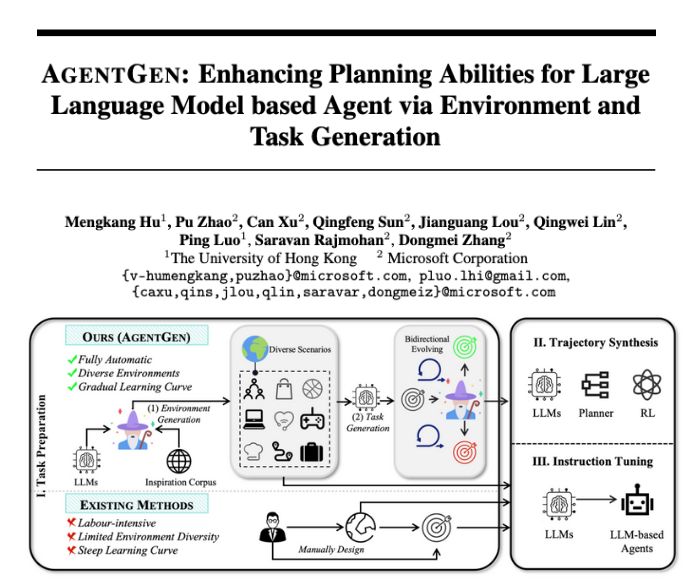
AgentGen is a framework that can help automate and simplify planning.
What is AgentGen?
Retrieve: Understanding AgentGen.
Definition: Framework designed to automate and improve planning capabilities of LLM-based agents.
Approach: Automates generation of diverse environments and planning tasks for more effective agent training.
Problem Solved: Addresses limitations of manual environment creation by using automated methods to create wide variety of scenarios and tasks with varying difficulty levels.
Key Features
Innovate: AgentGen’s innovations.
| Feature | Description | Benefit |
|---|---|---|
| Inspiration Corpus | Uses LIMA dataset with domain-specific text segments | ⬆️ Diverse scenarios |
| Bidirectional Evolution | Creates planning tasks with smooth difficulty curve | ⬆️ Gradual skill acquisition |
| Trajectory Data | Uses action-observation pairs for instruction-tuning | ⬆️ Better decision-making |
1. Inspiration Corpus:
- Uses LIMA dataset composed of domain-specific text segments
- Generates wide range of environment specifications
- Covers numerous scenarios and domains
- Enhances training landscape for agents
2. Bidirectional Evolution (BI-EVOL):
- Creates planning tasks with smooth difficulty curve
- Evolves tasks in both simpler and more complex directions
- Facilitates LLMs’ gradual acquisition of planning skills
3. Trajectory Data:
- Uses high-quality trajectory data (action-observation pairs)
- Instruction-tunes LLMs
- Improves decision-making and planning capabilities
Performance Results
Retrieve: AgentGen achievements.
Results: AgentGen-tuned models, such as Llama-3 8B, show significant performance improvements:
- ✅ Surpassing GPT-3.5
- ✅ Outperforming GPT-4 in certain tasks
Key Takeaways
Retrieve: Agents 2.0 is the best-performing open model agent framework (top 1 on GAIA), with simpler, modular design and React Agents for performance. AgentGen automates planning capabilities through inspiration corpus, bidirectional evolution, and trajectory data.
Innovate: By using Agents 2.0 for building agents and AgentGen for automating planning, you can create high-performing agentic systems that surpass GPT-3.5 and even GPT-4 in certain tasks.
Curiosity → Retrieve → Innovation: Start with curiosity about agent frameworks, retrieve insights from Agents 2.0 and AgentGen, and innovate by building agentic systems with automated planning and improved performance.
Next Steps:
- Explore Agents 2.0
- Read AgentGen paper
- Build your agents
- Automate planning