Research
Diffusion Models, Visually: How Noise Becomes an Image (and Why a Game Studio Should Care)
A visual, equation-light breakdown of diffusion models — forward noising, the noise-prediction loss, timestep embeddings, U-Nets, latent diffusion, classifier-free guidance, and diffusion transformers — read through the lens of shipping game content.
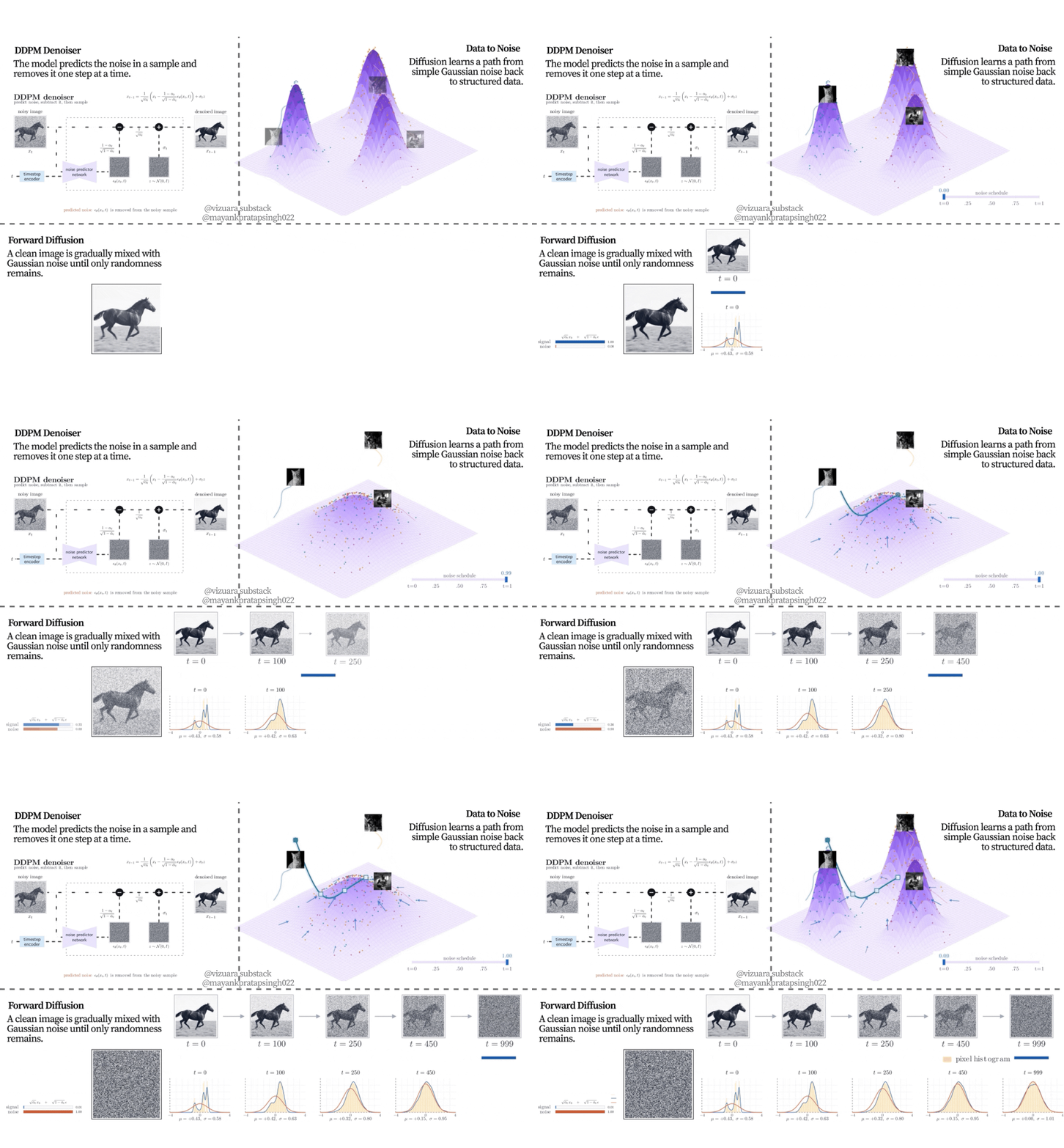
This post is my game-developer reading of Mayank Pratap Singh’s excellent visual breakdown, Diffusion Model Visual Breakdown (Vizuara, Jun 2026). All figures are from that article; the framing, code, and production angle are mine.
🤔 Curiosity: Why Does Generating One Image Feel So Hard?
After 8 years shipping AI-powered games at NC SOFT and COM2US, I have a scar from every “let’s just generate the asset” meeting. A single texture, splash art, or concept frame is not one decision. The subject can distort, the texture can go mushy, the pose can collapse, the background can look fake, or the image can be razor-sharp but boringly repetitive. An image is a large set of decisions that all have to agree at once.
That’s exactly why one-shot generators were so painful to train. You ask a network to paint the whole canvas in a single forward pass, and when it’s wrong, the loss has to somehow explain which of the thousand simultaneous mistakes mattered.
Diffusion models change the shape of the problem. Instead of “paint the whole image now,” they ask a much smaller question, many times:
Curiosity: Given a slightly noisy image, can you predict how to remove a little of the noise? Then do it again. And again.
That reframing is the whole game. Generation stops being a leap and becomes a guided recovery process. Let me walk through the breakdown the way I’d explain it to a graphics engineer who has to ship a feature on top of it.
The core loop: start from random noise, apply many small learned corrections, and structure emerges. Generation is a path, not a lookup.
📚 Retrieve: The Stack, One Layer at a Time
Why GANs and VAEs left room for a different approach
Diffusion didn’t land in empty space. It solved pain points that two earlier families made painfully obvious.
GANs could produce crisp images by pitting a generator against a discriminator. The realism signal was learned, which is far richer than a hand-written pixel loss — but the two-network game is fragile. If the discriminator gets too strong too fast, the generator starves on weak gradients. If the generator finds a few outputs that fool the critic, it repeats them and you get mode collapse: sharp images, zero diversity.
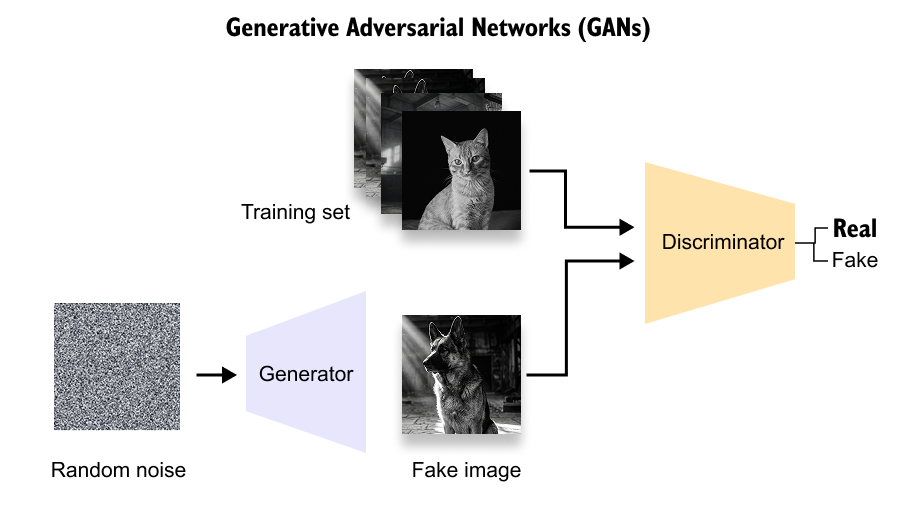 Figure 8.1 — A GAN is a two-network game: the generator maps noise to fakes, the discriminator judges real vs. fake, and the training signal comes from a moving critic rather than a fixed target.
VAEs took the other road: encode an image into a latent distribution, sample, and decode back. That gave the field a reusable idea — a compressed latent space — but samples often came out too smooth.
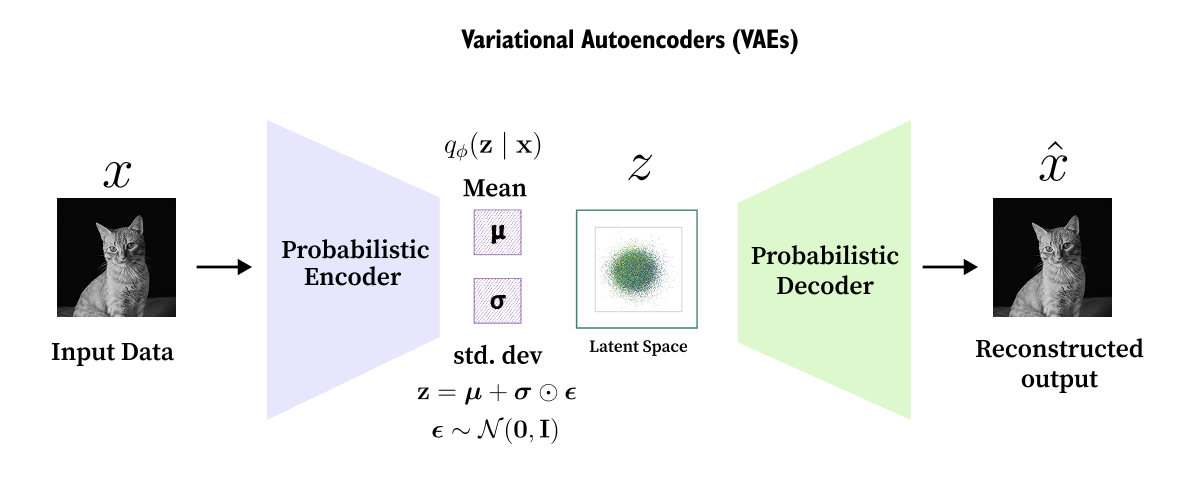 Figure 8.2 — The VAE’s surviving contribution is compression: keep the meaningful structure of an image in far fewer values. Latent diffusion later borrows exactly this.
Here’s the contrast that matters for the rest of the post:
| Family | Training target | Failure mode | What diffusion borrowed |
|---|---|---|---|
| GAN | Another network’s current opinion (moving) | Mode collapse, unstable training | The lesson that realism must be a strong learned signal |
| VAE | Reconstruction + latent regularization | Over-smooth samples | The compressed latent space idea |
| Diffusion | The exact noise that was added (known) | Slow sampling (many steps) | — |
The punchline: a diffusion model can manufacture its own training pairs. Input = a noisy version of a real image; target = the exact noise the training code added. No adversary, no moving target.
The diffusion idea: define corruption, learn the reversal
The central trick is almost cheeky: take real data, slowly destroy it into noise on purpose, and train a model to undo that destruction. The forward (noising) process is defined, not learned. The reverse (denoising) process is what the network learns.
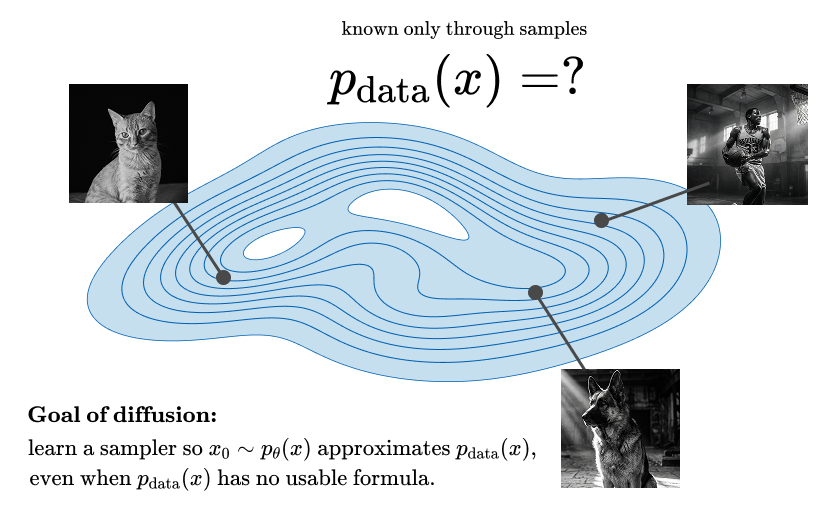 Figure 8.3 — We only know the true image distribution through examples. Diffusion learns a sampler that starts from a simple base distribution and walks toward data-like regions.
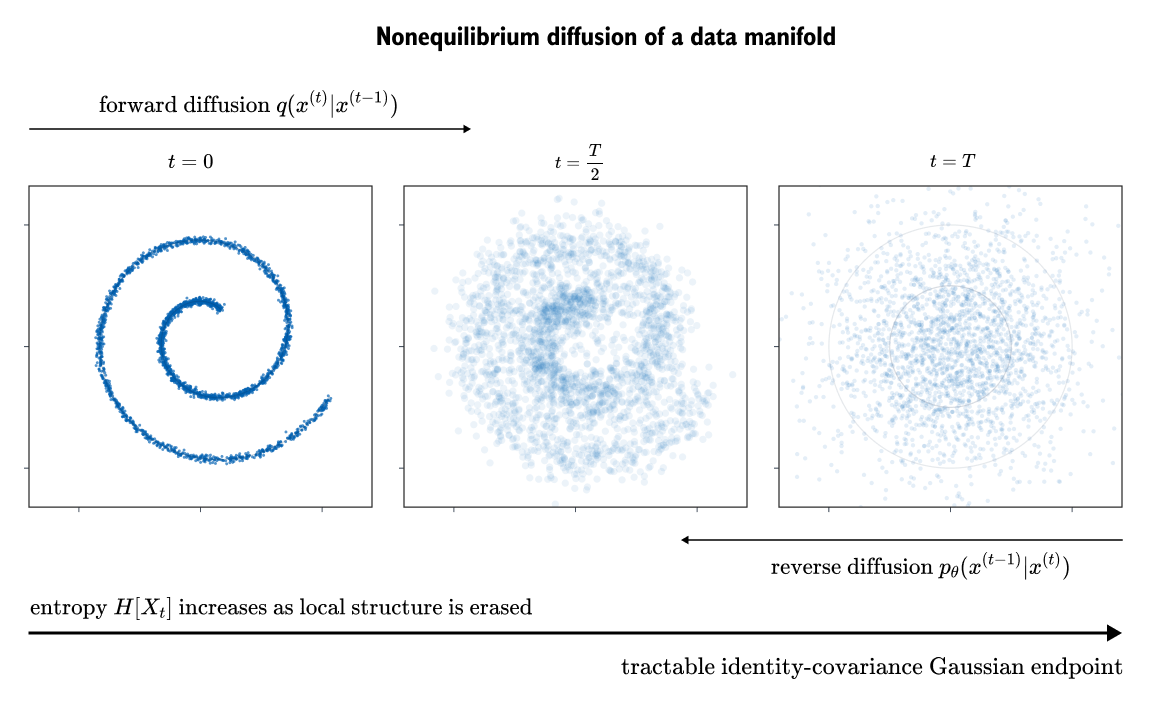 Figure 8.4 — A 2-D spiral diffuses into an isotropic Gaussian. The reverse model learns to move samples from the easy noisy endpoint back toward the structured data — the same picture holds for images.
Misconception to kill early: the initial noise does not secretly contain the final image. The noise is random. The trained denoiser plus the condition (e.g., a text prompt) is what steers a random sample into something image-like.
Why the endpoint is Gaussian noise
Every generator needs a starting point, and a complicated start makes sampling hard before you even begin. Diffusion starts from a standard Gaussian:
\[x_T \sim \mathcal{N}(0, I)\]It’s trivial to sample, easy to reason about, and a neutral “blank canvas” — it doesn’t prefer faces, dogs, or product shots. All structure comes from the learned reverse process.
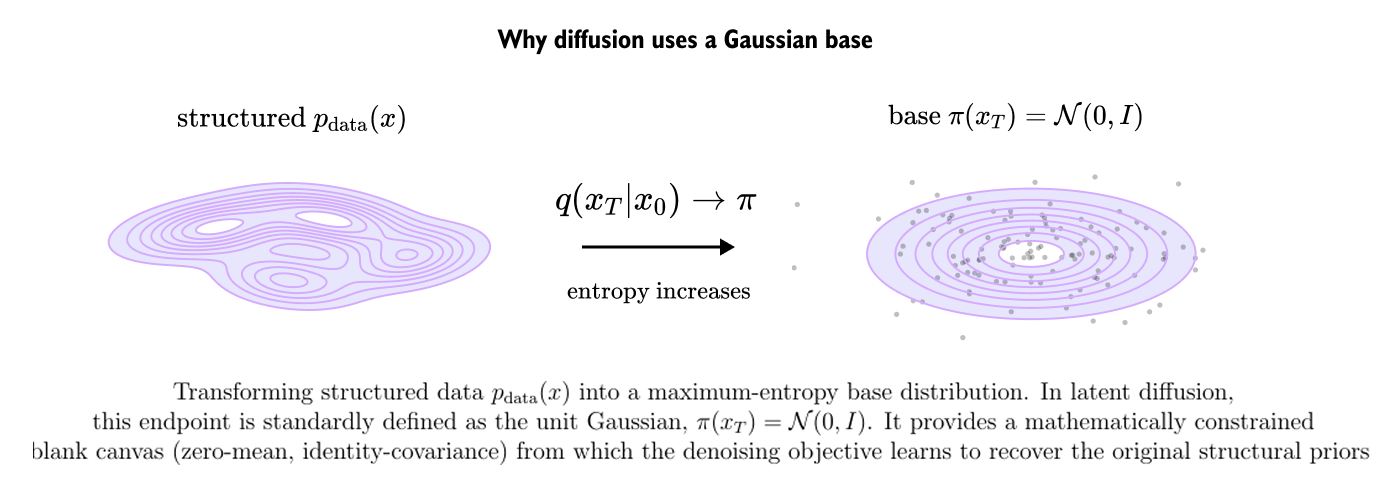 Figure 8.5 — Structured data is hard to sample directly; a maximum-entropy Gaussian endpoint is easy. The forward process maps data → Gaussian, the reverse process learns to undo it.
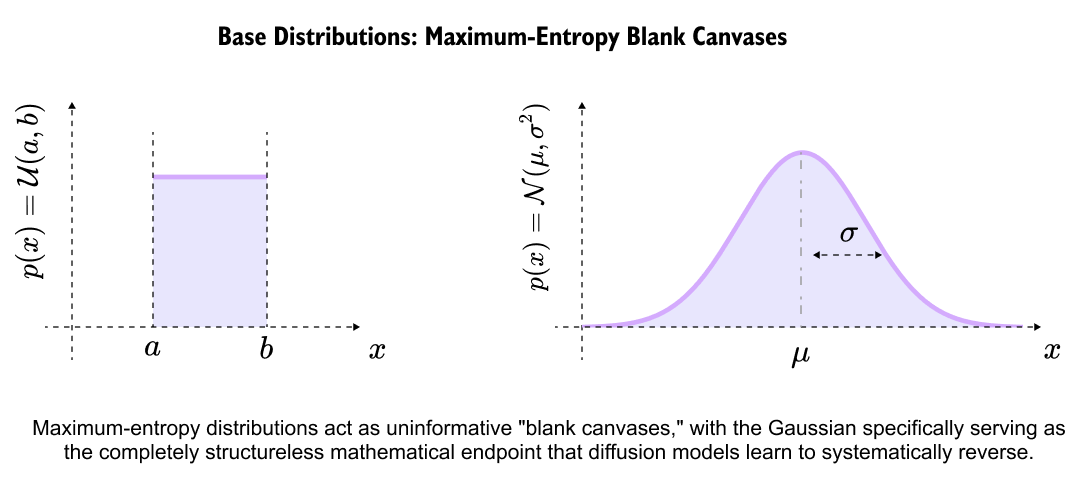 Figure 8.6 — Gaussian noise is especially convenient: add independent Gaussian noise repeatedly and the result stays Gaussian, giving a tractable endpoint. It’s a practical choice, not a mystical one.
The forward process: the equation you actually need
At each step the clean image keeps some signal and gains some fresh Gaussian noise. The notation:
β_t— the amount of new noise injected at stept.α_t = 1 − β_t— the signal kept at that step.ᾱ_t = ∏ α_s— the cumulative signal still present aftertsteps (≈1 early, ≈0 late).
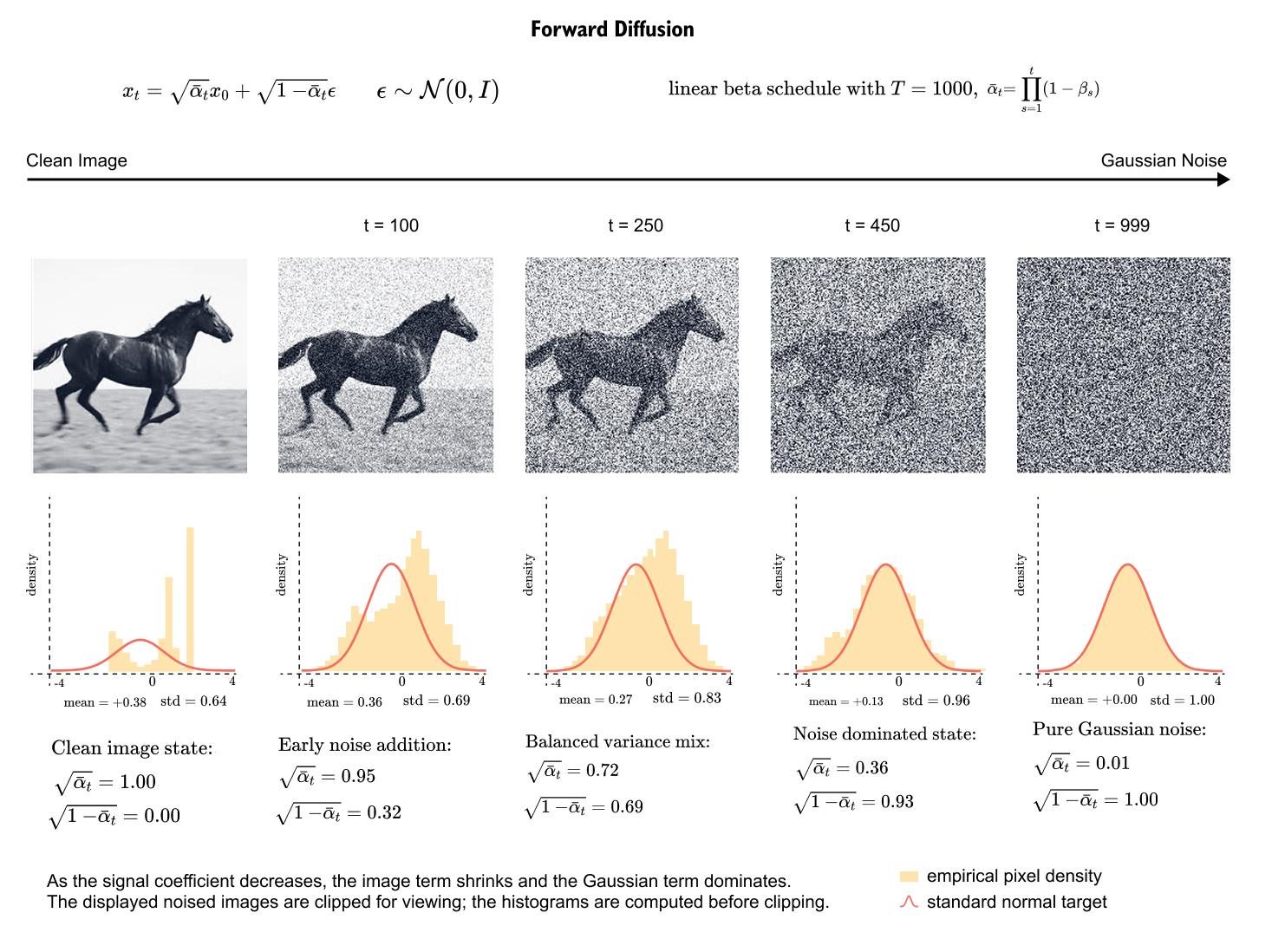 Figure 8.7 — A clean horse is corrupted step by step. The coefficient view below shows signal shrinking and noise growing — the model trains on the whole curriculum, not just clean vs. pure noise.
The single most useful line in the entire topic is that you can jump to any timestep in one step:
\[x_t = \sqrt{\bar{\alpha}_t}\, x_0 + \sqrt{1 - \bar{\alpha}_t}\,\epsilon, \quad \epsilon \sim \mathcal{N}(0, I)\]A noisy image is just a variance-balanced mixture of the clean image x_0 and pure noise ε. The square roots are there to balance variance, not brightness. Read it as: √ᾱ_t scales the clean part, √(1−ᾱ_t) scales the noise. Small t → mostly clean; large t → mostly noise.
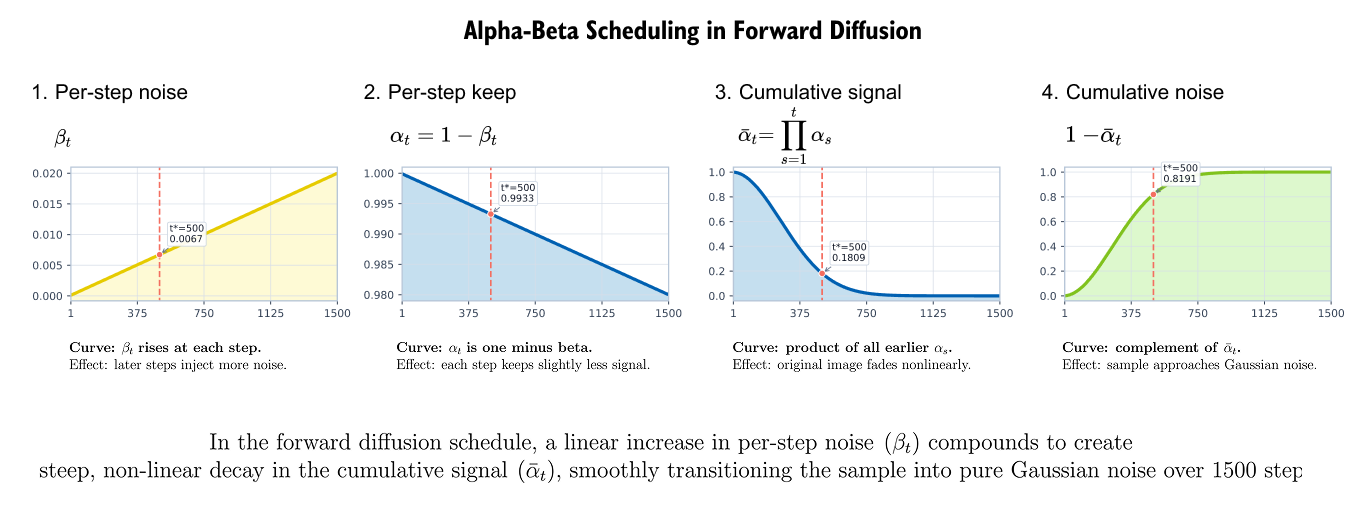 Figure 8.8 — The β schedule sets how aggressively noise is added; α tracks per-step retention; ᾱ tracks cumulative retention. A good schedule keeps the denoising tasks neither trivial nor destructive.
This is why you never simulate every intermediate step during training. You sample a random timestep, sample a noise tensor, mix, and you have a fresh supervised example — from every image, at every noise level.
What the denoiser actually learns
The denoiser receives a noisy sample x_t, the timestep t, and (often) a condition c — a class label, text prompt, mask, edge/depth map, or low-res image. In the basic noise-prediction view, it outputs ε_θ(x_t, t, c), its estimate of the noise that made x_t. Because the training code chose that noise, the target is known, and the loss is a plain regression:
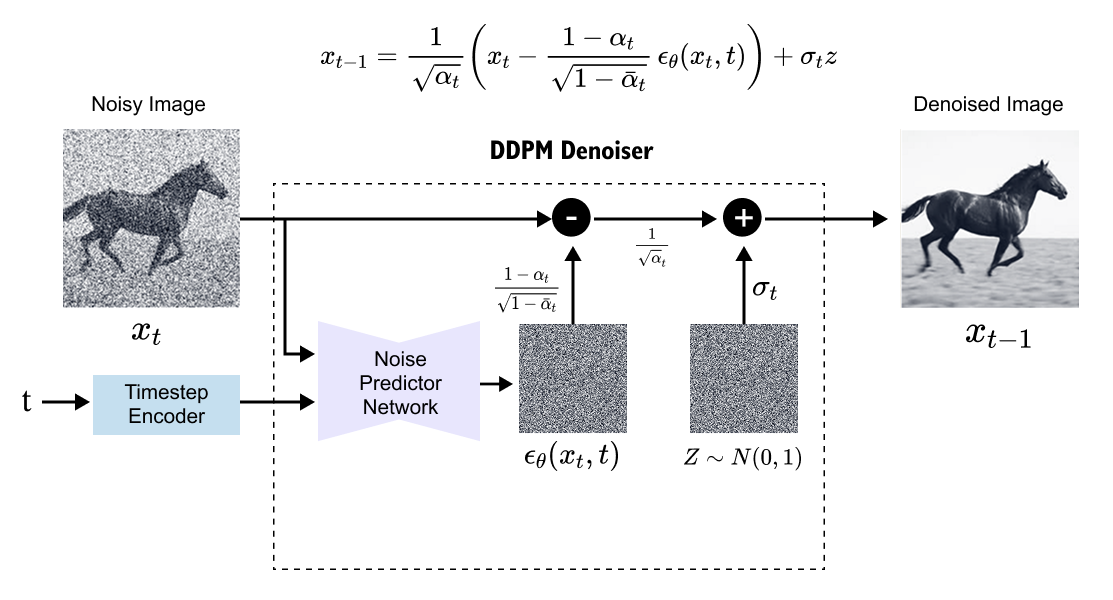 Figure 8.9 — The noisy image and timestep enter the denoiser; it predicts the noise; the sampler uses that to produce a slightly cleaner
 x_{t−1}. Repeat many times.
The loss is simple but the task is rich. At low noise, predicting the noise means cleaning up edges and texture. At high noise, it means inferring plausible global structure from weak evidence and the condition. Same loss, two very different jobs — selected by which timestep you sampled. That’s also why diffusion training is easier to reason about than GAN training: a direct regression target tells you, unambiguously, when you’re wrong.
Here’s the entire training loop, stripped to the workhorse equation. If you’ve ever written a PyTorch training step, this will feel suspiciously short:
1
2
3
4
5
6
7
8
9
10
11
12
13
14
15
16
17
18
19
20
21
22
23
24
25
26
27
28
29
30
31
32
33
34
import torch
import torch.nn.functional as F

def ddpm_training_step(model, x0, alpha_bar, cond=None):
    """One DDPM training step (noise-prediction / epsilon objective).

    Curiosity:  Can a network learn to undo corruption it never simulated step-by-step?
    Retrieve:   x_t = sqrt(a_bar_t) * x0 + sqrt(1 - a_bar_t) * eps   (closed-form forward)
    Innovation: predict eps directly -> a stable, known regression target.

    Args:
        model:     denoiser eps_theta(x_t, t, cond) -> predicted noise
        x0:        clean batch, shape (B, C, H, W) in [-1, 1]
        alpha_bar: precomputed cumulative product a_bar, shape (T,)
        cond:      optional conditioning (text/class/mask embeddings)
    """
    B = x0.size(0)
    T = alpha_bar.size(0)

    # 1) Sample a random timestep per image -> a curriculum across noise levels.
    t = torch.randint(0, T, (B,), device=x0.device)

    # 2) Sample the *known* target noise.
    eps = torch.randn_like(x0)

    # 3) Jump straight to x_t in one shot (no step-by-step simulation needed).
    a_bar_t = alpha_bar[t].view(B, 1, 1, 1)
    x_t = a_bar_t.sqrt() * x0 + (1.0 - a_bar_t).sqrt() * eps

    # 4) Ask the network to recover the noise it can't see was added.
    eps_pred = model(x_t, t, cond)

    # 5) Plain MSE between true and predicted noise. That's the whole signal.
    return F.mse_loss(eps_pred, eps)
Retrieve → Innovation: Modern systems sometimes predict the clean sample, a velocity target, or a flow direction instead of
ε. The plumbing changes; the teaching idea — learn a direction that moves a noisy sample toward the data — does not.
One more separation worth internalizing: the denoiser predicts a target from the current state; the sampler decides how to use that prediction to step forward. The same trained denoiser can run under a slow, careful sampler (many steps) or a fast one (few, larger steps). The model learns the direction; the sampler chooses the route.
Giving the network a sense of time
A timestep like t = 427 is just a scalar, and networks treat raw scalars poorly. Diffusion models expand it into sinusoidal timestep embeddings — sine/cosine features at multiple frequencies — so nearby timesteps map to related vectors and distant ones don’t.
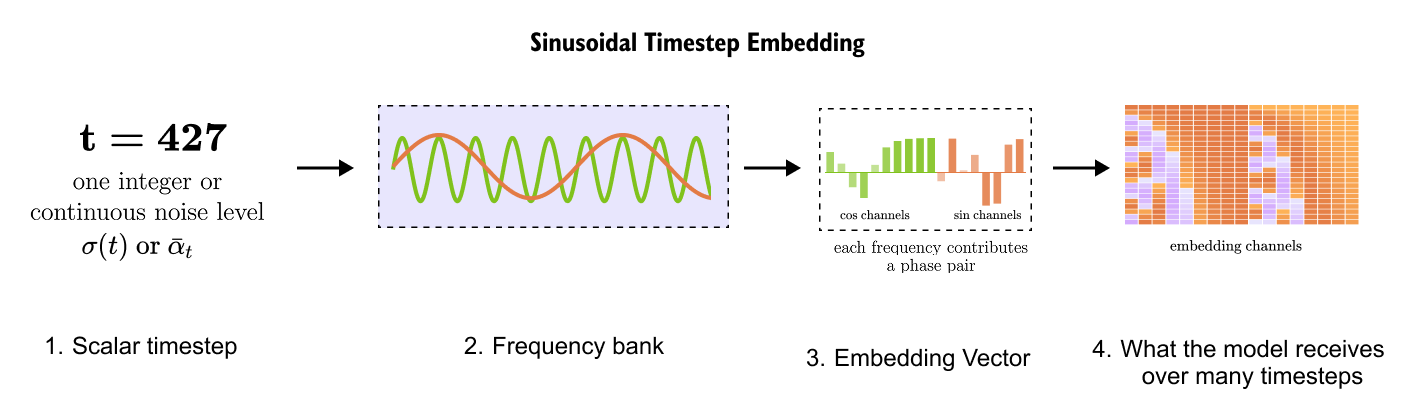 Figure 8.10 — A scalar timestep becomes a vector via sinusoids at many frequencies, so one network can change its behavior across noise levels. Same spirit as positional embeddings in transformers.
Without this, the denoiser wouldn’t know whether to make a tiny edge correction or a bold structural guess. In a U-Net it’s usually injected into residual blocks; in a diffusion transformer it often modulates normalization layers.
Why U-Nets became the classic denoiser
Denoising needs global context (what could this image contain?) and local precision (edges, textures, alignment). The U-Net is a natural fit: an encoder downsamples and widens features, a decoder upsamples back, and skip connections carry high-resolution detail across so it isn’t lost.
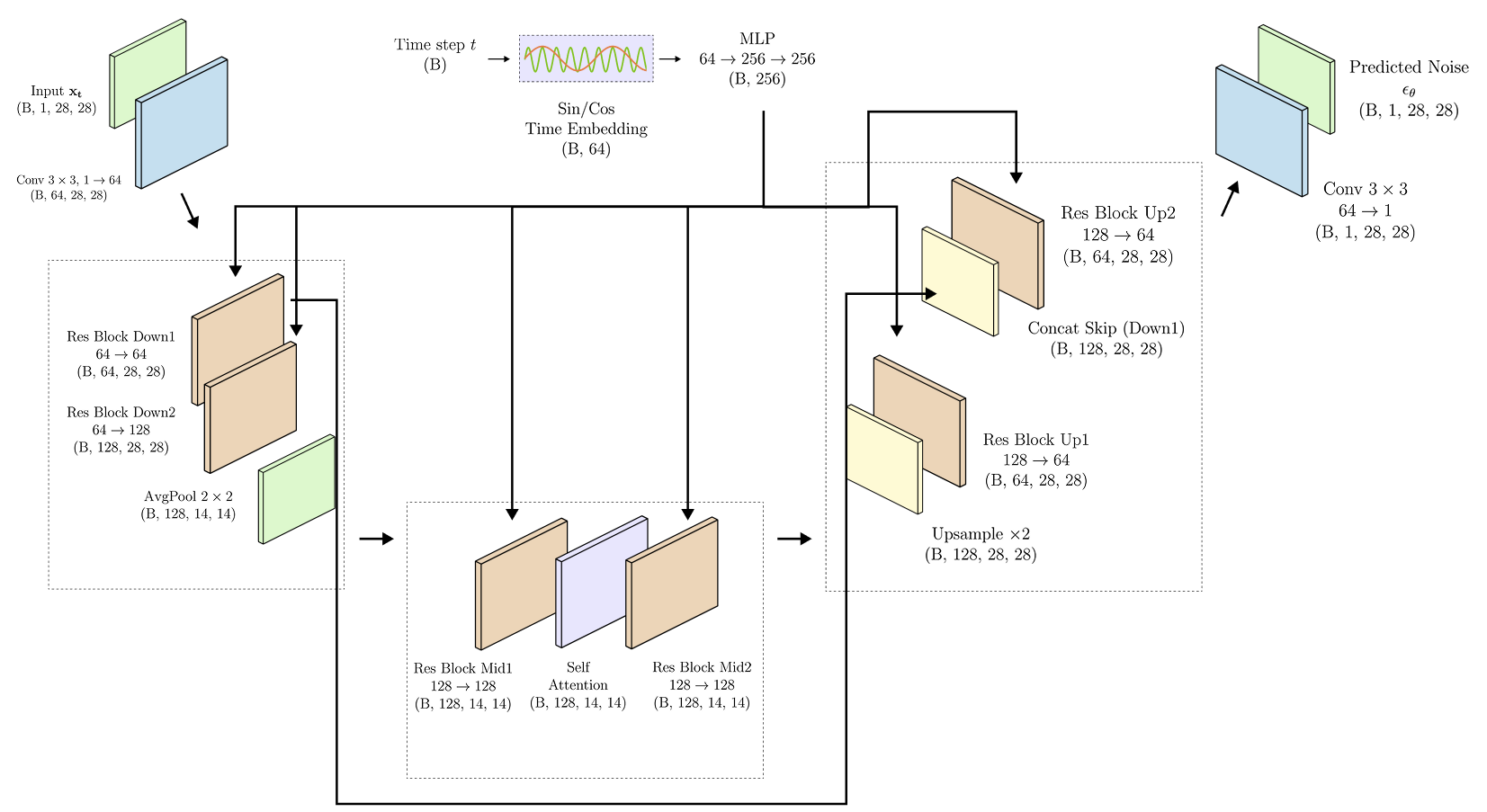 Figure 8.11 — Down blocks shrink space and grow channels, middle blocks process a compact representation, up blocks reconstruct, and skip connections preserve fine spatial detail. Attention is often added at selected resolutions.
This matches diffusion’s changing nature: high noise wants broad semantic guesses, low noise wants small sharpening corrections. The U-Net supports both. Written compactly, ε_θ(x_t, t, c) — drop c and it’s unconditional; make c a class label and it’s class-conditional; make c a text embedding and it’s text-to-image.
Latent diffusion: stop paying for every pixel
Pixel-space diffusion is clean but expensive. A 512×512×3 image is 786,432 values, and you run the denoiser on it many times per sample.
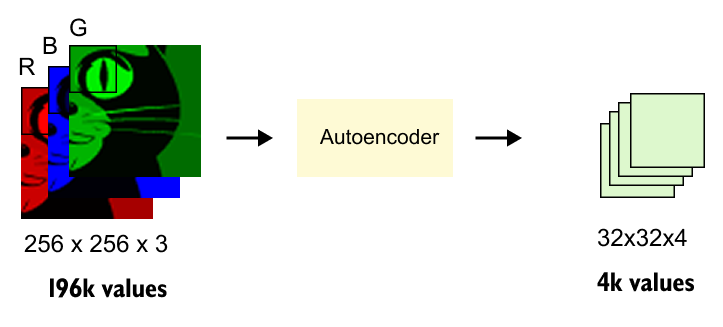 Figure 8.12 — An autoencoder maps a 256×256×3 image (~196k values) to a 32×32×4 latent (~4k values). Denoising in that compressed space is dramatically cheaper — this is why high-res text-to-image became practical on consumer GPUs.
The tradeoff is real: compress too hard and small text, fine geometry, faces, and repeated patterns suffer; compress too little and you’re back to paying pixel prices. Latent diffusion is the working compromise.
Conditioning: making the model listen
Unconditional diffusion generates something from the distribution. Conditional diffusion generates something that matches an input — a prompt, mask, edge map, depth map, pose skeleton, or low-res image. Text-to-image systems encode the prompt and feed it in, typically via cross-attention, so image features can “ask” which prompt tokens matter for their region.
To make the condition bite harder at sampling time, classifier-free guidance (CFG) compares the conditional and unconditional predictions:
\[\hat{\epsilon} = \epsilon_\theta(x_t, t, \varnothing) + s\,\big(\epsilon_\theta(x_t, t, c) - \epsilon_\theta(x_t, t, \varnothing)\big)\]The guidance scale s is a steering knob, not a quality knob. Low s leaves freedom but may ignore the prompt; high s follows the prompt harder but can flatten diversity and exaggerate textures. Negative prompts slot into the same idea — they tell the model what to move away from.
Diffusion transformers: from feature maps to tokens
Recent systems increasingly swap the U-Net for a transformer backbone. The latent is patchified into tokens, timestep and conditioning modulate the blocks, and attention lets distant tokens interact directly.
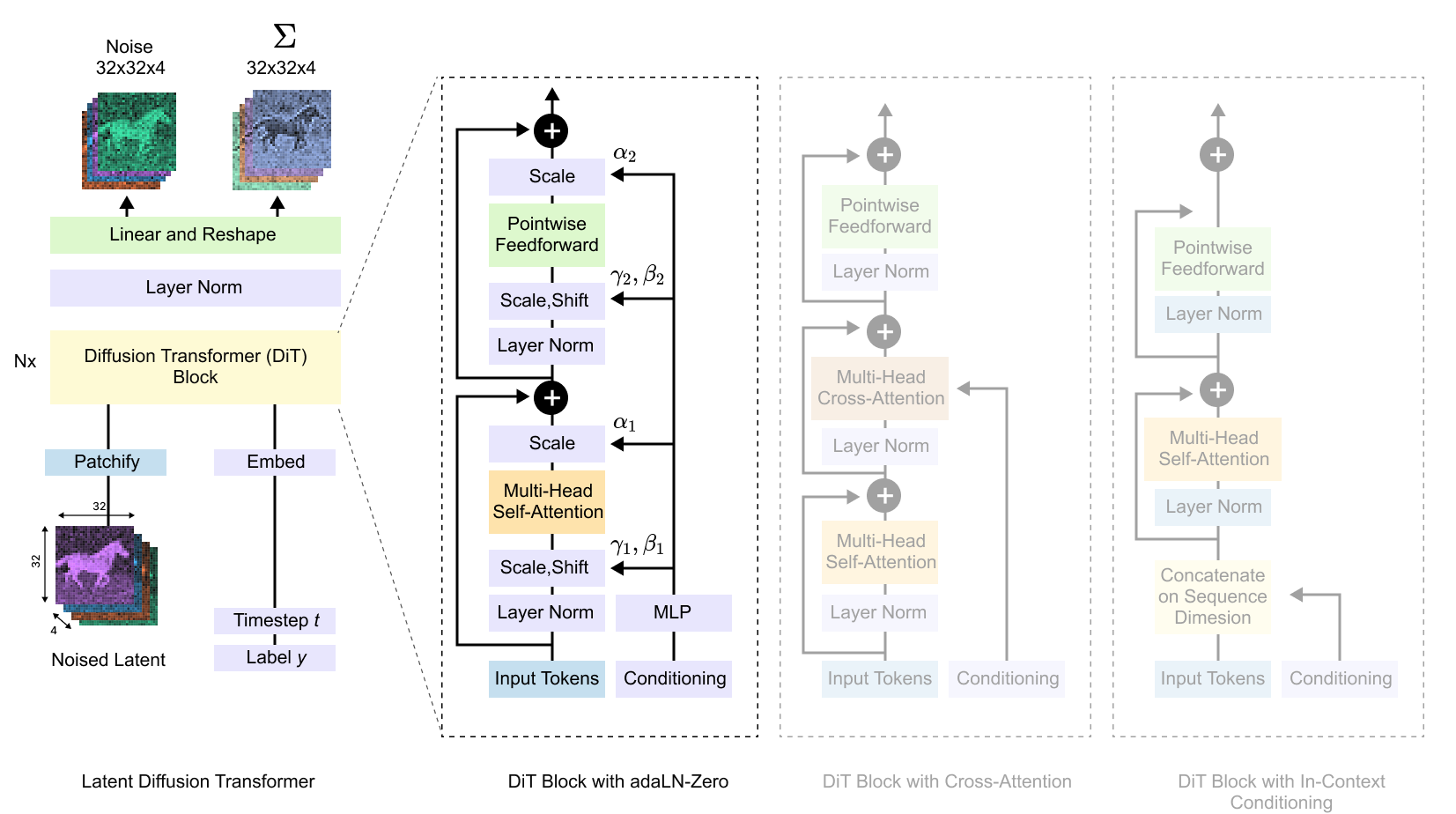 Figure 8.13 — The noisy latent is split into patches → tokens; timestep and class info modulate transformer blocks; output tokens are reshaped back into a latent prediction. The objective is unchanged; the backbone is not.
The token count for a latent of size H_z × W_z with patch size p is roughly:
Smaller patches preserve detail but cost more attention; larger patches are cheaper but coarser. Latent space is what makes this tractable — patchifying raw pixels would explode the token count.
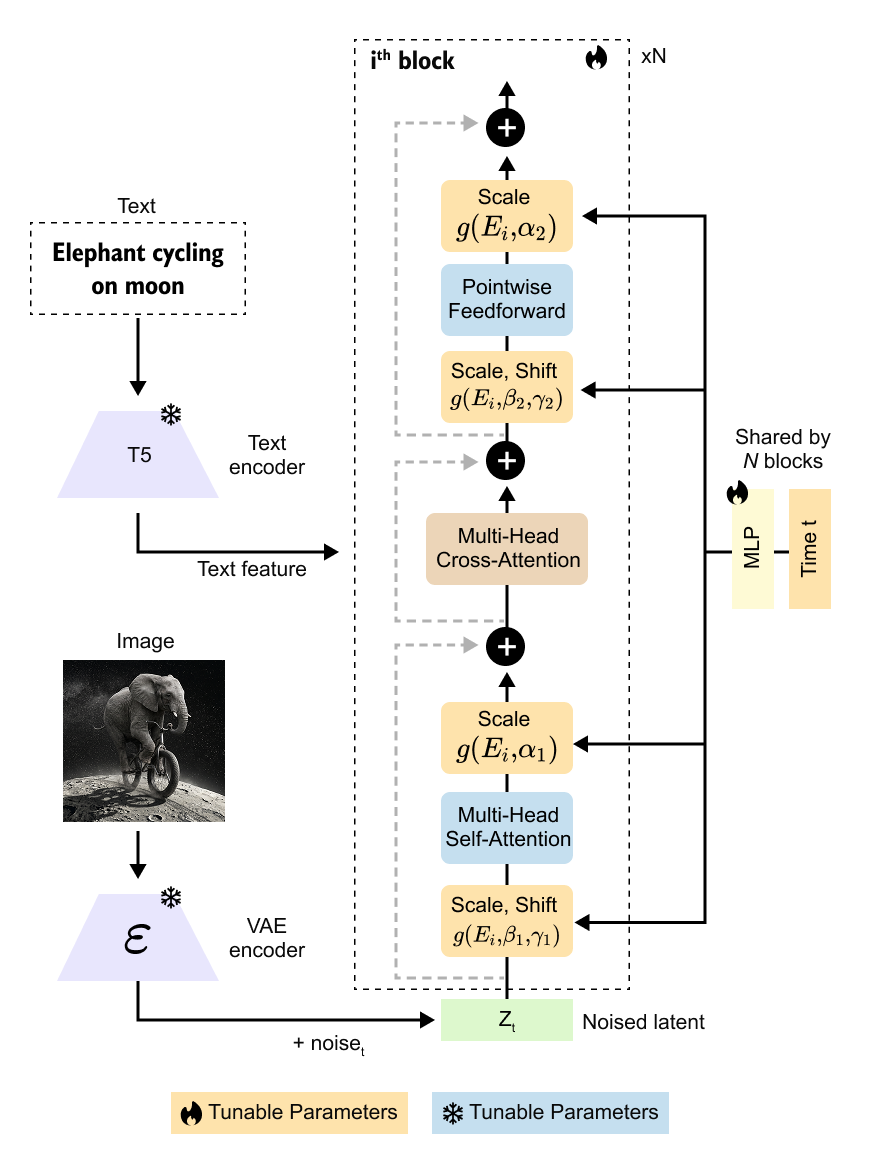 Figure 8.14 — PixArt-α style: text embeddings condition the denoising transformer that operates on latent tokens, emphasizing efficient conditioning over a U-Net backbone.
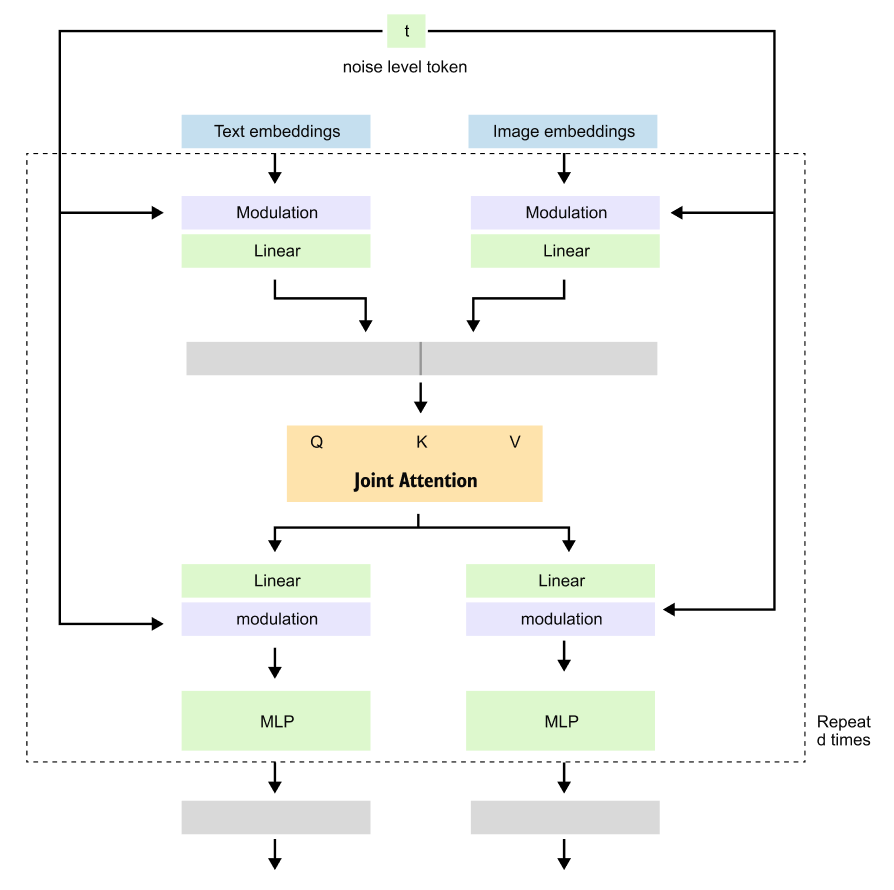 Figure 8.15 — MM-DiT: text and image streams get their own transformations, while joint attention lets information flow between modalities. Used in the Stable Diffusion 3 family.
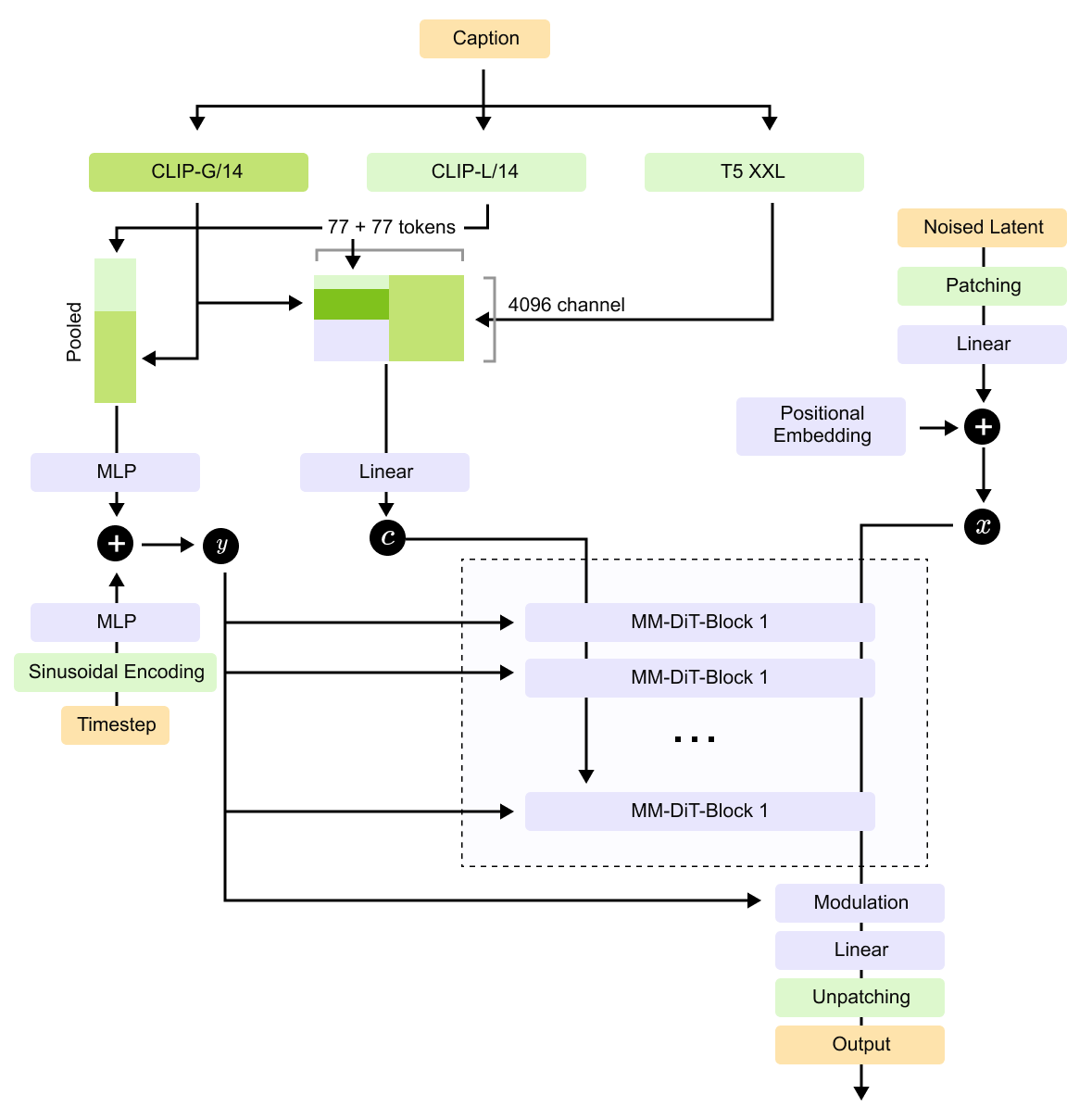 Figure 8.16 — Multiple text encoders produce conditioning, image latents are patchified, timestep info is embedded, a stack of MM-DiT blocks denoises, and the output is unpatchified and decoded. SD3-style systems also use rectified-flow ideas — another way to learn a path from noise to data.
The exact architecture keeps shifting, but the direction is stable: latent-space generation + strong text encoders + transformer backbones + guidance + carefully designed sampling paths.
💡 Innovation: Reading This as a Game Builder
Strip the pipeline to two stories and it stops being intimidating:
flowchart LR
    subgraph TRAIN["🏗️ Training (direction known)"]
        A["Clean image x0"] --> B["Encode to latent (optional)"]
        B --> C["Pick timestep t<br/>sample noise eps"]
        C --> D["Mix: x_t = sqrt(a_bar)*x0<br/>+ sqrt(1-a_bar)*eps"]
        D --> E["Denoiser predicts eps_theta"]
        E --> F["MSE(eps, eps_theta)<br/>update weights"]
    end

    subgraph SAMPLE["🎨 Sampling (direction flipped)"]
        G["Start: x_T ~ N(0, I)"] --> H["Denoiser predicts step"]
        H --> I["Sampler -> lower noise level"]
        I --> J{"Clean enough?"}
        J -->|No| H
        J -->|Yes| K["Decode latent -> pixels"]
    end

    F -.shared denoiser.-> H

    style D fill:#4ecdc4,stroke:#0a9396,color:#000
    style E fill:#ff6b6b,stroke:#c92a2a,color:#fff
    style H fill:#ff6b6b,stroke:#c92a2a,color:#fff
    style K fill:#ffe66d,stroke:#f4a261,color:#000
Six knobs decide how any diffusion system behaves — and these are exactly the levers I’d reach for when fitting one into a studio pipeline:
| Knob | What it controls | Studio decision it maps to |
|---|---|---|
| Noise schedule (β) | Which denoising tasks the model sees | How much “from-scratch” vs. “refine” capacity you want |
| Prediction target (ε / x0 / v / flow) | What the network outputs | Stability vs. few-step sampling tradeoffs |
| Backbone (U-Net / DiT) | How spatial + semantic info mix | VRAM budget and max resolution |
| Conditioning (text / mask / depth / pose) | What the output must obey | Art-direction control: ControlNet-style guidance |
| Sampler (DDPM / DDIM / consistency) | Speed, quality, randomness | Batch asset gen vs. interactive previews |
| Autoencoder | Information available in latent space | Whether tiny UI text and faces survive |
What I’d try first in a content pipeline
- Texture and material variation — heavy conditioning (depth/normal maps), aggressive sampler, low guidance. You want variety on a known surface, not prompt obedience.
- Concept and splash art — strong text encoders, higher guidance, slow sampler. Here prompt adherence is the product.
- Interactive previews for designers — distilled / consistency-style few-step models so the loop feels live, accepting some quality loss.
- Sprite/UI assets — be honest about the autoencoder. If tiny text and 1-px alignment matter, latent compression is your enemy; budget for pixel-space refinement or upscaling.
Honest limitations (the part that survives the demo)
| Limitation | Why it happens | What it costs a studio |
|---|---|---|
| Sampling cost | Many network calls per image | Slow batch gen; weak interactivity without distillation |
| Fine detail loss | Autoencoder compression | Broken tiny text, hands, repeated patterns |
| Weak compositional reasoning | Statistical text↔image learning, not logic | “Three cubes behind two spheres” fails; “a cube on a table” works |
| Data bias | Learned from the training distribution | Outputs inherit over/under-represented aesthetics |
| Control vs. freedom | Every condition narrows the output space | More masks/poses → more predictable, less surprising |
Innovation, distilled: diffusion is powerful because it breaks one impossible decision into thousands of small, known-target corrections. The cost is many forward passes — and almost all current research (faster samplers, distillation, consistency models, flow matching) is a fight to keep that quality while paying less for it.
New questions this raises for me
- Can I co-train a game-specific autoencoder so latent space preserves the things my art team actually cares about (pixel-perfect UI, readable in-game text)?
- For live-ops, what’s the real Pareto frontier between consistency-model few-step sampling and quality, on my art style rather than a benchmark?
- If conditioning is the real product surface, is a ControlNet-style pose/depth rig a better investment than yet another prompt-engineering sprint?
References
Source article
- Diffusion Model Visual Breakdown — Mayank Pratap Singh (Vizuara) — the visual breakdown and all figures this post builds on.
- Author: LinkedIn · Twitter/X
Research papers
- Denoising Diffusion Probabilistic Models (DDPM) — the forward noising equation, noise-prediction loss, and iterative sampler.
- High-Resolution Image Synthesis with Latent Diffusion Models — latent diffusion, autoencoder compression, cross-attention conditioning.
- Scalable Diffusion Models with Transformers (DiT) — replacing U-Nets with transformer blocks over latent patches.
- PixArt-α: Fast Training of Diffusion Transformer for Photorealistic Text-to-Image — the PixArt-α architecture.
- Flow Matching for Generative Modeling — the flow-matching view of the broader diffusion family.
- Scaling Rectified Flow Transformers for High-Resolution Image Synthesis — the Stable Diffusion 3 / MM-DiT architecture and rectified-flow design.
Learning resources
- The Principles of Diffusion Models (YouTube playlist) — Dr. Rajat — a thorough video walkthrough of the math.
Related production tooling
- Hugging Face Diffusers — reference implementations of schedulers, U-Net/DiT backbones, and samplers.
- ControlNet — spatial conditioning (pose, depth, edges) for art-directed control.
Working on something like this?
I take a small number of paid, scoped reviews: AI agent/RAG architecture diagnosis, Unity CI & build-automation audits, and multimodal QA design review. Each one ends in a written findings document.
Work with me