AI
NPGA Audit: Neural Parametric Gaussian Avatars, Two Years On
A source audit of NPGA against its own tables: the framework is worth 2.01 PSNR at fixed tracking, the expression space 1.44, and the code is still unreleased.
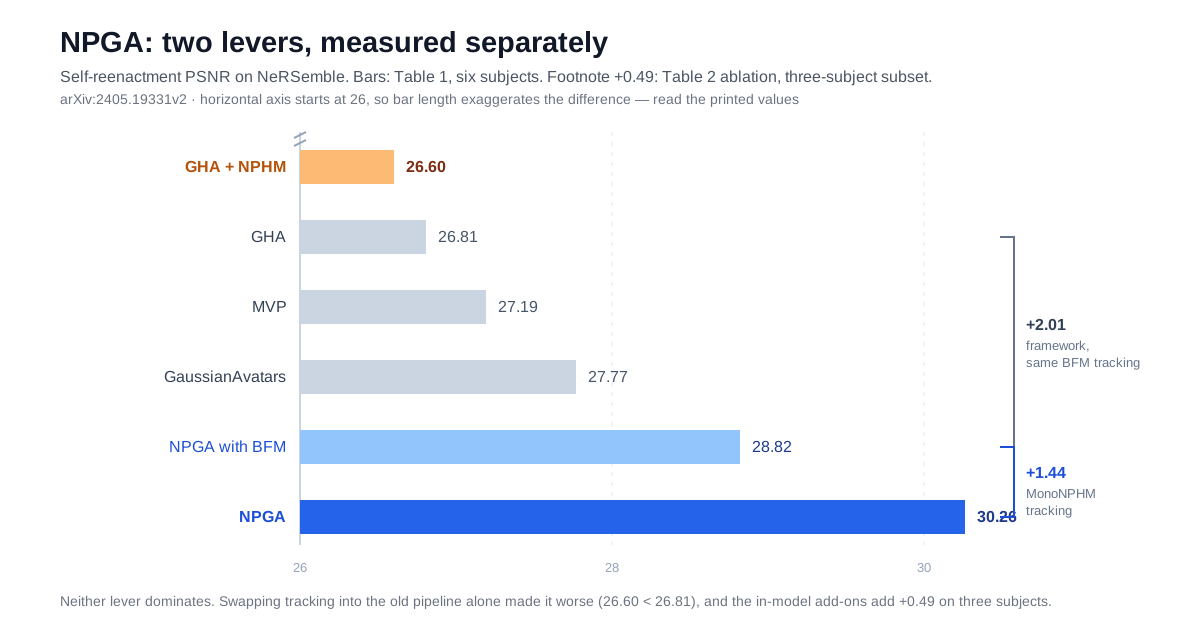
Which half of an avatar paper is doing the work?
Every Gaussian-avatar paper ships two things at once: a driving signal, the expression space that says what the face is doing, and a renderer, the primitives and tricks that make pixels sharp. My prior going in was that announcements mostly sell the renderer while production teams mostly pay for the driving signal. The paper’s own numbers turned out to be less tidy than that.
NPGA is a good place to test that, because the authors ran the experiments that separate the two. This post re-reads the paper against its own tables and asks what a game team could adopt today.
Originally published 2024-06-01. Fully re-audited and rewritten on 2026-09-02 against arXiv:2405.19331v2.
Correction (2026-09-02). An earlier version of this note credited the wrong authors. The names previously listed here belong to LangSplat, a different paper. The correct NPGA authors are recorded below.
Technical Analysis: what the pinned sources say
NPGA: Neural Parametric Gaussian Avatars appeared at SIGGRAPH Asia 2024 (DOI 10.1145/3680528.3687689), by Simon Giebenhain, Tobias Kirschstein, Martin Rünz, Lourdes Agapito, and Matthias Nießner (TU Munich, Synthesia, University College London). Every metric below is read from arXiv:2405.19331v2, the September 2024 revision; repository and project-page facts are dated separately and linked in the References.
The method keeps a canonical 3D Gaussian point cloud and drives it with a neural parametric head model instead of a mesh-based 3DMM. The backward deformation field of MonoNPHM is distilled into forward deformations a rasterizer can consume, each Gaussian carries a latent feature conditioning its own dynamics, and Laplacian terms regularize the extra freedom that creates.
Finding 1 — Two levers, and the paper measures them separately
NPGA reports 30.26 PSNR on self-reenactment against 27.77 for the strongest baseline. The decomposition is more interesting than the gap.
| Variant | PSNR ↑ | SSIM ↑ | LPIPS ↓ | What it isolates |
|---|---|---|---|---|
| GHA + NPHM | 26.60 | 0.911 | 0.078 | New expression space, old pipeline |
| GHA | 26.81 | 0.914 | 0.077 | Prior high-fidelity Gaussian head |
| MVP | 27.19 | 0.919 | 0.114 | Volumetric primitives baseline |
| GaussianAvatars | 27.77 | 0.926 | 0.104 | FLAME-rigged Gaussians |
| NPGA with BFM | 28.82 | 0.924 | 0.076 | NPGA pipeline, classical 3DMM |
| NPGA | 30.26 | 0.934 | 0.055 | Full method |
Two rows in that table hold one variable fixed each, which is what makes them useful.
| Comparison | Held fixed | Delta |
|---|---|---|
| NPGA with BFM (28.82) vs GHA (26.81) | tracking, both on GHA’s BFM codes | +2.01 |
| NPGA (30.26) vs NPGA with BFM (28.82) | framework, both full NPGA | +1.44 |
| Full model vs vanilla, three-subject ablation | everything except the add-ons | +0.49 |
So neither lever dominates. At identical BFM tracking the NPGA framework still gains 2.01 PSNR over GHA, which the paper describes as its framework “still slightly outperforms GHA when using the same tracked expression codes.” Holding the framework fixed and moving to MonoNPHM tracking is worth a further 1.44. The in-model refinements are the small term: on the three-subject ablation subset the model walks from a vanilla variant at 30.16 through per-Gaussian features and Laplacian smoothing to 30.65 with the CNN, 0.49 PSNR combined.
Worth noting as an audit observation: the paper calls its 2.6 PSNR margin over baselines “significantly outperforms” while calling its own 2.01 framework margin “slightly outperforms.” Read one way that hedging is asymmetric, since the two deltas are comparable. Read another, “slightly” is relative to NPGA’s full 3.45 PSNR margin over GHA, which the BFM-tracked variant cuts to 2.01. I record the observation rather than resolve it.
The GHA + NPHM row is the sharpest result. Feeding NPHM codes into the older GHA pipeline made it worse, 26.60 against 26.81, and the paper states that “MonoNPHM expression codes alone do not immediately boost performance.” It offers a hypothesis: “without NPHM’s motion prior as initialization, NPHM’s latent expression distribution might provide a more complicated training signal compared to the linear blendshapes of BFM.”
One caveat on the 1.44 figure. Ours_BFM uses “the BFM tracking from GHA,” so the comparison swaps a whole tracking pipeline, not a basis matrix in isolation. In fairness to GHA, it is also the one baseline handled unevenly on resolution: it trains at 1024×1024 and the authors “downsample and crop the generated images accordingly” to score it at 550×802.
Finding 2 — The headline number and the printed table do not reconcile
The abstract says the method “outperforms the previous state-of-the-art avatars on the self-reenactment task by ≈2.6 PSNR,” and the introduction states “2.6 PSNR and 0.021 SSIM.”
Against the strongest baseline in Table 1 the gap computes to 2.49 PSNR and 0.008 SSIM. The 0.021 SSIM figure sits closest to the gap against GHA, 0.020, which is not the strongest baseline on that metric. The paper does not state which pairing produces the headline numbers, so I report the table and flag the mismatch instead of guessing which is authoritative. The direction and rough magnitude survive either way; the figure you quote should come from Table 1.
Finding 3 — The cost is per identity, and it is not small
| Item | Reported value |
|---|---|
| Training per avatar | ≈30 h on an RTX 3090 (GHA the same; GaussianAvatars ≈7 h and MVP ≈60 h, both on an RTX 2080), plus 5 h of high-resolution fine-tuning for the qualitative results |
| Optimization steps | 800,000 |
| Gaussian budget | capped at 250k primitives |
| Render speed | 31 FPS at 550×802 and 18 FPS at 1100×1604 on an RTX 3080, including deformation, rendering and CNN |
| Render speed without CNN | 43 FPS and 38 FPS respectively |
| GHA baseline, same machine | 22 FPS at 1024×1024, against NPGA’s 31 FPS at the smaller 550×802; the paper gives no equal-resolution comparison |
| Evaluation resolution | 550×802, facial region only |
Those figures describe one head, alone, on a desktop GPU, in an implementation the authors call unoptimized. Convert them: 31 FPS is about 32 ms per frame, roughly twice the entire 16 ms budget of a 60 Hz frame, and even dropping the CNN (43 FPS, about 23 ms) does not fit. So this is a single-subject, near-real-time technique. It suits a cinematic or a one-on-one dialogue scene, it does not fit inside a 60 Hz frame alongside the rest of a game, and it is nowhere near a crowd.
Finding 4 — The evaluation masks out exactly what interactive characters need
Metrics are computed on the facial region with neck and torso masked out through segmentation, because those regions “are not accurately explained by NPHM and the underlying 3DMMs” of the baselines. The limitations section is blunter: neck, torso, tongue, and eyeball rotation fall outside NPHM’s expression codes and “cannot be animated as reliably or might even lead to artifacts due to overfitting.”
For film that is a reasonable scope. For an interactive character it is not a cosmetic gap: gaze is how a character signals attention, and the tongue is visible through much of ordinary speech.
Finding 5 — Reproducibility has not moved in two years
As of 2026-09-02 the project page still shows a “Code (coming soon)” button, its GitHub icon points at the author’s account rather than a repository, and no NPGA repository exists under that account or in a GitHub repository search. This is not an abandoned-account story: the same author’s NPHM, MonoNPHM and pixel3dmm repositories are all public, and pixel3dmm was pushed as recently as 2026-01-12.
The data path is gated as well. NeRSemble is public in the sense that anyone may apply, but access runs through a request form and an approval email, and neither of its repositories carries a licence file.
Rights split by venue, and the split matters if you want to reuse anything. The ACM version carries © rightsretained, and the project page states no reuse terms for its figures or videos. The arXiv version, however, is published under CC BY 4.0, so its figures are reusable with attribution. This post still uses an original diagram, not because the source figures are off limits but because the decomposition it plots is one the paper never draws.
What I would take into a game pipeline
Budget the tracker and the consuming architecture together. Neither lever dominates here: at fixed tracking the framework is worth 2.01 PSNR, and at fixed framework the tracking is worth 1.44. A pipeline stuck at “the face looks slightly wrong” can be failing on either side, so measure both before spending.
Do not assume a richer prior drops into an existing pipeline. GHA plus NPHM going backwards is the cheapest warning in the paper. NPGA’s architecture includes a distillation step converting backward deformations into rasterizer-compatible forward ones. But this comparison does not remove only that step, so it does not isolate its contribution. The authors instead hypothesize that missing motion-prior initialization makes the expression codes harder to use.
Treat masked metrics as a scope statement. When a benchmark masks neck and torso, the number describes a face, not a character. Write down which parts your own evaluation excludes, because that list is the honest boundary of the claim.
Price the cast, not the shot. At roughly 30 GPU-hours per identity, a twelve-character cast is a scheduling problem before it is a rendering problem. Semantic control of a scene, the direction LangSplat-style language fields take, has the same shape: per-scene cost decides whether a technique ships.
Read the ethics section as a requirements list. The paper flags identity theft and deepfakes among its concerns. A studio adopting person-specific avatars inherits consent, retention, and revocation questions that no PSNR column measures.
Key Takeaways
- Two levers, both material: at identical BFM tracking the NPGA framework gains 2.01 PSNR over GHA, and moving that framework to MonoNPHM tracking adds a further 1.44. The in-model add-ons contribute 0.49 on a three-subject subset.
- The same expression codes fed into the older GHA pipeline reduced quality, 26.60 against 26.81. Swapping codes alone was not enough; the paper hypothesizes that the missing NPHM motion prior makes the training signal harder. This is not an ablation of the distillation step alone.
- The abstract’s “≈2.6 PSNR” does not reconcile with Table 1’s 2.49 against the strongest baseline. Quote the table.
- Roughly 30 GPU-hours per identity and 31 FPS for a single head make this a cinematic or one-on-one technique today, not a crowd technique.
- Neck, torso, tongue and eyeball rotation sit outside the model, and the benchmark masks the first two away.
- No code, two years on. Reproduction currently means reimplementation plus a gated dataset request.
New Questions
- Does the 1.44 PSNR expression-space advantage hold on a dataset other than NeRSemble, or is part of it a tracking-quality artifact of the same capture rig?
- What does the gap look like unmasked, with gaze and mouth interior scored?
- Could a lighter distillation target close the 30-hour training gap against FLAME-rigged Gaussians while keeping most of the fidelity?
References
Paper and project
- NPGA paper: https://arxiv.org/abs/2405.19331v2 (v2, September 2024)
- ACM entry: https://doi.org/10.1145/3680528.3687689
- Project page: https://simongiebenhain.github.io/NPGA/
Underlying models and data
- NPHM (CVPR 2023): https://simongiebenhain.github.io/NPHM/
- MonoNPHM: https://arxiv.org/abs/2312.06740
- NeRSemble dataset: https://tobias-kirschstein.github.io/nersemble/
Baselines referenced
- GaussianAvatars: https://arxiv.org/abs/2312.02069
- 3D Gaussian Splatting: https://repo-sam.inria.fr/fungraph/3d-gaussian-splatting/
Licence of the arXiv version
- CC BY 4.0, stated on https://arxiv.org/abs/2405.19331v2
Repositories checked for the code-availability finding
- https://github.com/SimonGiebenhain/NPHM
- https://github.com/SimonGiebenhain/MonoNPHM
- https://github.com/SimonGiebenhain/pixel3dmm
- https://github.com/tobias-kirschstein/nersemble-data
한국어 요약
NPGA(SIGGRAPH Asia 2024, Giebenhain 외)는 3D 가우시안 스플래팅 아바타를 메시 기반 3DMM 대신 신경 파라메트릭 헤드 모델(MonoNPHM)의 표정 공간으로 구동한다.
논문의 표에는 변수를 하나씩 고정한 비교가 두 개 있다. 트래킹을 GHA의 BFM으로 똑같이 맞추면 NPGA 프레임워크가 +2.01 PSNR, 프레임워크를 고정하고 트래킹을 MonoNPHM으로 바꾸면 +1.44 PSNR이다. 즉 어느 한쪽이 지배적이지 않다. 모델 내부 개선(per-Gaussian 특징·Laplacian·CNN)은 3인 부분집합에서 합쳐 0.49 PSNR로 가장 작다. 한편 기존 GHA 파이프라인에 NPHM 코드만 넣으면 오히려 떨어진다(26.60 대 26.81). 코드 교체만으로는 개선되지 않았으며, 저자들은 NPHM 모션 사전으로 초기화하지 않은 점을 가설로 제시한다. 증류 단계만 제거한 비교가 아니므로 그 단계의 독립적인 필수성을 입증한 결과로 읽으면 안 된다.
실무 제약도 분명하다. 아바타 1인당 학습이 RTX 3090으로 약 30시간, 렌더는 550×802에서 31 FPS(단일 두상)이고, 평가는 목·몸통을 마스킹한 얼굴 영역만이며 혀와 안구 회전은 모델 밖이다. 코드는 2026-09-02 현재까지 미공개이고 NeRSemble은 신청·승인이 필요하다.
Editorial method: claims in this article point to primary documentation, pinned source code, runnable checks, or dated measurements, with AI-assisted research under the site's evidence-gated policy. How this site verifies claims and discloses AI assistance · Report a correction.
Working on something like this?
I take a small number of paid, scoped reviews: AI agent/RAG architecture diagnosis, Unity CI & build-automation audits, and multimodal QA design review. Each one ends in a written findings document.
Work with me