Review/Trends
RLHF from Scratch: Learning to Summarize from Human Feedback on a Single DGX Spark
A complete implementation guide for reproducing RLHF (Reinforcement Learning from Human Feedback) on a single DGX Spark. Learn how to train SFT models, reward models, DPO, and GRPO for TL;DR summarization using Qwen2.5 models.
🤔 Curiosity: Can We Train RLHF on a Single GPU Node?
What if you could reproduce the entire RLHF pipeline—from supervised fine-tuning to reward modeling to policy optimization—on a single DGX Spark? What if you could train models that learn to summarize from human feedback without needing an 8-H100 cluster?
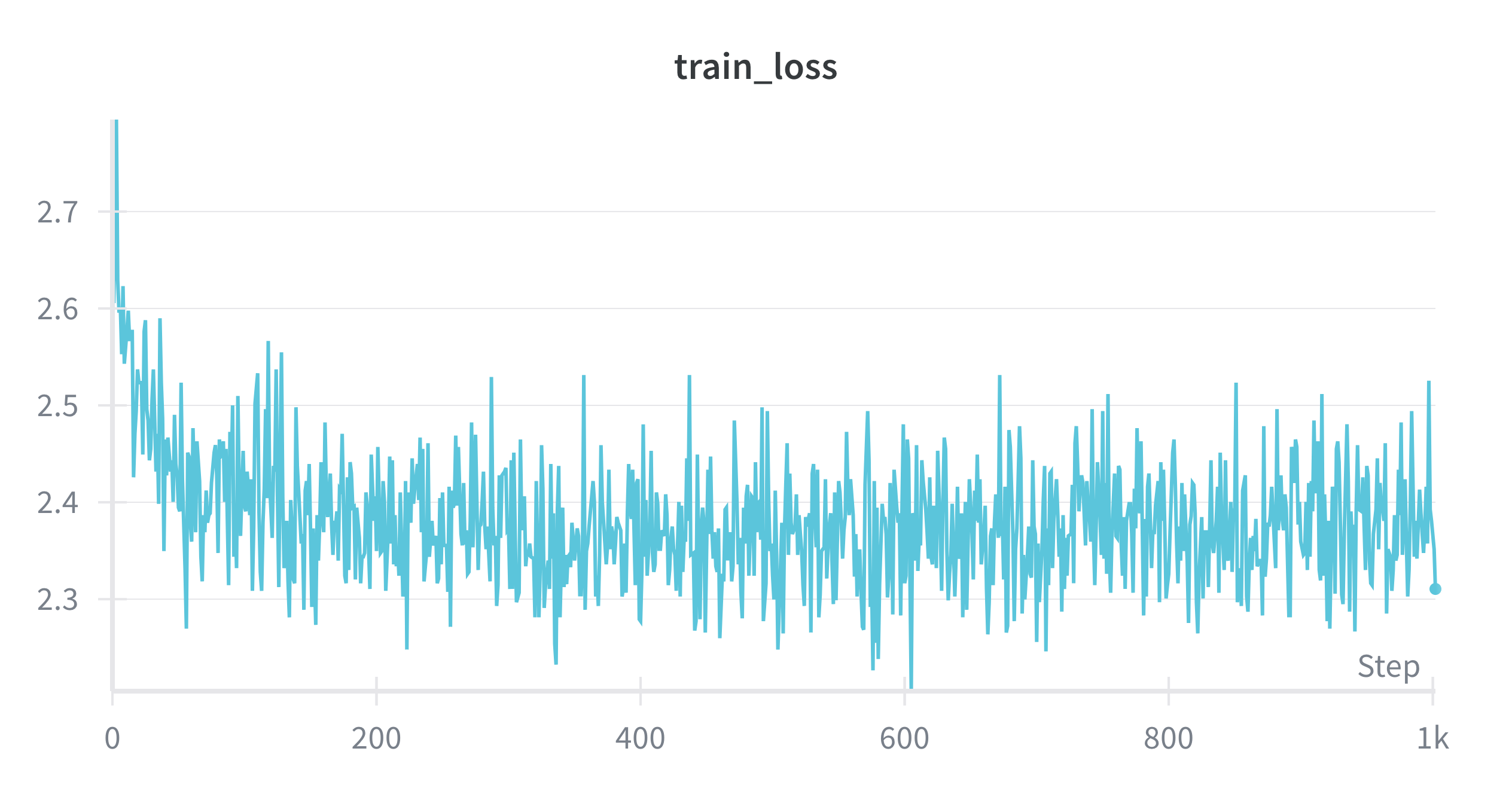
Curiosity: RLHF typically requires massive compute resources. But what if we could scale it down to a single node while maintaining the core learning principles? How would that change accessibility to RLHF?
Reinforcement Learning from Human Feedback (RLHF) has become the standard approach for aligning language models with human preferences. However, most implementations require significant computational resources—often 8+ H100 GPUs. This repository demonstrates how to reproduce the complete RLHF pipeline on a single DGX Spark, making RLHF more accessible.
The question: How do we implement the full RLHF pipeline—SFT, reward modeling, DPO, and GRPO—on limited hardware? What are the key implementation details that make this possible?
As someone who’s trained RLHF systems, I know the challenges of scaling down while maintaining training quality. This implementation provides valuable insights into making RLHF more accessible.
📚 Retrieve: Understanding the RLHF Pipeline
The Complete Pipeline
RLHF consists of four main stages:
graph TB
    subgraph Stage1["Stage 1: Supervised Fine-Tuning"]
        Base[Base Model<br/>Qwen2.5-0.5B] --> SFT[SFT Model]
        SFT_Data[TL;DR Dataset] --> SFT
    end

    subgraph Stage2["Stage 2: Reward Model Training"]
        RM_Base[Qwen2.5-1.5B] --> RM[Reward Model]
        Comparison[Comparison Dataset] --> RM
    end

    subgraph Stage3["Stage 3: DPO Training"]
        SFT --> DPO_Ref[Reference Model]
        SFT --> DPO_Policy[Policy Model]
        Comparison --> DPO_Policy
        DPO_Ref --> DPO_Policy
    end

    subgraph Stage4["Stage 4: GRPO Training"]
        SFT --> GRPO_Policy[Policy Model]
        RM --> GRPO_Reward[Reward Signal]
        GRPO_Policy --> GRPO_Reward
        GRPO_Reward --> GRPO_Policy
    end

    style SFT fill:#4ecdc4,stroke:#0a9396,stroke-width:2px,color:#fff
    style RM fill:#ff6b6b,stroke:#c92a2a,stroke-width:2px,color:#fff
    style DPO_Policy fill:#ffe66d,stroke:#f4a261,stroke-width:2px,color:#000
    style GRPO_Policy fill:#95e1d3,stroke:#2d8659,stroke-width:2px,color:#000
Key Insight: Each stage builds on the previous one, creating a pipeline that progressively aligns the model with human preferences.
Implementation Details
This implementation is based on:
- Learning to summarize from human feedback (OpenAI, 2020)
- The N+ Implementation Details of RLHF with PPO (2024)
- verl framework
Hardware Requirements:
- Single DGX Spark (or equivalent single-node GPU setup)
- Docker for containerization
- Hugging Face token for model access
💡 Innovation: Stage-by-Stage Implementation
Stage 1: Supervised Fine-Tuning (SFT)
Goal: Train a base model to generate summaries in the desired format.
Base Model: Qwen/Qwen2.5-0.5B
Dataset: summarize_from_feedback_tldr_3_filtered
Key Preprocessing:
- Add prepending whitespace and trailing
<|endoftext|>token to reference summaries - Maximum response length: 63 tokens
Training Configuration:
| Parameter | Value |
|---|---|
num_train_epochs | 1 (116,722 episodes) |
batch_size | 16 |
gradient_accumulation_steps | 8 |
| Effective batch size | 128 |
learning_rate | 3e-06 |
min_learning_rate | 3e-07 |
warmup_steps | 10 |
lr_decay_steps | 800 |
grad_clip | 1 |
use_eight_bit_optimizer | true |
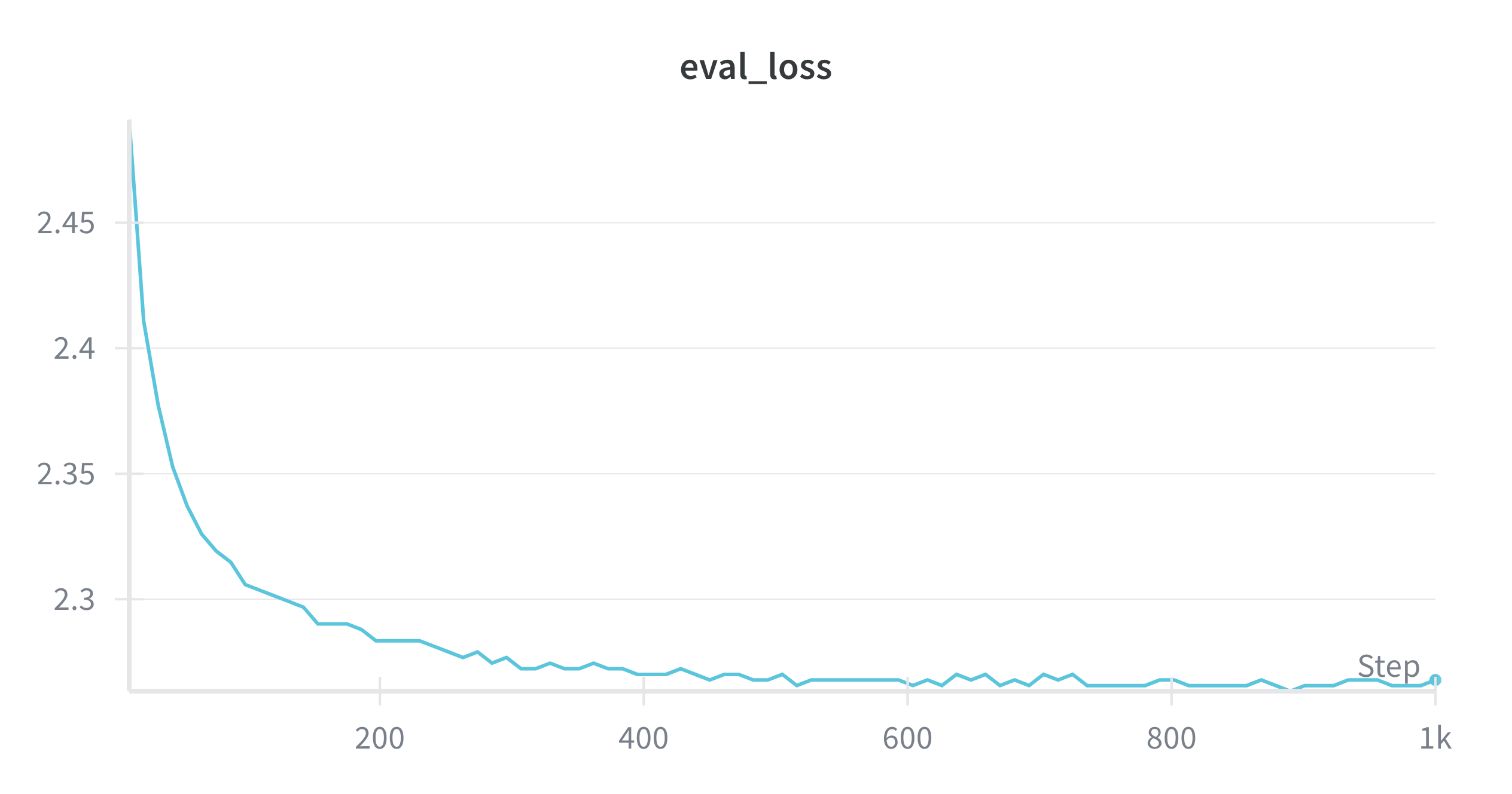
Results:
The SFT model produces much more coherent summaries than the base model:
| Input | Base Model | SFT Model |
|---|---|---|
| Reddit post about relationship | “Is it okay to ask if everything is okay or am I being pushy?” | “Guy I’m dating hasn’t been texting me in a month and I asked if everything was okay and he said yes. Am I being pushy or too clingy asking if everything is okay?” |
Implementation Steps:
1
2
3
4
5
6
7
8
9
10
11
# 1. Build Docker container
sudo docker build --build-arg HF_TOKEN=$HF_TOKEN -t summary_from_human_feedback .

# 2. Run container
sudo sh launch_docker.sh

# 3. Process SFT dataset
python3 -m dgx_spark_summary_from_human_feedback.process_sft_dataset

# 4. Train SFT model
python sft.py
Stage 2: Reward Model Training
Goal: Train a model to predict which summary is better (chosen vs. rejected).
Dataset: openai/summarize_from_feedback
Key Finding: Using the SFT model to initialize the reward model didn’t work well (likely due to 0.5B model size). Better results with:
- Qwen2.5-0.5B: Baseline performance
- Qwen2.5-1.5B: Better training and validation performance ✅
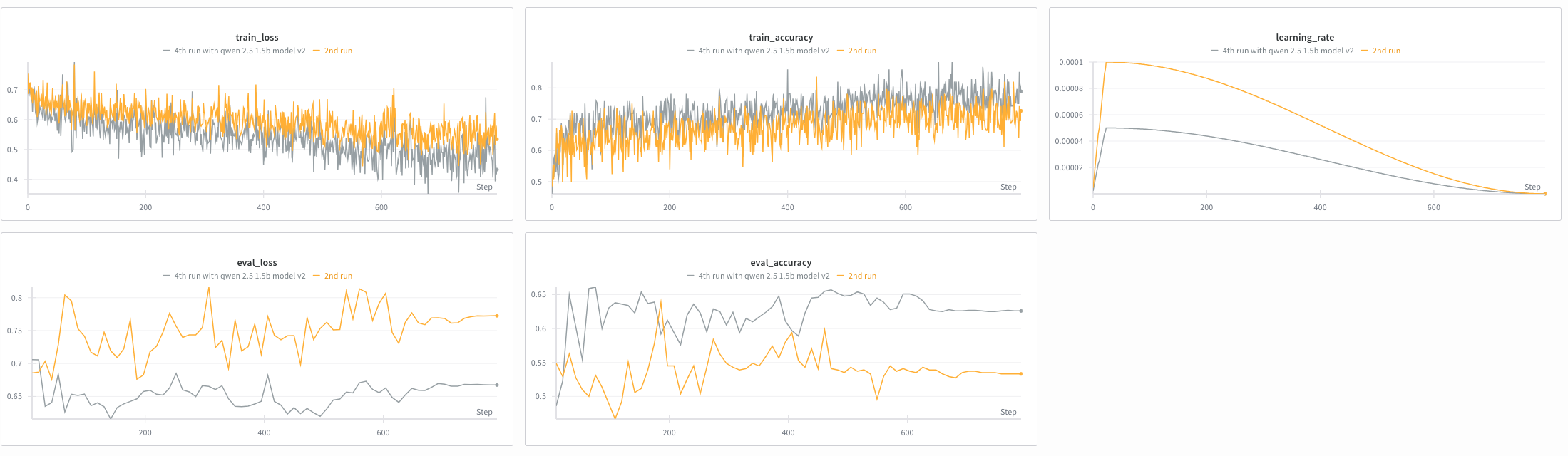
Training Configuration (Qwen2.5-1.5B):
| Parameter | Value |
|---|---|
batch_size | 8 |
gradient_accumulation_steps | 16 |
learning_rate | 0.00005 |
warmup_ratio | 0.03 |
num_train_epochs | 1 |
grad_clip | 1 |
use_eight_bit_optimizer | true |
Reward Normalization:
Following best practices, compute average reward on SFT dataset and normalize reward model output:
1
2
# Normalize reward by subtracting mean reward on SFT dataset
normalized_reward = reward_model_output - mean_sft_reward
Upload to Hugging Face:
1
2
3
4
python3 -m dgx_spark_summary_from_human_feedback.load_local_reward_model_and_push_to_hf \
    --model_path /path/to/checkpoint \
    --push_to_hf \
    --hf_repo_id seangogo/Qwen2.5-1.5B_reward_model_v2
Stage 3: DPO Training
Goal: Align the model with human preferences without a reward model.
Key Innovation: DPO (Direct Preference Optimization) eliminates the need for a separate reward model by directly optimizing on preference pairs.
DPO Loss Function:
\[\mathcal{L}_{\text{DPO}}(\pi_\theta) = -\mathbb{E}_{(x, y_c, y_r) \sim \mathcal{D}_{\text{PREF}}} \left[ \log \sigma \left( \beta \log \frac{\pi_\theta(y_c | x)}{\pi^{\text{SFT}}(y_c | x)} - \beta \log \frac{\pi_\theta(y_r | x)}{\pi^{\text{SFT}}(y_r | x)} \right) \right]\]Where:
- $\pi_\theta$: Current policy model
- $\pi^{\text{SFT}}$: SFT reference model
- $(x, y_c, y_r)$: Prompt, chosen response, rejected response
- $\beta$: Hyperparameter controlling confidence in comparison data
Training Configuration:
| Parameter | Value |
|---|---|
batch_size | 8 |
gradient_accumulation_steps | 16 |
learning_rate | 0.00005 |
beta | 0.1 |
label_smoothing | 0.1 |
num_train_epochs | 1 |
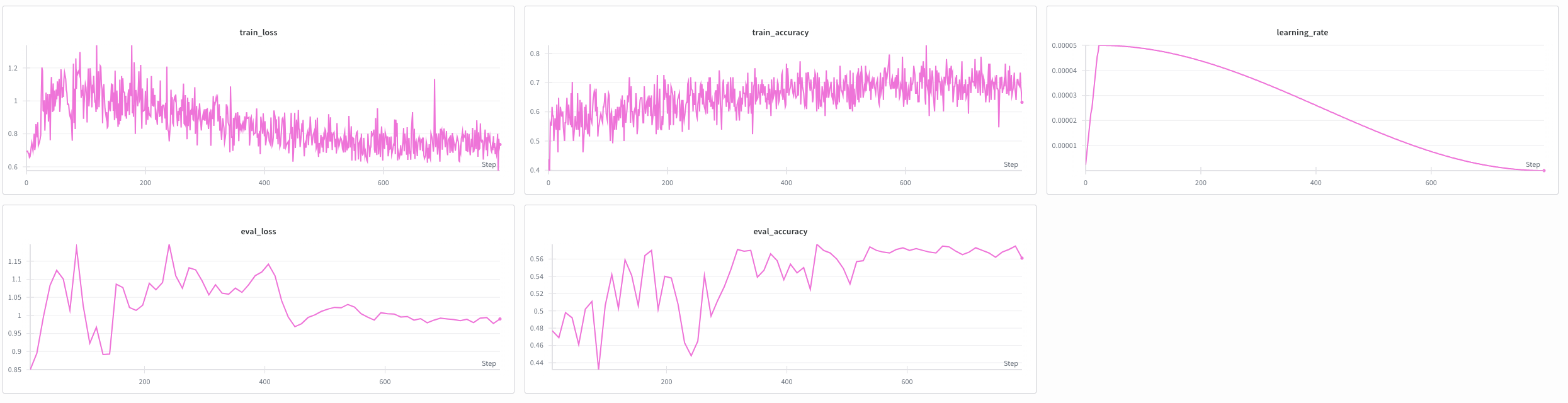
Results:
DPO produces more detailed summaries compared to SFT:
| Model | Summary Quality |
|---|---|
| Base | Repetitive, low quality |
| SFT | Coherent but basic |
| DPO | More detailed, better captures context |
Training Command:
1
2
3
python3 dpo.py \
    --output_dir dpo_output \
    --sft_model_path <local_or_hf_path_to_sft_model>
Stage 4: GRPO Training
Goal: Optimize the policy using reinforcement learning with the reward model.
GRPO (Group Relative Policy Optimization) is a variant of PPO optimized for language model training.
Key Implementation Details:
1. Generation Configuration:
1
2
3
4
5
6
7
8
9
generation_config = GenerationConfig(
    max_new_tokens=63,  # response_length
    temperature=0.7 + 1e-7,
    top_k=0,
    top_p=1.0,
    do_sample=True,
    eos_token_id=tokenizer.eos_token_id,  # Must be explicit!
    pad_token_id=tokenizer.pad_token_id,
)
Critical Notes:
- EOS token must be explicitly set - default is
None, causing generation to continue untilmax_new_tokens - No
min_new_tokens- setting it equal tomax_new_tokensprevents EOS generation - Left padding for prompts to ensure consistent prompt lengths
2. Optimization Process:
Multiple epochs of mini-batch gradient updates:
- Split rollout data into mini-batches
- Further split mini-batches into micro-batches for gradient accumulation
- Update policy weights after processing all micro-batches
Total weight update steps:
\[\frac{\text{num\_epochs} \times \text{total\_samples} \times \text{num\_responses\_per\_prompt}}{\text{batch\_size} \times \text{mini\_batch\_size}}\]3. Loss Functions:
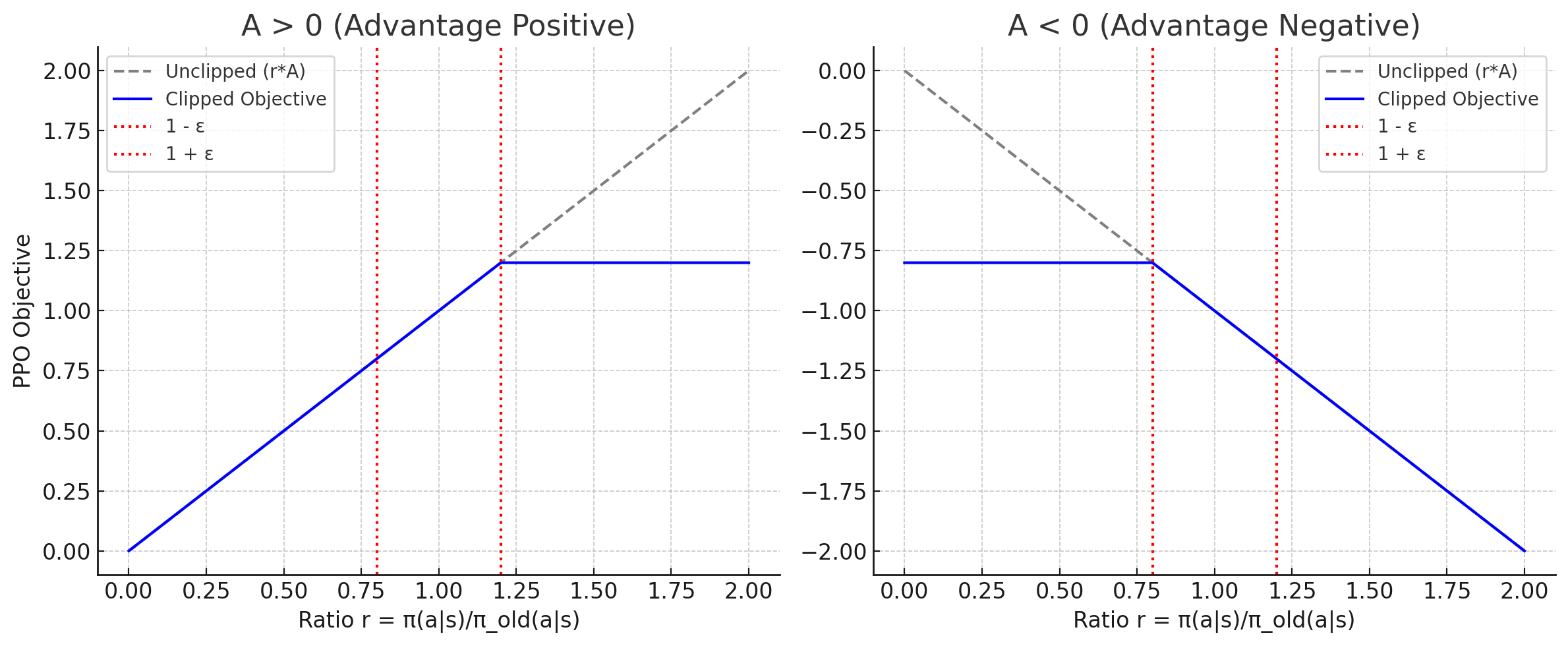
Vanilla PPO Loss:
- Bounded when advantage is positive
- Unbounded when advantage is negative (problem!)
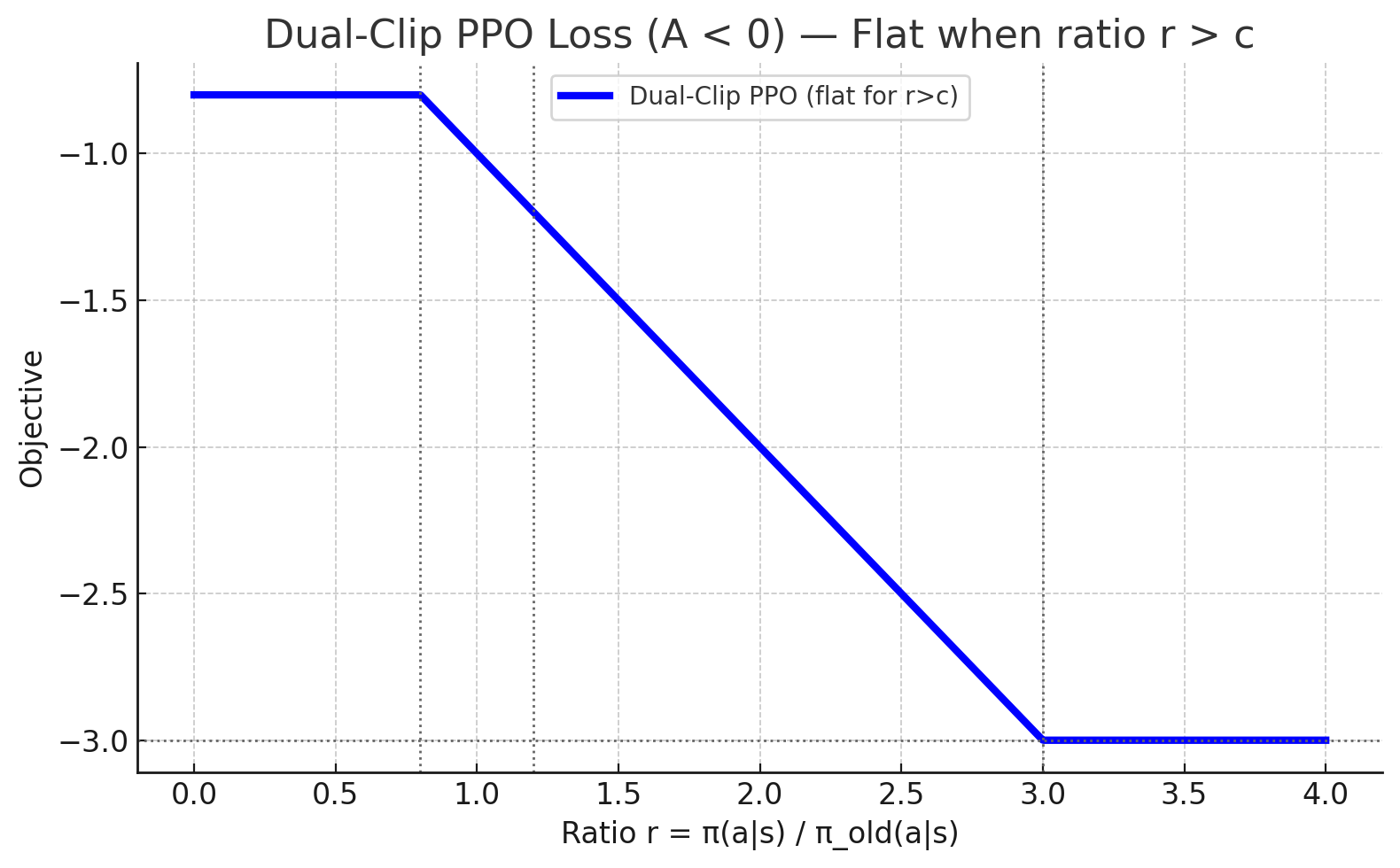
Dual Clip Loss:
- Clips loss when advantage is negative and ratio >
c - Stabilizes training by bounding negative advantage cases
Training Configuration:
| Category | Hyperparameter | Value |
|---|---|---|
| Training | num_train_epochs | 1 |
learning_rate | 5e-5 | |
warmup_ratio | 0.03 | |
grad_clip | 1.0 | |
| Batch Sizes | batch_size | 16 |
mini_batch_size | 64 | |
micro_batch_size | 8 | |
num_responses_per_group | 8 | |
| GRPO | update_per_rollout | 4 |
clip_ratio | 0.2 | |
kl_coeff | 0.05 | |
kl_penalty_mode | “k3” | |
normalize_adv_by_std_of_group | true | |
no_eos_penalty | -1.0 | |
| Generation | response_length | 63 |
temperature | 0.7 |
Results Comparison:
| Model | Summary |
|---|---|
| Base | “Is it okay to ask if everything is okay or am I being pushy?” |
| SFT | “Guy I’m dating hasn’t been texting me in a month…” |
| DPO | “I have been dating this guy for 1 month and he hasn’t responded…” |
| GRPO | “Dating guy is acting different and never responds to anything I ask. Is it okay to ask if everything is okay or am I being pushy?” |
Training Command:
1
sh run_grpo.sh
🎯 Key Implementation Insights
1. Model Size Matters for Reward Models
Finding: SFT model (0.5B) didn’t work well as reward model initialization. Qwen2.5-1.5B performed significantly better.
Implication: Reward modeling may require larger models than policy models for effective learning.
2. Generation Configuration is Critical
Key Issues:
- EOS token must be explicitly set
min_new_tokenscan prevent EOS generation- Proper padding ensures consistent batch processing
Solution: Careful configuration of generation parameters is essential for RLHF training.
3. Dual Clip Loss Stabilizes Training
Problem: Vanilla PPO loss is unbounded for negative advantages.
Solution: Dual clip loss bounds the loss magnitude, preventing training instability.
4. Reward Normalization Improves Performance
Practice: Normalize reward model output by subtracting mean reward on SFT dataset.
Benefit: Better reward signal stability during policy optimization.
5. Efficient Batch Processing
Strategy: Use gradient accumulation with micro-batches to fit large models in limited GPU memory.
Formula: Effective batch size = batch_size × gradient_accumulation_steps × micro_batch_size
📊 Performance Comparison
| Stage | Model | Key Metric | Improvement |
|---|---|---|---|
| Base | Qwen2.5-0.5B | Baseline | - |
| SFT | Fine-tuned 0.5B | Coherent summaries | ✅ Significant |
| Reward | Qwen2.5-1.5B | Preference prediction | ✅ Better than 0.5B |
| DPO | DPO-aligned 0.5B | More detailed summaries | ✅ Over SFT |
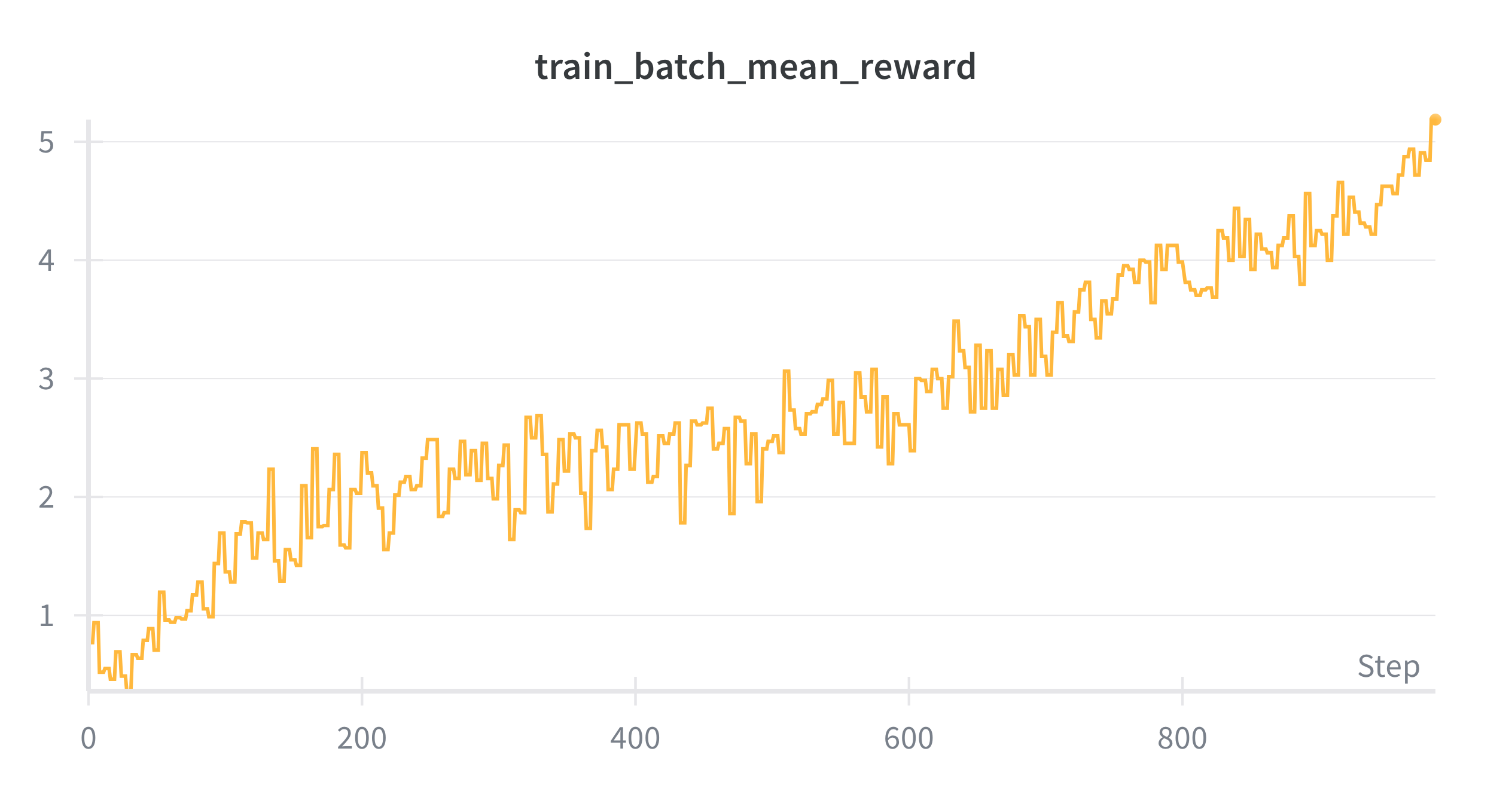
| GRPO | GRPO-optimized 0.5B | Best quality | ✅ Over DPO |
Key Takeaways:
- SFT provides foundation - Essential baseline for all subsequent stages
- Larger reward models help - 1.5B > 0.5B for reward modeling
- DPO is efficient - No reward model needed, faster training
- GRPO achieves best quality - RL optimization produces highest quality summaries
🔧 Technical Deep Dive
Docker Setup
Build Container:
1
2
3
4
sudo docker build \
    --build-arg HF_TOKEN=$HF_TOKEN \
    --build-arg CUDA_VERSION=13.0 \
    -t summary_from_human_feedback .
Run Container:
1
sudo sh launch_docker.sh
Dataset Processing
SFT Dataset:
- Source:
vwxyzjn/summarize_from_feedback_tldr_3_filtered - Processing: Add whitespace and EOS tokens
- Max length: 63 tokens
Comparison Dataset:
- Source:
openai/summarize_from_feedback - Format: (prompt, chosen, rejected) triplets
- Max length: 133 tokens
Memory Optimization
Strategies:
- 8-bit optimizer for SFT and reward model
- Gradient accumulation for large effective batch sizes
- Micro-batching for GRPO training
- Efficient attention mechanisms
🎯 Key Takeaways
| Insight | Implication | Action |
|---|---|---|
| Single-node RLHF is feasible | RLHF accessible on limited hardware | Use efficient implementations |
| Model size matters for rewards | Larger models better for reward modeling | Use 1.5B+ for reward models |
| Generation config is critical | EOS handling affects training | Explicitly set EOS tokens |
| Dual clip stabilizes PPO | Better than vanilla PPO loss | Use dual clip for GRPO |
| Reward normalization helps | More stable reward signals | Normalize by SFT mean |
Why This Matters
As someone who’s trained RLHF systems, here’s what stands out:
- Accessibility: Single-node implementation makes RLHF more accessible
- Complete Pipeline: All stages from SFT to GRPO are covered
- Practical Details: Real implementation details that matter in practice
- Reproducibility: Docker setup ensures reproducible environment
- Open Source: All code and models available on Hugging Face
What I’d Try First:
- Run the Docker setup on a single GPU
- Experiment with different model sizes for reward modeling
- Compare DPO vs. GRPO performance
- Test reward normalization impact
🤔 New Questions This Raises
Scaling: How does performance scale with more GPUs? What’s the optimal GPU count?
Model Size: What’s the minimum model size for effective reward modeling?
DPO vs. GRPO: When is DPO sufficient vs. when do you need GRPO?
Reward Normalization: How does normalization affect different reward model architectures?
Generation Config: What other generation parameters significantly affect RLHF training?
Memory Efficiency: Can we further optimize memory usage for larger models?
Next Steps: Experiment with the implementation, try different hyperparameters, and explore scaling to multiple GPUs.
References
Repository:
Research Papers:
- Learning to summarize from human feedback (OpenAI, 2020)
- The N+ Implementation Details of RLHF with PPO: A Case Study on TL;DR Summarization (2024)
- Direct Preference Optimization: Your Language Model is Secretly a Reward Model (Rafailov et al., 2023)
- Proximal Policy Optimization Algorithms (Schulman et al., 2017)
- Dual Clip PPO: Preventing Policy Collapse in PPO (Wang et al., 2019)
Related Implementations:
Models:
- Qwen/Qwen2.5-0.5B - Hugging Face
- Qwen/Qwen2.5-1.5B - Hugging Face
- SFT Model - Hugging Face
- Reward Model - Hugging Face
- DPO Model - Hugging Face
- GRPO Model - Hugging Face
Datasets:
- summarize_from_feedback_tldr_3_filtered - Hugging Face
- openai/summarize_from_feedback - Hugging Face
- processed_tldr_sft_dataset - Hugging Face
RLHF Resources:
- RLHF: Reinforcement Learning from Human Feedback - Hugging Face
- PPO for Language Models - Hugging Face TRL
- DPO Trainer - Hugging Face TRL
Training Optimization: