LLM/Model & Papers
The Top 6 "Anything as a Service" Models You Should Know in 2024
As a Service
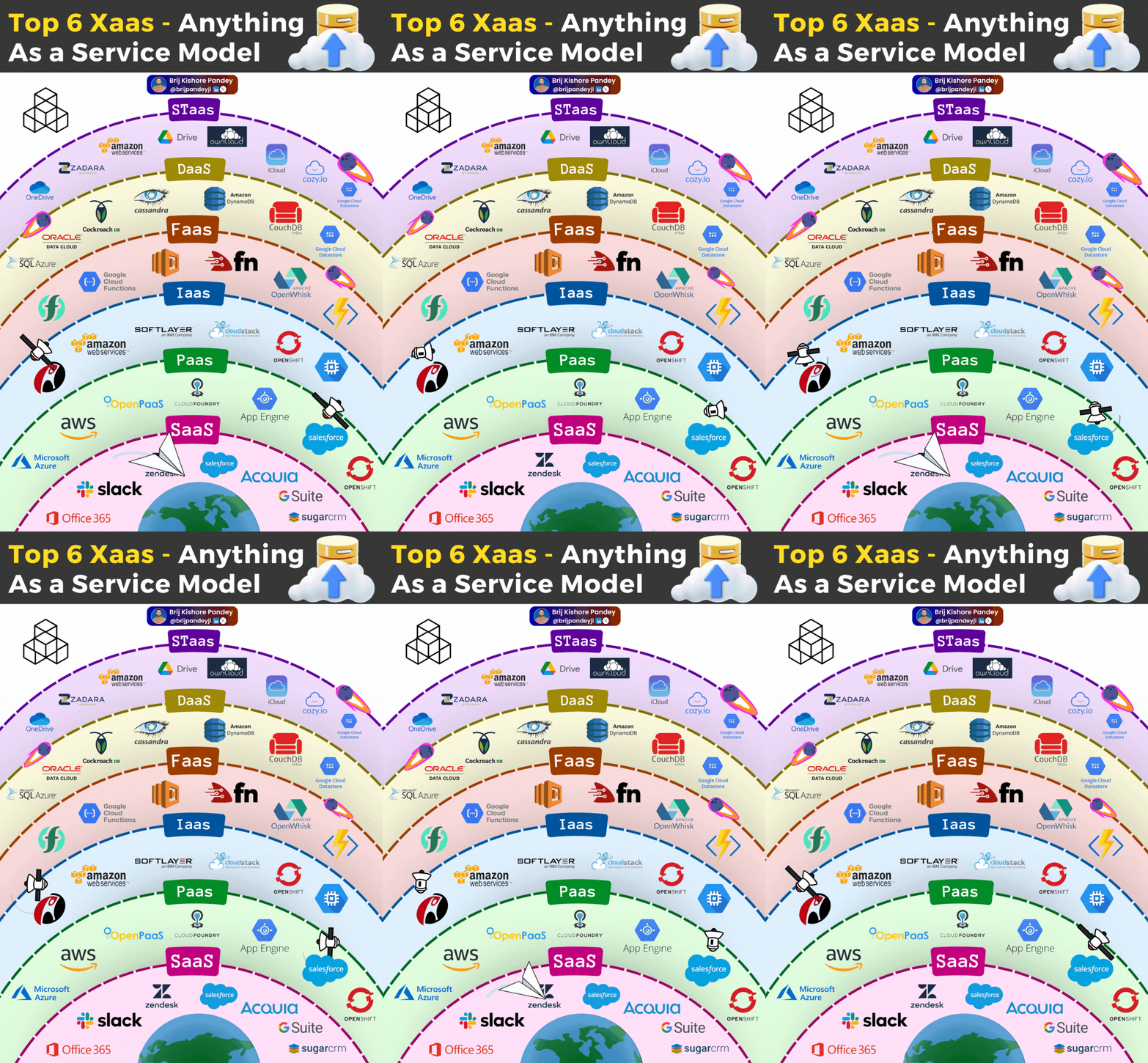
Top 6 “Anything as a Service” Models in 2024
Curiosity: How are XaaS models revolutionizing business operations? What cloud-based services offer the best efficiency, scalability, and cost savings?
In today’s rapidly evolving tech landscape, XaaS (Anything as a Service) models are revolutionizing how businesses operate. These cloud-based solutions offer on-demand access to various services, driving efficiency, scalability, and cost savings.
XaaS Models Overview
Retrieve: Understanding the XaaS ecosystem.
graph TB
    A[XaaS Models] --> B[SaaS]
    A --> C[PaaS]
    A --> D[IaaS]
    A --> E[DaaS]
    A --> F[STaaS]
    A --> G[FaaS]

    B --> B1[Software]
    C --> C1[Platform]
    D --> D1[Infrastructure]
    E --> E1[Data]
    F --> F1[Storage]
    G --> G1[Functions]

    style A fill:#e1f5ff
    style B fill:#fff3cd
    style G fill:#d4edda
Top 6 XaaS Models
Innovate: Comprehensive breakdown of XaaS offerings.
| # | Model | Description | Use Case | Examples |
|---|---|---|---|---|
| 1 | SaaS | Software over internet, subscription | ⬆️ Business applications | Salesforce, Office 365, Zendesk |
| 2 | PaaS | Platform for app development/deployment | ⬆️ Custom applications | AWS Beanstalk, App Engine, Azure |
| 3 | IaaS | IT building blocks (servers, storage) | ⬆️ Infrastructure control | AWS, Azure, GCP |
| 4 | DaaS | On-demand cloud data access | ⬆️ Large datasets, backups | S3, Azure Blob, GCS |
| 5 | STaaS | On-demand cloud storage | ⬆️ Data storage, backups | S3, Azure Blob, GCS |
| 6 | FaaS | Serverless function execution | ⬆️ Microservices, serverless | Lambda, Cloud Functions, Azure Functions |
Detailed Breakdown
Retrieve: Key characteristics of each XaaS model.
1. SaaS (Software as a Service)
Characteristics:
- Most common XaaS model
- Subscription-based access
- No installation required
- Automatic updates
Benefits: Easy access, low maintenance, scalable
2. PaaS (Platform as a Service)
Characteristics:
- Development platform
- No infrastructure investment
- Built-in tools and services
- Deployment automation
Benefits: Faster development, reduced complexity, focus on code
3. IaaS (Infrastructure as a Service)
Characteristics:
- Virtualized infrastructure
- Full control over resources
- Pay-as-you-go pricing
- Scalable resources
Benefits: Flexibility, control, cost-effective scaling
4. DaaS (Data as a Service)
Characteristics:
- On-demand data access
- Managed data services
- API-based access
- Data processing capabilities
Benefits: Easy data access, managed services, integration
5. STaaS (Storage as a Service)
Characteristics:
- Cloud storage solutions
- Scalable capacity
- Backup and recovery
- Data redundancy
Benefits: Unlimited storage, reliability, cost-effective
6. FaaS (Functions as a Service)
Characteristics:
- Serverless execution
- Event-driven
- Auto-scaling
- Pay-per-execution
Benefits: No server management, cost-efficient, scalable
Comparison Matrix
Innovate: Choosing the right XaaS model.
| Model | Control Level | Management | Best For |
|---|---|---|---|
| SaaS | Low | Provider | End-user applications |
| PaaS | Medium | Shared | Application development |
| IaaS | High | User | Infrastructure control |
| DaaS | Medium | Provider | Data access |
| STaaS | Low | Provider | Storage needs |
| FaaS | Low | Provider | Event-driven tasks |
Key Takeaways
Retrieve: XaaS models offer on-demand access to software, platforms, infrastructure, data, storage, and functions, driving efficiency, scalability, and cost savings.
Innovate: By understanding different XaaS models—from SaaS for software access to FaaS for serverless functions—you can choose the right service model for your business needs, optimizing costs and capabilities.
Curiosity → Retrieve → Innovation: Start with curiosity about cloud service models, retrieve insights from XaaS offerings, and innovate by implementing the right combination of services that transform your business operations.
Next Steps:
- Assess your business needs
- Choose appropriate XaaS models
- Implement cloud services
- Optimize costs and performance
Translate to Korean
오늘날 빠르게 진화하는 기술 환경에서 XaaS(Anything as a Service) 모델은 비즈니스 운영 방식을 혁신하고 있습니다.
이러한 클라우드 기반 솔루션은 다양한 서비스에 대한 온디맨드 액세스를 제공하여 효율성, 확장성 및 비용 절감을 촉진합니다.
비즈니스를 혁신할 수 있는 상위 6개 XaaS 모델을 살펴보겠습니다.
1️⃣ SaaS(서비스형 소프트웨어)
- • 가장 일반적인 XaaS 모델
- • 인터넷을 통해 구독 방식으로 소프트웨어 사용
- • 예: Salesforce, Microsoft Office 365, Zendesk
2️⃣ PaaS(서비스형 플랫폼)
- • 인프라에 투자하지 않고 응용 프로그램을 개발, 배포 및 관리합니다.
- • 맞춤형 앱 구축에 적합
- • 예: AWS Elastic Beanstalk, Google App Engine, Microsoft Azure
3️⃣ IaaS(서비스형 인프라)
- • 기본 IT 구성 요소에 액세스: 서버, 스토리지, 네트워킹
- • 필요에 따라 IT 리소스 확장
- • 예: AWS(Amazon Web Services), Microsoft Azure, Google Cloud Platform
4️⃣ DaaS(서비스형 데이터)
- • 클라우드 스토리지에 대한 온디맨드 액세스
- • 대규모 데이터 세트 또는 보안 백업에 이상적
- • 예: Amazon S3, Microsoft Azure Blob Storage, Google Cloud Storage
5️⃣ STaaS (서비스형 스토리지)
- • 온디맨드 클라우드 스토리지 솔루션
- • 대용량 데이터 저장 또는 보안 백업에 적합
- • 예: Amazon S3, Microsoft Azure Blob Storage, Google Cloud Storage
6️⃣ FaaS (서비스형 기능)
- • 인프라 관리 없이 코드 개발 및 배포
- • 마이크로서비스 또는 서버리스 애플리케이션에 적합
- • 예: AWS Lambda, Google Cloud Functions, Microsoft Azure Functions
프로젝트에 가장 큰 영향을 미친 XaaS 모델은 무엇입니까?