Review/Trends
🤩 𝐀𝐰𝐞𝐬𝐨𝐦𝐞-𝐏𝐫𝐨𝐝𝐮𝐜𝐭𝐢𝐨𝐧-𝐋𝐋𝐌
Curiosity: What are the best open-source libraries for building production-ready LLM applications?
Awesome Production LLM: Curated Open-Source Libraries
Curiosity: What are the best open-source libraries for building production-ready LLM applications? How can we systematically organize tools across the LLM development lifecycle?
This repository contains a curated list of awesome open-source libraries for production large language models. 59 projects are selected with high standards, covering the entire LLM application development lifecycle.
GitHub Repository: https://github.com/jihoo-kim/awesome-production-llm
Repository Overview
Retrieve: Comprehensive collection of production LLM tools organized by category.
graph TB
    A[Awesome Production LLM] --> B[Data Preprocessing]
    A --> C[Training/Finetuning]
    A --> D[Evaluation/Benchmark]
    A --> E[Serving/Inference]
    A --> F[Application/RAG]
    A --> G[Testing/Monitoring]
    A --> H[Guardrails/Security]

    B --> B1[6 Projects]
    C --> C1[12 Projects]
    D --> D1[6 Projects]
    E --> E1[12 Projects]
    F --> F1[12 Projects]
    G --> G1[7 Projects]
    H --> H1[4 Projects]

    style A fill:#e1f5ff
    style B fill:#fff3cd
    style C fill:#d4edda
    style D fill:#f8d7da
    style E fill:#e7d4f8
    style F fill:#ffe5e5
    style G fill:#e5f3ff
    style H fill:#fff0e5
Library Categories
| Category | Count | Description | Key Focus |
|---|---|---|---|
| 📚 Data Preprocessing | 6 | Data preparation and cleaning | Quality, format conversion |
| 🤖 Training / Finetuning | 12 | Model training and adaptation | Efficiency, customization |
| 📊 Evaluation / Benchmark | 6 | Performance assessment | Metrics, comparisons |
| 🚀 Serving / Inference | 12 | Model deployment | Latency, scalability |
| 🛠️ Application / RAG | 12 | Application frameworks | RAG, tool use, agents |
| 🧐 Testing / Monitoring | 7 | Quality assurance | Observability, debugging |
| 🛡️ Guardrails / Security | 4 | Safety and security | Content filtering, safety |
LLM Development Lifecycle
Innovate: Tools organized across the complete development workflow.
graph LR
    A[Data Preprocessing] --> B[Training/Finetuning]
    B --> C[Evaluation]
    C --> D[Serving/Inference]
    D --> E[Application/RAG]
    E --> F[Testing/Monitoring]
    F --> G[Guardrails/Security]
    G --> A

    style A fill:#e1f5ff
    style B fill:#fff3cd
    style C fill:#d4edda
    style D fill:#f8d7da
    style E fill:#e7d4f8
    style F fill:#ffe5e5
    style G fill:#fff0e5
Category Breakdown
📚 LLM Data Preprocessing (6 projects)
Retrieve: Tools for preparing and cleaning data for LLM training.
Focus Areas:
- Data cleaning and normalization
- Format conversion
- Quality assurance
- Dataset preparation
🤖 LLM Training / Finetuning (12 projects)
Retrieve: Frameworks for training and adapting LLMs.
Focus Areas:
- Efficient training methods
- Parameter-efficient fine-tuning (LoRA, QLoRA)
- Distributed training
- Model optimization
📊 LLM Evaluation / Benchmark (6 projects)
Retrieve: Tools for assessing LLM performance.
Focus Areas:
- Benchmark datasets
- Evaluation metrics
- Model comparison
- Performance analysis
🚀 LLM Serving / Inference (12 projects)
Innovate: Solutions for deploying LLMs in production.
Focus Areas:
- Low-latency inference
- Scalability
- Model serving
- Optimization techniques
🛠️ LLM Application / RAG (12 projects)
Innovate: Frameworks for building LLM applications.
Focus Areas:
- RAG implementations
- Tool use and agents
- Application frameworks
- Integration patterns
🧐 LLM Testing / Monitoring (7 projects)
Retrieve: Tools for quality assurance and observability.
Focus Areas:
- Testing frameworks
- Monitoring and logging
- Performance tracking
- Debugging tools
🛡️ LLM Guardrails / Security (4 projects)
Retrieve: Safety and security solutions.
Focus Areas:
- Content filtering
- Safety mechanisms
- Security best practices
- Risk mitigation
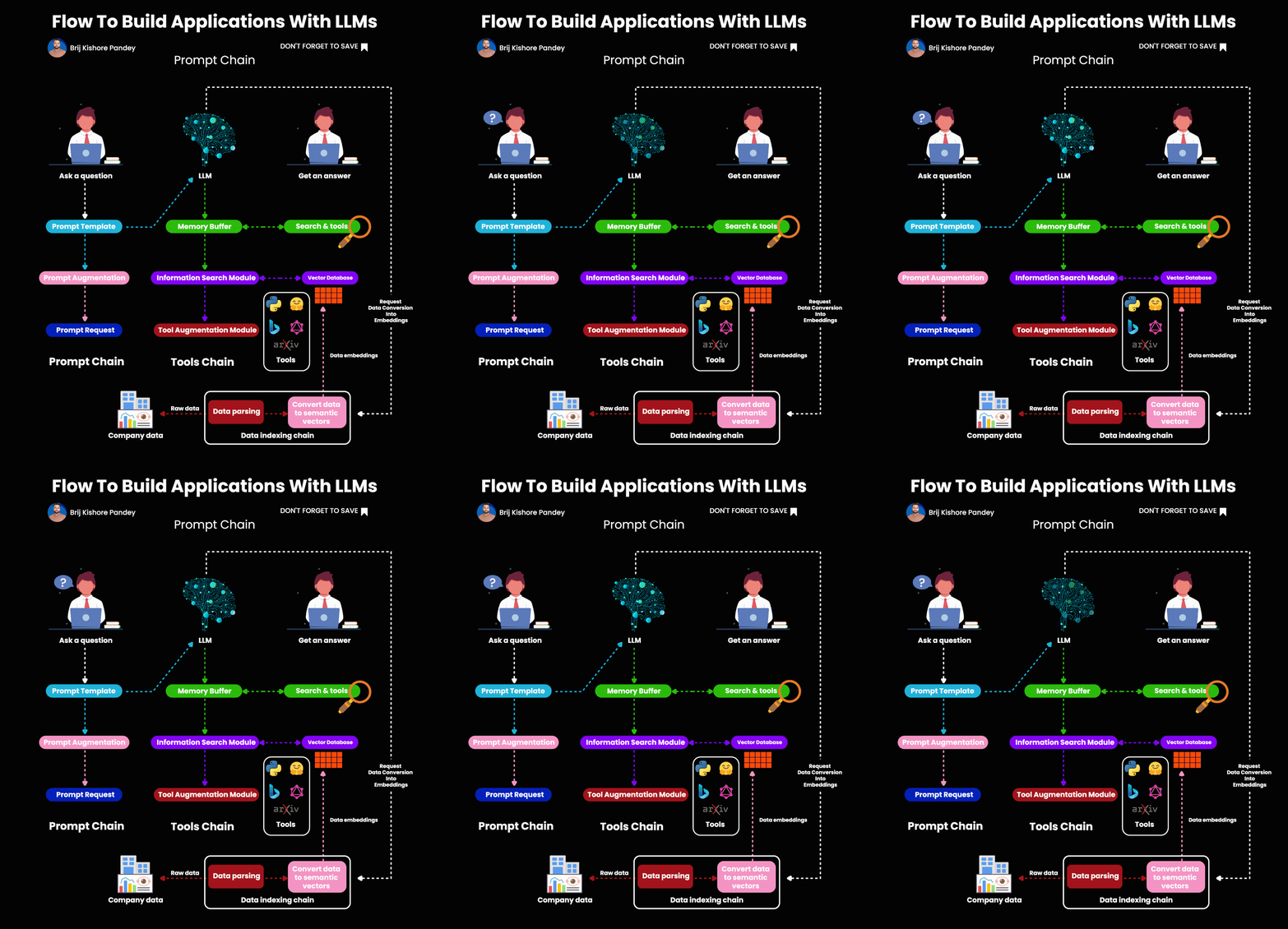
7-Step Technical Framework for LLM Applications
Innovate: Comprehensive framework for architecting robust LLM-powered applications.
graph TB
    A[LLM Application Architecture] --> B[1. Define Scope]
    B --> C[2. Prompt Engineering]
    C --> D[3. Memory Management]
    D --> E[4. RAG & Tools]
    E --> F[5. Data Pipeline]
    F --> G[6. Testing]
    G --> H[7. Deployment]

    style A fill:#e1f5ff
    style B fill:#fff3cd
    style C fill:#d4edda
    style D fill:#f8d7da
    style E fill:#e7d4f8
    style F fill:#ffe5e5
    style G fill:#e5f3ff
    style H fill:#fff0e5
1️⃣ Define Application Scope and User Interaction Model
Retrieve: Establish clear requirements and interaction patterns.
Key Activities:
- Identify core use cases and potential edge cases
- Design user interaction flow (multi-turn dialogues, single-query responses)
- Consider scalability and performance requirements
Considerations:
| Aspect | Considerations |
|---|---|
| Use Cases | Core functionality, edge cases, error handling |
| Interaction | Single-turn vs. multi-turn, context management |
| Scalability | Expected load, response time requirements |
| Performance | Latency targets, throughput needs |
2️⃣ Engineer Prompt Chain Architecture
Innovate: Design robust prompt engineering systems.
Key Activities:
- Implement prompt engineering techniques (few-shot learning, chain-of-thought)
- Develop robust prompt template system with version control
- Optimize for token efficiency and response coherence
Prompt Engineering Techniques:
| Technique | Purpose | Use Case |
|---|---|---|
| Few-shot Learning | Provide examples | Task-specific adaptation |
| Chain-of-Thought | Step-by-step reasoning | Complex problem solving |
| Template System | Consistency and versioning | Production stability |
| Token Optimization | Cost and latency reduction | Efficiency |
3️⃣ Implement Stateful Conversations with Advanced Memory Buffers
Retrieve: Manage conversation context effectively.
Key Activities:
- Choose appropriate memory structures (sliding window, summary buffers)
- Implement efficient serialization and deserialization of conversation state
- Design memory management strategies for long-running sessions
Memory Strategies:
graph LR
    A[Conversation State] --> B[Sliding Window]
    A --> C[Summary Buffer]
    A --> D[Semantic Search]

    B --> E[Recent Context]
    C --> F[Compressed History]
    D --> G[Relevant Context]

    style A fill:#e1f5ff
    style B fill:#fff3cd
    style C fill:#d4edda
    style D fill:#f8d7da
4️⃣ Integrate Retrieval-Augmented Generation (RAG) and Tool Use
Innovate: Enhance LLM capabilities with external knowledge and tools.
Key Activities:
- Implement vector databases for semantic search capabilities
- Develop flexible tool-use framework (OpenAI function calling paradigm)
- Design fall-back mechanisms for API failures or out-of-domain queries
RAG & Tool Integration:
| Component | Function | Implementation |
|---|---|---|
| Vector Database | Semantic search | Pinecone, Weaviate, Qdrant |
| Tool Framework | Function calling | OpenAI functions, LangChain tools |
| Fallback | Error handling | Default responses, retry logic |
5️⃣ Establish Robust Data Processing Pipeline
Retrieve: Build efficient data ingestion and processing systems.
Key Activities:
- Implement ETL processes for diverse data sources
- Develop efficient indexing strategies for quick retrieval
- Design data validation and sanitization protocols
Data Pipeline Components:
graph LR
    A[Data Sources] --> B[ETL Process]
    B --> C[Validation]
    C --> D[Indexing]
    D --> E[Vector Store]
    E --> F[Retrieval]

    style A fill:#e1f5ff
    style B fill:#fff3cd
    style E fill:#d4edda
6️⃣ Rigorous Testing and Iterative Refinement
Retrieve: Ensure quality through comprehensive testing.
Key Activities:
- Implement comprehensive unit and integration testing suites
- Develop metrics for response quality, latency, and coherence
- Utilize A/B testing for prompt and model optimization
Testing Strategy:
| Test Type | Focus | Tools |
|---|---|---|
| Unit Tests | Individual components | pytest, unittest |
| Integration Tests | End-to-end flows | pytest, testcontainers |
| A/B Testing | Prompt/model comparison | Custom frameworks |
| Quality Metrics | Response evaluation | Custom metrics, LLM-as-judge |
7️⃣ Production Deployment and Monitoring
Innovate: Deploy and monitor LLM applications in production.
Key Activities:
- Containerize application for consistent deployment
- Implement robust logging and telemetry
- Design auto-scaling mechanisms to handle variable load
Deployment Architecture:
graph TB
    A[Application] --> B[Container]
    B --> C[Orchestration]
    C --> D[Load Balancer]
    D --> E[Monitoring]

    E --> F[Logging]
    E --> G[Metrics]
    E --> H[Alerts]

    style A fill:#e1f5ff
    style C fill:#fff3cd
    style E fill:#d4edda
Key Takeaways
Retrieve: The Awesome Production LLM repository provides 59 curated open-source libraries organized across 7 categories, covering the complete LLM development lifecycle.
Innovate: By following the 7-step framework and leveraging these tools, you can build robust, scalable, and production-ready LLM applications with proper architecture, testing, and monitoring.
Curiosity → Retrieve → Innovation: Start with curiosity about production LLM tools, retrieve knowledge from this curated repository, and innovate by applying the 7-step framework to build enterprise-grade LLM applications.
Next Steps:
- Explore the GitHub repository
- Select tools for your use case
- Apply the 7-step framework
- Build production-ready LLM applications