AI
Context Engineering Is the Missing Layer Between Your Agent and Its Memory
Prompt engineering tells the model what to do. Context engineering tells it what to know. A practical game-production view of retrieval, memory, context assembly, and reasoning scaffolds.
This historical note links Sourcegraph’s context engineering guide, the MemGPT paper, and the A-Mem paper. The four-layer game-production lens below is my organizing framework, not Sourcegraph’s four-pillar enumeration. The balance-review scenario and patch outcomes are hypothetical examples, not reported production measurements.
🤔 Curiosity: Why Do Smart Agents Make Dumb Mistakes?
Consider a hypothetical live-ops failure, not a reported production incident.
A capable agent had access to patch notes, telemetry exports, and a vector search over the team’s decision history. On paper, the setup looked complete. In practice, it kept recommending balance changes that had already been reverted two patches earlier, complete with confident explanations.
The agent was not stupid. Its reasoning was coherent. The problem was that the relevant fact was not in context when the agent needed it.
This is the problem that context engineering names. Prompt engineering tells a model what to do. Context engineering designs the information that makes reliable action possible in the first place.
Sourcegraph describes context engineering as deliberately designing what a language model sees on each inference call, including retrieved documents, conversation history, tool definitions, and long-term memory. Cross-session state is one important part of that broader pipeline. An agent that can carry decisions, constraints, and failures forward needs deliberate memory design.
The question: if the system prompt tells the model what to do, what tells it what to know?
📚 Retrieve: The Four Pillars
A useful context-engineering system has four related layers: retrieval, memory, context assembly, and reasoning scaffolds. I will map each one to a game-production problem.
1. Retrieval: find the right evidence, not every match
An agent cannot know the whole repository, telemetry history, and design archive at once. It needs a retrieval layer that finds the smallest useful set of evidence at decision time.
For game code, vector search alone is often insufficient. Text search can find ten mentions of cooldown, but it does not necessarily tell you which component owns the value, which configuration reaches the live build, or which telemetry event measures the outcome.
Structured code intelligence adds the missing relationships: call graphs, symbol ownership, type information, and cross-repository references. The practical question is not only “where does this word appear?” It is “which path changes the player-visible result?”
graph LR
    Q[Agent query] --> V[Semantic search]
    Q --> G[Code graph]
    V --> R[Ranked evidence]
    G --> O[Ownership and call path]
    R --> A[Context assembly]
    O --> A
    A --> M[Language model]
In a balance review, the useful retrieval result might combine the ability definition, the owning system, the last three related decisions, and the telemetry window for the affected cohort. A pile of loosely related snippets is not context. It is noise with citations.
2. Memory: separate the session from the history
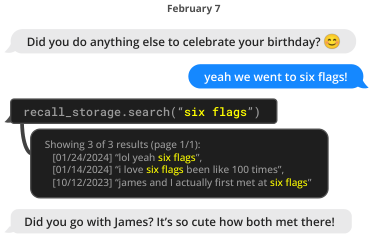
Memory has at least two species.
Short-term memory is the current conversation, tool results, and task state. It lives in the context window and normally dies with the session.
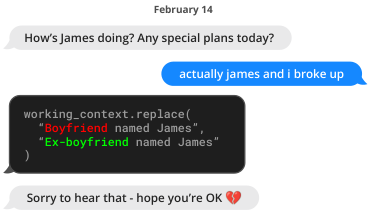
Long-term memory persists across sessions: user preferences, project conventions, prior decisions, post-mortems, and constraints. This is the layer teams often underinvest in because it has no immediate demo effect.
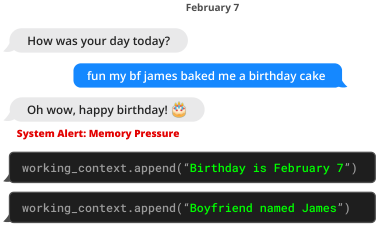
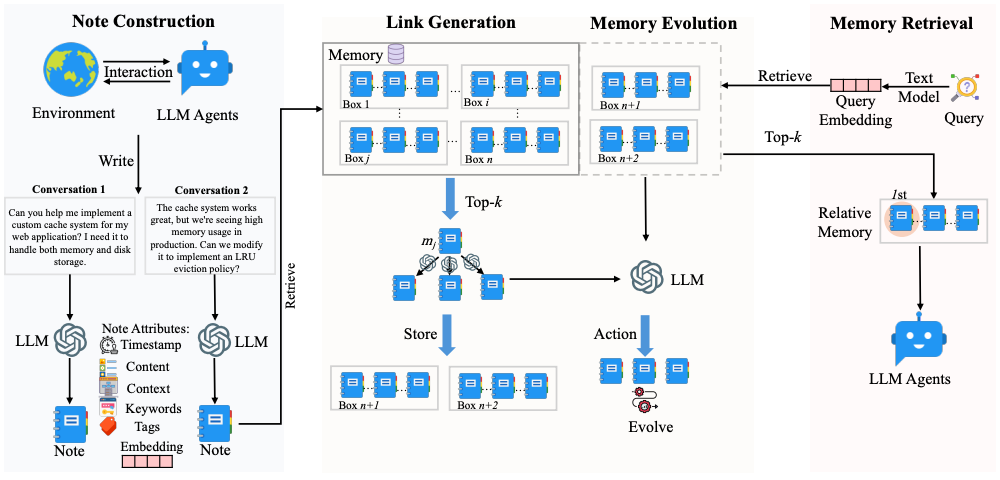
Raw conversation history is a poor long-term memory format. It grows too quickly and forces every future run to re-read the same irrelevant turns. A better design extracts durable facts: what was decided, why, which evidence supported it, what happened afterward, and when the fact should be rechecked.
For a live-service team, the durable record is not “the agent said this in turn 47.” A hypothetical record might say “the cooldown reduction shipped in patch 7.2, raised pick rate, reduced D7 retention in the affected cohort, and was reverted in 7.5.” These patch numbers and outcomes are illustrative, not measured results. A real record would need its own evidence.
3. Context assembly: relevance beats recency
Good retrieval can still produce bad decisions if the pieces are assembled in the wrong order.
A practical assembly usually contains:
- system instructions and tool definitions
- ranked source documents
- relevant conversation history
- long-term memory snippets
- current user input
- explicit uncertainty or freshness markers
The common failure mode is recency bias. The agent sees the last twenty turns but misses the constraint established three weeks ago. The context window is full, yet the important signal is absent.
graph TB
    I[Instructions] --> C[Full context]
    T[Tools] --> C
    D[Ranked documents] --> C
    H[Compressed history] --> C
    M[Long-term memory] --> C
    U[Current input] --> C
    C --> L[Model]
Context assembly should therefore be an explicit design decision. Even heuristic relevance scores are better than an implicit order nobody can inspect. A prior rollback may deserve more weight than a newly indexed design note. A current telemetry window may outrank a six-month-old assumption. The system should make that judgement visible.
4. Reasoning scaffolds: use the context before acting
The final layer is how the agent uses the context. A reasoning scaffold can require the agent to check prior decisions, state uncertainty, compare current evidence with historical evidence, or run a verification tool before proposing a change.
This is where prompt engineering belongs, but notice the order. The scaffold comes after retrieval, memory, and assembly. Most teams start by rewriting the system prompt while the agent still has no reliable way to find the facts that prompt asks it to use.
💡 Innovation: A Balance-Review Guardrail
Here is the smallest useful context-engineering slice I would build for a game team: a pre-change guardrail for balance proposals.
1
2
3
4
5
6
7
8
9
10
11
12
13
14
15
16
17
18
19
20
21
22
from dataclasses import dataclass

@dataclass
class BalanceContext:
    related_decisions: list[dict]
    code_ownership: dict
    telemetry_window: dict
    prior_reverts: list[dict]
    constraints: list[str]


def assemble_context(proposal, decisions, graph, metrics):
    system = extract_system(proposal)
    lever = extract_lever(proposal)

    return BalanceContext(
        related_decisions=decisions.search(f"{system} {lever}", top_k=5),
        code_ownership=graph.trace_ownership(system),
        telemetry_window=metrics.last_30_days(system),
        prior_reverts=decisions.filter(system=system, status="reverted"),
        constraints=decisions.get_constraints(scope="global"),
    )
The exact code is not the point. The shape is the point. The agent receives a deliberately assembled object rather than an accidental transcript dump.
Before proposing a change, the guardrail can ask:
- Have we tried this lever before?
- Was the previous attempt shipped, reverted, or left unmeasured?
- Which code path owns the behavior?
- What did the affected cohort do in the latest comparable window?
- Which constraints are still valid for this patch?
The result should not blindly block the designer. It should surface the evidence and make the decision legible. “This was reverted before” is a useful challenge. It is not automatically a veto because the product, cohort, and patch may have changed.
MCP as a retrieval bus
The Model Context Protocol is useful here because production context is heterogeneous. A game team may have a Git repository, a telemetry warehouse, a design wiki, a ticket tracker, and a balance database. Each source can expose a tool surface instead of forcing every agent pipeline to contain bespoke retrieval code.
Honest tradeoffs
Context engineering has costs that should be measured rather than hidden:
- Latency: every retrieval hop adds time, and an interactive agent can become frustratingly slow.
- Token cost: more context means more tokens, so compression and ranking are also budget controls.
- Staleness: a constraint that was correct in patch 7.2 may be wrong in 7.5. Facts need TTLs, event-based invalidation, or explicit revalidation.
- Complexity: each layer can fail independently. Start with one high-value workflow instead of building an abstract memory platform first.
- Evaluation: retrieval metrics do not fully measure whether the assembled context led to a good decision. The final guardrail needs outcome-based tests.
Key Takeaways
| Insight | Implication | Next step |
|---|---|---|
| Prompt engineering is not context engineering | What the agent knows is a separate system from what it is told to do | Audit the agent’s information sources before rewriting the system prompt |
| Memory has different lifetimes | Session context dies quickly, while decisions and constraints need durable storage | Pick one cross-session fact and store it with a source and freshness rule |
| Code retrieval needs structure | Vector search can lose ownership and call-graph information | Add one structured code-intelligence source beside the vector index |
| Assembly order matters | Recency is not the same as relevance | Make ranking and uncertainty visible in the assembled context |
| Small guardrails beat abstract platforms | A real workflow reveals the missing evidence faster than a generic memory layer | Start with one pre-change review and measure repeated mistakes |
New Questions This Raises
- What freshness policy should a live-service game use when the ground truth changes every patch?
- If multiple specialized agents share a memory store, who resolves conflicting writes?
- How do we evaluate the quality of assembled context without running the entire agent loop?
The tools are maturing quickly. The engineering responsibility remains the same: make the evidence that shapes an agent’s decision visible, current, and testable.