Infrastructure/System
MLflow를 활용한 Hybrid MLOps 구축 예제
Curiosity: How can we combine on-premise GPU training with cloud-based inference?
Hybrid MLOps with MLflow: On-Prem Training + SageMaker Inference
Curiosity: How can we combine on-premise GPU training with cloud-based inference? What’s the best way to manage ML workflows across hybrid infrastructure?
This sample project demonstrates a Hybrid MLOps System combining On-Prem GPUs for training with SageMaker Endpoints for inference. Perfect for organizations considering hybrid infrastructure.
GitHub Repository: https://github.com/aws-samples/aws-kr-startup-samples/tree/main/machine-learning/mlflow
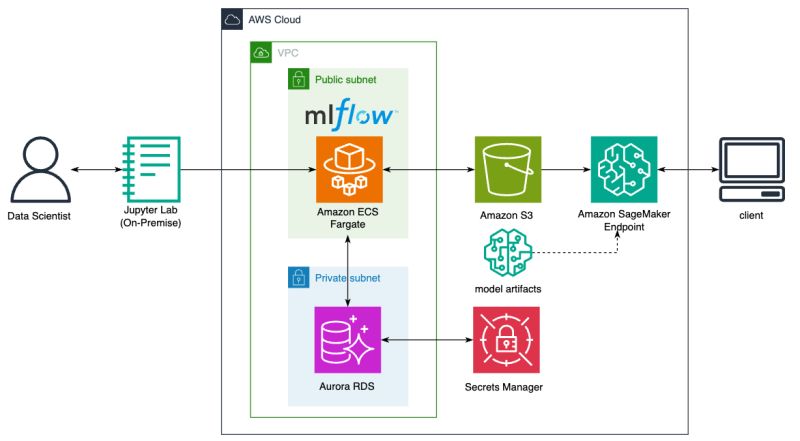
System Architecture
Retrieve: Hybrid architecture combining on-premise training with cloud inference.
graph TB
    A[On-Prem GPUs] --> B[Model Training]
    B --> C[MLflow Server<br/>AWS]
    C --> D[Model Artifacts<br/>S3]
    D --> E[SageMaker Endpoint]
    E --> F[Inference Service]

    B --> C
    C --> G[Training Tracking]
    C --> H[Experiment Management]

    style A fill:#e1f5ff
    style C fill:#fff3cd
    style E fill:#d4edda
Key Components
| Component | Location | Purpose | Benefit |
|---|---|---|---|
| Training | On-Prem GPUs | Model training | ⬇️ Cost control |
| MLflow | AWS | Experiment tracking | ⬆️ Centralized management |
| Model Artifacts | S3 | Storage | ⬆️ Scalability |
| Inference | SageMaker | Model serving | ⬆️ Easy deployment |
Workflow
Innovate: Streamlined workflow from training to deployment.
Training Phase:
- Train models on On-Prem GPUs
- Track experiments with MLflow (AWS)
- Store model artifacts in S3
- Monitor training progress
Deployment Phase:
- Select model from MLflow
- Deploy to SageMaker Endpoint
- Automatic scaling and load balancing
- Production inference service
Why This Architecture?
Retrieve: Benefits of hybrid MLOps approach.
Advantages:
| Benefit | Description | Impact |
|---|---|---|
| Cost Efficiency | Use existing GPUs | ⬇️ Training costs |
| Scalability | Cloud inference | ⬆️ Handle traffic |
| Simplicity | MLflow vs. Kubeflow | ⬇️ Learning curve |
| Flexibility | Hybrid infrastructure | ⬆️ Options |
SageMaker Endpoint Benefits:
- ✅ No need for ALB setup
- ✅ Automatic scaling
- ✅ Easy deployment (few clicks)
- ✅ ML developers don’t need backend expertise
- ✅ Backend developers don’t need ML expertise
MLflow vs. Kubeflow
Retrieve: Why MLflow is better for startups.
| Feature | MLflow | Kubeflow |
|---|---|---|
| Complexity | Simple | Complex |
| Infrastructure | Single server | Kubernetes cluster |
| Learning Curve | Low | High |
| Setup Time | Minutes | Days |
| Best For | Startups, small teams | Large organizations |
MLflow Advantage: Run like a web server—just start one MLflow server and you’re ready to go!
Use Cases
Innovate: Perfect for specific scenarios.
Ideal For:
- Startups with limited resources
- Organizations with existing GPUs
- Teams wanting simple MLOps
- Hybrid cloud strategies
Requirements:
- On-Prem GPUs for training
- AWS account for MLflow and SageMaker
- S3 for model storage
Key Takeaways
Retrieve: Hybrid MLOps with MLflow enables cost-effective training on-premise while leveraging cloud scalability for inference, with minimal complexity compared to Kubernetes-based solutions.
Innovate: By combining On-Prem GPUs, MLflow for tracking, and SageMaker for deployment, you can build a production-ready MLOps system that’s simple to operate and scales efficiently.
Curiosity → Retrieve → Innovation: Start with curiosity about hybrid infrastructure, retrieve insights from this architecture, and innovate by building MLOps systems that balance cost, complexity, and scalability.
Next Steps:
- Explore the GitHub repository
- Set up MLflow on AWS
- Configure On-Prem training
- Deploy to SageMaker