AI
mini-AGI's forgetting fix is measured on reading, not on chat
A Source Audit of mini-AGI: the no-forgetting result comes from a 0.1x trunk rate on a corpus probe, while chat learning is on by default and unmeasured.
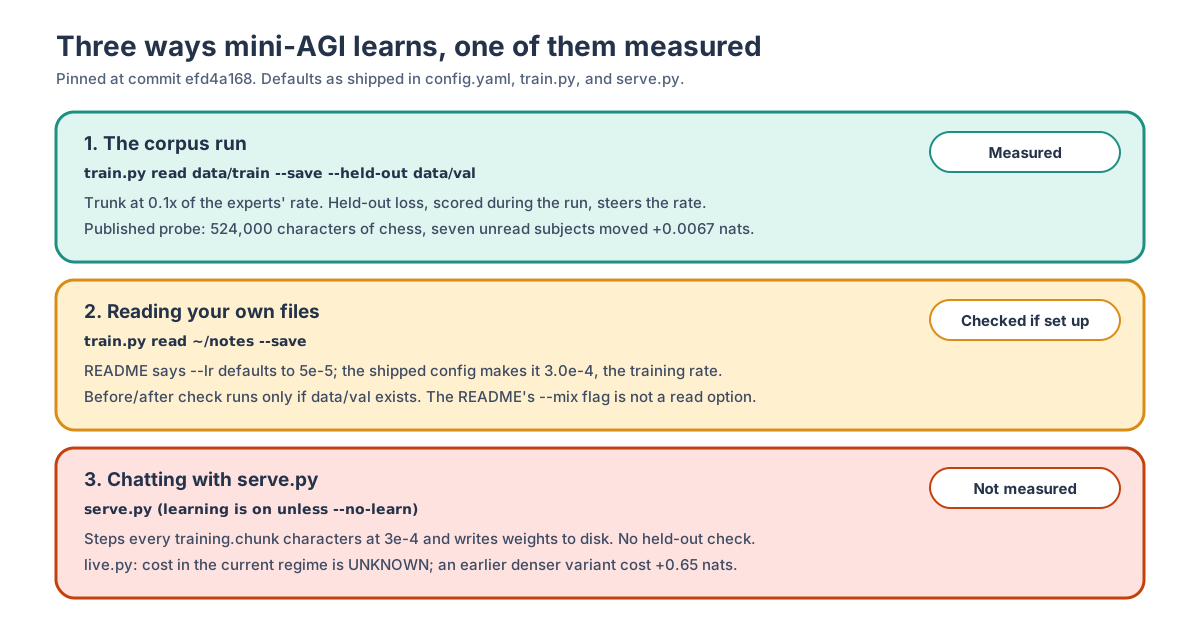
Which part of mini-AGI learns without forgetting?
mini-AGI is Alexey Borsky’s new MIT-licensed project, created on September 19, 2026. Its README describes a continual learning byte-level language model that assembles its own architecture, trains from scratch on a single 8 GB VRAM GPU, and keeps learning from everything it reads. The author is careful to add that, for now, it is a small toy-level model.
The pitch that caught my attention is in the Motivation section: a model that is yours, trained on your hardware, and that keeps learning from every conversation you have with it. For anyone building a personal assistant or a studio tool, that is the interesting part. It is also the risky part, because continual learning usually fails through forgetting.
So I asked a narrow question:
Does the published no-forgetting evidence cover the ways I would actually use a personal model: reading my files and chatting with it?
The pinned code says only partly. The forgetting probe measures corpus reading with a slowed-down trunk. Chat learning is on by default, writes to disk, and its own source file says its cost is not measured. The file-reading path runs faster than the README says.
To be fair to the author, most of this is visible in the repository itself. The code is unusually candid. The gap is between the Motivation paragraph and what has been measured so far.
Technical Analysis: What the pinned repository shows
I pinned the repository at commit efd4a168 from September 23 and read the README, serve.py, minagi/live.py, train.py, config.yaml, and minagi/config.py. The repository had 20 commits at that point, and the MIT license was added on September 21.
A model that pages its experts from disk
mini-AGI stores each expert as a file. Only a working set sits on the GPU: the README says 32 experts are resident at a time, about 109M parameters of the 540M in its parameter table, which is why the pool can grow on an 8 GB card. The reference machine is an RTX 3070 Laptop GPU. The weights are not published yet.
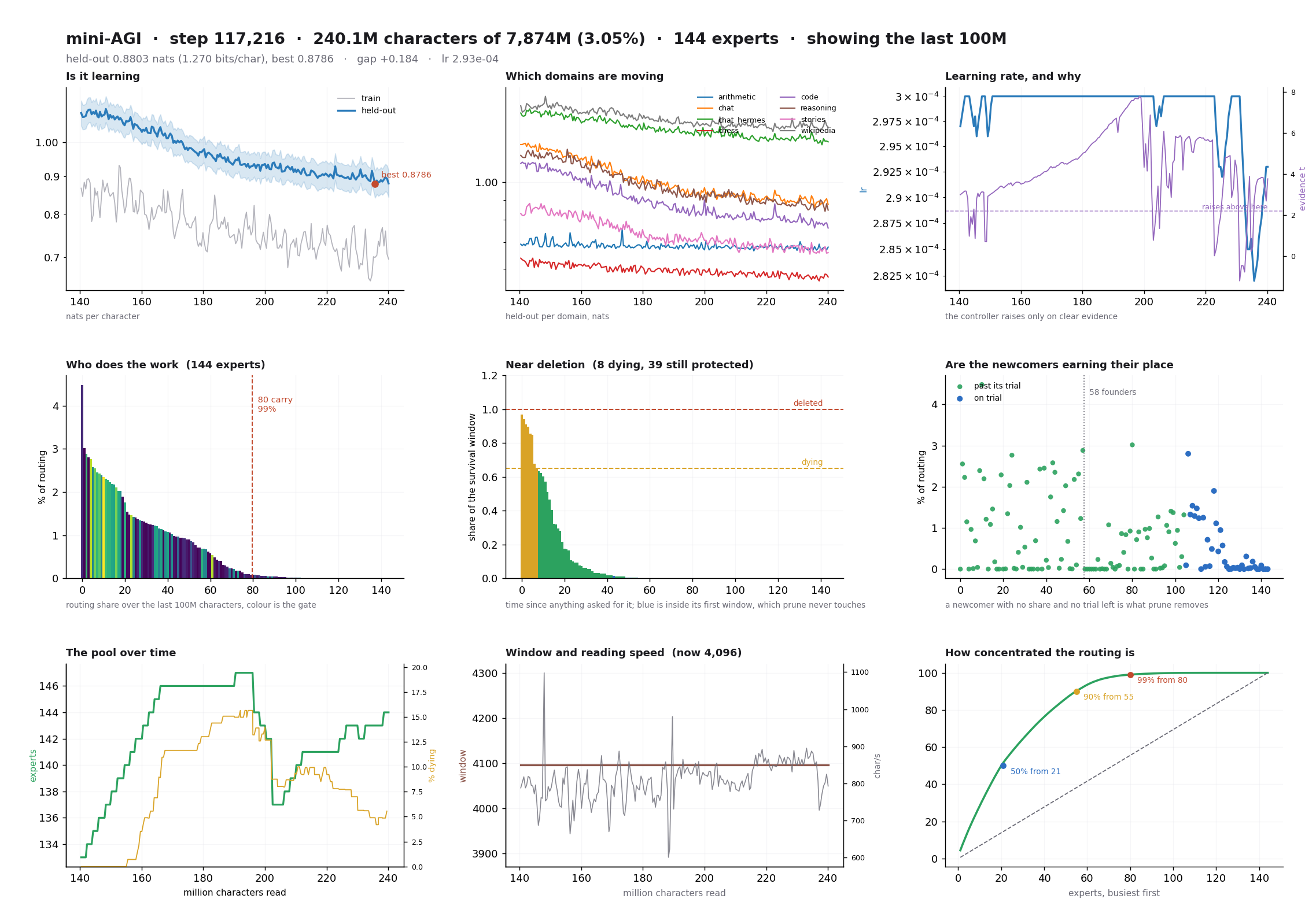
Characters pass through two dense blocks and then one recurrent block that can be applied up to 24 times, with each application picking its own top-8 experts and a halting head deciding when a character has had enough depth. The README’s architecture animation shows that routing live.
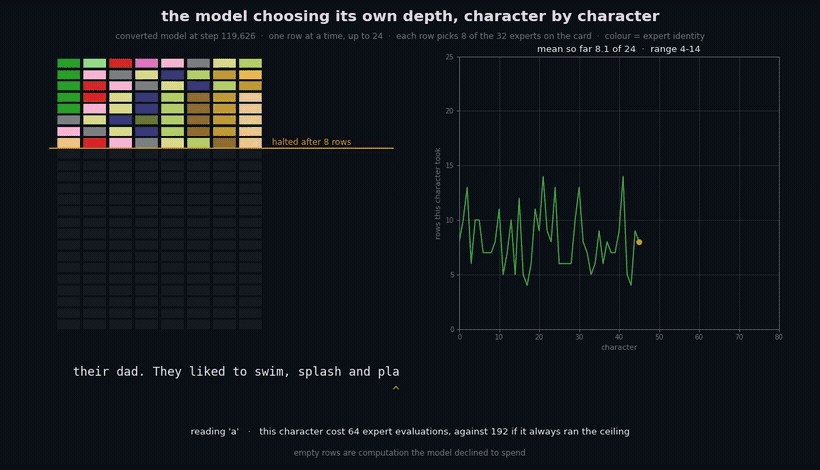
One provenance note matters for everything below. The README’s AI usage section says a Claude model implemented most of the code, and that the animations, graphs, and other media were produced by Claude from the real data traces. The figures in this post are the author’s published charts, reproduced as evidence of what the project reports.
The forgetting probe, and what it proves
The README calls this the measurement the whole design rests on. The model reads 524,000 characters of chess and nothing else, at batch 1, and the project scores what happens to the seven subjects it did not read.
| Configuration, as reported | Unread subjects | Retained vs chance |
|---|---|---|
| Working set frozen, trunk rate = expert rate | +2.5871 nats | 42.88% |
| Swapping, trunk rate = expert rate | +2.2300 nats | 50.68% |
| Swapping, trunk at 0.1x, the run’s setting | +0.0067 nats | 99.84% |
The README is explicit that the expert pool is not what prevents forgetting. Freezing the working set costs only 0.3571 nats, 13.8% of the effect. The mechanism is the trunk learning rate: the trunk carries 97.6% of the squared gradient norm, and running it at a tenth of the experts’ rate is what keeps the unread subjects flat.
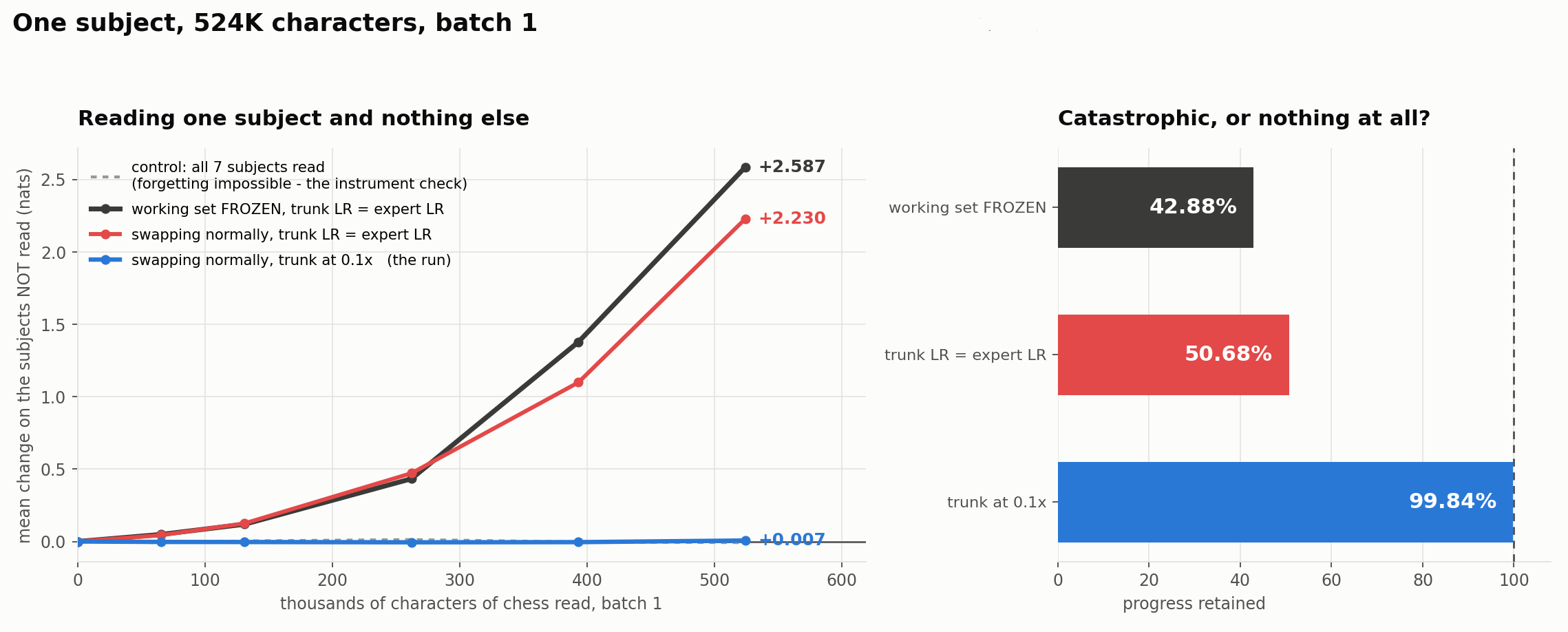
The second chart looks inside the same probe with the trunk at 0.1x. Chess, the subject being read, improves by 0.013 nats, the seven unread subjects stay within ±0.02 nats, and only 54 of 136 experts receive any gradient.
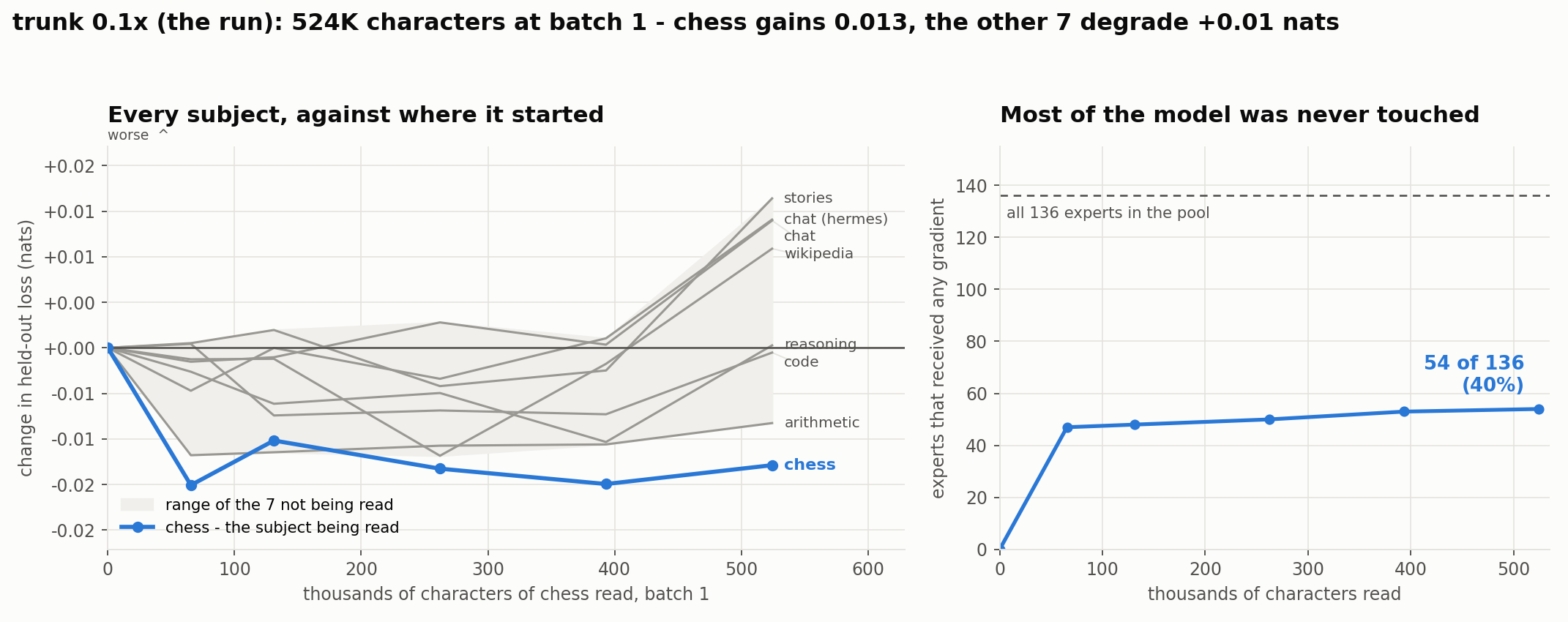
Here is my reading, and it is an interpretation rather than a new measurement. The README’s own Benchmarks section says the same configuration run twice lands about 0.014 apart and tells readers to treat about 0.03 as the threshold for a real difference. By that rule, both numbers from the working configuration, the +0.0067 nats of forgetting and the 0.013-nat chess gain, sit below a real difference. The probe shows that the 0.1x trunk did not forget. It does not, on its own, show how much the model learned from those 524,000 characters. That is the classic stability-versus-plasticity question, and it is still open.
Path 1: the corpus run
The README starts the main run with train.py read data/train --save --weights-dir weights --held-out data/val. The shipped config.yaml sets the trunk to 0.1x, and the read command applies a controller that watches held-out loss and moves the learning rate in both directions. This is the path the probe describes, and it is the one with published numbers.
Path 2: reading your own files
The README’s “Reading your own files” section is the shortest route to a personal model: train.py read ~/notes --save. Its flag table makes two promises that the pinned code does not keep.
First, it says --lr defaults to 5e-5, below a training run. In train.py, the default is read from config.yaml’s training.lr, and 5e-5 is only the fallback when that key is missing. The shipped config sets training.lr to 3.0e-4, and minagi/config.py loads that file from the repository root. So with the repository as published, reading your notes starts from the same base rate as the corpus run unless you pass --lr yourself.
Second, the table lists --mix "" to skip the before/after scoring. The read subcommand defines no --mix argument; only the stream subcommand does. The before/after scoring on read is controlled by --held-out, which defaults to data/val, and it runs only if that folder exists.
When it does run, the check is a good one. read prints a warning when held-out loss after reading exceeds the before value by more than two standard errors, and nothing is saved without --save.
Path 3: chatting with serve.py
The chat server is where the Motivation promise lives, and its docstring is blunt: “IT LEARNS WHILE YOU TALK TO IT, and this CHANGES THE WEIGHTS ON DISK.” The model takes an optimiser step every training.chunk characters of the conversation. Learning is the default: --no-learn is the opt-out, and --learn-lr defaults to 3e-4. The live learner does receive the configured 0.1x trunk multiplier.
The cost is where the file is most candid. minagi/live.py says that learning from a conversation “IS NOT MEASURED IN THE CURRENT REGIME.” In an earlier, denser variant, it cost around +0.65 nats on held-out against +0.02 for real documents of the same length. Whether the cost is still material now is, in the file’s own capitals, UNKNOWN. It also says a smaller learning rate is not the fix, because the model is partly learning from its own output.
I searched both files for a held-out evaluation, revert, or forgetting check. Neither serve.py nor minagi/live.py contains one; the only matches are docstring mentions. So the path the README pitches most warmly is the one path with no measurement and no guard.
What the scaling numbers can tell you
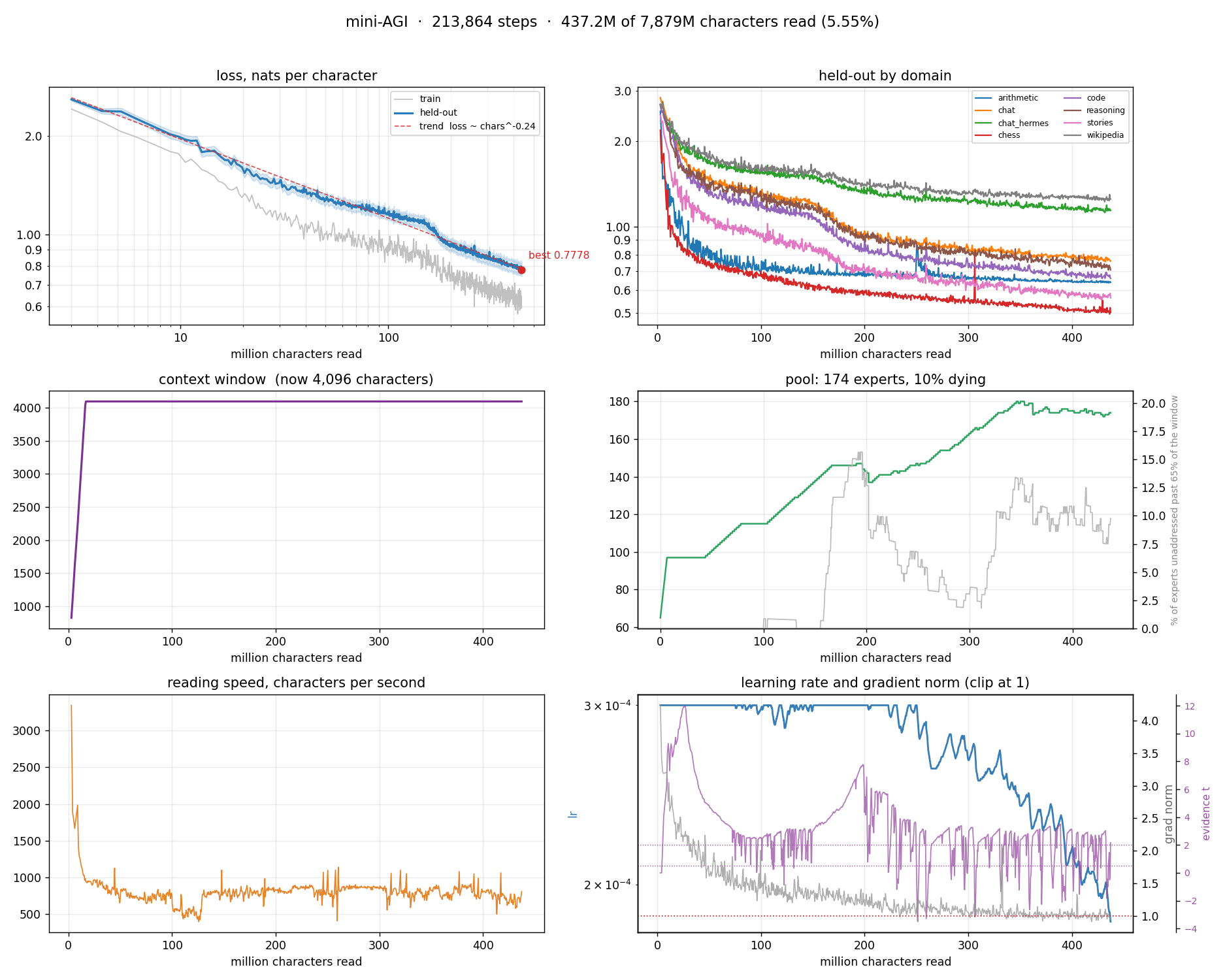
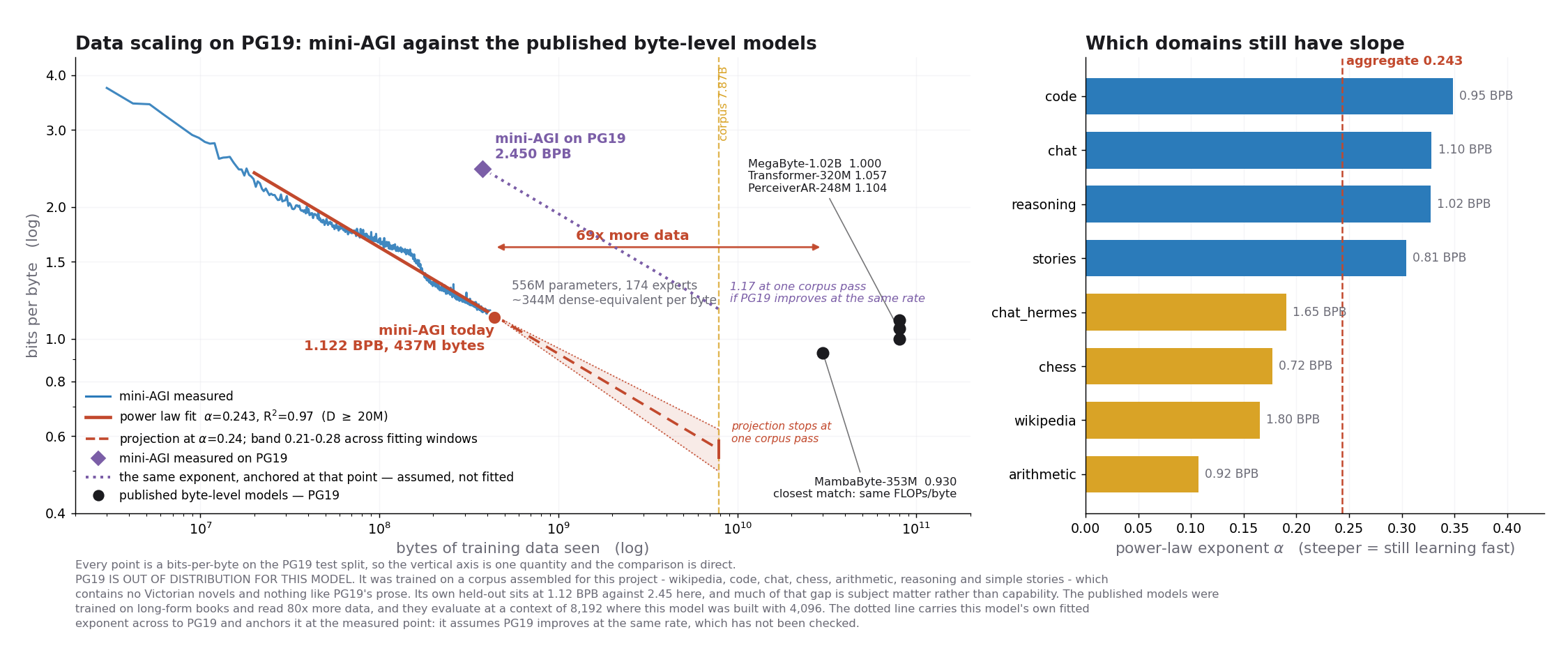
The README reports 2.450 bits per byte on the PG19 test split, a fitted power law of L ∝ D^-0.243 with R² 0.97 on its own held-out data, and a reading rate of about 804 characters per second at 437.2M characters read. The days-to-target table built on that fit is a forecast from one ongoing run, and the author presents it as such.
Key Takeaways: Treat each learning path as its own claim
The useful move is to stop reading “continual learning without forgetting” as one property of the model. In mini-AGI it is three paths with three evidence levels.
| Path | Default as shipped | Evidence in the repository |
|---|---|---|
Corpus run (train.py read data/train) | trunk at 0.1x, rate steered by held-out loss | published chess probe and benchmarks |
Your files (train.py read ~/notes --save) | rate 3.0e-4 from config, not the documented 5e-5 | per-read check, only if data/val exists |
Chat (serve.py) | learning on, rate 3e-4, writes to disk | none; the code calls the cost unknown |
If I were wiring this into a personal assistant or a studio tool today, I would start from that table:
- Serve with
--no-learnuntil chat learning has its own held-out readout. The code itself says the cost is unknown. - Pass
--lrexplicitly when reading your own files, for example the 5e-5 the README intends, and point--held-outat a folder that actually exists. - Copy the weights directory before any
--save. The README says the directory is the model, so a copy is your only undo. - Score held-out loss after every learning session, and treat changes smaller than 0.03 as noise, as the README advises.
- Keep product memory outside the weights until the chat path is measured.
None of this argues against the project. It argues for measuring the chat path with the same care the author gave the corpus path.
🎯 Key Takeaways
- mini-AGI’s no-forgetting result is a corpus-reading probe: 524,000 characters of chess moved the seven unread subjects by +0.0067 nats with the trunk at 0.1x.
- By the README’s own 0.03 threshold, that probe also shows only a 0.013-nat gain on the subject being read, so how much the model learns during such a read is still open.
serve.pylearns from chat by default and writes weights to disk, whileminagi/live.pysays that cost is not measured and neither file has a held-out check.- The personal-file path runs at 3.0e-4 under the shipped config, not the README’s 5e-5, and the README’s
--mix ""flag does not exist onread. - For a personal or studio assistant, serve read-only, set
--lrexplicitly, keep a real held-out folder, and back up the weights directory before saving.
Limitations and trade-offs
- I read the code and the README at one commit. I did not train, serve, or chat with the model, and the weights are not published.
- The probe numbers and charts are the author’s self-reported results from one run.
- Applying the README’s 0.03 rule to within-run probe deltas is my interpretation; a within-run comparison may have less noise than two separate runs.
- The repository is days old and changing quickly, so these defaults may change after the pinned commit.
🤔 New Questions
- What does an hour of chat do to held-out loss under the current streaming regime, compared with the +0.65 nats of the earlier variant?
- Can the forgetting probe be rerun with the trunk at 0.2x or 0.3x to map how much learning the 0.1x setting gives up?
- Should the chat server refuse to save when held-out loss rises beyond the noise floor, the way
readalready warns? - For a studio assistant, is a slowly learning local model better than a frozen model with a growing external memory?
References
Primary repository evidence
Working on something like this?
I take a small number of paid, scoped reviews: AI agent/RAG architecture diagnosis, Unity CI & build-automation audits, and multimodal QA design review. Each one ends in a written findings document.
Work with me