RAG/Search
What is a RAG?
Curiosity: What is a RAG? How can we retrieve knowledge from external sources and augment LLM responses to create more accurate, context-aware answers…
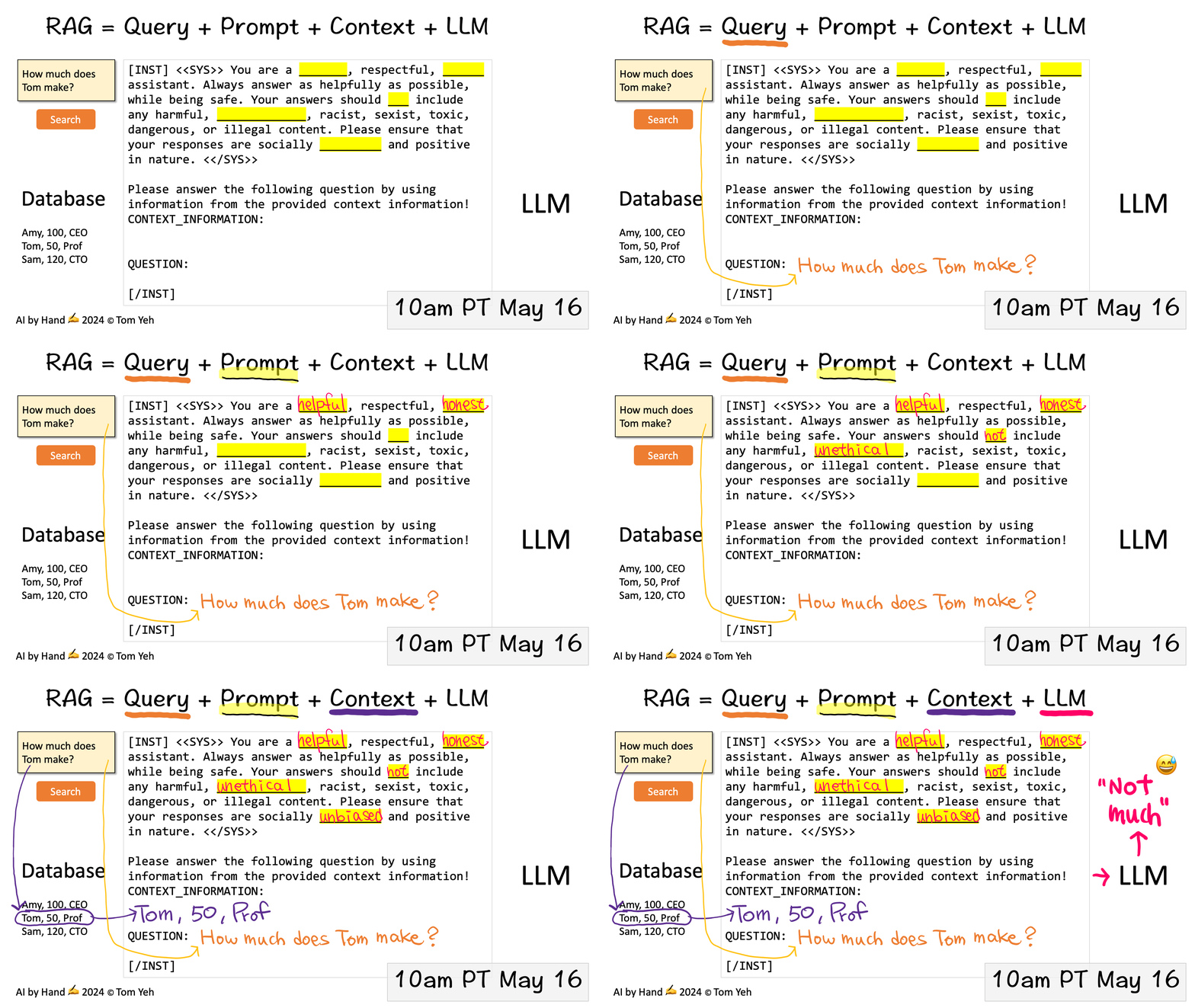
RAG = Query + Prompt + Context + LLM
Curiosity: What is a RAG? How can we retrieve knowledge from external sources and augment LLM responses to create more accurate, context-aware answers?
Retrieval-Augmented Generation (RAG) is a powerful technique that combines the best of information retrieval and language generation. This simple equation captures the essence of RAG: Query + Prompt + Context + LLM = Enhanced Response.
Understanding the RAG Equation
graph TB
    A[User Query] --> B[Query Processing]
    B --> C[Vector Search]
    C --> D[Retrieve Relevant Context]
    D --> E[Augment Prompt]
    E --> F[LLM Generation]
    F --> G[Enhanced Response]

    H[Knowledge Base] --> C
    I[Embedding Model] --> C

    style A fill:#e1f5ff
    style D fill:#fff3cd
    style F fill:#d4edda
    style G fill:#f8d7da
RAG Components Breakdown
| Component | Purpose | Key Technologies |
|---|---|---|
| Query | User’s information need | Natural language processing, query expansion |
| Prompt | Instructions for LLM | System prompts, few-shot examples, templates |
| Context | Retrieved relevant information | Vector databases, embedding models, similarity search |
| LLM | Text generation | GPT-4, Claude, Llama, Mistral |
Core RAG Workflow
The RAG process consists of several critical steps:
1. Indexing Phase (Offline)
1
2
3
4
5
6
7
8
9
10
11
12
13
14
15
16
17
18
19
20
from langchain.text_splitter import RecursiveCharacterTextSplitter
from langchain.embeddings import OpenAIEmbeddings
from langchain.vectorstores import Chroma

# Step 1: Load documents
documents = load_documents("knowledge_base/")

# Step 2: Split into chunks
text_splitter = RecursiveCharacterTextSplitter(
    chunk_size=1000,
    chunk_overlap=200
)
chunks = text_splitter.split_documents(documents)

# Step 3: Create embeddings
embeddings = OpenAIEmbeddings()
vectorstore = Chroma.from_documents(
    documents=chunks,
    embedding=embeddings
)
2. Retrieval Phase (Online)
1
2
3
4
# Step 4: Retrieve relevant context
query = "What is RAG?"
retriever = vectorstore.as_retriever(search_kwargs={"k": 3})
relevant_docs = retriever.get_relevant_documents(query)
3. Augmentation Phase
1
2
3
4
5
6
7
8
9
10
# Step 5: Augment prompt with context
context = "\n\n".join([doc.page_content for doc in relevant_docs])
augmented_prompt = f"""Use the following context to answer the question.

Context:
{context}

Question: {query}

Answer:"""
4. Generation Phase
1
2
3
4
5
6
# Step 6: Generate response
from langchain.llms import OpenAI

llm = OpenAI(temperature=0)
response = llm(augmented_prompt)
print(response)
Key Concepts in RAG
Indexing
- Purpose: Prepare knowledge base for efficient retrieval
- Process: Document loading → Chunking → Embedding → Storage
- Tools: LangChain, LlamaIndex, Haystack
Loading
- Sources: PDFs, web pages, databases, APIs
- Formats: Text, markdown, structured data
- Considerations: Data quality, format consistency
Splitting
- Strategies: Character-based, sentence-based, semantic
- Chunk Size: Balance between context and precision (typically 200-1000 tokens)
- Overlap: Maintain context continuity (typically 10-20% overlap)
Embedding
- Models: OpenAI
text-embedding-ada-002, Sentence Transformers, Cohere - Dimensions: 384, 768, 1536 (model-dependent)
- Evaluation: MTEB Leaderboard, domain-specific benchmarks
Storing
- Vector Databases: Pinecone, Weaviate, Chroma, Qdrant, SingleStore
- Features: Similarity search, filtering, metadata storage
- Scalability: Horizontal scaling, distributed search
Retrieval
- Methods: Dense retrieval, sparse retrieval, hybrid search
- Metrics: Cosine similarity, dot product, Euclidean distance
- Optimization: Re-ranking, query expansion, multi-query
Augmentation
- Techniques: Context injection, prompt engineering, few-shot examples
- Best Practices: Clear separation of context and query, structured prompts
Generation
- Models: GPT-4, Claude, Llama, Mistral
- Parameters: Temperature, max_tokens, top_p
- Optimization: Streaming, caching, parallel generation
Advanced RAG Techniques
Multi-Query Retrieval
1
2
3
4
5
6
7
8
9
10
from langchain.retrievers.multi_query import MultiQueryRetriever

# Generate multiple query variations
retriever = MultiQueryRetriever.from_llm(
    retriever=vectorstore.as_retriever(),
    llm=OpenAI()
)

# Retrieve diverse perspectives
docs = retriever.get_relevant_documents(query)
Contextual Compression
1
2
3
4
5
6
7
8
9
from langchain.retrievers import ContextualCompressionRetriever
from langchain.retrievers.document_compressors import LLMChainExtractor

# Compress retrieved documents to most relevant parts
compressor = LLMChainExtractor.from_llm(OpenAI())
compression_retriever = ContextualCompressionRetriever(
    base_compressor=compressor,
    base_retriever=vectorstore.as_retriever()
)
RAG vs. Fine-tuning Comparison
| Aspect | RAG | Fine-tuning |
|---|---|---|
| Knowledge Update | ✅ Real-time | ❌ Requires retraining |
| Source Attribution | ✅ Yes | ❌ No |
| Cost | 💰 Lower (API calls) | 💰💰 Higher (training) |
| Domain Adaptation | ⚠️ Limited | ✅ Strong |
| Hallucination | ⚠️ Possible | ⚠️ Possible |
| Best For | Dynamic knowledge, citations | Style, format, domain expertise |
Tools and Resources
| Tool | Purpose | Link |
|---|---|---|
| SingleStore | Vector database with SQL interface | SingleStore |
| LlamaIndex | Data framework for LLM applications | LlamaIndex |
| Superlinked | Vector database API | Superlinked |
| MTEB Leaderboard | Embedding model benchmarks | Hugging Face MTEB |
| LangChain | LLM application framework | LangChain |
Webinar Information
On May 16th, Thursday, I gave a webinar covering these concepts in depth:
Hosts: Matt Brown, Akmal Chaudhri, Esq.
The webinar covered:
- Mathematical foundations of RAG
- Practical implementation examples
- Advanced techniques and optimizations
- Real-world use cases and best practices
RSVP: https://by-hand.ai/rag
Key Takeaways
Retrieve: RAG enables LLMs to access up-to-date, domain-specific information without retraining.
Innovate: By combining retrieval and generation, we can build systems that are both knowledgeable and flexible.
Curiosity → Retrieve → Innovation: The RAG workflow embodies this cycle—curiosity drives the query, retrieval brings relevant knowledge, and innovation emerges from the augmented generation.
Translate to Korean
RAG = 쿼리 + 프롬프트 + 컨텍스트 + LLM ~ RSVP 👉 https://by-hand.ai/rag
RAG란 무엇입니까? 이것은 RAG가 무엇인지에 대한 이해를 개념화하기 위해 생각해 낸 간단한 방정식입니다.
5월 16일 목요일에는 웨비나를 진행합니다.
RAG 초보자 가이드
제 RAG 방정식에 대한 설명을 듣고 싶으시면 웨비나에 참여하십시오. RSVP 링크는 위에 있습니다.
해시태그#rag 해시태그#vectordatabases 해시태그#aibyhand
–개념–
RAG 방정식과 관련된 주요 개념을 다루겠습니다.
•인덱싱 •로드 •분할 •포함 •저장 •검색 •확대 •세대
시간이 허락한다면 다음과 같은 고급 기술에 대해 이야기 할 수 있습니다.
• 다중 쿼리 • 상황별 압축
–수학–
항상 그렇듯이 제 웨비나에서 수학을 기대해야 합니다. 그러나 수학은 재미있고, 접근하기 쉬우며, 유용할 것이라고 장담합니다.
–도구–
다음과 같은 다양한 유용한 도구에 대한 예를 포함하겠습니다. SingleStore LlamaIndex Superlinked 의 API Hugging Face 의 MTEB 리더보드