RAG/Search
EdgeQuake: Graph‑RAG in Rust for Production‑Grade Retrieval
A detailed look at EdgeQuake, a high‑performance Graph‑RAG framework built in Rust—knowledge graphs, multi‑mode querying, and why it matters for real‑world agent stacks.
🤔 Curiosity: Why do graph‑aware RAG stacks keep winning?
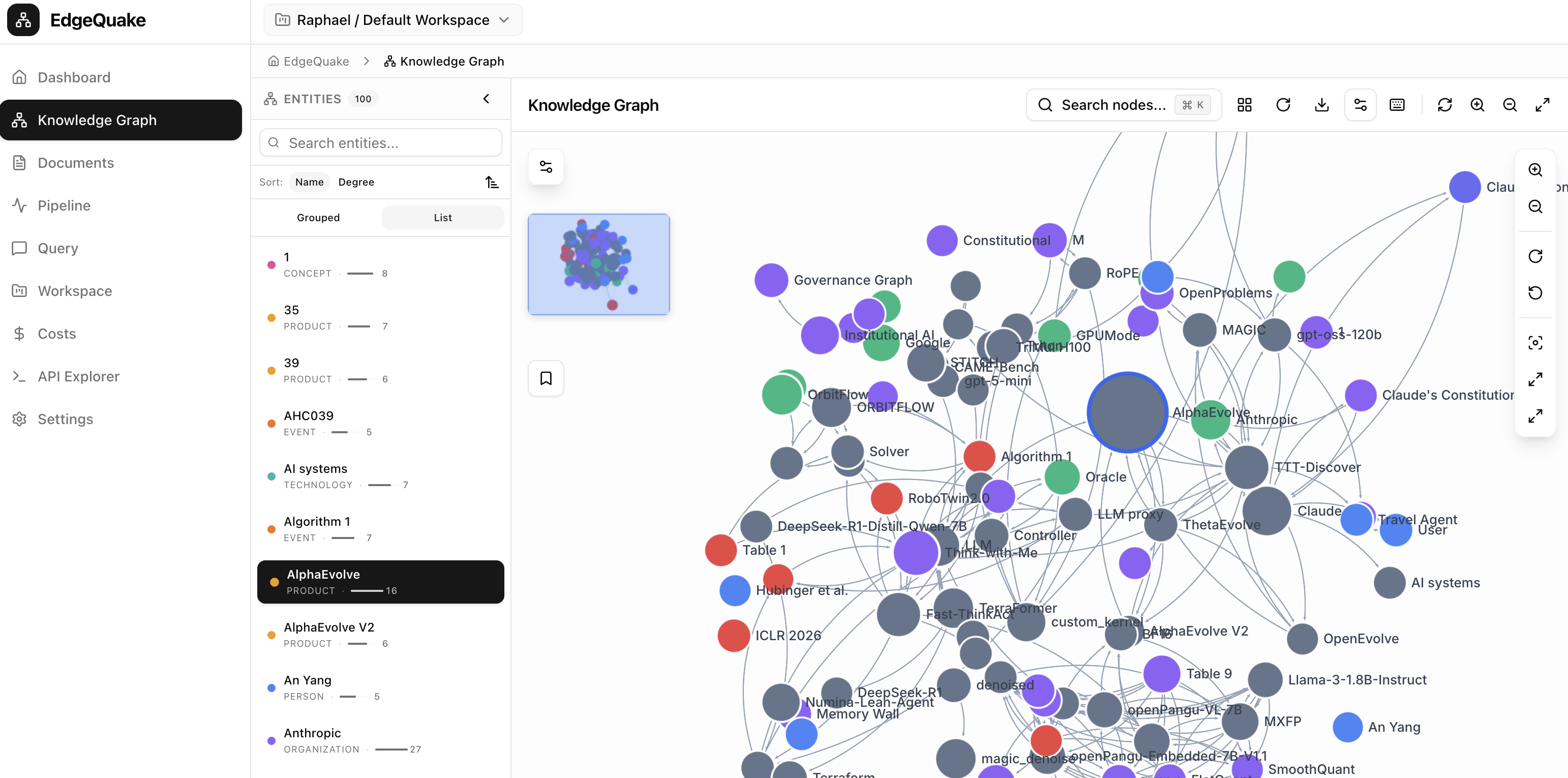
In production RAG, I keep running into the same wall: vector similarity alone struggles with multi‑hop reasoning—“how does X relate to Y through Z?” EdgeQuake positions itself as a Graph‑RAG engine that keeps the structure of the document, not just its semantics. That immediately maps to how we build systems in games: relationships matter as much as facts.
📚 Retrieve: What EdgeQuake ships
EdgeQuake is a high‑performance Graph‑RAG framework in Rust that implements the LightRAG algorithm. The core idea is simple but powerful: extract a knowledge graph during ingestion, then query that graph in addition to vector space.
Key capabilities (from the repo)
- Knowledge Graph Extraction (entities + relationships)
- 6 Query Modes (naive → local → global → hybrid → mix → bypass)
- Rust performance (Tokio async + zero‑copy design)
- REST API + SSE streaming (OpenAPI 3.0)
- React 19 UI with Sigma.js graph visualization
- MCP integration for agent tooling




📚 Retrieve: How the LightRAG pipeline works
Minimal API usage (ingest + query)
1
2
3
4
5
6
7
8
9
10
11
# Upload a document
curl -X POST http://localhost:8080/api/v1/documents/upload \
  -F "file=@your-document.pdf"

# Query the system
curl -X POST http://localhost:8080/api/v1/query \
  -H "Content-Type: application/json" \
  -d '{
    "query": "What are the main concepts?",
    "mode": "hybrid"
  }'
The ingestion pipeline (as described in README) is essentially:
1) Chunk documents 2) Extract entities/relationships with LLMs 3) Glean (multi‑pass extraction for recall) 4) Normalize entities (dedup) 5) Embed chunks/entities 6) Store in graph + vector backends (AGE + pgvector)
And at query time, you can pick modes depending on the question:
| Mode | Best for | Behavior |
|---|---|---|
| Naive | keyword‑like lookups | vector similarity only |
| Local | specific relationships | entity neighborhood traversal |
| Global | themes | community summaries |
| Hybrid | balanced | combines local + global |
| Mix | controlled weighting | blend naive + graph |
| Bypass | general queries | LLM only |
flowchart LR
  A[Document] --> B[Chunking]
  B --> C[LLM Entity Relation Extraction]
  C --> D[Gleaning Pass]
  D --> E[Entity Normalization]
  E --> F[Graph Store AGE]
  E --> G[Vector Store pgvector]
  H[User Query] --> I{Query Mode}
  I --> J[Graph Traversal]
  I --> K[Vector Search]
  J --> L[Hybrid Merge]
  K --> L
  L --> M[LLM Answer]
💡 Innovation: Why this matters for game‑scale RAG
1) Graph‑first retrieval matches game design
In narrative systems, relationships are the content. If we retrieve only by semantic similarity, we miss the why behind a fact. Graph‑RAG lets us answer:
- “Which factions influence this NPC?”
- “What events led to the quest chain?”
2) Multi‑mode querying is production leverage
I love that EdgeQuake exposes multiple query modes. We can map modes to UX flows:
| UX Flow | Query Mode | Rationale |
|---|---|---|
| Quick FAQ | Naive | speed > depth |
| World‑lore | Global | thematic coverage |
| Quest chain | Local | relationships matter |
| GM tools | Hybrid | balanced recall |
3) MCP makes it agent‑ready
EdgeQuake ships an MCP server. That’s immediate plug‑in to agent workflows without writing glue code.
💡 Innovation: What I’d ship first
1) Internal lore QA tool using Hybrid queries 2) Live‑ops incident debugger with graph traversal (root‑cause explanation) 3) Narrative consistency checker to validate quests against lore graph
Practical evaluation checklist
- Graph extraction quality (precision/recall)
- Query latency under load
- Memory footprint per doc
- Hybrid query gains vs naive
References
Code & Docs
- Repo: https://github.com/raphaelmansuy/edgequake
- LightRAG paper: https://arxiv.org/abs/2410.05779
- Docs index: https://github.com/raphaelmansuy/edgequake/tree/edgequake-main/docs
MCP
- MCP: https://modelcontextprotocol.io/