RAG/Search
Zvec: The SQLite Moment for Vector Databases
Alibaba’s Zvec is an in‑process vector database built on Proxima—fast, lightweight, and perfect for local RAG and edge agents. Here’s why it matters for production.
🤔 Curiosity: Do we really need a server for every RAG?
Every RAG stack I’ve built eventually asked the same question: why are we spinning up a full vector database service just to search a few thousand vectors? We don’t deploy Postgres when SQLite is enough—and Zvec feels like that moment for vector search.
Zvec is an in‑process vector database built on Alibaba’s Proxima engine. It runs inside your app, persists to disk, and removes the “deploy a vector DB first” tax. If you’re shipping agents, offline tools, or privacy‑first pipelines, that’s a big deal.
📚 Retrieve: What Zvec actually ships
Key Features (from the repo)
- Blazing Fast: Searches billions of vectors in milliseconds.
- Simple, Just Works:
pip install zvecand go. - Dense + Sparse Vectors: One API handles both.
- Hybrid Search: Combine semantic similarity with structured filters.
- Runs Anywhere: In‑process for notebooks, servers, edge devices.



One‑Minute Example
1
2
3
4
5
6
7
8
9
10
11
12
13
14
15
16
17
18
19
20
import zvec

schema = zvec.CollectionSchema(
    name="example",
    vectors=zvec.VectorSchema("embedding", zvec.DataType.VECTOR_FP32, 4),
)

collection = zvec.create_and_open(path="./zvec_example", schema=schema)

collection.insert([
    zvec.Doc(id="doc_1", vectors={"embedding": [0.1, 0.2, 0.3, 0.4]}),
    zvec.Doc(id="doc_2", vectors={"embedding": [0.2, 0.3, 0.4, 0.1]}),
])

results = collection.query(
    zvec.VectorQuery("embedding", vector=[0.4, 0.3, 0.3, 0.1]),
    topk=10
)

print(results)
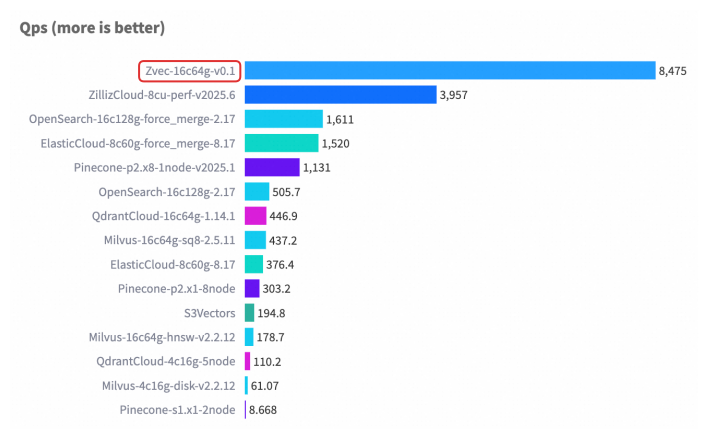
Performance at scale
📚 Retrieve: Why this is a big deal for games & agents
I see three production‑grade implications immediately:
1) Local RAG by default – no extra infra or network hops. 2) Edge & offline support – works on dev machines, kiosks, or devices with no outbound access. 3) Privacy‑first retrieval – embeddings never leave the machine.
Here’s a pragmatic retrieval stack that actually fits most game tools:
flowchart LR
  A[Input Query] --> B[Dense Retrieval]
  A --> C[Sparse Retrieval]
  B --> D[Merge TopK]
  C --> D
  D --> E[Cross Encoder Rerank]
  E --> F[LLM Generation]
💡 Innovation: The SQLite analogy is real
The analogy holds because Zvec doesn’t try to replace Milvus/Qdrant. It shrinks the default so that simple pipelines can ship without infrastructure debt.
Where I would deploy Zvec first
| Use Case | Why Zvec Works | Production Win |
|---|---|---|
| On‑device RAG | In‑process + persistence | No server, no latency |
| Internal tooling | Simple API | Faster prototypes |
| Edge agents | Runs anywhere | Offline fallback |
| Privacy‑first apps | Local retrieval | Compliance wins |
What I’d evaluate before shipping
- Index build time vs. update rate
- Memory footprint & warm‑cache behavior
- Hybrid scoring quality with your metadata
- Reranker gains vs. baseline top‑K
Key Takeaways
| Insight | Implication | Next Step |
|---|---|---|
| Zvec removes infra tax | RAG becomes a library call | Ship local RAG first |
| Hybrid search is native | Better recall for rare tokens | Add sparse vectors early |
| In‑process changes UX | Latency drops massively | Design for sub‑100ms search |
New Questions I’m Asking
- How does Zvec scale in a multi‑process game server?
- What’s the optimal hybrid weighting for player‑authored content?
- Can we use it as a hot‑cache layer in front of a larger vector DB?
References
Code & Docs
- Zvec GitHub: https://github.com/alibaba/zvec
- Zvec Docs: https://zvec.org/en/docs/
- Zvec Benchmarks: https://zvec.org/en/docs/benchmarks/
Installation
- PyPI: https://pypi.org/project/zvec/
- NPM: https://www.npmjs.com/package/@zvec/zvec