Review/Trends
Federated Learning, One way to solve for AI having difficulty making
Curiosity: How can we train ML models on private data without centralizing it?
Federated Learning: Training on Private Data Without Centralization
Curiosity: How can we train ML models on private data without centralizing it? What happens when we bring the model to the data instead of bringing data to the model?
One of the main factors preventing AI adoption in healthcare and banking is data privacy requirements. Hospitals and banks are reluctant to share sensitive data. Federated Learning solves this by training models on distributed data without centralization.
The Challenge
Retrieve: Why data privacy blocks AI adoption.
Problem:
- Healthcare and banking require strict data privacy
- Regulations make data sharing risky
- Benefits don’t outweigh risks
- Models can’t access training data
Impact: AI struggles to enter regulated industries.
Federated Learning Solution
Innovate: Bringing models to data instead of data to models.
Key Concept: Instead of bringing data to the model, bring the model to the data.
Real-World Examples:
- Google’s query suggestions on Android (Gboard)
- Self-driving car continuous training
- Healthcare model training
- Banking fraud detection
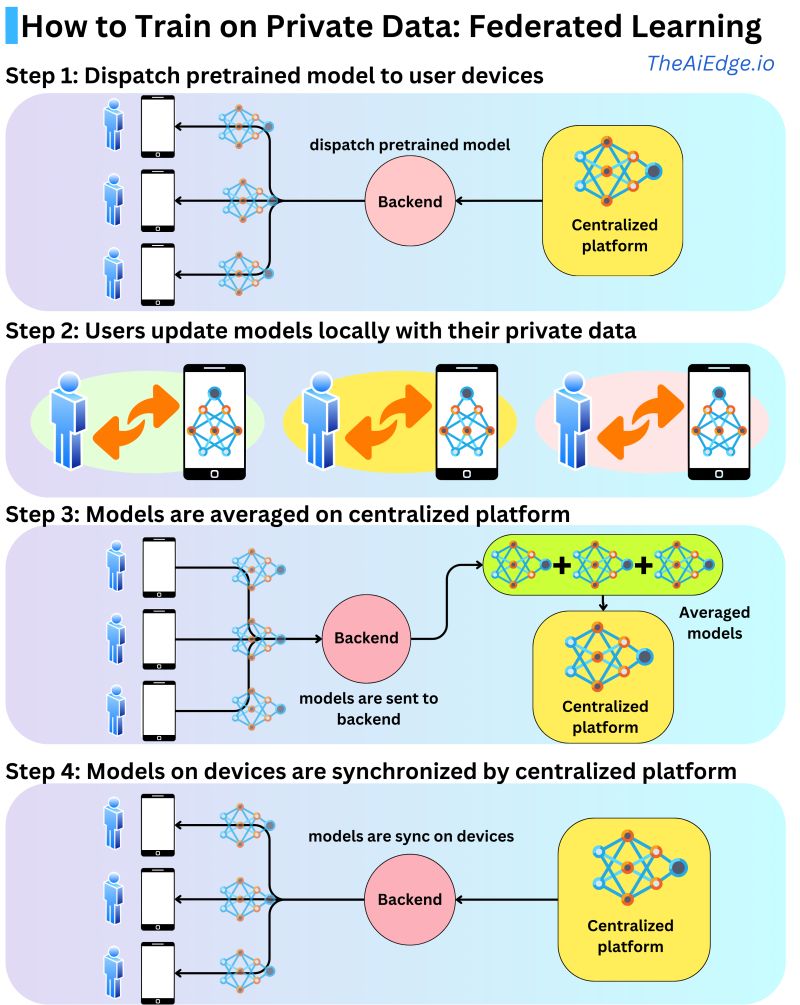
Federated Learning Process
Retrieve: How federated learning works.
graph TB
    A[Central Server] --> B[Pre-trained Model]
    B --> C[Device 1]
    B --> D[Device 2]
    B --> E[Device N]

    C --> F[Local Training]
    D --> G[Local Training]
    E --> H[Local Training]

    F --> I[Gradients/Model]
    G --> I
    H --> I

    I --> J[Aggregation]
    J --> K[Updated Model]
    K --> A

    style A fill:#e1f5ff
    style F fill:#fff3cd
    style K fill:#d4edda
Step-by-Step Process
Retrieve: Detailed federated learning workflow.
| Step | Process | Purpose |
|---|---|---|
| 1. Pre-training | Central server pre-trains model | ⬆️ Initial model |
| 2. Distribution | Send model to user devices | ⬆️ Local deployment |
| 3. Local Training | Users interact, model fine-tunes locally | ⬆️ Privacy-preserving |
| 4. Aggregation | Send gradients/models back to server | ⬆️ Centralized learning |
| 5. Averaging | Average updates into one model | ⬆️ Global improvement |
| 6. Synchronization | Sync updated model to devices | ⬆️ Continuous learning |
Key Benefit: Train on data from millions of users without ever storing the data.
Advantages
Innovate: Why federated learning matters.
| Advantage | Description | Impact |
|---|---|---|
| Privacy | Data never leaves devices | ⬆️ Compliance |
| Regulation | Meets privacy requirements | ⬆️ Adoption |
| Scale | Millions of users | ⬆️ Training data |
| Efficiency | Distributed training | ⬆️ Resource use |
Industry Adoption
Retrieve: Growing trend in federated learning.
Trend: With increasing data regulations, federated learning usage is growing.
Major Investors:
- Google: Significant investment in federated learning
- Meta: Developing federated learning technology
Applications:
- Healthcare (patient data privacy)
- Banking (financial data protection)
- Mobile devices (on-device learning)
- IoT (edge device training)
Resources
Retrieve: Tools and frameworks for federated learning.
Resources:
- Google Federated Learning: https://federated.withgoogle.com/
- TensorFlow Federated: https://www.tensorflow.org/federated/federated_learning
- OpenFL: https://github.com/securefederatedai/openfl
Key Takeaways
Retrieve: Federated learning enables training on private data by bringing models to data sources instead of centralizing data, solving privacy challenges in regulated industries.
Innovate: By implementing federated learning, you can train models on data from millions of users without storing or centralizing sensitive data, enabling AI adoption in healthcare, banking, and other privacy-sensitive domains.
Curiosity → Retrieve → Innovation: Start with curiosity about privacy-preserving ML, retrieve insights from federated learning approaches, and innovate by implementing distributed training that respects data privacy regulations.
Next Steps:
- Explore TensorFlow Federated
- Try OpenFL
- Design federated architecture
- Deploy federated systems
- Here is the dedicated page just for federated learning from Google: 👉 https://federated.withgoogle.com/
- TensorFlow was one of the first to provide a high-level framework for federated learning: 👉 https://www.tensorflow.org/federated/federated_learning?hl=ko.
- OpenFL is also another open-source project: 👉 https://github.com/securefederatedai/openfl