Agent/Orchestration
🤖 If you're looking to build agentic GenAI applications
Curiosity: How do we design agentic GenAI applications? What patterns enable agents to think, plan, and collaborate effectively?
Agentic Application Design Patterns: Building Intelligent AI Systems
Curiosity: How do we design agentic GenAI applications? What patterns enable agents to think, plan, and collaborate effectively?
Agentic AI is evolving rapidly, opening possibilities for a new paradigm of applications. When developing agentic applications, choosing the right design patterns is crucial for success.
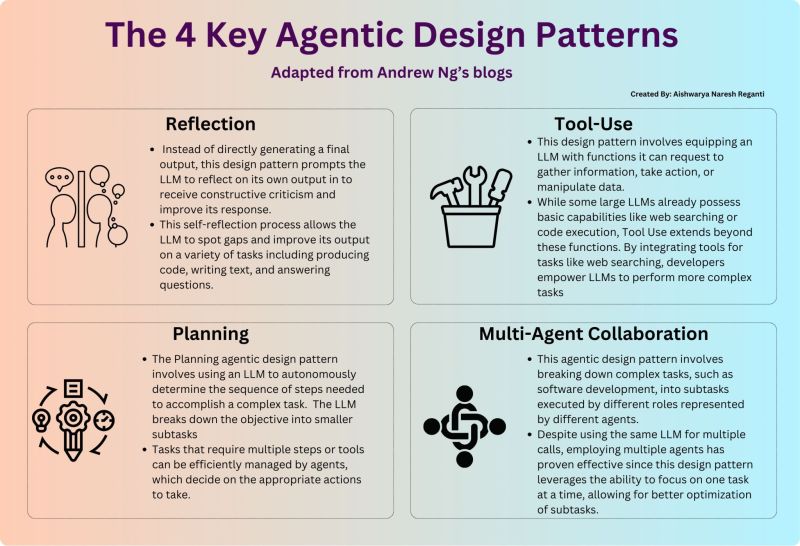
Design Patterns Overview
graph TB
    A[Agentic Design Patterns] --> B[Reflection]
    A --> C[Tool Use]
    A --> D[Planning]
    A --> E[Multi-Agent Collaboration]

    B --> B1[Self-Review]
    B --> B2[Improvement]

    C --> C1[Web Search]
    C --> C2[Code Execution]
    C --> C3[Functions]

    D --> D1[Multi-Step Plans]
    D --> D2[Goal Achievement]

    E --> E1[Task Division]
    E --> E2[Collaboration]

    style A fill:#e1f5ff
    style B fill:#fff3cd
    style C fill:#d4edda
    style D fill:#f8d7da
    style E fill:#e7d4f8
The 4 Key Design Patterns
| Pattern | Description | Use Case | Complexity |
|---|---|---|---|
| Reflection | LLM reviews its own work | Quality improvement | ⭐ Low |
| Tool Use | LLM equipped with tools | Information gathering | ⭐⭐ Medium |
| Planning | Multi-step plan execution | Complex tasks | ⭐⭐⭐ High |
| Multi-Agent | Multiple agents collaborate | Large-scale problems | ⭐⭐⭐⭐ Very High |
1. Reflection Pattern
Retrieve: The LLM reviews its own work to identify ways to improve.
How It Works:
- Agent generates initial output
- Reviews and critiques its own work
- Identifies improvements
- Refines output
Architecture:
graph LR
    A[Input] --> B[Generate Output]
    B --> C[Review Output]
    C --> D{Needs<br/>Improvement?}
    D -->|Yes| B
    D -->|No| E[Final Output]

    style B fill:#e1f5ff
    style C fill:#fff3cd
    style E fill:#d4edda
Example:
1
2
3
4
5
6
7
8
9
10
11
12
13
14
15
16
17
# Reflection pattern
def reflection_agent(query):
    # Initial generation
    output = llm.generate(query)

    # Review
    critique = llm.generate(
        f"Review this output and suggest improvements:\n{output}"
    )

    # Refine if needed
    if "improve" in critique.lower():
        output = llm.generate(
            f"Original: {output}\nImprovements: {critique}\nGenerate improved version"
        )

    return output
Benefits:
- ✅ Self-improvement
- ✅ Quality enhancement
- ✅ Error correction
- ✅ Iterative refinement
Article: Reflection Pattern
2. Tool Use Pattern
Innovate: The LLM is equipped with tools to gather information, take action, or process data.
Tools Available:
- 🔍 Web search
- 💻 Code execution
- 📊 Data processing
- 🔧 API calls
- 📁 File operations
Architecture:
graph TB
    A[User Query] --> B[Agent]
    B --> C{Need Tool?}
    C -->|Yes| D[Select Tool]
    D --> E[Execute Tool]
    E --> F[Process Result]
    F --> B
    C -->|No| G[Generate Response]

    style B fill:#e1f5ff
    style D fill:#fff3cd
    style G fill:#d4edda
Example:
1
2
3
4
5
6
7
8
9
10
11
12
13
14
15
16
17
18
19
# Tool use pattern
tools = {
    "web_search": web_search_tool,
    "code_exec": code_execution_tool,
    "calculator": calculator_tool
}

def tool_use_agent(query):
    # Agent decides which tools to use
    tool_selection = llm.select_tools(query, available_tools=tools)

    results = []
    for tool_name in tool_selection:
        tool = tools[tool_name]
        result = tool.execute(query)
        results.append(result)

    # Generate response using tool results
    return llm.generate(query, context=results)
Benefits:
- ✅ Extended capabilities
- ✅ Real-time information
- ✅ Action execution
- ✅ Data processing
Article: Tool Use Pattern
3. Planning Pattern
Retrieve: The LLM devises and follows a multi-step plan to achieve a goal.
Process:
- Analyze goal
- Create step-by-step plan
- Execute plan steps
- Monitor progress
- Adjust if needed
Architecture:
graph TB
    A[Goal] --> B[Create Plan]
    B --> C[Step 1]
    C --> D[Step 2]
    D --> E[Step N]
    E --> F{Goal<br/>Achieved?}
    F -->|No| B
    F -->|Yes| G[Complete]

    style A fill:#e1f5ff
    style B fill:#fff3cd
    style G fill:#d4edda
Example:
1
2
3
4
5
6
7
8
9
10
11
12
13
14
15
16
17
18
19
20
# Planning pattern
def planning_agent(goal):
    # Create plan
    plan = llm.generate(
        f"Create a step-by-step plan to achieve: {goal}"
    )

    steps = parse_plan(plan)

    # Execute plan
    results = []
    for step in steps:
        result = llm.execute_step(step, context=results)
        results.append(result)

        # Check if goal achieved
        if check_goal_achieved(goal, results):
            break

    return compile_results(results)
Use Cases:
- Essay writing (outline → research → draft)
- Complex problem solving
- Multi-step workflows
- Project management
Article: Planning Pattern
4. Multi-Agent Collaboration Pattern
Innovate: Multiple AI agents work together, dividing tasks and discussing ideas.
Benefits:
- ✅ Task specialization
- ✅ Better solutions
- ✅ Parallel processing
- ✅ Collective intelligence
Architecture:
graph TB
    A[Task] --> B[Coordinator]
    B --> C[Agent 1]
    B --> D[Agent 2]
    B --> E[Agent N]

    C --> F[Results 1]
    D --> G[Results 2]
    E --> H[Results N]

    F --> I[Discussion]
    G --> I
    H --> I
    I --> J[Final Solution]

    style A fill:#e1f5ff
    style B fill:#fff3cd
    style I fill:#d4edda
    style J fill:#f8d7da
Example:
1
2
3
4
5
6
7
8
9
10
11
12
13
14
15
16
17
18
19
20
# Multi-agent collaboration
agents = {
    "researcher": ResearchAgent(),
    "writer": WriterAgent(),
    "editor": EditorAgent()
}

def multi_agent_system(task):
    # Coordinator divides task
    subtasks = coordinator.divide_task(task, agents)

    # Agents work in parallel
    results = {}
    for agent_name, subtask in subtasks.items():
        agent = agents[agent_name]
        results[agent_name] = agent.process(subtask)

    # Discussion and synthesis
    final_result = coordinator.synthesize(results)
    return final_result
Use Cases:
- Complex research projects
- Content creation teams
- Software development
- Problem-solving teams
Article: Multi-Agent Collaboration
Pattern Selection Guide
graph TD
    A[Agentic Application Need] --> B{Task Complexity?}
    B -->|Simple| C[Reflection]
    B -->|Medium| D[Tool Use]
    B -->|Complex| E[Planning]
    B -->|Very Complex| F[Multi-Agent]

    C --> C1[Self-Review]
    D --> D1[External Tools]
    E --> E1[Multi-Step]
    F --> F1[Collaboration]

    style A fill:#e1f5ff
    style C fill:#fff3cd
    style D fill:#d4edda
    style E fill:#f8d7da
    style F fill:#e7d4f8
Combining Patterns
Innovate: Patterns can be combined for more powerful systems.
Example Combinations:
- Reflection + Tool Use: Agent uses tools, then reflects on results
- Planning + Multi-Agent: Multiple agents execute a coordinated plan
- All Patterns: Comprehensive agentic system
Key Takeaways
Retrieve: Four key design patterns—Reflection, Tool Use, Planning, and Multi-Agent Collaboration—provide frameworks for building agentic GenAI applications.
Innovate: By understanding and applying these patterns, you can design intelligent agentic systems that think, plan, use tools, and collaborate to solve complex problems.
Curiosity → Retrieve → Innovation: Start with curiosity about agentic design, retrieve insights from these patterns, and innovate by combining them to build powerful agentic applications.
Complete Blog Series: https://www.deeplearning.ai/the-batch/how-agents-can-improve-llm-performance/?ref=dl-staging-website.ghost.io
Next Steps:
- Study each pattern in detail
- Choose patterns for your use case
- Implement and test
- Combine patterns as needed