LLM/Model & Papers
Deploy an ML model 🧠
Curiosity: How do we deploy machine learning models in production? What are the different deployment patterns and when should we use each one?
ML Model Deployment Strategies: A Comprehensive Guide
Curiosity: How do we deploy machine learning models in production? What are the different deployment patterns and when should we use each one?
Deploying ML models requires choosing the right strategy based on latency requirements, data volume, and infrastructure constraints. This guide explores four fundamental deployment patterns: Batch, Real-time, Streaming, and Edge deployment.
Deployment Architecture Overview
graph TB
    A[ML Model Deployment] --> B[Batch Deployment]
    A --> C[Real-time Deployment]
    A --> D[Streaming Deployment]
    A --> E[Edge Deployment]

    B --> B1[Daily Reports]
    B --> B2[Offline Processing]

    C --> C1[Chatbots]
    C --> C2[API Services]

    D --> D1[Real-time Monitoring]
    D --> D2[Event Processing]

    E --> E1[Mobile Apps]
    E --> E2[IoT Devices]

    style A fill:#e1f5ff
    style B fill:#fff3cd
    style C fill:#d4edda
    style D fill:#f8d7da
    style E fill:#e7d4f8
Deployment Strategies Comparison
| Strategy | Latency | Use Case | Infrastructure | Best For |
|---|---|---|---|---|
| Batch | Hours to days | Daily reports, analytics | Database + ML service | Non-urgent predictions |
| Real-time | Milliseconds to seconds | Chatbots, APIs | ML service + Database | Immediate responses |
| Streaming | Seconds to minutes | Monitoring, events | Stream processor + Queue | Continuous data streams |
| Edge | Milliseconds | Mobile apps, IoT | Local device | Low latency, offline |
1. Batch Deployment
Retrieve: Pre-computed predictions stored in database for fast retrieval.
Process Flow:
graph LR
    A[User Request] --> B[Backend Service]
    B --> C[Database]
    C --> D[Pre-computed Predictions]
    D --> E[Response]

    F[ML Service] --> G[Daily Batch Inference]
    G --> C

    style A fill:#e1f5ff
    style D fill:#fff3cd
    style F fill:#d4edda
Characteristics:
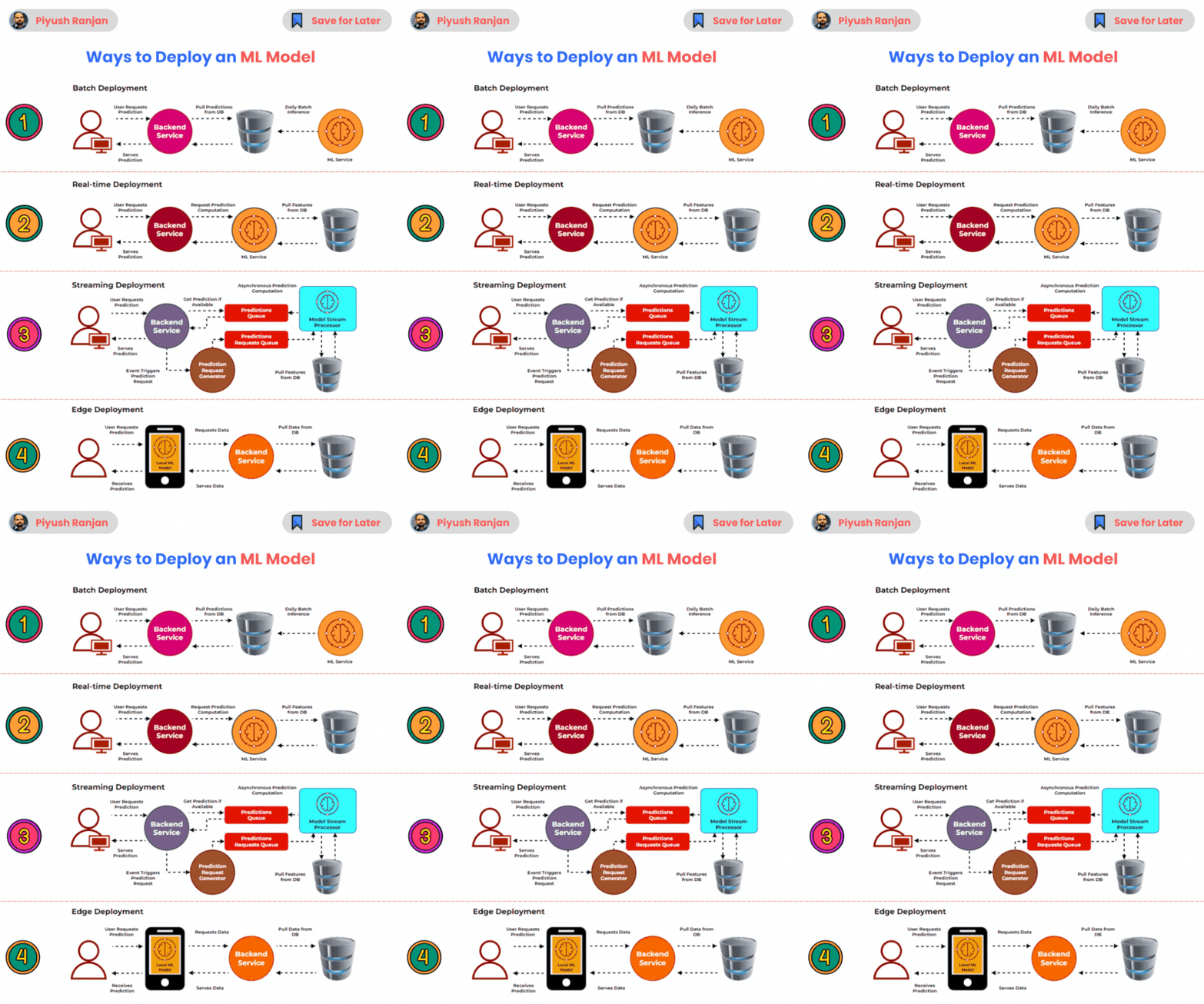
- Process: User requests prediction → Backend service pulls predictions from the database → Daily batch inference by ML service
- Usage: Suitable for scenarios where predictions don’t need to be immediate, like daily reports
- Advantages: Cost-effective, predictable load, efficient resource usage
- Disadvantages: Not suitable for real-time needs, requires storage
Example Use Cases:
- Daily sales forecasts
- Weekly customer segmentation
- Monthly churn predictions
- Batch recommendation systems
2. Real-time Deployment
Innovate: On-demand inference for instant responses.
Process Flow:
graph LR
    A[User Request] --> B[Backend Service]
    B --> C[ML Service]
    B --> D[Database]
    D --> E[Features]
    E --> C
    C --> F[Real-time Inference]
    F --> G[Response]

    style A fill:#e1f5ff
    style C fill:#fff3cd
    style F fill:#d4edda
Characteristics:
- Process: User requests prediction → Backend service requests prediction computation from ML service → Features pulled from the database for real-time inference
- Usage: Ideal for applications requiring instant responses, like chatbots
- Advantages: Low latency, up-to-date predictions, interactive applications
- Disadvantages: Higher infrastructure costs, requires model serving infrastructure
Example Use Cases:
- Chatbots and virtual assistants
- Fraud detection
- Real-time recommendations
- Image classification APIs
Sample Implementation:
1
2
3
4
5
6
7
8
9
10
11
12
13
14
15
16
from flask import Flask, request, jsonify
import pickle
import numpy as np

app = Flask(__name__)
model = pickle.load(open('model.pkl', 'rb'))

@app.route('/predict', methods=['POST'])
def predict():
    data = request.json
    features = np.array(data['features']).reshape(1, -1)
    prediction = model.predict(features)
    return jsonify({'prediction': prediction.tolist()})

if __name__ == '__main__':
    app.run(host='0.0.0.0', port=5000)
3. Streaming Deployment
Retrieve: Asynchronous processing for continuous data streams.
Process Flow:
graph LR
    A[User Request] --> B[Backend Service]
    B --> C{Prediction Available?}
    C -->|Yes| D[Return from Queue]
    C -->|No| E[Trigger Event]
    E --> F[Stream Processor]
    F --> G[ML Model]
    G --> H[Queue]
    H --> D

    style A fill:#e1f5ff
    style F fill:#fff3cd
    style H fill:#d4edda
Characteristics:
- Process: User requests prediction → Backend service checks if prediction is available → If not, an event triggers prediction request → Asynchronous computation by model stream processor → Prediction results stored in queue
- Usage: Best for continuous data streams, such as real-time monitoring
- Advantages: Handles high throughput, decoupled architecture, scalable
- Disadvantages: Eventual consistency, requires queue infrastructure
Example Use Cases:
- Real-time anomaly detection
- IoT sensor data processing
- Log analysis and monitoring
- Social media sentiment analysis
4. Edge Deployment
Innovate: On-device inference for privacy and low latency.
Process Flow:
graph LR
    A[User Request] --> B[Local Device]
    B --> C[Local ML Model]
    C --> D[Prediction]
    D --> E[Response]

    B --> F{Need Additional Data?}
    F -->|Yes| G[Backend Service]
    G --> H[Database]
    H --> B

    style A fill:#e1f5ff
    style C fill:#fff3cd
    style D fill:#d4edda
Characteristics:
- Process: User requests prediction on a local device → Local ML model processes data → Backend service serves additional data if needed → Data pulled from database
- Usage: Perfect for applications with latency constraints or offline capabilities, like mobile apps
- Advantages: Ultra-low latency, privacy-preserving, works offline, reduces server costs
- Disadvantages: Limited model complexity, device resource constraints, model update challenges
Example Use Cases:
- Mobile app features (face unlock, voice commands)
- Autonomous vehicles
- Smart home devices
- AR/VR applications
Choosing the Right Deployment Strategy
graph TD
    A[Choose Deployment Strategy] --> B{Latency Requirement?}
    B -->|Milliseconds| C{Offline Needed?}
    B -->|Seconds| D[Real-time]
    B -->|Minutes/Hours| E[Batch]

    C -->|Yes| F[Edge]
    C -->|No| D

    G{Continuous Stream?} -->|Yes| H[Streaming]
    G -->|No| B

    style A fill:#e1f5ff
    style D fill:#d4edda
    style E fill:#fff3cd
    style F fill:#f8d7da
    style H fill:#e7d4f8
Key Takeaways
Retrieve: Four deployment strategies—Batch, Real-time, Streaming, and Edge—each optimized for different latency, infrastructure, and use case requirements.
Innovate: By understanding these patterns, you can architect ML systems that balance performance, cost, and user experience effectively.
Curiosity → Retrieve → Innovation: Start with curiosity about deployment needs, retrieve knowledge of these strategies, and innovate by selecting and combining patterns that best fit your application requirements.