Learning/Guide
A User's Guide to FlexAttention in FlashAttention CuTe DSL
Learn how to use FlexAttention in FlashAttention 3 CuTe DSL to implement various attention variants like causal, sliding window, ALiBi, and more. This guide covers score modification, mask modification, and block sparsity optimizations.
🤔 Curiosity: Can We Unify All Attention Variants Under One Framework?
What if we could implement causal attention, sliding window attention, ALiBi, and dozens of other attention variants using a single, elegant API? What if this unified framework could achieve 95% of FlashAttention 3’s performance while being flexible enough to support novel attention patterns?
Curiosity: Attention mechanisms have evolved into many variants—causal, sliding window, ALiBi, and more. Can we unify them all under one framework without sacrificing performance?
Many variants of attention have become popular in recent years, each addressing specific needs: causal attention for autoregressive language modeling, sliding window attention for long-context efficiency, ALiBi for better extrapolation, and many others. The PyTorch team at Meta recognized that most of these variants can be unified under one elegant framework called FlexAttention.
The question: How does FlexAttention work, and how can developers use it to implement custom attention variants efficiently?
As someone who’s worked with attention mechanisms in production, I’ve seen how different variants require different implementations. FlexAttention offers a unified approach that’s both flexible and performant.
📚 Retrieve: Understanding FlexAttention
The FlexAttention Framework
Core Concept:
FlexAttention adds two options for customization:
score_mod: A callable that modifies pre-softmax attention scoresmask_mod: A callable that masks out pre-softmax attention scores
The unified formula is:
\[\text{FlexAttention}(Q, K, V) = \text{Softmax}\left(\text{mask\_mod}\left(\text{score\_mod}\left(QK^T\right)\right)\right) V\]Key Insight: mask_mod is a special case of score_mod where scores are set to -inf. They’re kept separate for efficiency reasons, especially when dealing with block sparsity.
Performance:
The original FlexAttention implementation in Triton achieved ~90% of FlashAttention 2 performance on Ampere GPUs, but performance on Hopper was significantly worse compared to FlashAttention 3.
The CuTe DSL Implementation:
The implementation in FlashAttention 3 CuTe DSL, done in collaboration with Driss Guessous (Meta) and Tri Dao (Princeton; Together AI), achieves 95% of FlashAttention 3’s performance in the forward pass. This is a roughly 50% speedup over the Triton version in most cases.
graph TB
    subgraph Input["Input"]
        Q[Query Q]
        K[Key K]
        V[Value V]
    end

    subgraph FlexAttention["FlexAttention Pipeline"]
        QK[QK^T]
        SM[score_mod]
        MM[mask_mod]
        S[Softmax]
        OV[Output × V]
    end

    subgraph Output["Output"]
        OUT[Attention Output]
    end

    Q --> QK
    K --> QK
    QK --> SM
    SM --> MM
    MM --> S
    S --> OV
    V --> OV
    OV --> OUT

    style SM fill:#ff6b6b,stroke:#c92a2a,stroke-width:2px,color:#fff
    style MM fill:#4ecdc4,stroke:#0a9396,stroke-width:2px,color:#fff
    style S fill:#ffe66d,stroke:#f4a261,stroke-width:2px,color:#000
💡 Innovation: Implementing FlexAttention
Score Modification
The score_mod Callable:
The score_mod callable modifies pre-softmax attention scores based on position and optional auxiliary tensors. The generic signature is:
1
2
3
4
5
6
7
8
9
10
def generic_score_mod(
    score: float,
    batch_idx: int,
    head_idx: int,
    q_idx: int,
    kv_idx: int,
    aux_tensors: Optional[list[tensor]],
) -> float:
    # Modify score based on position and aux tensors
    return modified_score
Example 1: T5 Relative Positional Bias
1
2
3
4
def rel_bias_score_mod(score, batch_idx, head_idx, q_idx, kv_idx, aux_tensors):
    bias_tensor = aux_tensors[0]
    rel_pos = math.abs(q_idx - kv_idx)
    return score + bias_tensor[batch_idx, head_idx, rel_pos]
Example 2: ALiBi (Attention with Linear Biases)
1
2
3
4
def alibi_score_mod(score, batch_idx, head_idx, q_idx, kv_idx, aux_tensors):
    slope = math.exp2(-(head_idx + 1))
    dist = math.abs(q_idx - kv_idx)
    return score - slope * dist
CuTe DSL Implementation:
In the CuTe DSL implementation, score_mod must be defined using the TensorSSA abstraction. For example, T5 bias:
1
2
3
4
5
6
7
8
9
10
11
12
13
14
15
16
17
@cute.jit
def rel_bias_score_mod_cute(
    tSrS_ssa: cute.TensorSSA,
    batch_idx: cute.TensorSSA,
    head_idx: cute.TensorSSA,
    q_idx: cute.TensorSSA,
    kv_idx: cute.TensorSSA,
    aux_tensors: Optional[list]
) -> cute.TensorSSA:
    bias_tensor = aux_tensors[0]
    rel_pos = cute.TensorSSA(
        mlir_math.absi(q_idx - kv_idx),
        q_idx.shape,
        q_idx.dtype
    )
    bias = bias_tensor[batch_idx[0], head_idx[0], rel_pos[0]].to(cutlass.Float32)
    return tSrS_ssa + bias
Vectorization:
Application of score_mod is expensive as it requires looping over all entries in the scores matrix. TensorSSA allows for easy vectorized and broadcasted instructions. In the attention mainloop, we compute modified scores in groups of vec_size, a tunable hyperparameter.
Note: Without further assumptions, vectorization of score_mod application is not feasible when using aux_tensors.
Using Score Modification:
Direct CuTe DSL interface:
1
2
3
4
5
6
7
from flash_attn.cute.interface import _flash_attn_fwd

out, _ = _flash_attn_fwd(
    q, k, v,  # torch.Tensor
    score_mod=rel_bias_score_mod_cute,
    aux_tensors=aux_tensors,  # Optional[list[torch.Tensor]]
)
PyTorch integrated interface:
1
2
3
4
5
6
7
8
from torch.nn.attention.flex_attention import flex_attention

compiled_fn = torch.compile(flex_attention)
out = compiled_fn(
    q, k, v,
    score_mod=rel_bias_score_mod,
    kernel_options={"force_flash": True},  # Use CuTe DSL backend
)
Mask Modification
The mask_mod Callable:
Defining mask_mod callables is similar to score_mod, but simpler. The mask application logic is contained in the FlashAttention forward kernel, so mask_mod need only return a Boolean indicating whether a score should be masked (set to -inf):
1
2
3
4
5
6
7
8
9
def generic_mask_mod(
    batch_idx: cute.TensorSSA,
    head_idx: cute.TensorSSA,
    q_idx: cute.TensorSSA,
    kv_idx: cute.TensorSSA,
    aux_tensors: Optional[list],
) -> cute.TensorSSA:  # dtype == cutlass.Boolean
    # Return True if score should be masked (set to -inf)
    return should_mask
Note: Unlike score_mod, we don’t pass in the score itself—we only need positional information to determine whether an attention element should be masked.
Example 1: Causal Mask with Offset
To create a causal mask with proper offset (seqlen_k - seqlen_q, or others as needed):
1
2
3
4
5
6
7
8
9
import flash_attn.cute.utils as utils

def create_causal_mask_with_offset(offset: int):
    @cute.jit
    def _causal_mask_mod(batch_idx, head_idx, q_idx, kv_idx, aux_tensors):
        offset_ssa = utils.scalar_to_ssa(val=offset, dtype=cutlass.Int32)
        return kv_idx <= q_idx + offset_ssa

    return _causal_mask_mod
Note: This mask will require recompilation every time seqlen_k - seqlen_q changes. To avoid this, one could pass in offset as an additional aux_tensor.
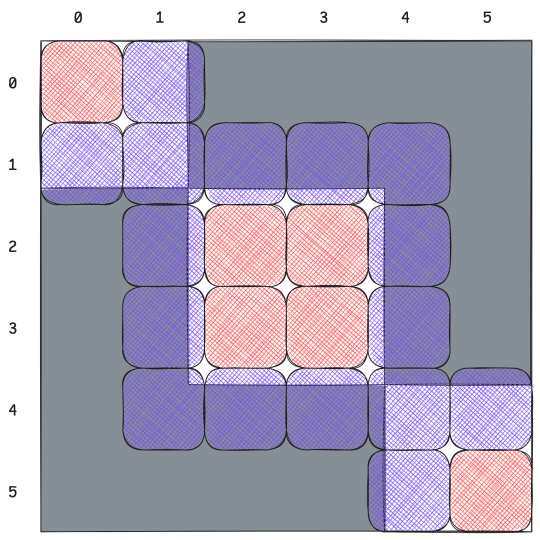
Example 2: Document Masking
When sequences from multiple documents have been concatenated, tokens should only attend within their document:
1
2
3
4
5
6
7
8
@cute.jit
def document_mask_mod(batch_idx, head_idx, q_idx, kv_idx, aux_tensors):
    doc_ids = aux_tensors[0]
    doc_id_q = doc_ids[batch_idx[0], head_idx[0], q_idx[0]]
    doc_id_kv = doc_ids[batch_idx[0], head_idx[0], kv_idx[0]]
    q_doc = utils.scalar_to_ssa(doc_id_q, cutlass.Int32)
    kv_doc = utils.scalar_to_ssa(doc_id_kv, cutlass.Int32)
    return q_doc == kv_doc
Here, doc_ids is an Int32 tensor of shape (B, H, seqlen) representing which document a token belongs to, with the assumption that documents are contiguous.
Usage:
1
2
3
4
5
out, _ = _flash_attn_fwd(
    q, k, v,
    mask_mod=document_mask_mod,
    aux_tensors=[doc_ids],
)
Block Sparsity
The Optimization Challenge:
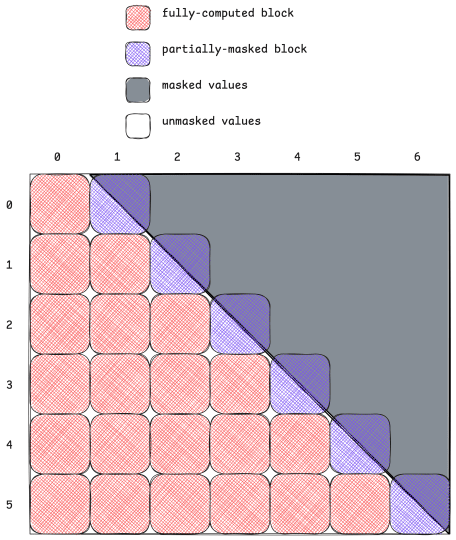
When large portions of the scores matrix are masked, we want to intelligently avoid these regions where possible, skipping unnecessary data movement and computation. FlexAttention implements block sparsity with mask mods.
Example: Causal Masking
Consider a problem with:
- Batch size: 1
- One head
seqlen_q = 768seqlen_kv = 896- Work tile size: 128×128
There are 42 total blocks to handle:
- 6 blocks along the main diagonal are split in half by the causal mask; these need
mask_modapplication - 21 blocks below the diagonal have no masking; these do not need
mask_modapplication (though they do needscore_mod), so we skip applyingmask_modon these blocks - 15 blocks are to be skipped entirely; it would be wasteful even to load them
Block Sparsity Tensors:
Each work tile in the FlashAttention kernel corresponds to one (batch, head, q_block) coordinate. To compute only the tiles needed, we need to know:
mask_block_idx:[B, H, num_q_blocks, num_kv_blocks]- blocks requiringmask_modfull_block_idx:[B, H, num_q_blocks, num_kv_blocks]- fully-computed blocks
And count tensors:
mask_block_cnt:[B, H, num_q_blocks]- number of partially-maskedkv_blocksfull_block_cnt:[B, H, num_q_blocks]- number of fully-computedkv_blocks
Where:
num_q_blocks = ceil_div(seqlen_q, tile_m)num_kv_blocks = ceil_div(seqlen_kv, tile_n)
BlockSparseTensors Class:
1
2
3
4
5
class BlockSparseTensors(NamedTuple):
    mask_block_cnt: cute.Tensor
    mask_block_idx: cute.Tensor
    full_block_cnt: Optional[cute.Tensor]
    full_block_idx: Optional[cute.Tensor]
Note: full_block_cnt and full_block_idx can be optional; mask_mod will be applied to all blocks in that case.
Example: Causal Masking Block Sparsity
For causal masking with the parameters above:
1
2
3
4
5
6
7
8
9
10
11
12
13
14
mask_block_cnt = [[[1, 1, 1, 1, 1, 1]]]
mask_block_idx = [[[[1, 0, 0, 0, 0, 0, 0],
                    [2, 0, 0, 0, 0, 0, 0],
                    [3, 0, 0, 0, 0, 0, 0],
                    [4, 0, 0, 0, 0, 0, 0],
                    [5, 0, 0, 0, 0, 0, 0],
                    [6, 0, 0, 0, 0, 0, 0]]]]
full_block_cnt = [[[1, 2, 3, 4, 5, 6]]]
full_block_idx = [[[[0, 0, 0, 0, 0, 0, 0],
                    [0, 1, 0, 0, 0, 0, 0],
                    [0, 1, 2, 0, 0, 0, 0],
                    [0, 1, 2, 3, 0, 0, 0],
                    [0, 1, 2, 3, 4, 0, 0],
                    [0, 1, 2, 3, 4, 5, 0]]]]
Computing Block Sparsity:
Computing BlockSparseTensors for a given mask_mod, sequence length, and tile size can be computationally expensive, but it’s generally amortized across all layers of a model.
PyTorch Integration:
PyTorch has a similar, more robust class BlockMask that can be converted into BlockSparseTensors:
1
2
3
4
5
6
7
8
9
10
11
12
13
14
15
16
17
from torch.nn.attention.flex_attention import create_block_mask

block_mask_torch = create_block_mask(
    mask_mod_fn,  # PyTorch mask function
    B, H, seqlen_q, seqlen_kv,
    device="cuda",
    BLOCK_SIZE=(tile_m, tile_n),
)

# Convert to CuTe DSL format
_, _, mask_cnt, mask_idx, full_cnt, full_idx, *_ = block_mask_torch.as_tuple()
block_sparse_tensors = BlockSparseTensorsTorch(
    mask_block_cnt=mask_cnt,
    mask_block_idx=mask_idx,
    full_block_cnt=full_cnt,
    full_block_idx=full_idx,
)
⚠️ Warning: The tile size used to compute block sparsity must be the same as the tile size used in the kernel.
Complete API Call
Full FlexAttention Call:
1
2
3
4
5
6
7
8
9
10
from flash_attn.cute.interface import _flash_attn_fwd

out, _ = _flash_attn_fwd(
    q, k, v,  # torch.Tensor, shape (B, H, seqlen_q, d)
    score_mod=score_mod_fn,  # Optional
    mask_mod=mask_mod_fn,  # Optional
    aux_tensors=aux_tensors,  # Optional[list[torch.Tensor]]
    block_sparse_tensors=block_sparse_tensors,  # Optional[BlockSparseTensors]
    # ... other optional arguments
)
PyTorch Interface:
1
2
3
4
5
6
7
8
9
from torch.nn.attention.flex_attention import flex_attention

compiled_fn = torch.compile(flex_attention)
out = compiled_fn(
    q, k, v,
    score_mod=score_mod_fn,
    mask_mod=mask_mod_fn,
    kernel_options={"force_flash": True},
)
🎯 Key Takeaways
| Feature | Description | Use Case |
|---|---|---|
| score_mod | Modifies pre-softmax attention scores | T5 bias, ALiBi, relative position encoding |
| mask_mod | Masks out attention scores (sets to -inf) | Causal masking, document masking, sliding window |
| Block Sparsity | Skips unnecessary computation for masked regions | Performance optimization for sparse attention |
| TensorSSA | Required abstraction for CuTe DSL | Vectorized and broadcasted operations |
| Performance | 95% of FlashAttention 3, 50% faster than Triton | Production-ready attention variants |
Why FlexAttention Matters
As someone who’s implemented attention variants, here’s what excites me:
- Unified API: One framework for many attention variants
- High Performance: 95% of FlashAttention 3 performance
- Flexibility: Easy to implement custom attention patterns
- Block Sparsity: Intelligent optimization for sparse attention
- Production Ready: Integrated into PyTorch and FlashAttention
What I’d Implement First:
- Causal attention with proper offset handling
- ALiBi for better long-context extrapolation
- Document masking for multi-document scenarios
- Custom score modifications for domain-specific attention patterns
🤔 New Questions This Raises
Performance Trade-offs: When does the flexibility of FlexAttention outweigh the performance cost compared to specialized implementations?
Block Sparsity Optimization: How do we automatically determine optimal block sparsity patterns for novel attention variants?
Vectorization Limits: How can we improve vectorization when using
aux_tensorsinscore_mod?Backward Pass: How does FlexAttention perform in the backward pass, and what are the optimization opportunities?
Novel Combinations: What new attention patterns can we create by combining different
score_modandmask_modfunctions?Hardware Optimization: How does FlexAttention perform on different GPU architectures (Ampere, Hopper, Blackwell)?
Next Steps: Experiment with custom attention variants, benchmark performance on different hardware, and explore novel combinations of score and mask modifications.
References
Original Article:
Research Papers:
- FlexAttention: Learning to Attend Efficiently (Guessous et al., 2024)
- Attention Is All You Need (Vaswani et al., 2017)
- Train Short, Test Long: Attention with Linear Biases (Press et al., 2021)
FlashAttention:
- FlashAttention: Fast and Memory-Efficient Exact Attention with IO-Awareness (Dao et al., 2022)
- FlashAttention-2: Faster Attention with Better Parallelism and Work Partitioning (Dao, 2023)
- FlashAttention-3: Fast and Accurate Attention with Asynchrony and Low-precision (Dao et al., 2024)
- FlashAttention GitHub Repository
CuTe DSL:
PyTorch Integration:
Related Attention Mechanisms:
- Sliding Window Attention
- Longformer: The Long-Document Transformer (Beltagy et al., 2020)
- T5: Exploring the Limits of Transfer Learning (Raffel et al., 2020)
Performance Optimization: