Agent/Orchestration
How Claude Code Works: The Agent Loop, Tools, and Safety
A practical breakdown of Claude Code’s agent loop, tool categories, sessions, permissions, and how to work with it effectively.
🤔 Curiosity: Why does Claude Code feel more “agentic” than a normal IDE assistant?
Claude Code isn’t just a chat box. It’s a terminal‑native agent that can read files, edit code, run commands, search the web, and verify results. That difference changes how we should design workflows.
Question: What’s the minimal mental model we need to collaborate with Claude Code effectively?
📚 Retrieve: The core architecture (from the docs)
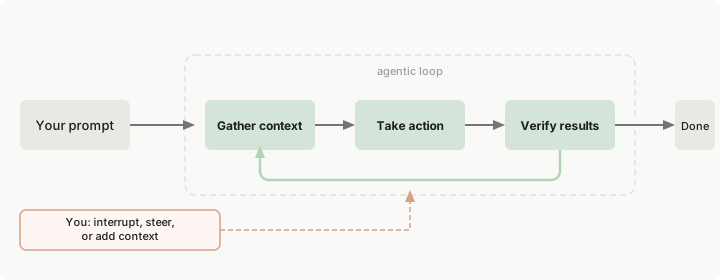
1) The Agent Loop
Claude Code runs a continuous loop:
- Collect context (read files, search code, fetch docs)
- Perform work (edit, run, refactor)
- Verify (tests, lint, runtime checks)
It’s not linear—Claude can iterate across all three steps and re‑route based on new evidence.
graph LR
  A[Collect Context] --> B[Perform Work]
  B --> C[Verify]
  C --> A
2) The Model + Tools split
Claude Code is an agent harness around the model. The model reasons; the tools act.
Tool categories in practice:
- File ops: read, edit, create, restructure
- Search: grep, regex, codebase traversal
- Execution: shell commands, tests, builds, git
- Web: search, fetch docs, look up errors
- Code intelligence: definitions, references, type errors (via plugin)
The model chooses tools dynamically based on the task and what it learns mid‑loop.
3) Sessions, context, and memory
Claude Code is session‑scoped. It doesn’t remember across sessions unless you write to CLAUDE.md.
Important details:
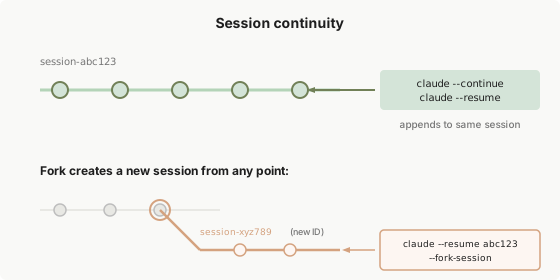
- Sessions can be resumed or forked
- Switching branches keeps the same conversation, but file views update
- Context is finite; Claude compresses when full
Production‑grade tip: Put long‑lived constraints into CLAUDE.md, not your chat history.
4) Safety by checkpoints + permissions
Claude Code creates checkpoints before edits and uses permission modes to control autonomy.
Modes include:
- Default: asks before edits/commands
- Auto‑accept edits: edits allowed, commands still ask
- Plan Mode: read‑only planning
- Delegate Mode: orchestrates teammates only
This is the key guardrail: fast iteration without losing control.
🧪 Working effectively (what the docs suggest + what I’ve found)
Give Claude verifiable targets
Claude performs best with tests, expected output, or screenshots. “Fix the bug” is less precise than “make this failing test pass.”
Use planning for complex tasks
For big refactors, switch to Plan Mode and iterate on the plan before implementation.
Delegate like a lead engineer
Don’t micromanage files. Provide goal + constraints, then let Claude choose paths.
💡 Innovation: How I apply this to real projects
1) Treat the loop like CI for humans
I structure my own workflow the same way: context → work → verify. The agent loop becomes my default engineering rhythm.
2) Keep knowledge in CLAUDE.md
If it’s important, it belongs in CLAUDE.md: rules, repo conventions, deployment steps.
3) Use permissions as a throttle
For dangerous operations, I keep Claude in Plan Mode or default permissions until I’m comfortable.
Visual: Session continuity (from the docs)
Key Takeaways
| Insight | Implication | Next Steps |
|---|---|---|
| Claude Code is a tool‑driven agent loop | You should design tasks around context‑work‑verify | Provide tests + constraints |
| Memory is session‑scoped | Durable knowledge must live in CLAUDE.md | Maintain a living project guide |
| Permissions are the control layer | Autonomy is adjustable | Use Plan Mode for risky work |
New Questions
- Can we automate CLAUDE.md updates from post‑mortems?
- What’s the right balance between Plan Mode and full autonomy?
- Should agent loops be exposed as explicit CI pipelines?
References
- Claude Code docs (KR): https://code.claude.com/docs/ko/how-claude-code-works
- Common workflows: https://code.claude.com/docs/ko/common-workflows
- Features overview: https://code.claude.com/docs/ko/features-overview