AI
OpenShell's auto-approval sees new methods, not wider paths
Source Audit of NVIDIA OpenShell at 71c3cd95: the gateway’s risk check keys findings by HTTP method, so a credentialed PUT widened to /repos/** adds no prover finding.
What does “risky new access” mean to the approval gate?
OpenShell is NVIDIA’s runtime for running autonomous agents inside policy-controlled sandboxes. It is an Apache-2.0 repository created on February 24, 2026, and it had more than 14,000 GitHub stars when I checked on October 5, 2026.
Its README makes two promises. The first is kernel-level enforcement. The second is the one I wanted to test: “Before a policy change is approved, OpenShell uses formal verification to flag risky new access it would grant, such as reaching a new host with credentials or calling a new API method, so those changes wait for human review.”
That matters most in one feature, the policy advisor. When the sandbox blocks a request, the agent can propose the network rule it needs. By default, every proposal waits for a person. An operator can switch on proposal_approval_mode=auto, and then OpenShell approves a proposal by itself when its risk checks find nothing to flag.
The advisor docs also tell agents how to behave: “A good proposal allows one method on the narrowest path the task needs”. The example lets /usr/bin/gh send PUT to /repos/NVIDIA/OpenShell/contents/docs/** on api.github.com.
So here is the narrow question:
If a sandbox already holds that narrow, credentialed
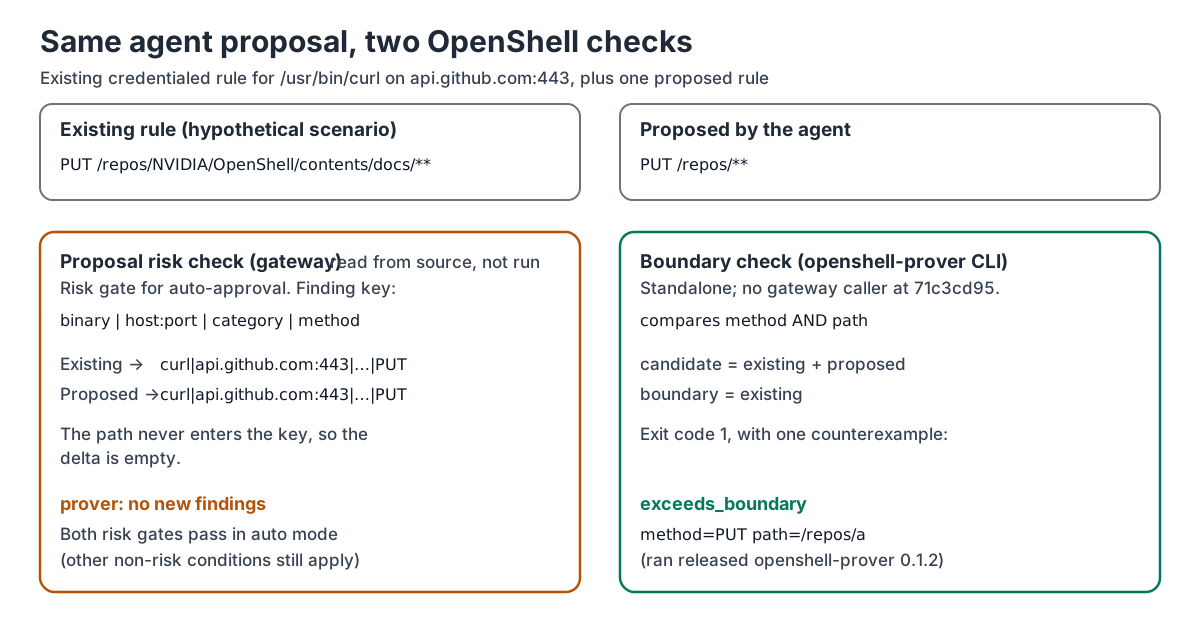
PUT, and the agent then proposesPUT /repos/**, do the risk checks that gate auto-approval notice that the path got wider?
At the pinned commit, my reading of the code says they do not. The gateway’s proposal risk check keys every finding by binary, host, port, category, and HTTP method. The request path is not part of the key, so the wider rule produces exactly the same keys as the narrow one, the verdict is prover: no new findings, and nothing about api.github.com:443 raises a security flag. In that scenario both risk gates pass. Whether the proposal is then approved still depends on the gateway’s other, non-risk conditions, which I list below, and I did not run a gateway to watch it happen. OpenShell also ships a second check, a standalone boundary prover, that does compare paths. When I ran the released binary, it rejected the widened policy with the counterexample PUT /repos/a. In my search of the pinned source, no gateway code calls that boundary check.
Technical Analysis: What the pinned source says
I pinned the audit to commit 71c3cd95, committed on October 3, 2026. I read the README, the architecture, advisor, and prover docs, the prover crate’s credential-safety queries, and the gateway code that evaluates proposals and auto-approves them. Then I ran the released openshell-prover 0.1.2 binary on three small policies.
Why a path is a permission here
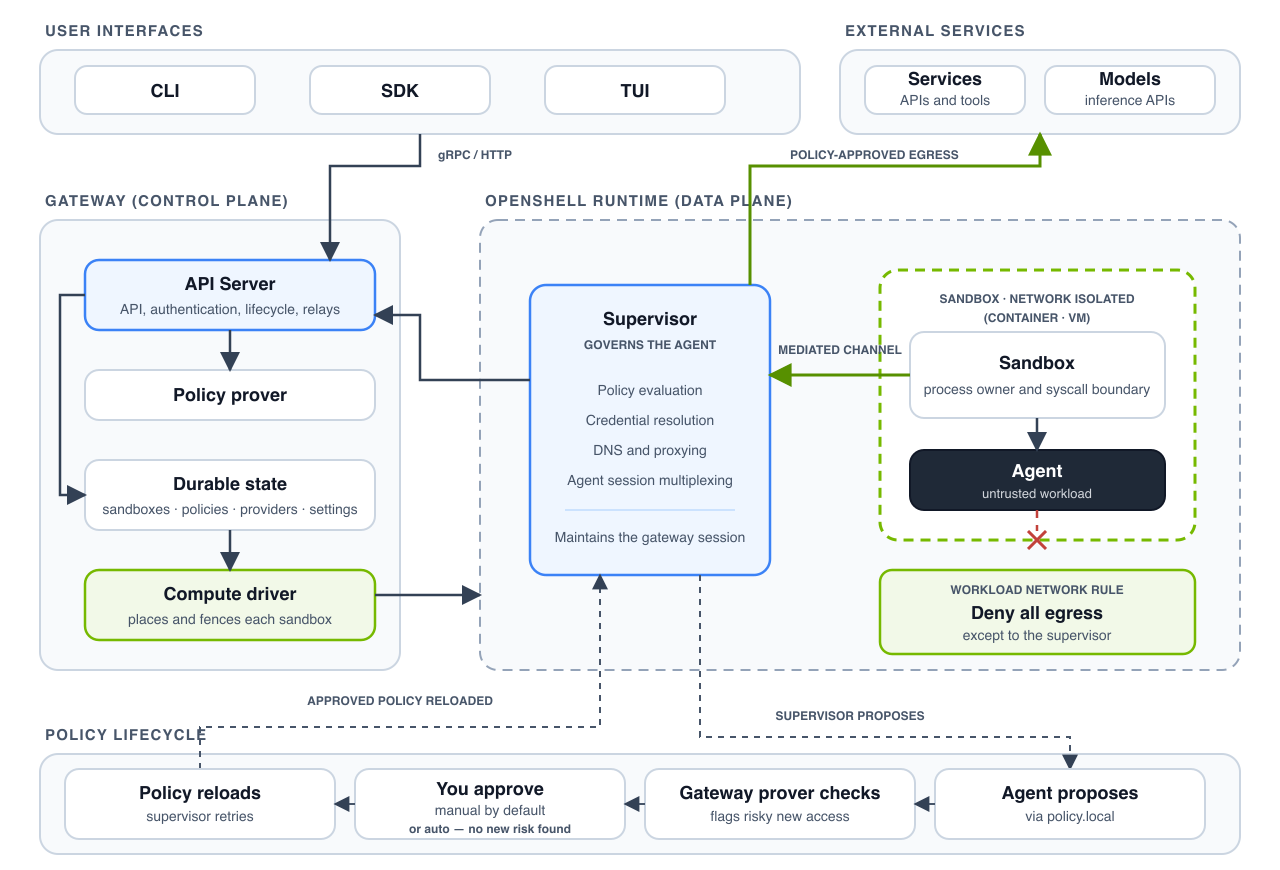
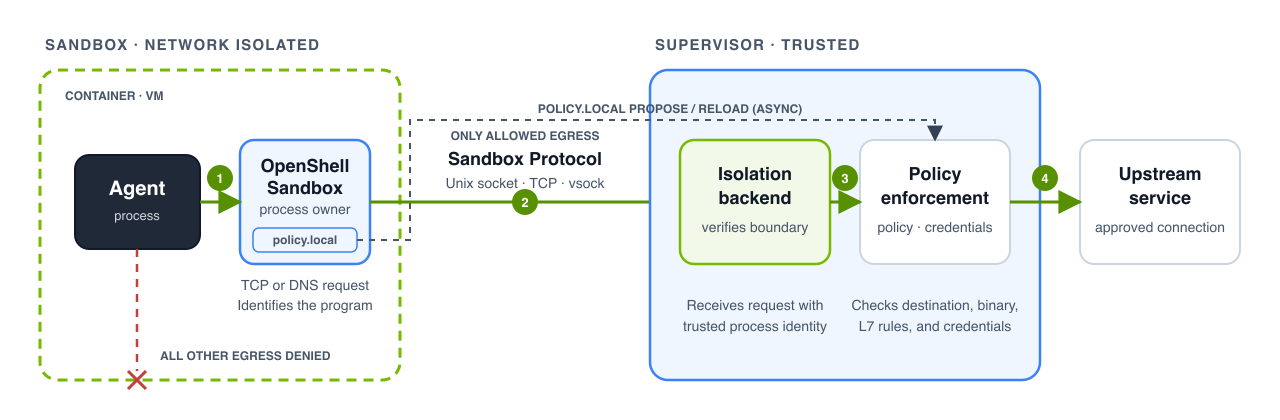
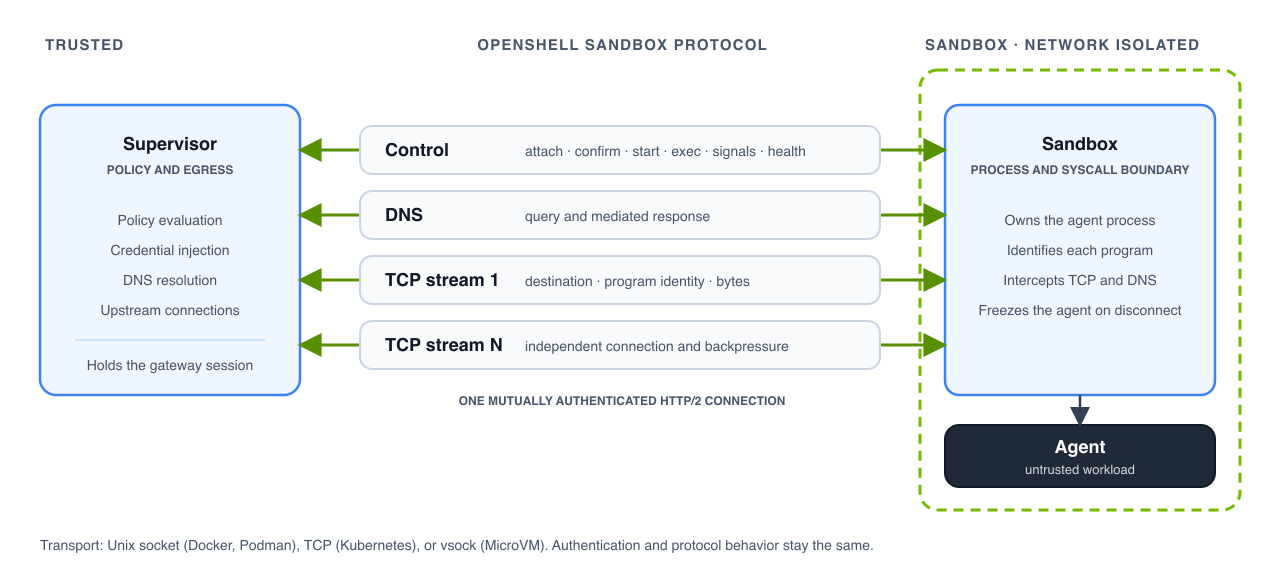
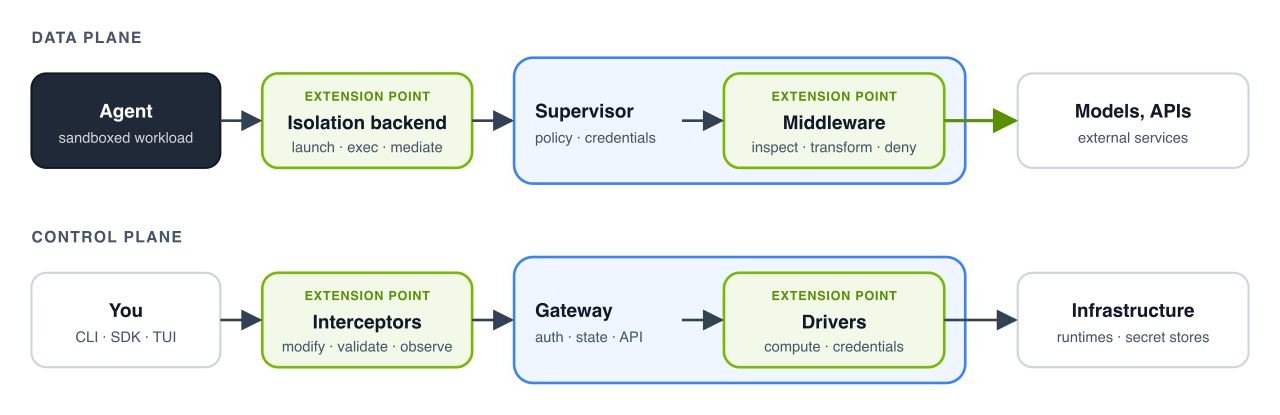
OpenShell’s sandbox has one way out. The architecture docs say the supervisor channel is the workload’s only allowed egress path, and the supervisor “checks requests against policy, supplies credentials, resolves DNS, opens approved connections.” Providers hold the real secrets, and “the supervisor hands that credential out only where policy allows it.”
So for a REST endpoint with a provider credential, the allowed path is the scope of what the agent can do with that credential. PUT on one docs folder and PUT on every repository path the token can write are very different grants, even though the method is the same.
Two more facts make the wider rule effective once it is approved. An approved proposal is added “as a separate rule,” and “if another rule covers the same host and port, a request is allowed when either rule allows it, and deny rules in either rule still apply.” OpenShell also refuses a proposal that disagrees with an overlapping endpoint on a single-valued setting such as tls or allowed_ips. My worked example has no deny rule and no conflicting setting. The policy merge code says the same thing from the other side: for two non-MCP endpoints, “the broader one authorizing what the narrower one covers is the documented behaviour and stays supported.”
What the proposal risk check looks at
The advisor docs list four findings. Two of them are about credentials. credential_reach_expansion means a binary can “use a provider credential at a host and port that it could not reach before.” capability_expansion means it can “use a new HTTP method at a host and port where it already uses a provider credential.”
The docs are precise, and so is the code. In the prover crate, capability_expansion is defined as “on a (binary, host, port) that already had credentialed reach, a new HTTP method was added.” The query loop in queries.rs emits one capability path per allowed method. The struct that carries a finding path has fields for the binary, host, port, mechanism, policy name, category, and method. It has no field for a request path.
The method list comes from allowed_methods() in the prover’s policy.rs. For an endpoint with explicit rules, it loops over the rules and collects r.method. The rule’s path is not read there.
Then the gateway decides what is new. In crates/openshell-server/src/grpc/policy.rs, finding_path_key builds this string:
1
2
3
4
format!(
    "exfil|{}|{}:{}|{}|{}",
    p.binary, p.endpoint_host, p.endpoint_port, p.category, p.method
)
It deliberately leaves out the policy name, and its comment states the intent: “adding a new method on an already-reached host surfaces as a new path; reuse of an existing method does not.” finding_delta keeps only keys that the current policy did not already produce. If none are left, the verdict is the literal string prover: no new findings.
What auto-approval requires
auto_approve_chunk has two risk gates. The verdict must equal prover: no new findings, and the proposal’s security notes must be empty. It also has conditions that are not about risk: it bails out while a global policy is active, it only approves a chunk that is still pending, it re-evaluates the proposal against current inputs, and it must merge the rule with validation against provider layers and credential bindings. If evaluation or the merge fails for a still-pending proposal, it is left unapproved and pending; a chunk that is no longer pending is simply skipped. generate_security_notes looks at the host, IP literals, wildcard hosts, allowed_ips, ports above 49152, a list of database ports, and the flag that allows credentials on uninspected traffic. In my reading of that function, no rule path is read.
Put those pieces together for one bounded scenario: an agent-authored proposal, auto mode on, no active global policy, and an effective policy with no deny rule or conflicting endpoint setting on that host.
- The current policy gives
/usr/bin/curlcredentialedPUTonapi.github.com:443. Its keys end in…|credential_reach_expansion|and…|capability_expansion|PUT. - The proposal adds
PUT /repos/**for the same binary on the same host and port. Its keys are identical, because the path is not in the key and the policy name is excluded on purpose. - The delta is empty and
api.github.com:443triggers no security note, so both risk gates pass. If the remaining merge and validation steps succeed, as I would expect for a plain REST allow rule, the proposal is approved without review.
This is an inference from the code, not an observed run. I did not start a gateway. The pieces it rests on are each read directly at the pinned commit, and the same key format and the same prover: no new findings comparison are in the v0.1.2 release source, tagged at commit 6648bd0c.
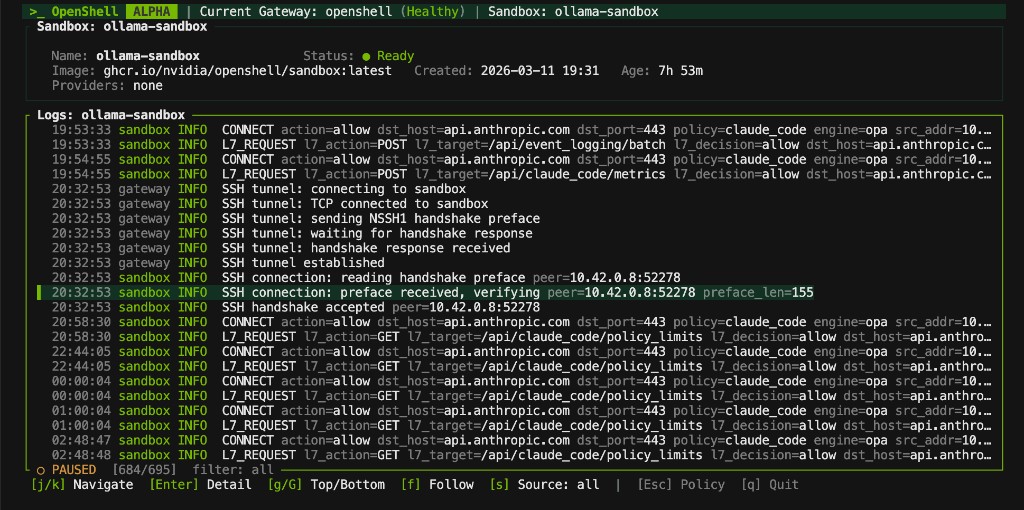
l7_action) and a path (l7_target); the REST policy rules themselves are method-and-path rules. Source: https://github.com/NVIDIA/OpenShell/blob/71c3cd957abef062eb7f37010056717cd49f2ed3/fern/assets/images/openshell-terminal.png. Publisher/creator: NVIDIA Corporation and OpenShell contributors. License: https://raw.githubusercontent.com/NVIDIA/OpenShell/71c3cd957abef062eb7f37010056717cd49f2ed3/LICENSE. Attribution: NVIDIA/OpenShell, fern/assets/images/openshell-terminal.png, Apache License 2.0, pinned at commit 71c3cd95; file extension changed to .jpg, image unchanged.
The other prover does see paths
OpenShell has a second use for its prover, the boundary check. Its docs say it “compares method and path allow and deny rules on endpoints with protocol: rest.” It is a standalone CLI that “remains independent of the gateway at runtime,” and it “does not apply or approve policies.”
I wanted to see that difference run, not just read it. I downloaded the openshell-prover 0.1.2 macOS arm64 release. Its tarball SHA-256 matched the checksums file published with the release. I wrote three policies:
base.yaml:/usr/bin/curlmayPUTto/repos/NVIDIA/OpenShell/contents/docs/**onapi.github.com:443, REST, enforced. This is the docs example withcurlin place ofgh.widened.yaml: the base plus a second rule allowingPUT /repos/**for the same binary and host.new-method.yaml: the base plus a rule allowingDELETEon the same docs folder.
Then I checked each one against base.yaml as the boundary:
| Change against the base | Boundary check, released 0.1.2 binary (ran) | Proposal risk check key delta (read from code, not run) |
|---|---|---|
| None (base against itself) | within_boundary, exit 0 | Not applicable |
Add PUT /repos/** | exceeds_boundary, exit 1, counterexample method=PUT path=/repos/a | No new key: same binary, host, port, and method |
Add DELETE on the docs folder | exceeds_boundary, exit 1, counterexample method=DELETE path=/repos/NVIDIA/OpenShell/contents/docs/a | New …|capability_expansion|DELETE key, a finding |
The new-method row is the control. By my reading, the risk check flags a new method, and the boundary check I ran did too. Only the boundary check catches a wider path with an old method.
The boundary check is the one that understands this case. I searched the full checkout at the pinned commit for check_within_boundary and within_boundary in Rust, Python, TypeScript, and Go files. Outside the openshell-prover and openshell-prover-cli crates there were zero matches. The architecture page describes the split honestly: the prover “runs in the gateway” to check proposals, and “also ships as the standalone openshell-prover command for checking a policy against a boundary in CI.”
What the project already says about this
This is not a hidden weakness, and the docs do not overclaim. The README’s examples, “reaching a new host with credentials or calling a new API method,” match the two credential findings exactly. The auto-approval section warns that the checks “do not treat access to a new public host as a risk when no provider credential applies there,” and tells operators to turn auto mode on “only if you accept” that. The prover docs say a passing boundary result does not mean “that the policy is as narrow as it could be.”
NVIDIA’s own governance interceptor example goes further. It denies SubmitPolicyAnalysis requests that contain proposals, “so a sandbox cannot use the gateway’s optional auto-approval path to widen its governed policy.” The example notes that “this rule belongs to the example.” The accepted RFC 0002 recommended that first-release automatic apply run “only when prover, validation, and org ceiling checks succeed without ambiguity.” In my reading, the shipped gateway runs the prover’s risk check and validation, while the policy-containment check I compared here, the boundary check, stays outside the gateway.
What I did not find in the README, the advisor, prover, and architecture docs, the governance example, or RFC 0002 is the specific consequence: the risk check is method-granular while REST rules are path-granular, so the docs’ own advice to propose “the narrowest path” is advice the auto gate does not verify.
Treat auto mode as method-level trust
The finding reduces to one sentence for operators: with auto mode on, widening only the path of a credentialed method the agent already holds, on the same binary, host, and port, adds no prover finding. On an unflagged destination like api.github.com:443 it then passes both risk gates, and approval rests on the remaining state, policy, and validated-merge conditions. That is my reading of the code, not an observed run. How much that matters depends on what the credential itself is allowed to do upstream; the sandbox policy is only the inner fence.
Here is what I would do with that, in order.
- Keep
proposal_approval_modeatmanualfor any sandbox with REST credentials. It is the default. Set it gateway-wide, because the docs say “a gateway-wide value overrides sandbox values,” and review the rule thatopenshell rule getshows, not the agent’s description of it. - If you need auto mode, put the boundary check in front of it.
SubmitPolicyAnalysisis on the gateway’s interceptable-method allowlist, and a validate-phase interceptor runs before the gateway handles the request. An interceptor could compose the effective policy with the proposed rule and run the prover’s boundary check against an operator-owned ceiling, rejecting anything that returns other thanwithin_boundary. That is my design suggestion. I have not built or run it, and the prover docs say the boundary check needs “the complete effective policy as it would be after the change.” - Run the boundary check on live policy anyway. The documented recipe is
openshell sandbox get my-sandbox --policy-only > candidate.yamlfollowed byopenshell-prover check candidate.yaml --boundary boundary.yaml. Run on a schedule, it catches a rule that was approved by any path, including auto mode, as soon as the policy exceeds the ceiling. - Treat every boundary result except
within_boundaryas a failure. The prover docs say exactly that, and they list REST shapes that returnunsupported, such as rules that match query parameters or use?or bracket expressions in paths.
For the project itself, two small changes would close the gap I traced. One is to make the risk check path-aware for credentialed REST endpoints, for example by recording a path pattern in the capability key, so that a wider pattern for an existing method surfaces as new. The other is to let auto mode consult an operator boundary, which is roughly what the RFC called an org ceiling. Both are my suggestions, not plans I found in the repository.
This is the same lesson as other agent gates audited on this blog: the gate’s unit of inspection decides what “approved” means. In OpenHarness, the order of permission checks decided what an operator’s deny rules meant. If you are comparing agent platforms, read the Cloudflare OS approval audit next: it traces another agent platform’s approval gate, where how an action is integrated decides whether it pauses for a human, so you can compare what each gate actually inspects. The OpenConnector audit covers the credential-gateway side of the same problem.
Limitations of this audit
- I did not run an OpenShell gateway or a sandbox. The auto-approval outcome for the widened rule is inferred from code read at the pinned commit, not observed.
- The boundary runs used the released 0.1.2 binary, not a build of the pinned commit. I checked that the gateway’s key format and approval comparison are the same at the v0.1.2 tag.
- My search for boundary-check callers covered four file types at one commit. A later commit, or an out-of-tree interceptor, could wire it in.
- This is not a vulnerability report. Auto mode is opt-in, the advisor is off by default, the docs define
capability_expansionexactly as a new HTTP method, and a person reviewing in manual mode sees the full rule.
Key Takeaways
| Insight | Implication | Next step |
|---|---|---|
| The gateway keys proposal findings by binary, host, port, category, and method | A wider path for an existing credentialed method on the same binary, host, and port adds no prover finding | Treat auto mode as method-level trust, not path-level trust |
Auto-approval’s risk gates are prover: no new findings and empty security notes, and neither reads paths | In my code reading, same-method path widening on an unflagged destination such as api.github.com:443 passes both risk gates; approval then rests on state, policy, and validated-merge conditions | Keep proposal_approval_mode at manual gateway-wide where REST credentials exist |
The released boundary check rejected PUT /repos/** with counterexample PUT /repos/a | The project already has a path-aware check | Run it in CI and on live sandbox policy against an exact-path ceiling |
| In a search of the pinned source, no gateway code calls the boundary check | The two provers answer different questions | Add a validate interceptor on SubmitPolicyAnalysis if you need auto mode |
New Questions
- Should a credentialed capability key include a normalized path pattern, and how would that interact with the REST shapes the boundary check already returns
unsupportedfor, such as?or bracket expressions? - Could the gateway accept an operator boundary file and run the boundary check before any automatic approval, as RFC 0002’s “org ceiling” suggests?
- How often do real agents propose a wider path after a narrow one was approved? The advisor’s logs record
CONFIG:APPROVEDwithauto:true, so a fleet could measure it. - Should the agent-facing guide tell agents that a wider path for an existing method will not be flagged, or would that only teach them to ask for more?
References
Code & Implementation (pinned at 71c3cd95):
- NVIDIA/OpenShell repository
- README.md
- openshell-server/src/grpc/policy.rs
- openshell-prover/src/queries.rs
- openshell-prover/src/finding.rs
- openshell-prover/src/policy.rs
- openshell-prover/src/containment.rs
- openshell-policy/src/merge.rs
- openshell-gateway-interceptors/src/routes.rs
- examples/governance-interceptor/README.md
- openshell-server/src/grpc/policy.rs at v0.1.2
- OpenShell v0.1.2 release, including the standalone prover
Documentation:
Editorial method: claims in this article point to primary documentation, pinned source code, runnable checks, or dated measurements, with AI-assisted research under the site's evidence-gated policy. How this site verifies claims and discloses AI assistance · Report a correction.
Working on something like this?
I take a small number of paid, scoped reviews: AI agent/RAG architecture diagnosis, Unity CI & build-automation audits, and multimodal QA design review. Each one ends in a written findings document.
Work with me