AI
OpenHarness Lets Its Allow List Outrank Your Deny Rules
A commit-pinned audit of the OpenHarness permission checker: its tool allow list returns before the command and path deny globs an operator configured.
If I write a deny rule into my agent, does it actually run?
Every agent harness eventually ships the same three knobs: a mode, an allow list, and a deny list. The interesting question is not whether they exist. It is what happens when two of them disagree.
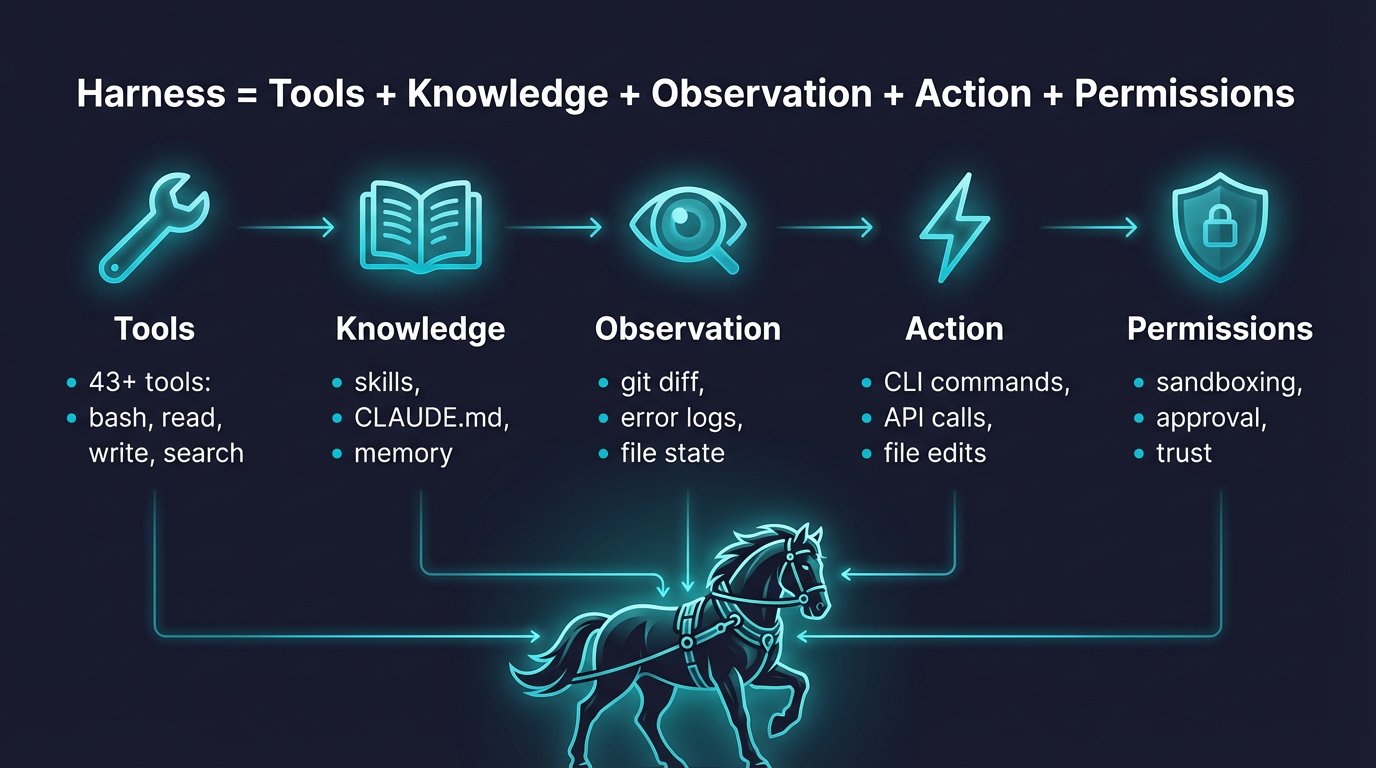
OpenHarness is a good place to ask, because it is explicit about the claim. The README defines a harness as tools, knowledge, observation, action, and permissions, and the repository markets governance as one of its pillars. At commit 9b2efd7 the project is MIT licensed, carries 15,638 stars, and was last pushed on 2026-06-04.
So I read the checker instead of the README, and then I ran it.
Technical Analysis: The order of checks is the whole story
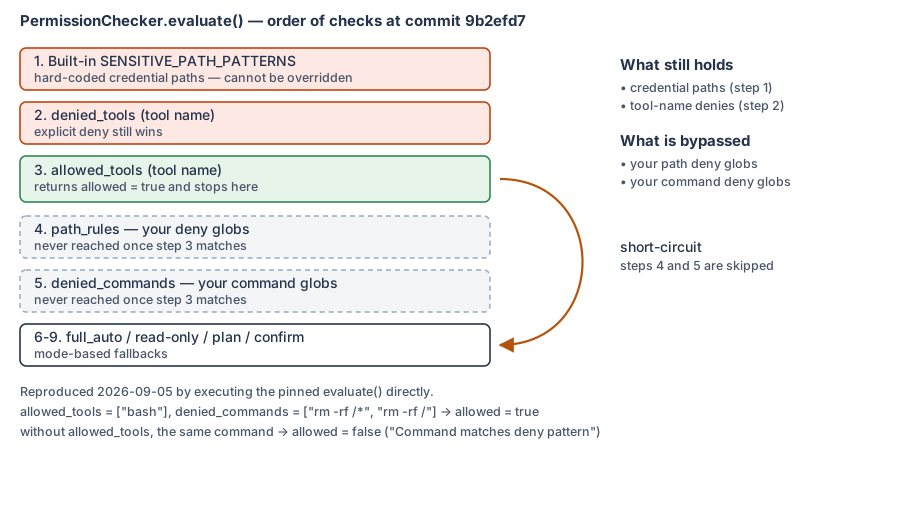
src/openharness/permissions/checker.py is 200 lines. evaluate() walks its rules in a fixed order and returns on the first match. That order is the finding.
- Built-in
SENSITIVE_PATH_PATTERNS— hard-coded credential paths (lines 84-96) denied_tools— deny by tool name (lines 100-102)allowed_tools— allow by tool name, returns immediately (lines 104-106)path_rules— your path deny globs (lines 109-116)denied_commands— your command deny globs (lines 119-126)- Mode fallbacks —
full_auto, read-only,plan, and the default confirmation prompt
Step 3 returns an allowed decision. Steps 4 and 5 are written below it. So the moment a tool name appears in allowed_tools, the deny globs the operator wrote are not consulted.

Reproducing it
Reading an ordering is cheap; asserting it is not. I imported the pinned checker.py directly and executed evaluate() unmodified. Only PermissionSettings was replaced, with a plain dataclass, because the pydantic model was unavailable in the sandbox and the checker reads settings purely through attribute access.
| Case | Config | Result |
|---|---|---|
| A | denied_commands set, full_auto, run rm -rf / | denied — Command matches deny pattern |
| B | same, plus allowed_tools contains the shell tool | allowed — bash is explicitly allowed |
| C | path_rules deny /etc/*, read /etc/shadow | denied — matches deny rule |
| D | same, plus allowed_tools contains the read tool | allowed — read_file is explicitly allowed |
| E | allowed_tools contains the read tool, read ~/.ssh/id_rsa | denied — built-in pattern holds |
| F | shell tool in both denied_tools and allowed_tools | denied — deny wins |
Cases E and F matter as much as B and D. This is not an open door.
What still holds
The hard-coded credential list runs first and survives the allow list. The maintainers clearly reasoned about exactly this hazard: tests/test_permissions/test_checker.py defines 17 tests, and one of them is named test_allowed_tools_does_not_bypass_sensitive_paths. Deny-by-tool-name also wins, because it sits at step 2.
What none of those 17 tests pin is the allow list against denied_commands or against user path_rules.
How reachable is this?
Three coordinates decide that.
evaluate() is called on the tool-execution path in engine/query.py line 933, after the file path and command are normalised — so this is the live path, not a helper. The allow list is an exposed CLI option declared at cli.py lines 2272-2277. And denied_commands is enforced in exactly one place in the entire tree.
That last one I checked exhaustively rather than assumed. Grepping denied_commands across every Python, Markdown, JSON, TOML and TypeScript file at the pinned commit returns five hits: the settings field definition, a test fixture set to the empty list, the README example, a demo script, and the single enforcement site at checker.py line 121. No second site enforces denied_commands further down the stack. Separate mechanisms such as PreToolUse hooks still exist and can reject a call, but they are a different feature an operator has to configure themselves.

The documentation gap is the sharper half
The README publishes a settings example containing path_rules and denied_commands. It is a natural thing to copy. But a recursive grep for allowed_tools, allowed-tools, and allowedTools across every Markdown file in the pinned tree returns nothing at all — no README section, no changelog line, no release note.
So the allow list is reachable from the CLI, decisive in the checker, and absent from the prose. An operator can read the documented deny example, add the allow-list flag for convenience, and never encounter a sentence telling them the two interact.

What this changes for anyone running a harness
Treat an allow list as a scope, not a shortcut. In this implementation allowed_tools does not mean skip confirmation for this tool. It means stop evaluating. Those are different powers, and only one of them is what most operators want when they type the flag.
Order is the contract. A permission layer is not a set of rules; it is a sequence. The same five rules in a different order produce a different security posture, and no amount of README wording changes it. When auditing a harness, read evaluate() top to bottom before reading the docs.
Test the interactions, not the rules. The 17 tests here each check a rule. The gap is a test that checks two rules disagreeing. test_allowed_tools_does_not_bypass_sensitive_paths is exactly that shape, and it is the one that proves the pattern is worth extending.
The fix is small. Moving the allow-list return below the path and command loops would make the operator’s deny globs authoritative while leaving cases E and F unchanged. That is a reordering, not a redesign.
For game teams this generalises past coding agents. A build agent with a shell tool allow-listed for convenience is a build agent whose destructive-command deny pattern is decorative.

Limitations
This audit is pinned to commit 9b2efd7, last pushed 2026-06-04. Later commits may reorder the checker. The reproduction substituted a dataclass for the pydantic settings model, so it exercises evaluate() faithfully but not the settings validation around it. The exhaustive greps cover the pinned tree only. I did not run the full OpenHarness test suite, and I make no claim about behaviour in the swarm permission-sync call site beyond noting that it exists. Star counts are a 2026-09-05 reading.
Nothing here is a vulnerability report. It is an ordering choice with an undocumented consequence, in an MIT-licensed project that already ships the strongest part of the protection — the credential list — ahead of everything else.
Key Takeaways
| Insight | Implication | Next step |
|---|---|---|
| The allow list returns before path and command deny rules | Operator-written deny globs are skipped for allow-listed tools | Read evaluate() before trusting a permission config |
Built-in credential paths and denied_tools still hold | This is a scoping surprise, not an open door | Keep secrets protection independent of user config |
| The allow list appears in no Markdown file in the tree | The interaction cannot be discovered from the docs | Document precedence explicitly in any harness you ship |
One enforcement site for denied_commands | No second gate downstream compensates | Grep for enforcement count, not mentions |
New Questions
- Should a harness allow list ever short-circuit a deny rule, or should deny always be terminal?
- What is the right default when an operator supplies both an allow list and deny globs — intersection, or ordered precedence?
- How many harnesses document their rule precedence at all, rather than leaving it implicit in source order?
References
Primary source (pinned at 9b2efd7)
- Repository tree: https://github.com/HKUDS/OpenHarness/tree/9b2efd795c6aa09f88b0c257d269a9e518da6ae7
- Permission checker: https://github.com/HKUDS/OpenHarness/blob/9b2efd795c6aa09f88b0c257d269a9e518da6ae7/src/openharness/permissions/checker.py
- Query engine call site: https://github.com/HKUDS/OpenHarness/blob/9b2efd795c6aa09f88b0c257d269a9e518da6ae7/src/openharness/engine/query.py#L925-L938
- CLI allow-list option: https://github.com/HKUDS/OpenHarness/blob/9b2efd795c6aa09f88b0c257d269a9e518da6ae7/src/openharness/cli.py#L2272-L2277
- Permission tests: https://github.com/HKUDS/OpenHarness/blob/9b2efd795c6aa09f88b0c257d269a9e518da6ae7/tests/test_permissions/test_checker.py
- README permissions section: https://github.com/HKUDS/OpenHarness/blob/9b2efd795c6aa09f88b0c257d269a9e518da6ae7/README.md#L625-L640
- Licence: https://github.com/HKUDS/OpenHarness/blob/9b2efd795c6aa09f88b0c257d269a9e518da6ae7/LICENSE
Official metadata
- GitHub REST API: https://api.github.com/repos/HKUDS/OpenHarness
Editorial method: claims in this article point to primary documentation, pinned source code, runnable checks, or dated measurements, with AI-assisted research under the site's evidence-gated policy. How this site verifies claims and discloses AI assistance · Report a correction.
Working on something like this?
I take a small number of paid, scoped reviews: AI agent/RAG architecture diagnosis, Unity CI & build-automation audits, and multimodal QA design review. Each one ends in a written findings document.
Work with me