Agent/Orchestration
GLM-4.7 - Your New Coding Partner with 358B Parameters
Z.ai releases GLM-4.7, a 358B MoE model excelling in agentic coding, complex reasoning, and tool-use with interleaved thinking capabilities
🤔 Curiosity: What Makes a Great Coding Agent?
Building AI-powered games at NC SOFT and COM2US, I’ve always wondered: Can an AI model truly understand the context of a complex codebase and act autonomously to fix bugs, implement features, or refactor code?
The answer is increasingly “yes” - and GLM-4.7 from Z.ai is the latest contender pushing the boundaries of what’s possible with agentic coding.
The question: How does a 358B parameter MoE model achieve state-of-the-art performance on coding benchmarks while maintaining practical inference speeds?
📚 Retrieve: Understanding GLM-4.7
What is GLM-4.7?
GLM-4.7 is Z.ai’s latest large language model, designed specifically for agentic coding tasks. It’s a 358B parameter Mixture-of-Experts (MoE) model that supports:
- Text Generation with multilingual support (English, Chinese)
- Tool calling via OpenAI-compatible APIs
- Interleaved thinking for complex reasoning
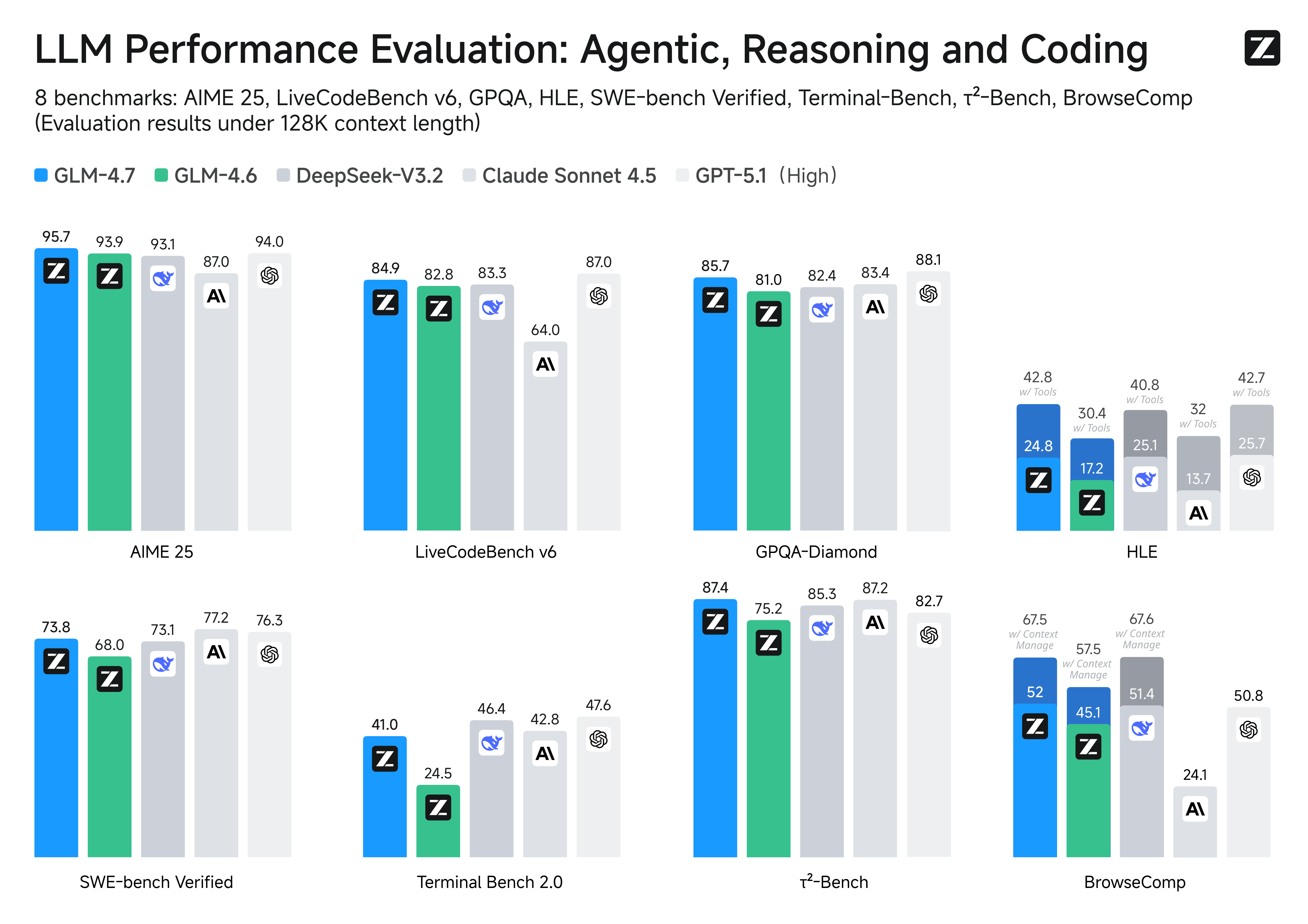
GLM-4.7 benchmark comparisons across reasoning, coding, and agent tasks
Key Features
| Feature | Description | Impact |
|---|---|---|
| Core Coding | Multilingual agentic coding and terminal tasks | 73.8% on SWE-bench (+5.8% vs GLM-4.6) |
| Vibe Coding | Improved UI quality for web/slide generation | Cleaner, modern designs |
| Tool Using | Enhanced function calling and web browsing | 87.4% on τ²-Bench |
| Complex Reasoning | Mathematical and logical reasoning | 42.8% on HLE (+12.4%) |
Benchmark Results
GLM-4.7 competes head-to-head with the latest models from OpenAI, Anthropic, Google, and others:
| Benchmark | GLM-4.7 | GLM-4.6 | GPT-5-High | GPT-5.1-High | Claude Sonnet 4.5 | Gemini 3.0 Pro |
|---|---|---|---|---|---|---|
| MMLU-Pro | 84.3 | 83.2 | 87.5 | 87.0 | 88.2 | 90.1 |
| GPQA-Diamond | 85.7 | 81.0 | 85.7 | 88.1 | 83.4 | 91.9 |
| HLE (w/ Tools) | 42.8 | 30.4 | 35.2 | 42.7 | 32.0 | 45.8 |
| AIME 2025 | 95.7 | 93.9 | 94.6 | 94.0 | 87.0 | 95.0 |
| HMMT Feb. 2025 | 97.1 | 89.2 | 88.3 | 96.3 | 79.2 | 97.5 |
| LiveCodeBench-v6 | 84.9 | 82.8 | 87.0 | 87.0 | 64.0 | 90.7 |
| SWE-bench Verified | 73.8 | 68.0 | 74.9 | 76.3 | 77.2 | 76.2 |
| SWE-bench Multilingual | 66.7 | 53.8 | 55.3 | - | 68.0 | - |
| Terminal Bench 2.0 | 41.0 | 24.5 | 35.2 | 47.6 | 42.8 | 54.2 |
| τ²-Bench | 87.4 | 75.2 | 82.4 | 82.7 | 87.2 | 90.7 |
Key Insight: GLM-4.7 excels in mathematical reasoning (AIME, HMMT) and agentic tasks (SWE-bench Multilingual), while Gemini 3.0 Pro leads in general knowledge benchmarks.
Interleaved Thinking Architecture
What sets GLM-4.7 apart is its thinking architecture:
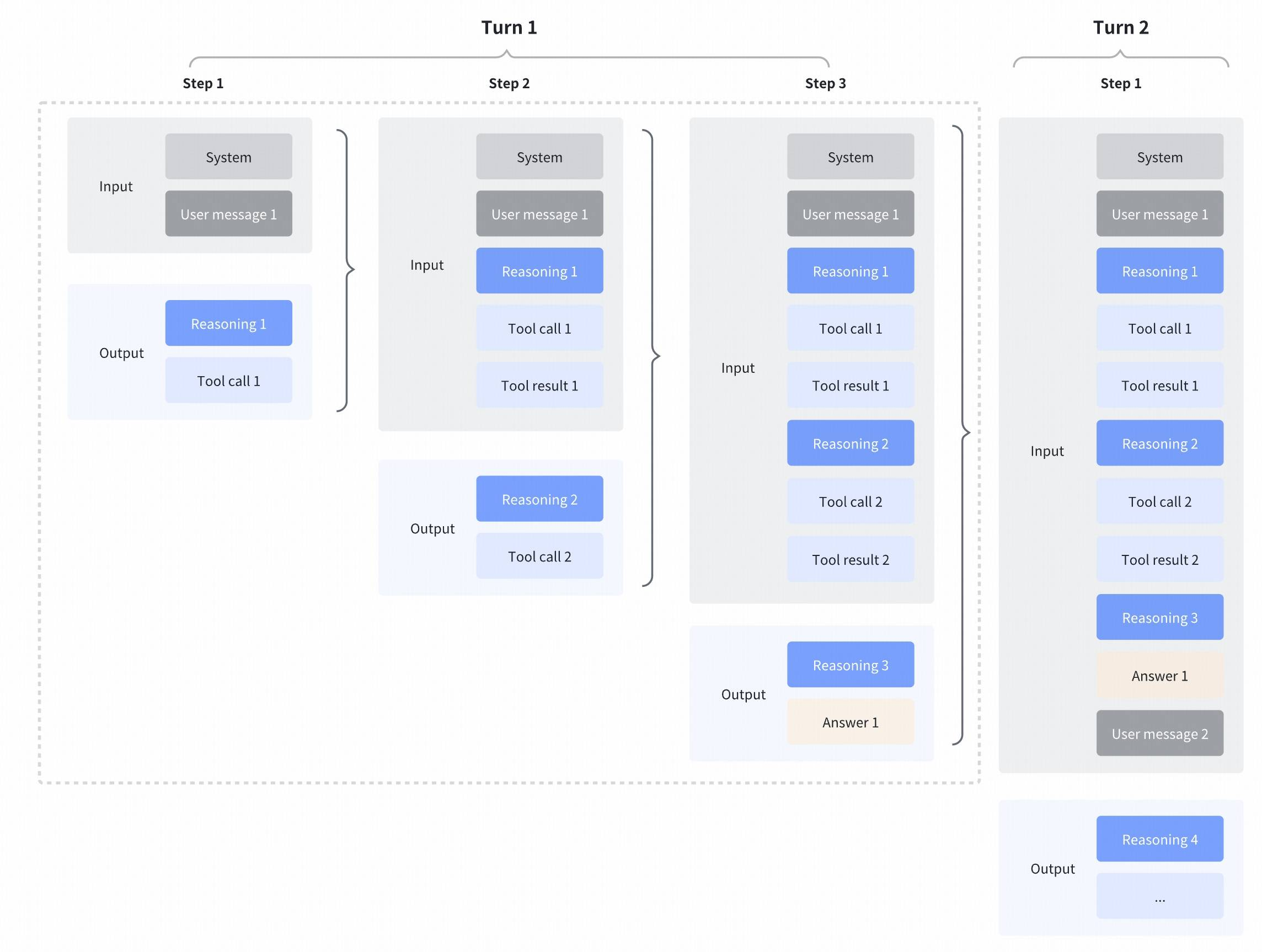 Interleaved, Preserved, and Turn-level Thinking modes
flowchart TB
    subgraph Input["User Request"]
        A[Complex Coding Task]
    end

    subgraph Thinking["🧠 Thinking Modes"]
        B["Interleaved Thinking<br/>Think before every action"]
        C["Preserved Thinking<br/>Retain context across turns"]
        D["Turn-level Thinking<br/>Enable/disable per turn"]
    end

    subgraph Output["Model Response"]
        E[Action/Tool Call]
        F[Code Generation]
        G[Explanation]
    end

    A --> B
    B --> C
    C --> D
    D --> E
    D --> F
    D --> G

    style B fill:#ff6b6b,stroke:#c92a2a,color:#fff
    style C fill:#4ecdc4,stroke:#0a9396,color:#fff
    style D fill:#ffe66d,stroke:#f4a261,color:#000
Three Thinking Modes:
- Interleaved Thinking: The model thinks before every response and tool call, improving instruction following
- Preserved Thinking: Automatically retains thinking blocks across multi-turn conversations - critical for long-horizon tasks
- Turn-level Thinking: Per-turn control - disable for lightweight requests, enable for complex tasks
💡 Innovation: Using GLM-4.7 in Production
Getting Started with vLLM
1
2
3
4
5
6
7
8
9
10
11
12
13
# Install vLLM nightly
pip install -U vllm --pre --index-url https://pypi.org/simple \
    --extra-index-url https://wheels.vllm.ai/nightly

# Serve the model
vllm serve zai-org/GLM-4.7-FP8 \
    --tensor-parallel-size 4 \
    --speculative-config.method mtp \
    --speculative-config.num_speculative_tokens 1 \
    --tool-call-parser glm47 \
    --reasoning-parser glm45 \
    --enable-auto-tool-choice \
    --served-model-name glm-4.7-fp8
Using with Transformers
1
2
3
4
5
6
7
8
9
10
11
12
13
14
15
16
17
18
19
20
21
22
23
24
25
26
27
28
29
30
31
32
33
34
35
36
import torch
from transformers import AutoModelForCausalLM, AutoTokenizer

MODEL_PATH = "zai-org/GLM-4.7"

# Initialize tokenizer and model
tokenizer = AutoTokenizer.from_pretrained(MODEL_PATH)
model = AutoModelForCausalLM.from_pretrained(
    MODEL_PATH,
    torch_dtype=torch.bfloat16,
    device_map="auto",
)

# Create messages with thinking enabled
messages = [{"role": "user", "content": "Implement a binary search tree in Python"}]

# Tokenize with chat template
inputs = tokenizer.apply_chat_template(
    messages,
    tokenize=True,
    add_generation_prompt=True,
    return_dict=True,
    return_tensors="pt",
).to(model.device)

# Generate response
generated_ids = model.generate(
    **inputs,
    max_new_tokens=8192,
    do_sample=True,
    temperature=1.0,
    top_p=0.95,
)

output = tokenizer.decode(generated_ids[0][inputs.input_ids.shape[1]:])
print(output)
Preserved Thinking for Agent Tasks
For agentic tasks, enable Preserved Thinking mode:
1
2
3
4
5
# SGLang configuration for preserved thinking
chat_template_kwargs = {
    "enable_thinking": True,
    "clear_thinking": False  # Keep thinking across turns
}
Integration with Coding Agents
GLM-4.7 works excellently with popular coding agent frameworks:
graph LR
    A[GLM-4.7] --> B[Claude Code]
    A --> C[Kilo Code]
    A --> D[Cline]
    A --> E[Roo Code]

    B --> F[Agentic<br/>Development]
    C --> F
    D --> F
    E --> F

    style A fill:#0077b6,stroke:#03045e,color:#fff
    style F fill:#4ecdc4,stroke:#0a9396,color:#fff
Evaluation Parameters
Default Settings (Most Tasks):
temperature: 1.0top-p: 0.95max_new_tokens: 131072
Coding Tasks (SWE-bench, Terminal Bench):
temperature: 0.7top-p: 1.0max_new_tokens: 16384
τ²-Bench (Agent Tasks):
temperature: 0max_new_tokens: 16384
🎯 Key Takeaways
| Insight | Implication | Production Consideration |
|---|---|---|
| MoE Architecture | 358B params with efficient routing | Requires multi-GPU setup (TP=4 minimum) |
| Preserved Thinking | Better context retention for agents | Enable for long-horizon tasks |
| Multilingual Coding | 66.7% on SWE-bench Multilingual | Great for polyglot codebases |
| MIT License | Fully open for commercial use | No licensing concerns |
What I’d Try First
- Deploy with vLLM: Use the FP8 quantized version for faster inference
- Enable Preserved Thinking: Essential for multi-turn agentic tasks
- Integrate with existing agent frameworks: Claude Code, Cline work well
- Benchmark on your codebase: Real-world performance may vary
When to Use GLM-4.7
Good fit:
- Complex debugging across multiple files
- Code refactoring with context awareness
- Multilingual codebase maintenance
- Long-horizon agentic development tasks
Consider alternatives:
- Simple code completion (smaller models are faster)
- Real-time IDE suggestions (latency-sensitive)
- Tasks without tool use (simpler models suffice)
🤔 New Questions This Raises
- Fine-tuning potential: Can we adapt GLM-4.7 for game-specific coding patterns?
- Agent orchestration: How does it compare to multi-agent setups like Claude Code + Sonnet?
- Context window utilization: With 131K tokens, how efficiently does it use long contexts?
- Production costs: What’s the inference cost vs. API-based alternatives?
Next experiment: Benchmark GLM-4.7 against Claude Opus 4.5 on game development tasks - shader code generation, gameplay balancing scripts, and procedural content generation.
References
Official Resources:
- GLM-4.7 on Hugging Face
- Z.ai Technical Blog
- GLM-4.7 API Platform
- GLM-4.7 Chat Interface
- Z.ai Discord Community
Research Papers:
- GLM-4.5: Agentic, Reasoning, and Coding (ARC) Foundation Models (arXiv:2508.06471)
- Thinking Mode Documentation
- Claude Opus 4.5 System Card (τ²-Bench fixes)
Code & Implementation:
Model Variants:
Inference Providers:
Related Benchmarks:
GLM-4.7 represents a significant step forward in open-source coding agents. With its MIT license and strong benchmark performance, it’s a compelling option for production AI-assisted development workflows.