Agent/Orchestration
OpenContext - Give Your AI Assistant a Persistent Memory for Multi-Agent Workflows
A personal context store for AI agents: CLI + MCP + Desktop app to capture, search, and reuse project knowledge across agents and repos
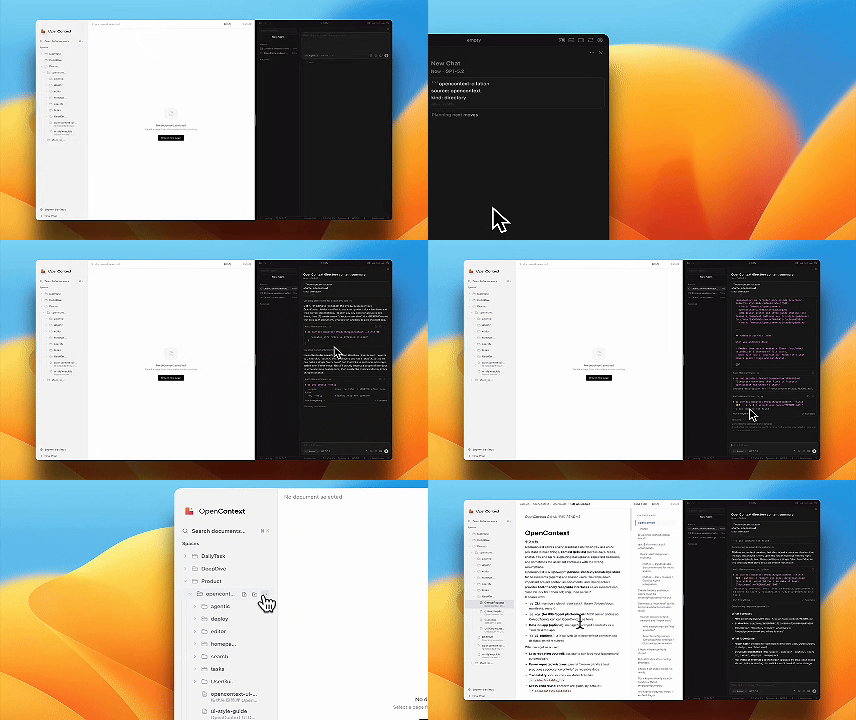
🤔 Curiosity: How Can We Give AI Agents Persistent Memory?
When building AI-powered applications, one recurring frustration stands out: context gets lost. Every new chat, every session restart, every repo switch — the AI forgets everything. You end up re-explaining your project background, repeating architectural decisions, and sometimes the assistant makes wrong assumptions because it lacks historical context.
Curiosity: What if AI agents could remember your project decisions, technical constraints, and domain knowledge across sessions, repos, and tools? How would that transform the multi-agent development workflow?
Core Question: Can we create a unified context store that works across Cursor, Claude Code, Codex, and other AI coding assistants?
📚 Retrieve: Understanding OpenContext
The Problem
| Before OpenContext | After OpenContext |
|---|---|
| 📂 Hard to share context across repos/sessions | ✅ Global context library works across all projects |
| 🤷 Your ideas can’t be quickly perceived by Agent | ✅ Agent loads your background & decisions automatically |
| 🔒 Existing knowledge can’t be operated by Coding Agent | ✅ Agent can directly read/write your knowledge base |
What is OpenContext?
OpenContext is a lightweight personal context/knowledge store for AI assistants and coding tools. It enables the paradigm:
“Load history first, then act; ship, then persist.”
The tool provides:
ocCLI — manage a globalcontexts/library (folders/docs, manifests, search)- MCP Server — so Cursor/Claude Code/Codex/Agents can call OpenContext as tools
- Skills + Slash Commands — user-level skills for Cursor/Claude Code/Codex
- Desktop App — manage/search/edit contexts with a native UI
- Web UI — browse/edit contexts locally (no install required)
Multi-Agent Integration Architecture
graph TB
    subgraph OpenContext["OpenContext Multi-Agent System"]
        A[User Context] --> B[OpenContext Store]

        B --> C[Cursor Agent]
        B --> D[Claude Code Agent]
        B --> E[Codex Agent]
        B --> F[Custom MCP Agents]

        C --> C1[opencontext-context]
        C --> C2[opencontext-search]
        C --> C3[opencontext-create]
        C --> C4[opencontext-iterate]

        D --> D1[Context Loading]
        D --> D2[Knowledge Search]
        D --> D3[Doc Creation]
        D --> D4[Insight Persistence]

        E --> E1[Skill-based Access]
        E --> E2[Tool Integration]

        F --> F1[MCP Protocol]
        F --> F2[Custom Tools]

        C1 --> G[Shared Knowledge Base]
        C2 --> G
        D1 --> G
        D2 --> G
        E1 --> G
        F1 --> G

        G --> H[Persistent AI Memory]
    end

    style B fill:#ff6b6b,stroke:#c92a2a,stroke-width:3px,color:#fff
    style G fill:#4ecdc4,stroke:#0a9396,stroke-width:2px,color:#fff
    style H fill:#ffe66d,stroke:#f4a261,stroke-width:2px,color:#000
💡 Innovation: Setting Up Multi-Agent Context Management
Quick Start (30 Seconds)
1
2
3
4
5
6
7
8
9
10
11
12
# 1. Install CLI
npm install -g @aicontextlab/cli

# 2. Initialize (prompts for tool setup; defaults to all)
cd your-project
oc init

# 3. Use slash commands (Cursor + Claude Code)
# /opencontext-context — load background before working
# /opencontext-search — find relevant docs
# /opencontext-create — create a new doc
# /opencontext-iterate — persist what you learned
Installed Components by oc init
| Component | Location | Purpose |
|---|---|---|
| Cursor Commands | ~/.cursor/commands | Slash commands for context operations |
| Claude Code Commands | ~/.claude/commands | Slash commands integration |
| Cursor Skills | ~/.cursor/skills/opencontext-*/SKILL.md | User-level skill definitions |
| Claude Code Skills | ~/.claude/skills/opencontext-*/SKILL.md | Skill-based context access |
| Codex Skills | ~/.codex/skills/opencontext-*/SKILL.md | Codex skill integration |
| MCP Config | ~/.cursor/mcp.json, ~/.claude/mcp.json | MCP server configuration |
CLI Commands Reference
| Command | What it does |
|---|---|
oc init | Initialize OpenContext + user-level tool integrations |
oc folder ls | List folders |
oc folder create <path> -d "desc" | Create a folder |
oc doc create <folder> <name>.md -d "desc" | Create a document |
oc doc ls <folder> | List documents |
oc context manifest <folder> | Generate file list for AI to read |
oc search "query" | Search documents |
oc mcp | Start MCP server for MCP clients |
oc ui | Start local Web UI |
🛠️ Integrating with Multi-Agent Workflows
Workflow Pattern: Context-First Development
flowchart LR
    subgraph BeforeWork["Before Work"]
        A1[opencontext-context]
        A2[Load project background]
    end

    subgraph DuringWork["During Work"]
        B1[opencontext-search]
        B2[Search existing conclusions]
    end

    subgraph AfterWork["After Work"]
        C1[opencontext-iterate]
        C2[Record decisions]
    end

    A1 --> A2
    A2 --> B1
    B1 --> B2
    B2 --> C1
    C1 --> C2
    C2 -.-> A1

    style A1 fill:#ff6b6b,stroke:#c92a2a,stroke-width:2px,color:#fff
    style B1 fill:#4ecdc4,stroke:#0a9396,stroke-width:2px,color:#fff
    style C1 fill:#ffe66d,stroke:#f4a261,stroke-width:2px,color:#000
Slash Commands Deep Dive
| Command | Description | Best For |
|---|---|---|
/opencontext-help | Not sure which to use? Start here | New users |
/opencontext-context | (Safe default) Load background before working | Starting any task |
/opencontext-search | Discover existing docs (no auto index build) | Finding prior decisions |
/opencontext-create | Draft a new doc/idea | Capturing new knowledge |
/opencontext-iterate | Persist conclusions & citations | Ending sessions |
Pro tip: Persist “acceptance criteria / common pitfalls / API contracts / dependency versions” as docs — highest ROI.
📊 Desktop App Features
For visual users who prefer a native UI:
Key Capabilities
- Create folders and docs — Organize by project or topic
- Search with
Cmd/Ctrl + K— Searches titles, descriptions, and content - Semantic search — Configure API Key in Settings → Embedding (auto-indexed)
- Cite to agents — Copy citations directly to Cursor/Claude/Agent
Citation Options
| Action | Steps | Effect |
|---|---|---|
| Cite text snippet | Select text → Right-click → “Copy Citation” | Agent reads snippet + source |
| Cite document | Click citation icon next to doc title | Agent gets full doc + stable_id |
| Cite folder | Right-click folder → “Copy Folder Citation” | Agent batch-reads all docs inside |
🔧 Search Configuration
Search Modes
| Mode | Flag | Requirements |
|---|---|---|
| Keyword | --mode keyword | No embeddings needed |
| Vector | --mode vector | Requires embeddings + index |
| Hybrid | --mode hybrid | Requires embeddings + index (default) |
Enabling Semantic Search (CLI)
1
2
3
4
5
6
7
8
9
10
11
# 1. Set API Key
oc config set EMBEDDING_API_KEY "<your_key>"

# 2. (Optional) Set base URL
oc config set EMBEDDING_API_BASE "https://api.openai.com/v1"

# 3. (Optional) Set Model
oc config set EMBEDDING_MODEL "text-embedding-3-small"

# 4. Build Index
oc index build
Warning: The
oc index buildcommand may use paid APIs. AI assistants are NOT allowed to auto-run it by default.
🤖 MCP Server Integration
OpenContext runs as a standard MCP (Model Context Protocol) server using stdio:
1
2
3
4
5
6
7
# Start manually
oc mcp

# User-level config locations:
# - Cursor: ~/.cursor/mcp.json
# - Claude Code: ~/.claude/mcp.json
# - Codex: ~/.codex/mcp.json
Example mcp.json Configuration
1
2
3
4
5
6
7
8
{
  "mcpServers": {
    "opencontext": {
      "command": "npx",
      "args": ["@aicontextlab/cli", "mcp"]
    }
  }
}
📈 Performance Comparison: With vs Without Context Store
| Metric | Without OpenContext | With OpenContext | Improvement |
|---|---|---|---|
| Context Re-explanation | Every session | Once | ⬇️ 95% |
| Decision Consistency | Variable | Tracked | ⬆️ High |
| Cross-repo Knowledge | Manual | Automatic | ⬆️ Seamless |
| Onboarding Time | Hours per project | Minutes | ⬇️ 80% |
| Agent Accuracy | Context-limited | Context-enriched | ⬆️ Significant |
🎯 Best Practices for Multi-Agent Context
What to Persist
| Document Type | Example Content | ROI |
|---|---|---|
| Acceptance Criteria | Feature requirements, success metrics | ⭐⭐⭐ |
| Common Pitfalls | Known bugs, edge cases, gotchas | ⭐⭐⭐ |
| API Contracts | Endpoint specs, data formats | ⭐⭐ |
| Dependency Versions | Lock file summaries, upgrade notes | ⭐⭐ |
| Architecture Decisions | ADRs, design rationale | ⭐⭐ |
| Domain Knowledge | Business logic, terminology | ⭐⭐⭐ |
Folder Organization Example
1
2
3
4
5
6
7
8
9
10
11
12
13
14
15
~/.opencontext/contexts/
├── personal/
│   ├── preferences.md
│   └── coding-style.md
├── project-frontend/
│   ├── architecture.md
│   ├── component-patterns.md
│   └── known-issues.md
├── project-backend/
│   ├── api-design.md
│   ├── database-schema.md
│   └── deployment-notes.md
└── shared/
    ├── team-conventions.md
    └── dependency-policies.md
🚀 Environment Configuration
Default Paths
| Purpose | Default Location |
|---|---|
| Contexts | ~/.opencontext/contexts |
| Database | ~/.opencontext/opencontext.db |
Override with Environment Variables
1
2
export OPENCONTEXT_CONTEXTS_ROOT="/path/to/contexts"
export OPENCONTEXT_DB_PATH="/path/to/opencontext.db"
🤔 New Questions This Raises
- Automatic Context Extraction: Can agents automatically identify and persist important decisions from conversations?
- Context Versioning: How do we handle context evolution and maintain historical snapshots?
- Team Collaboration: Can multiple developers share and sync context across a team?
- Domain-Specific Templates: What context structures work best for different project types (web app, mobile, ML, etc.)?
- Context Quality: How do we measure and improve the quality of persisted context?
Next Experiment: Building automated context extraction from conversation history using multi-agent orchestration.
References
Official Resources:
- OpenContext GitHub Repository
- OpenContext Usage Guide
- OpenContext Website
- NPM Package: @aicontextlab/cli
Related Tools & Frameworks:
Multi-Agent Systems:
Context Management Research:
- RAG: Retrieval-Augmented Generation
- Long-term Memory for LLMs
- Building Effective AI Agents (Anthropic)
Production Resources: