AI
SoL-Pi's Capability Floor Is Per Mechanism, Not Per Harness
Source Audit of NVlabs/SoL-Pi: a per-mechanism capability gate permits losses that accumulate until the assembled harness retains roughly 94% of Pi’s EdgeBench average.
What does “without getting less done” have to survive?
NVlabs/SoL-Pi is eleven days old and already carries 1,608 stars. It is MIT-licensed TypeScript, created on 2026-09-02, and the README frames it as an add-on rather than a replacement: “a standalone extension for Pi” and “not an official distribution of Pi.” The research page is less cautious and calls SoL-Pi an agent harness in its own right — which is the first place the two scopes in this article drift apart. Four efficiency mechanisms — Action Fusion, ObservationPack, Evidence-Preserving Reducer, and Online Context Compact — install on top of an unmodified Pi release, and every one is disabled by default.
The pitch is a promise about what the savings must not cost. The research page leads with “Spend less without getting less done.” The README says the same thing in longer form: spend less “without making the agent do less useful work.”
That is a falsifiable promise, and the project publishes enough to test it. So I read the tree at d7ecfc08, the research page, and the benchmark the numbers rest on.
The promise holds one mechanism at a time. The page says so itself, and in the very next sentence says the gate rules out “getting less done.”
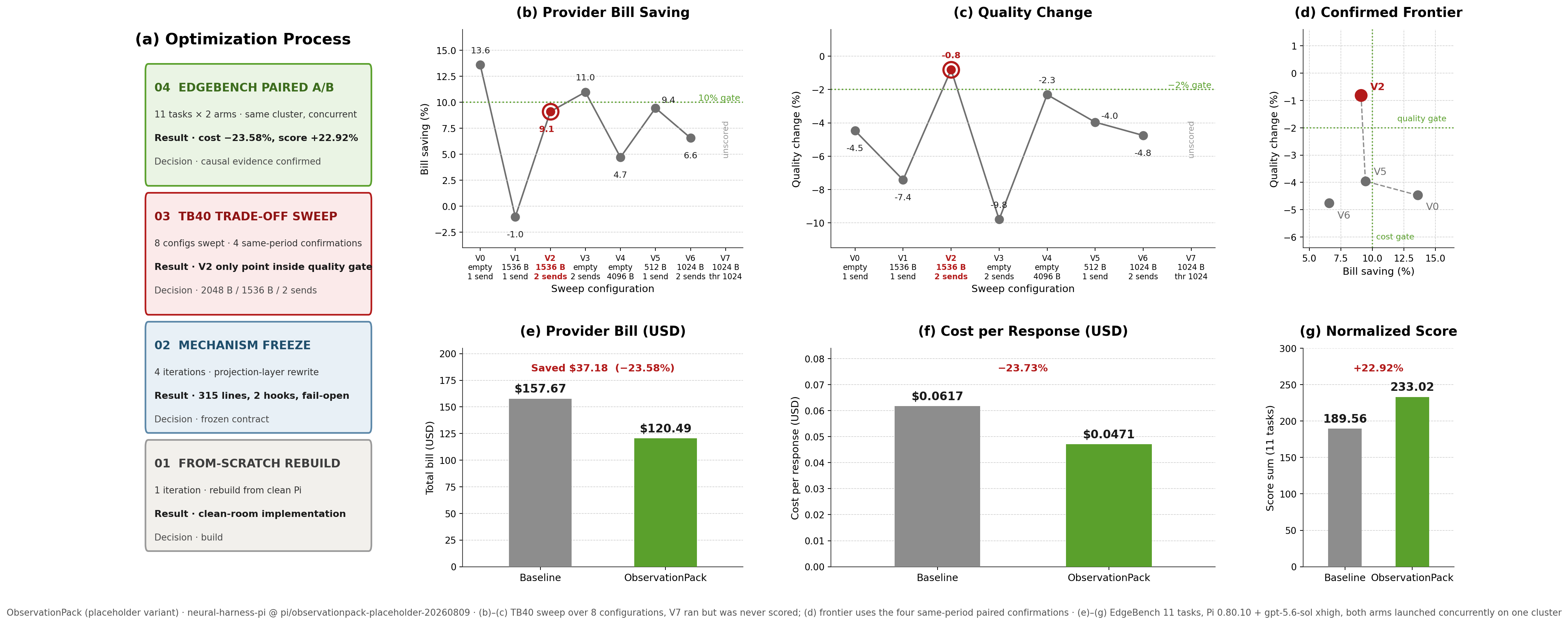
neural-harness-pi at a ref that is not publicly available, on Pi 0.80.10, over 11 EdgeBench tasks — Image from NVlabs/SoL-Pi (MIT), commit d7ecfc08. Source: https://nvlabs.github.io/SoL-Pi/. Publisher: NVlabs (NVlabs/SoL-Pi). Licence: MIT.Technical Analysis: Reading the gate, then the totals
The gate is predeclared, and it is per mechanism
SoL-Pi’s search is not “make it cheaper.” The page defines constrained efficiency: reductions in cost or token use “subject to a predeclared capability-preservation criterion.” A candidate fails “if it saves by stopping early, skipping necessary verification, or removing evidence required to finish the task.” Each loop applies two acceptance gates; the first requires every capability metric to stay within its predeclared tolerance.
Then comes the sentence that this audit is built on:
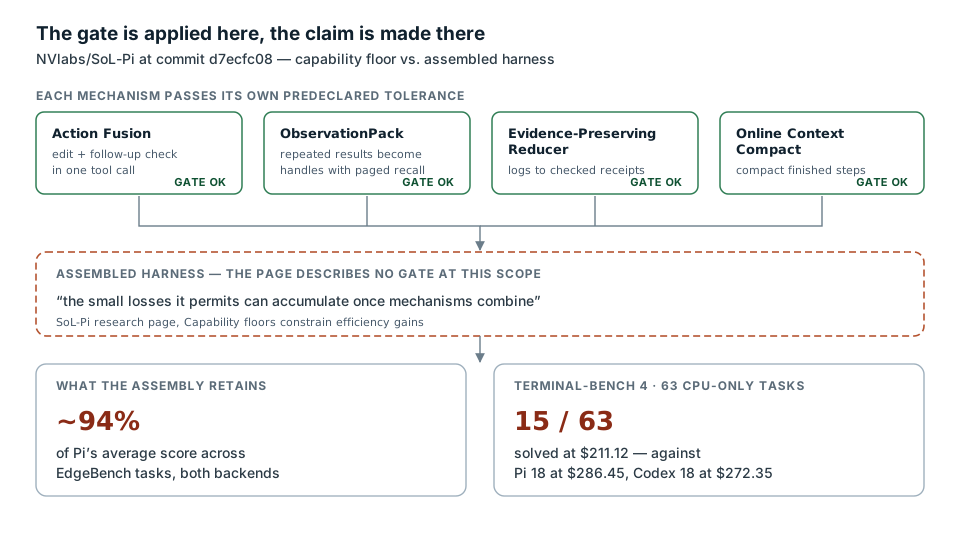
The gate applies to one mechanism at a time, so the small losses it permits can accumulate once mechanisms combine: the assembled harness retains roughly 94% of Pi’s average score. What the gate rules out is savings that come from getting less done.
Both halves are on the same page, in the same paragraph. The first states that composition costs about six percent of average score across EdgeBench tasks, on both model backends. The second states that the gate rules out getting less done. Read together, “getting less done” has quietly been redefined as getting less done for the wrong reason — a tolerance question, not an outcome question.
That is a defensible engineering position. It is not what the hero line promises a reader who never scrolls this far.
| Scope | What is measured or promised | Where it is stated |
|---|---|---|
| One mechanism | stays inside a predeclared capability tolerance | research page, Capability floors constrain efficiency gains |
| Assembled harness | retains roughly 94% of Pi’s average score across EdgeBench tasks, on both model backends | capability-floor paragraph; the scope wording is in Results |
| Whole product | “Spend less without getting less done” | research page hero |
| Shipped artifact | Pi 0.84.2 required by the install instructions | README.md, Requirements |
| Measured artifact | placeholder variant on Pi 0.80.10, 11 EdgeBench tasks | footer of the ObservationPack panel |
The totals, where the reader can check them
The efficiency side is stated plainly. Against Pi, the page reports 45–49% fewer tokens and about one-third lower cost; against the model-native harnesses, 35–64% fewer tokens at list-price API cost 50–54% lower. The headline converts that to money, scoped by the page to “a professional researcher working on a single problem”: SoL-Pi saves “$8.75–$13.50 per hour” against native Codex and Claude Code harnesses and “$4.36–$5.71 per hour” against Pi. A footnote in the same section says the range “reflects the model backend and is calculated using official API-equivalent pricing” — a price model applied to measured token counts, not an invoice.
The capability cost shows up again on a second benchmark, at a different scale and on a different metric. The page reports:
On 63 CPU-only tasks, Codex solves 18 at $272.35, Pi solves 18 at $286.45, and SoL-Pi solves 15 at $211.12.
Fifteen against eighteen is three tasks, or about 17% fewer solved, for roughly 26% less money than Pi. Whether that trade is good depends entirely on what a task is worth, which is a judgement the reader has to make — and can only make because the project published the losing number beside the winning one. It did not have to.

What the headline chart was actually measured on
The research overview panel is the most detailed result artifact on the page, and its own footer is the most useful sentence on it:
ObservationPack (placeholder variant) · neural-harness-pi @ pi/observationpack-placeholder-20260809 · (b)–(c) TB40 sweep over 8 configurations, V7 ran but was never scored; (d) frontier uses the four same-period paired confirmations · (e)–(g) EdgeBench 11 tasks, Pi 0.80.10 + gpt-5.6-sol xhigh, both arms launched concurrently on one cluster
Four facts follow from that line, and each is checkable.
The measured code is labelled a placeholder variant, living in neural-harness-pi at a ref that is not publicly available. https://api.github.com/repos/NVlabs/neural-harness-pi returns 404 unauthenticated. The public repository is a different tree: 23 source files under src/sol-pi/ and 19 test files, organised as four extension directories.
The measured substrate is Pi 0.80.10. The README of the release you can install requires @earendil-works/pi-coding-agent 0.84.2. The numbers on the front page were not produced by the thing the install instructions give you.
The paired experiment used 11 tasks, not 51 and not 134. EdgeBench is described on SoL-Pi’s page as “a 51-task suite… we reserve its tasks, verifiers, and feedback for final held-out evaluation.” The benchmark’s own site is more specific: it is a ByteDance Seed suite of 134 day-long tasks across six capability families, each with an agent runtime of at least twelve hours, of which “an initial 51 of the 134 tasks” are released. SoL-Pi’s 51 is the public subset, correctly cited; the headline paired run is 11 tasks.
And the footer volunteers that V7 ran but was never scored — a disclosure result panels often omit.
The composition boundary in the code
The four mechanisms are independent by construction, and the README states the rules: no Pi patches, explicit opt-in, preserve evidence, and use Pi’s runtime choices for authentication, provider URLs, the main model, and shell behaviour. Each lives in its own directory under src/sol-pi/extensions/ and composes through Pi’s public extension APIs.
That independence is exactly why the gate cannot see the sum. A tolerance applied to Action Fusion knows nothing about what ObservationPack already spent from the same budget. The page’s own sentence is the honest description of the consequence, and the 94% figure is the measured size of it.
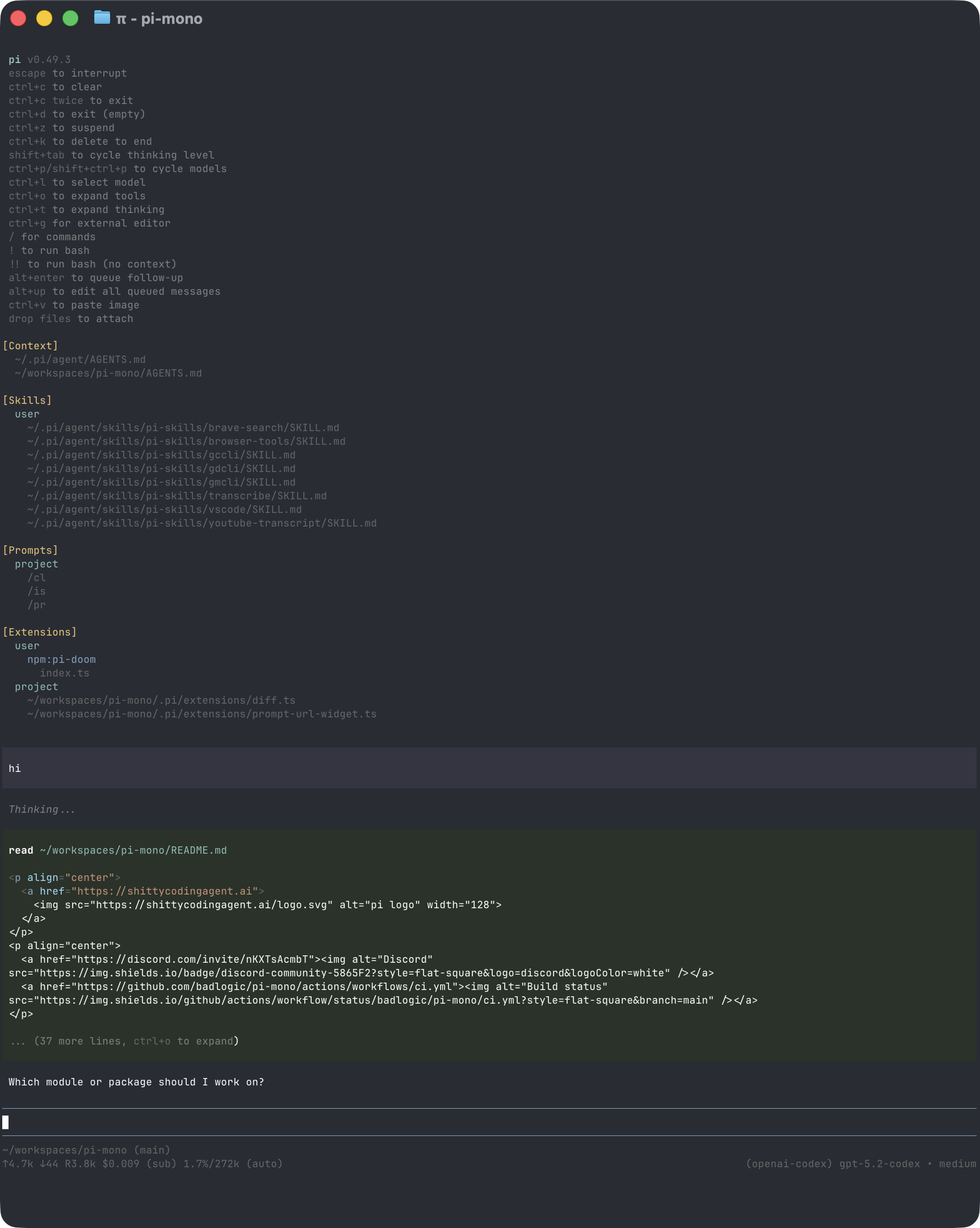
.pi/extensions directory, and its status line already reports the token counters, dollar cost and context-window pressure that SoL-Pi sets out to reduce — Image from earendil-works/pi (MIT), commit 71dca871. Source: https://github.com/earendil-works/pi. Publisher: Mario Zechner (earendil-works/pi). Licence: MIT.Per-component tolerances do not compose
The transferable lesson here has nothing to do with agents specifically. It is about where a quality gate is applied.
A tolerance is a budget, and budgets add. If each of four mechanisms may cost up to some small amount of capability and each is judged alone, the system has authorised four withdrawals against one account that nobody reconciles. SoL-Pi’s page reports the reconciliation as roughly 94% of Pi’s average score across EdgeBench tasks, on both model backends. The fix is not a stricter per-mechanism gate — that would reject good mechanisms — but a second gate on the assembled harness, which is a different experiment with a different cost.
The claim and the gate must share a scope. “Spend less without getting less done” is a claim about the harness. The capability floor is a criterion about a mechanism. Any promise stated at the system level needs a measurement at the system level, or the promise silently becomes a promise about components.
Publishing the losing number is the thing that makes the rest credible. Nothing in this audit required inference. The 94% sentence, the 15-of-63 line, the placeholder label, the unscored V7, the Pi version, and the 11-task scope are all printed by the project. That is rarer than it should be, and it is why a reader can form a view at all rather than taking a bar chart on faith.
Version-pin your evidence to the artifact you ship. A result measured on Pi 0.80.10 and an install that requires Pi 0.84.2 are two different systems. This is the same failure surface as a published number whose guard never reads the file a reader opens — see ripwire Guards Its Gate Count in Source, Not in the PDF, where the guarded source and the shipped artifact disagreed for the same structural reason.
Key Takeaways
- SoL-Pi’s capability floor is applied to one mechanism at a time. The project states that the permitted losses accumulate and that the assembled harness retains roughly 94% of Pi’s average score across EdgeBench tasks, on both model backends.
- On 63 Terminal-Bench 4 CPU-only tasks the page reports SoL-Pi 15 solved at $211.12 against Pi 18 at $286.45 and Codex 18 at $272.35 — cheaper, and three tasks short.
- The dollar headline ($8.75–$13.50/hr vs native harnesses, $4.36–$5.71/hr vs Pi) is an API-equivalent price model applied to token counts, not a billed amount; the asterisk says so.
- The flagship ObservationPack panel was measured on a placeholder variant in a private
neural-harness-piref, on Pi 0.80.10, over 11 EdgeBench tasks — while the public release requires Pi 0.84.2. - EdgeBench is a third-party ByteDance Seed suite of 134 day-long tasks with an initial 51 released; SoL-Pi treats it as held out and says so.
- Generalisable rule: a claim stated about a system needs a gate measured on that system. Per-component tolerances are budgets, and budgets add.
New Questions This Raises
- What would an assembled-harness capability gate cost to run, and is there a cheaper proxy that still catches accumulation across four mechanisms?
- Would the 94% figure move if the mechanisms were enabled in a different order, or is the loss roughly additive regardless of composition order?
- SoL-Pi solves fewer Terminal-Bench 4 tasks but is cheaper per solved task only if the unsolved three are worth less than the saving. Is there a task class where the loss concentrates?
- The public tree is not the measured tree. Would re-running the paired EdgeBench experiment with the released extension on Pi 0.84.2 reproduce −23.58% and +22.92%?
Limitations
This is a static audit of the pinned tree at d7ecfc08 and the project’s published research page as read on 2026-09-14. I did not install SoL-Pi, run Pi, execute EdgeBench or Terminal-Bench 4, or reproduce any measurement, so I make no claim that any published figure is wrong — only about what is claimed, at what scope, and against which artifact. Every figure quoted here is the project’s own, or ByteDance Seed’s own for EdgeBench’s structure. The 404 statement is scoped to an unauthenticated GitHub API lookup of one exact repository name; private repositories return 404 to anonymous callers, so the correct reading is “not publicly available”, not “does not exist”. The reading of the 94% sentence is mine: the project may intend “getting less done” narrowly, as a statement about causes rather than outcomes, and the article argues that the hero line does not carry that qualification. Star counts and page wording are retrieval-time observations, and this repository is eleven days old and moving quickly.
References
Primary sources (pinned at d7ecfc08)
- NVlabs/SoL-Pi @ d7ecfc08 — audited tree
- README.md — extension note, four mechanisms, shared rules, Pi 0.84.2 requirement
- src/sol-pi/extensions — the four mechanism directories
- LICENSE — MIT
- SoL-Pi research page — capability floor, 94% sentence, Terminal-Bench 4 totals, hourly savings, chart footer
- GitHub API: NVlabs/SoL-Pi — repository metadata at retrieval
Benchmark and substrate
- ByteDance-Seed/EdgeBench @ 668c7d45 — Apache-2.0; the held-out suite
- edge-bench.org — 134 tasks across six families, initial 51 released
- earendil-works/pi @ 71dca871 — MIT; the harness SoL-Pi extends
Related on this site
Editorial method: claims in this article point to primary documentation, pinned source code, runnable checks, or dated measurements, with AI-assisted research under the site's evidence-gated policy. How this site verifies claims and discloses AI assistance · Report a correction.
Working on something like this?
I take a small number of paid, scoped reviews: AI agent/RAG architecture diagnosis, Unity CI & build-automation audits, and multimodal QA design review. Each one ends in a written findings document.
Work with me