AI
ripwire Guards Its Gate Count in Source, Not in the PDF
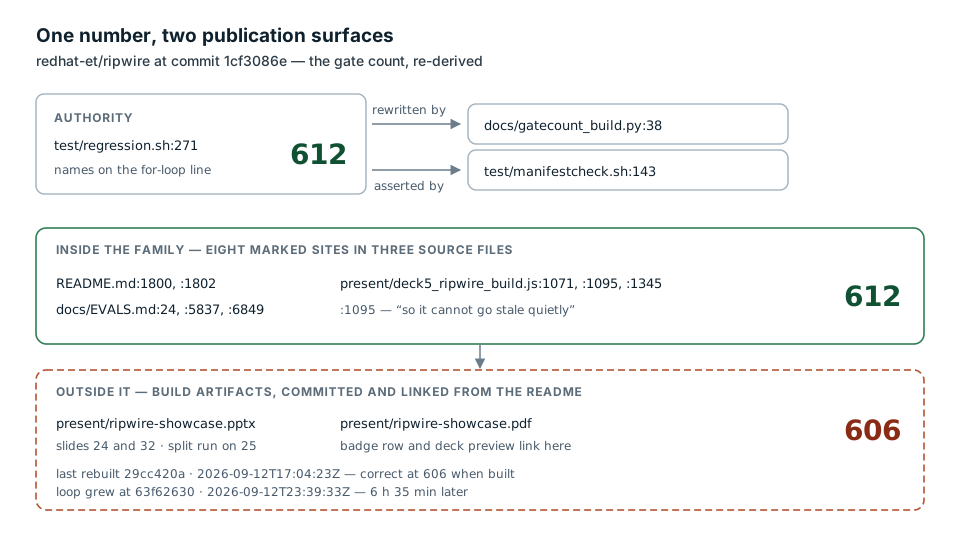
Source Audit of redhat-et/ripwire at 1cf3086e: the gate count reads 612 in three guarded source files and 606 in the committed showcase deck the README links.
If a project gates its own numbers, where can one still go stale?
redhat-et/ripwire does not ask you to take its figures on trust, and it says so loudly. It is a C++23 CLI and MCP server the project calls zero-dependency — every dependency is vendored in-tree — and it hands a coding agent a ranked call graph instead of letting it grep around. Its pitch is not only speed. It is that every number it publishes has a committed instrument behind it. The repository is Apache-2.0, was created on 2026-07-29, and at retrieval carried 1,928 stars with a push timestamped 2026-09-13T03:07:28Z.
That is an unusual promise, and unlike most promises it is checkable. So I checked one number: how many gate scripts the suite runs. It appears on the front page, in the evaluation docs, and on the showcase deck. The deck prints it directly above the line “the COUNT itself is gated against the runner’s own loop, so it cannot go stale quietly.”
At commit 1cf3086e that sentence is true of three files and false of two.
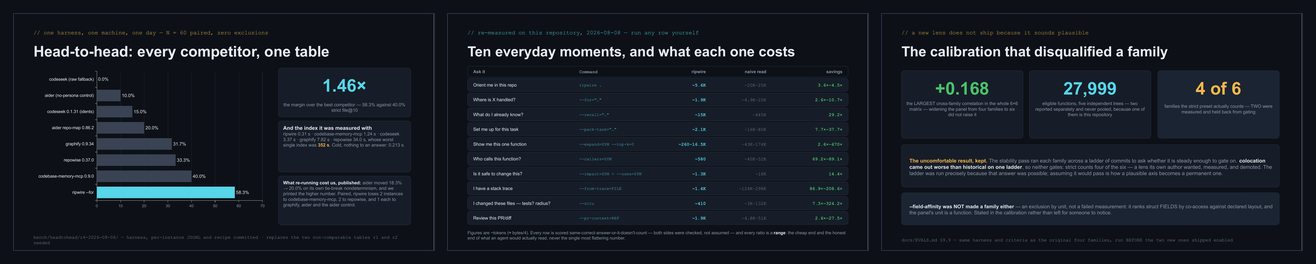
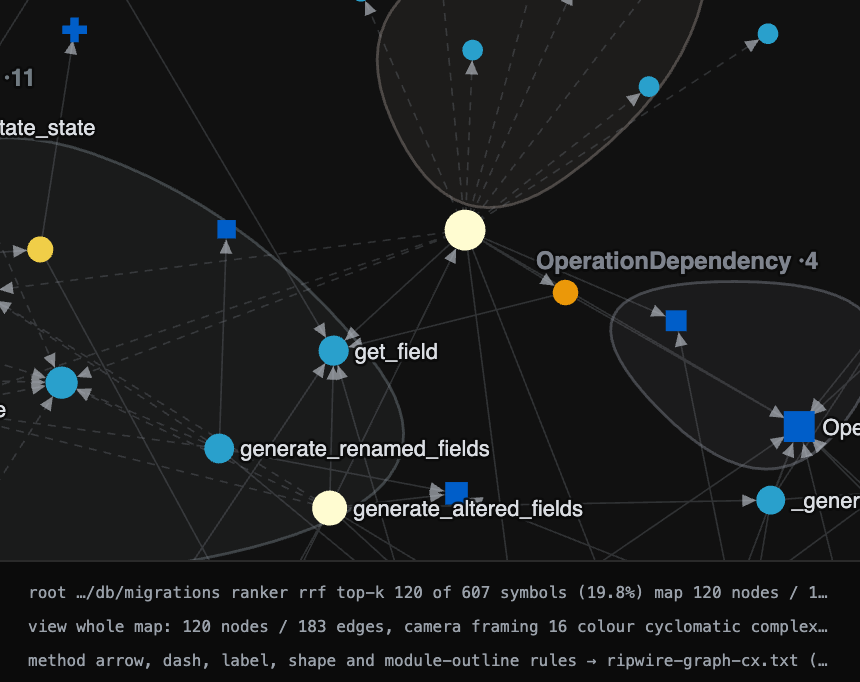
present/ripwire-showcase.pdf; the PDF behind this image is the artifact that still states 606 — Image from redhat-et/ripwire (Apache-2.0), commit 1cf3086e. Source: https://github.com/redhat-et/ripwire/blob/1cf3086e8f7c1eb67368bca90a86e5438d911517/README.md. Publisher: redhat-et (redhat-et/ripwire). Licence: Apache-2.0.Technical Analysis: Counting the same number on five surfaces
I cloned the tree at 1cf3086e, counted the authority myself, read each stated surface at its line, and extracted the text of both committed binaries. Every figure below is a recount, not a quotation of the project’s own summary.
The authority is one line
The gate list is a single for loop. At test/regression.sh:271, for _g in a9disclosurecheck abicheck accessshapecheck … carries 612 whitespace-separated names. That line is the definition of the number; everything else is a restatement of it.
The three surfaces that are rewritten
docs/gatecount_build.py:38 declares the rewrite targets exactly: SITES = ( 'README.md', 'docs/EVALS.md', 'present/deck5_ripwire_build.js' ). The generator derives the count from the same loop and rewrites every marked site, so the number is no longer hand-written in those files. test/manifestcheck.sh:143 then asserts the same three files independently, with gateCountSites=( "docs/EVALS.md" "README.md" "present/deck5_ripwire_build.js" ).
There are eight marked sites across those three files, and all eight read 612 at the pinned commit: README.md:1800 and :1802; docs/EVALS.md:24, :5837 and :6849; and present/deck5_ripwire_build.js:1071, :1095 and :1345. Each carries a <!-- gatecount --> or // gatecount marker so the generator can find it — test/gatecountcheck.sh:5 and test/manifestcheck.sh:136 both say eight.
Two derivations of one number from one loop is deliberate redundancy, and it holds for seven of those eight. The generator recognises three spellings; manifestcheck.sh:145 calls its own scan “BOTH spellings” and implements two of them. The third — (?<=loop in \test/regression.sh` names )[0-9]+ — is used at exactly one site, docs/EVALS.md:6849, so that line is written by the generator and checked only by the generator's own –check, which test/gatecountcheck.sh:51` shells out to. One number, one derivation, at the site nobody quotes.
Line 1095 of the generator is the one worth reading in full:
1
stat(s, "612", "gate scripts named by test/regression.sh — and the COUNT itself is gated against the runner's own loop, so it cannot go stale quietly", // gatecount
The two surfaces that are not
present/ripwire-showcase.pdf and present/ripwire-showcase.pptx are committed build artifacts of that generator. The README links the PDF twice on the way in: from the badge row at README.md:8, as a slides badge labelled “the showcase deck”, and at README.md:798, where the deck-preview image above is itself an anchor to the PDF.
Running pdftotext over the committed PDF gives 606 gate scripts at two places, and at the stat slide the figure 606 sits immediately above that same “so it cannot go stale quietly” label. unzip -p 'ppt/slides/*.xml' over the PPTX matches 606 gate scripts on slides 24 and 32; slide 25 carries 606 as a standalone stat figure with its label in a separate run, which is the same split-argument shape the prose spelling cannot see. On the deck’s “Every claim, and the command that re-derives it” slide, the row reads 606 gate scripts beside bash test/manifestcheck.sh — a claim naming an instrument that did not produce it.
The artifact was right when it was built
This is not sloppiness, and the timeline says so. Asking the GitHub API which commit last touched each path at 1cf3086e:
| Path | Last changed by | Committed |
|---|---|---|
present/ripwire-showcase.pdf | 29cc420a | 2026-09-12T17:04:23Z |
present/ripwire-showcase.pptx | 29cc420a | 2026-09-12T17:04:23Z |
present/deck5_ripwire_build.js | 63f62630 | 2026-09-12T23:39:33Z |
test/regression.sh | 63f62630 | 2026-09-12T23:39:33Z |
Fetching test/regression.sh at 29cc420a and counting the loop again returns 606, and README.md at that commit also says 606. The deck was accurate at the moment it was exported. Six hours and thirty-five minutes later the loop grew by six, the generator and the three source files moved together, and the two binaries stayed behind. The drift did not come from a wrong number being typed. It came from a correct number being frozen into a file the rewrite does not reach.
present/README.md explains why the freeze is possible: the rebuild is a local manual step — npm install, node deck5_ripwire_build.js, then soffice --headless --convert-to pdf or a PowerPoint export. Neither .github/workflows/ci.yml nor release.yml mentions the deck, the pptx, LibreOffice or the present/ directory, so no job regenerates them on push.
The suite already knows how to read the artifact
The most interesting part is that the capability is not missing. test/deckcheck.sh states the boundary as a design decision in its header: the built artifacts “are NOT scanned (same rule as docs/COMMANDS.md: gate the generator, not its output) — and they cannot be, being binary.”
A sibling gate in the same suite disagrees with that last clause. test/ripwirepubliccheck.sh:106–134 loops over present/ripwire-showcase.pdf and present/ripwire-showcase.pptx, extracts their text with pdftotext and unzip -p 'ppt/slides/*.xml', and greps five scrub classes — home paths, temp paths, internal document names, internal document headings and e-mail addresses — over what it extracts. When the extractor is absent it prints SKIP … (NOT a pass) rather than passing quietly, and a mutation control feeds each class a planted string to prove the grep is not inert.
So the artifacts are opened, decoded and searched on every regression run. They are searched for leaked filesystem paths, not for a stale count. All five gates involved — manifestcheck, gatecountcheck, deckcheck, readmedriftcheck and ripwirepubliccheck — are members of the very loop whose length is at issue.
This exact drift has reached a public PDF before
test/manifestcheck.sh carries its own history in a comment, and it is unusually candid. The file list was widened on 2026-09-06 “for the third instance of exactly the drift the paragraph above describes”, and the instance it names is this one:
while the loop stood at 542 the deck’s own “every claim, and the command that re-derives it” slide said 451, in a row that NAMES THIS GATE as the command that re-derives it — a claim citing its own instrument, that the instrument had never read. The deck shipped that way through a public PDF.
The fix was to add the generator to the scanned family, then on 2026-09-10 to reconcile the whole thing with docs/gatecount_build.py so the number is written by a derivation rather than by hand. Both changes were correct. Both were applied to the generator. The published artifact was left where it was.
What else the tree publishes about itself
Two more committed files are worth naming, because they are the reason this audit could be done from the outside at all.
.ripwire_quality_acks is a suppression ledger: 1,270 ack lines, each recording a quality finding that “stays suppressed until it worsens past its acked magnitude”, with a reason written out in prose. The classes are led by short-horizon-churn (422), api-surface:new-symbol (202), api-surface (148), verbosity (135), duplication (134) and complexity (121). That ledger is what makes the project’s own quality lens checkable from outside: the suppressions are readable without running anything.
.ripwire_notes is a field-notes file, and one of its two entries is now stale in an instructive direction. Dated 2026-08-23, it warns that “README.md’s single ‘<N> gate scripts’ claim (~line 1305) is NOT enforced — the derived-vs-stated sibling loop here covers docs/EVALS.md only.” The 2026-09-06 widening closed that gap; README.md has been in gateCountSites since. The note is a dated working record rather than a published claim surface, so it is stale rather than wrong — but it shows the ledger habit cuts both ways, and that a hand-maintained note is itself a surface nothing re-derives.
A drift gate’s blast radius is its file list, not its idea
The useful lesson here is not “ripwire has a bug”. Six is a small delta on a number no reader will act on, and the project caught this failure mode twice already without anyone outside noticing. The lesson is structural, and it generalises to any repository that publishes a derived figure.
A claim-drift gate protects the population it enumerates. ripwire’s own header comments make this point better than I can: a glob that matches nothing is silent, a real file no glob covers sits unscanned, and both look green. The gate-count family was widened from one file to its siblings, then to the number’s siblings across documents. The next boundary was never a document at all — it was the format. docs/gatecount_build.py rewrites text it can parse; a PDF and a PPTX are outputs of that text, and outputs are not in SITES.
“Gate the generator, not its output” is sound only when the output is not itself published. For docs/COMMANDS.md, where the rule came from, that holds. For a deck that ships as a committed binary, linked from the badge row of the front page, the output is the surface a reader consumes — often before the README. At that point the artifact is a claim, and it needs either a gate or a build step.
The cheapest fix is the one the repository already owns. ripwirepubliccheck.sh proves the extraction path works and already runs inside the regression loop. Adding the two artifacts to the gate-count comparison would be one more arm over text the suite is already decoding. The alternative — rebuilding the deck in CI so the binary cannot lag its source — is stronger but needs LibreOffice in the runner, which is a real cost for a repository whose whole identity is that a clone builds with the network unplugged.
And a dated ledger is not a gate. .ripwire_notes recorded a gap correctly, and the gap was closed by someone reading it. That is a good outcome and an unreliable mechanism. If a note describes an enforcement hole, the note’s own staleness is the next hole.
For the mirror image of this problem — a headline number with no recountable artifact at all, rather than an artifact that recounts to the wrong value — see Gensee Crate’s Defense Rate Is the One Number You Cannot Recount. ripwire is several floors above that baseline; this audit is only possible because the instruments are committed.
Key Takeaways
- At
1cf3086e, the loop intest/regression.sh:271names 612 gate scripts; all eight marked sites acrossREADME.md,docs/EVALS.mdandpresent/deck5_ripwire_build.jsagree at 612, and the committedripwire-showcase.pdfand.pptxboth say 606. - The artifacts were correct when exported: at
29cc420athe loop named 606 too. The gap opened six hours and thirty-five minutes later, at63f62630, and the binaries are rebuilt by hand rather than by CI. - The guarded family is defined by file, not by claim:
docs/gatecount_build.py:38andtest/manifestcheck.sh:143both list the same three source paths, and build outputs are not among them. Within those files the redundancy is also uneven —manifestcheckimplements two of the generator’s three spellings, sodocs/EVALS.md:6849has a single derivation rather than two. test/deckcheck.shstates the artifacts “cannot be” scanned “being binary”, whiletest/ripwirepubliccheck.sh:106–134extracts and greps both of them — the capability exists, it is just pointed at leaked paths instead of stale counts.- If you publish a built artifact, treat it as a claim surface. Gate the file a reader opens, not only the file a generator reads.
New Questions This Raises
- What is the right default for committed build artifacts in a claims-disciplined repository: regenerate them in CI, gate their extracted text, or stop committing them and attach them to releases instead?
ripwirepubliccheck.shskips loudly whenpdftotextis missing. Should a claim gate over binaries be allowed to skip at all, or should the extractor become a hard prerequisite of the suite?- The suppression ledger’s 1,270 entries are readable by anyone. Is there a point where a standing-suppression count becomes its own published metric, gated like the others?
- ripwire’s drift class has now been caught three times by widening a file list. Is there a derivation that enumerates claim surfaces automatically — say, every tracked file whose extracted text matches a registered claim pattern — rather than by hand?
Limitations
This is a static audit of the pinned tree at 1cf3086e, retrieved 2026-09-13. I did not build the project, run its gate suite, or execute the MCP server, so I make no claim about whether the suite passes today or about any performance or token figure the project publishes — only about which surfaces state the gate count and what each of them says. The 606/612 comparison is scoped to the three spellings the project’s generator recognises plus a whole-tree grep for [0-9]+ gate scripts; my first pass used only the two spellings manifestcheck.sh implements and missed docs/EVALS.md:6849, which is the same enumeration failure this article is about. Remaining matches are historical records or subset measurements and are correctly not rewritten: CHANGELOG.md:1380, CHANGELOG.md:1586 and both hits in bench/recalleval/snapshot.mdpack, along with a comment in test/det-gate.sh:11 that states a different subset ratio I did not attempt to reconcile. The statement that no CI job rebuilds the deck is scoped to the two workflow files present at this commit. PDF text extraction depends on pdftotext; the PPTX figures come from the raw slide XML. Repository metrics are retrieval-time values from the GitHub API. A rebuild of the deck — plausibly before you read this — closes the specific gap while leaving the structural point intact, and the project’s track record suggests it will.
References
Primary sources (pinned at 1cf3086e)
- redhat-et/ripwire @ 1cf3086e — audited tree
- test/regression.sh — the authoritative gate loop
- docs/gatecount_build.py — the rewrite generator and its
SITES - test/manifestcheck.sh — derived-vs-stated assertion and the 451 incident
- test/deckcheck.sh — “gate the generator, not its output”
- test/ripwirepubliccheck.sh — arm 2b, which extracts both artifacts
- present/deck5_ripwire_build.js — deck generator, line 1095
- present/README.md — the manual rebuild path
- present/ripwire-showcase.pdf — the linked artifact
- README.md — badge row, deck link, gate-count lines
- docs/EVALS.md — the second stated surface
- .ripwire_quality_acks — the suppression ledger
- .ripwire_notes — the field-notes entry
- THIRD_PARTY.md — the vendored dependency set
- LICENSE — Apache-2.0
Comparison point
- test/regression.sh @ 29cc420a — the loop at the commit that last rebuilt the artifacts
- GitHub API: redhat-et/ripwire — repository metadata at retrieval
Related on this site
Editorial method: claims in this article point to primary documentation, pinned source code, runnable checks, or dated measurements, with AI-assisted research under the site's evidence-gated policy. How this site verifies claims and discloses AI assistance · Report a correction.
Working on something like this?
I take a small number of paid, scoped reviews: AI agent/RAG architecture diagnosis, Unity CI & build-automation audits, and multimodal QA design review. Each one ends in a written findings document.
Work with me