AI
Deploy Safer OpenClaw Agents with NVIDIA NemoClaw: A Practical Guide (10:00 AM Edition)
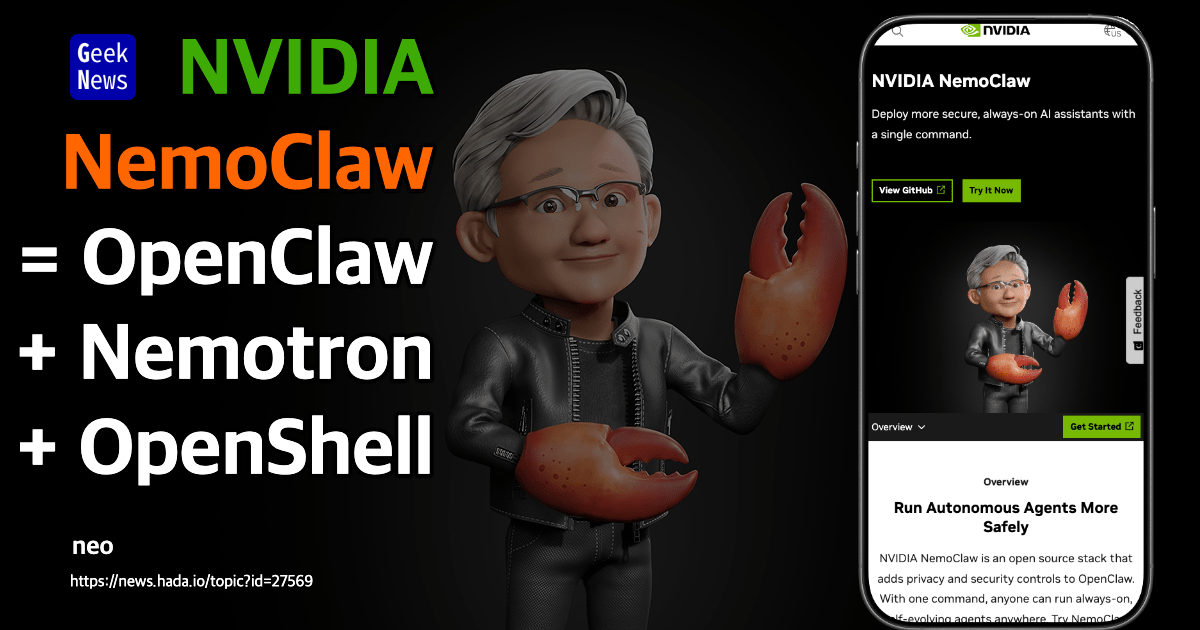
NVIDIA NemoClaw adds policy-based privacy and security guardrails to OpenClaw, enabling always-on autonomous agents through a one-command install and guided onboarding with OpenShell and OpenClaw integration.

🤔 Curiosity: Why are people moving from “just run an agent” to “run it safely?”
If you followed the last few months of AI tooling, you’ve probably seen the same pattern:
- Agents are becoming always-on.
- They need to do real work across time and state.
- Organizations need them to be practical without becoming a blind spot.
So the real question is not whether we run autonomous agents, but how we prevent them from becoming uncontrolled control planes.
NVIDIA’s NemoClaw is a direct answer to that problem. It is framed as an open-source layer that adds privacy and security controls to OpenClaw, with a strong emphasis on:
- policy-driven behavior control,
- safer sandbox execution,
- and local-first or controlled model usage.
On top of that, it is marketed as a one-command path to launch always-on assistants. That “one command” angle is compelling, but the deeper question is what control you actually get once it starts.
NVIDIA and community coverage:
- NVIDIA product page: https://www.nvidia.com/en-us/ai/nemoclaw/#referrer=vanity
- Community summary: https://news.hada.io/topic?id=27569
📚 Retrieve: What we can confirm from sources
What NemoClaw is supposed to do
From NVIDIA’s official page and the GitHub repository:
- NemoClaw is an open-source stack for safer long-running AI agents.
- It is designed to add policy-based privacy and security guardrails to OpenClaw.
- It is connected to NVIDIA Agent Toolkit / OpenShell as part of runtime hardening.
- It explicitly positions itself as enabling “always-on, self-evolving/always-running agents” in controlled settings.
- It is marked as Alpha software, so behaviors and APIs may still be changing.
The repo short description is explicit that this is currently an early-stage project:
“NVIDIA NemoClaw is an open source stack that simplifies running OpenClaw always-on assistants safely.”
And one important constraint from the README:
- NemoClaw requires a fresh installation of OpenClaw.
What the official install flow looks like
NVIDIA NemoClaw’s repository provides a “Quick Start” entry with a compact setup path. At minimum, the workflow includes:
- Prepare prerequisites (Docker, OpenShell) and confirm host readiness.
- Run one installer script.
- Complete guided onboarding for sandbox, inference routing, and security policy.
- Start/operate through host + plugin-level commands.
The README highlights this one-line install flow:
1
curl -fsSL https://nvidia.com/nemoclaw.sh | bash
And it describes the command as installing Node.js if missing, then launching a guided OpenClaw onboarding wizard.
Practical source-of-truth references I used
- Nvidia official product page: https://www.nvidia.com/en-us/ai/nemoclaw/#referrer=vanity
- Nvidia NemoClaw repository: https://github.com/NVIDIA/NemoClaw
- Community digest: https://news.hada.io/topic?id=27569
💡 Innovation: A field-ready deployment guide you can use this week
Below is a practical, low-noise blueprint for a production-minded local lab.
1) Preflight checklist (must-have before touching install)
- Fresh OpenClaw install: NemoClaw docs explicitly assume a clean OpenClaw baseline.
- Docker running: install checks and sandbox steps assume containerized execution path availability.
- OpenShell availability: it is part of enforcement/runtime lineage.
- Model routing plan: define whether you prioritize local model execution, cloud inference, or mixed mode.
2) Run the official one-command install
From the repository quick start:
1
curl -fsSL https://nvidia.com/nemoclaw.sh | bash
This script is intended to:
- install Node.js if absent,
- guide onboarding,
- set up sandbox settings,
- and enforce policy configuration.
⚠️ As with any alpha tooling, treat success logs as “initially successful” and re-validate each session.
3) Validate that both OpenClaw and the NemoClaw layer are active
Use your normal OpenClaw checks first (CLI status, version, plugin/config checks), then verify:
- NemoClaw host command availability.
- OpenClaw plugin surface includes
nemoclaw. - You can launch chat/tui for a sandboxed agent path.
If your CLI has plugin warnings, capture them first in logs:
- warnings can be real debt.
- they should be cleared intentionally, not ignored in shared environments.
4) Run a minimal end-to-end behavior test
Treat this as your smoke test before real workloads:
1
2
3
4
5
6
7
8
9
# 1. Confirm command entry exists
openclaw help | grep -i nemoclaw || true

# 2. Verify plugin surface (command varies by installed version)
openclaw plugin list

# 3. Start an isolated sandboxed check agent
# (Use your tool’s equivalent chat command)
openclaw ask "Give me a safe, read-only summary of your policy capabilities and default constraints."
Expected result should include:
- clear mention of sandbox boundary,
- constrained/limited actions,
- and guardrail policy enforcement behavior.
5) Translate setup into security operations
If you are running persistent agents, add this operating policy:
- Policy template by environment
- Dev: broader logging, lower policy strictness.
- Production: strictest policy, allowlist commands only.
- Approval model
- read-only tasks can be automated.
- write/write-infra tasks require explicit approval.
- Model boundaries
- define fallback model behavior when external inference is unavailable.
6) Daily operations checklist
- Confirm Docker/container state at startup.
- Verify OpenClaw → NemoClaw command surface.
- Run a policy smoke command and validate output.
- Verify mount/file/data allowlists.
- Audit recent agent behavior logs for policy override attempts.
- Record any exception and decide whether policy tuning or sandbox redesign is required.
Real-world deployment patterns
Pattern A) Research team helper agent
Use a narrow tool policy:
- read-only source browsing,
- no destructive file writes,
- no network commands unless explicitly approved.
This helps extract insights without granting broad execution.
Pattern B) Ops support assistant
Give the model:
- fixed command allowlist,
- bounded token budget,
- strict escalation thresholds for any action with side effects.
This lowers blast radius while preserving utility.
Pattern C) Long-running content bot
Great for always-on use cases but requires:
- strict session isolation,
- periodic checkpointing,
- immutable audit logs.
If output drift appears, restart under a reset policy and force re-onboarding.
Caveats and constraints to respect
- NemoClaw is early-stage alpha: expect API and behavior churn.
- A “one-command install” is not “zero-configuration.”
- Policy confidence grows with:
- explicit allowlists,
- deterministic command boundaries,
- and repeatable verification commands.
In short, it is a strong security scaffold, not a magic shield. It lowers risk if your operating model is disciplined.
Quick implementation template
Use this in your project notes:
1
2
3
4
5
6
7
8
9
10
11
12
13
14
15
# NemoClaw rollout plan
- Prereqs: OpenClaw fresh, Docker, OpenShell
- Install: curl -fsSL https://nvidia.com/nemoclaw.sh | bash
- Validation:
  - openclaw help
  - plugin command list
  - smoke policy test
- Security posture:
  - environment-specific policy level
  - allowlist-first command model
  - periodic audit cadence
- Rollback:
  - disable policy exceptions
  - isolate or stop agent sessions
  - review logs and re-onboard
References
- NVIDIA NemoClaw product page: https://www.nvidia.com/en-us/ai/nemoclaw/#referrer=vanity
- NVIDIA NemoClaw GitHub: https://github.com/NVIDIA/NemoClaw
- Community coverage (GeekNews): https://news.hada.io/topic?id=27569