AI
Deploying NanoClaw in Docker Sandboxes: A Practical Security-First Guide
A step-by-step guide to run each NanoClaw agent in isolated Docker Sandboxes, with hardening checks and real operational patterns for small teams and production rollouts.
🤔 Curiosity: Why isolate agents by default now?
Teams keep adopting AI agents faster than they adopt security patterns. That mismatch creates a dangerous illusion: “if it runs in code, it must be safe.”
This guide is not about theory.
If one agent should not see your email, code, or credentials, how can we make that guarantee with real defaults?
NanoClaw’s new Docker Sandboxes answer is exactly that: layered isolation with practical usability.
I reviewed:
- NanoClaw official release post and feature notes: https://nanoclaw.dev/blog/nanoclaw-docker-sandboxes/
- Public summary/report in Korean community feed: https://news.hada.io/topic?id=27493
📚 Retrieve: What the sources describe
From both sources, four claims are clear:
- One-command setup for Docker-backed isolation.
- Micro-VM + container dual boundary (not just container).
- Per-agent isolation for filesystem, context, and tool surface.
- Permission-first execution model for practical security and team deployment.
The article states this flow explicitly: each agent runs in its own container inside a micro VM, and each agent has its own context/tools/session split.
💡 Innovation: Step-by-step implementation guide
This is written to be executable by a small team or personal setup.
0) What you need first
- Docker Desktop (or Docker Engine equivalent)
- NanoClaw binary installed (or access to run the installer)
- A machine policy for secrets (no tokens mounted directly into every agent)
- Enough disk space for additional micro-VM images and per-agent containers
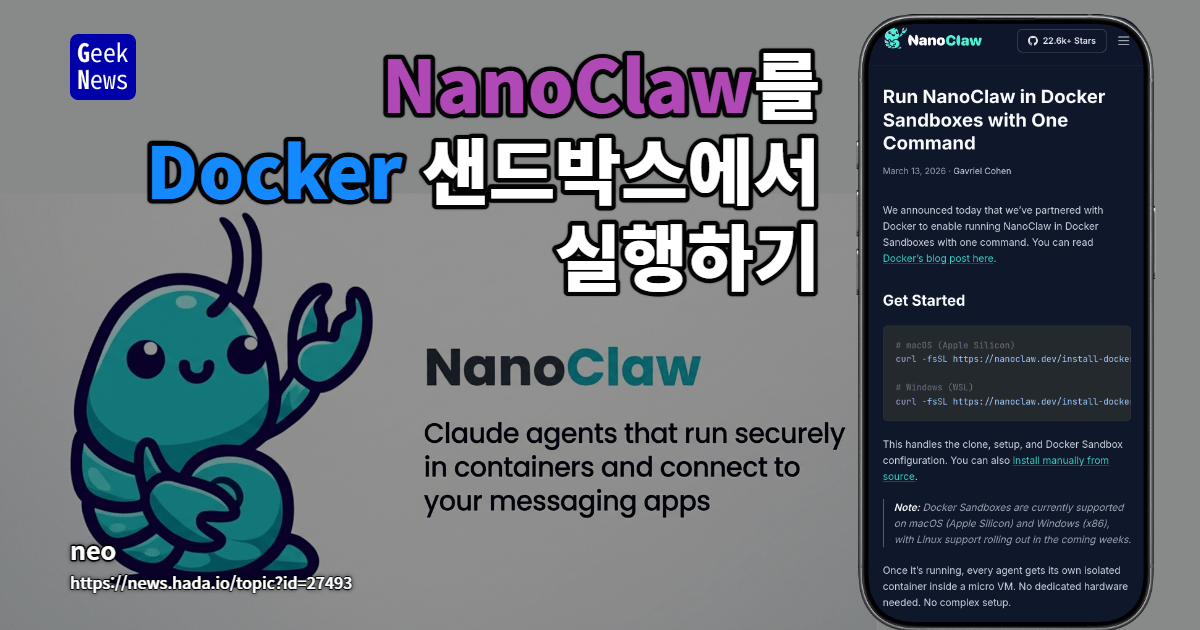
1) Install NanoClaw Docker Sandboxes
On macOS Apple Silicon:
1
curl -fsSL https://nanoclaw.dev/install-docker-sandboxes.sh | bash
On Windows (WSL):
1
curl -fsSL https://nanoclaw.dev/install-docker-sandboxes-windows.sh | bash
Linux support is mentioned as rolling out in the source notes, so check release status before relying on production parity.
2) Confirm service status and environment
After install, verify:
- daemon is running (Docker reachable)
- micro-VM layer is available
- sandbox runtime command(s) are registered by NanoClaw
Common checks:
1
2
3
4
5
6
# Docker and daemon check
docker version

docker ps

# expected: sandbox-related containers/services appear after NanoClaw startup
Also verify that your normal NanoClaw environment and sandbox environment are not silently sharing the same permission context.
3) Launch NanoClaw with isolated profile
Use your existing launch flow, but make sure each agent uses the sandbox mode with dedicated identity and tool bindings. The goal is:
- one container per agent
- one permission profile per container
- no implicit host mounts unless explicitly required
Conceptual mapping:
1
2
3
4
5
6
7
8
9
10
11
12
13
14
agents:
  - name: sales-agent
    runtime: sandbox
    vm: micro
    tools:
      - crm-api
    readonly_tools: false

  - name: support-agent
    runtime: sandbox
    vm: micro
    tools:
      - support-ticket-api
    readonly_tools: true
4) Validate isolation manually
Before adding production credentials, run these tests:
- agent A cannot read files created by agent B
- agent B cannot call tool X reserved for agent A
- agent crash cannot access host credentials
- container exit does not leak mounted secrets
A quick hardening test pattern:
- Create a marker file in Agent A workspace.
- Try reading it from Agent B session. Should fail.
- Revoke all broad host mounts.
- Re-run and confirm no host exposure.
This is where “sandboxing” becomes meaningful.
5) Rollout strategy for team scale
Don’t enable one giant team immediately. Use a staged rollout:
- Week 1: 1 critical agent, strict logging only.
- Week 2: Add second agent with independent context.
- Week 3: Enable non-critical automations + permission boundary matrix.
- Week 4: Human-in-the-loop for high-risk actions (code push, email send, DB writes).
Security operating model that matters
The article’s strongest line for me: design your agent access as if the agent could become malicious.
That sounds harsh, but it yields practical policy:
- Least privilege first: never ship credentials in defaults.
- Context partitioning first: separate CRM, email, repo data by agent role.
- Human approval for irreversible actions: send, deploy, delete.
- Dual boundary mindset:
- container boundary
- micro-VM boundary
Common mistakes and how to avoid them
- Mistake: turning off isolation for “convenience.”
- Fix: keep a dev and production profile.
- Mistake: giving every agent the same tool set.
- Fix: role-permission mapping.
- Mistake: skipping failure drills.
- Fix: simulate a tool leak or command escape and verify host remains protected.
Practical checklists you can copy
Pre-deploy checklist
- Docker daemon healthy
- Sandbox installer succeeded on intended OS
- Agent permissions reviewed per profile
- Audit logging enabled
- Host volumes not broadly mounted by default
Monitoring checklist (weekly)
- Failed escapes / boundary violations = 0
- Unscheduled host access attempts = 0
- Cross-agent data leakage events = 0
- At-risk actions require approval
- Cost and token usage per agent separated by workload
Why this guide format
Because NanoClaw agents are moving from single tools to team infrastructures, this setup should be treated as infra work, not CLI experimentation.
If you follow the same policy baseline for every agent, you get three wins:
- Security is no longer an afterthought.
- Productivity is measurable (role-specific workflows stay sharp).
- Scale is safe (adding more agents doesn’t mean multiplying risk).
References
- NanoClaw announcement + implementation notes: https://nanoclaw.dev/blog/nanoclaw-docker-sandboxes/
- Community summary / context (Korean): https://news.hada.io/topic?id=27493