AI
OpenClaw Skills at Scale: How to Start from Frontend when the Catalog Has 5,000+ items
I reviewed the OpenClaw skill ecosystem through a large Korean article and the curated Awesome OpenClaw Skills list, then distilled how frontend teams can adopt plugins without getting lost in a sea of choices.

🤔 Curiosity: What are we optimizing for, really?
When the ecosystem reaches thousands of skills, the main problem stops being “which tool is best?” and becomes:
How do we avoid spending all our time choosing and never building?
I asked the same question while reading the update on OpenClaw’s ecosystem and checking the latest Awesome OpenClaw Skills collection.
The two sources I read made me think differently about scale:
- OpenClaw as a local, composable AI assistant foundation.
- A curated community list with counts large enough to overwhelm a planner.
📚 Retrieve: What the sources revealed
Source 1) OpenClaw ecosystem view
This post reinforces one core point: the ecosystem’s value is not in one mega-skill, but in a local, skill-driven architecture.
Key signals I pulled:
- OpenClaw itself is a base runtime: a local AI assistant with user-controlled context.
- Skills are the multiplication layer.
- The ecosystem is broad enough that filtering and curation become operational concerns.
- Installation can be done from ClawHub CLI, manual workspace path, or conversational prompts.
Source 2) Curated skills list
- URL: https://github.com/VoltAgent/awesome-openclaw-skills?tab=readme-ov-file#web--frontend-development
The list is built as a practical index:
- 5,400+ skills are tracked in the curated set.
Web & Frontend Developmentsits at 938 skills in this catalog slice.- The structure keeps discoverability high by using explicit categories and per-category “view all” splits.
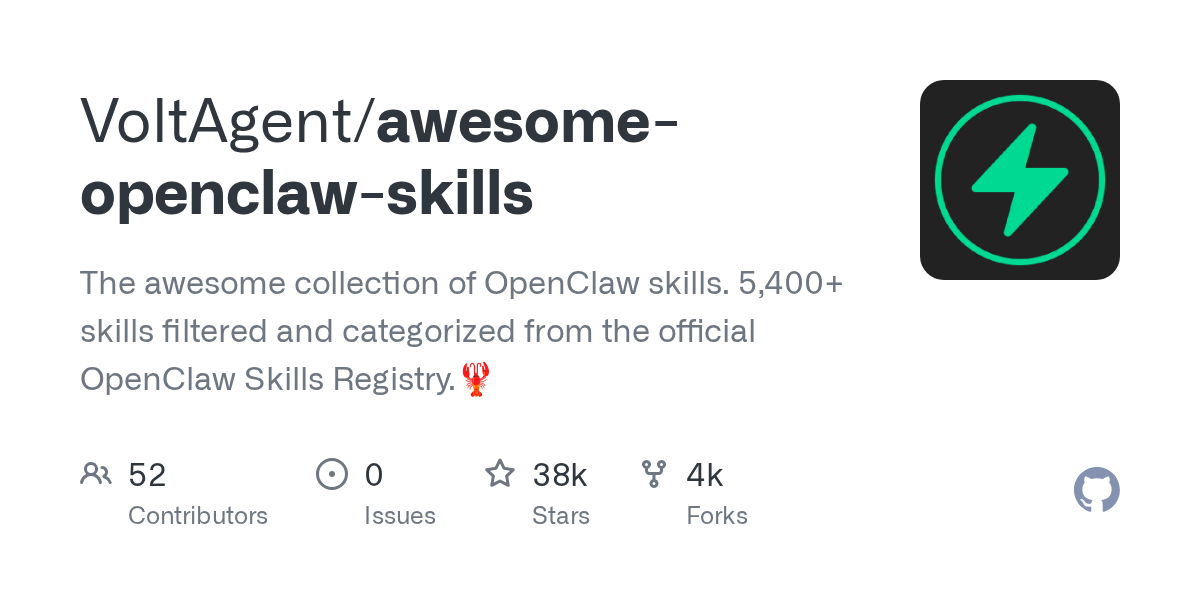
From the raw list snapshot, the Web & Frontend section exposes the same pattern we want in real projects:
- utility-focused automations (
analytics,chat,dashboard,topology) - conversion/comms tooling (
content,search,AEO/SEO) - security + platform controls (
prompt screening,consent,rate limiting)
A quick glance sample (representative):
(There are many more: the section ends with a “View all 925 skills in Web & Frontend Development” pointer in the source.)
💡 Innovation: A practical strategy for frontend-first adoption
I don’t want to copy-paste a giant list and call it a workflow. I want a front-end-first execution plan.
1) Narrow by use-case (not by popularity)
For frontend and web teams, I usually start with three paths:
- Interface automation (dashboard rendering, browser automation, scraping)
- Content and discoverability (AEO, analytics, SEO-oriented tasks)
- Operational guardrails (auth, consent, rate limit, monitoring)
2) Treat skill counts as backlog, not choice sets
“938” is impressive, but for a team, it’s noise unless partitioned.
I use this simple filter matrix:
| Filter | Rule |
|---|---|
| Trust signal | prefer actively maintained + clear docs + explicit permissions |
| Security risk | reject if role/permission boundaries are unclear |
| Maintenance cost | keep install path short (CLI/manual) and easy to uninstall |
| Reuse potential | maximize skills that map to >=2 recurring tasks |
3) Keep a team-local registry
Because OpenClaw already supports workspace-level plugin precedence, teams can keep a local skills baseline and pin what “works for our stack.”
1
2
3
4
5
# workspace-first approach
# 1) install essential frontend skills from curated source
# 2) validate in staging
# 3) promote to team workspace only after 1-week dry run
clawhub install <skill-slug>
How to avoid decision paralysis (realistically)
From the ecosystem evidence, the mistake is not choosing wrong skills. The mistake is treating the catalog like a shopping list and not like a build system.
Use this order:
- Start with 3 skills.
- Build a “can we run safely today?” checklist.
- Remove anything not used after two production cycles.
- Add one category only when the team has measurable workflow pain in it.
Code Lens: a tiny parser for section growth (optional)
If you maintain docs or CI checks, this pattern is useful to validate future README changes.
1
2
3
4
5
6
7
8
import re
from pathlib import Path

README = Path('README.md')
text = README.read_text(encoding='utf-8')

m = re.search(r'Web & Frontend Development', text)
print('web section exists:', bool(m))
References
- Korean ecosystem breakdown: https://digitalbourgeois.tistory.com/m/2878
- Curated list and Web & Frontend section: https://github.com/VoltAgent/awesome-openclaw-skills?tab=readme-ov-file#web--frontend-development
Snippets (quick copy)
OpenClaw skill ecosystem
- “OpenClaw is stronger when its capabilities are extended through skills.”
- Why this matters: choose architecture, not a fixed feature set.
Awesome list entry
- “Web & Frontend Development (938)”
- Why this matters: clear category boundaries can reduce onboarding friction.
Practical takeaway
- Curated catalogs are powerful only when your team applies adoption filters (trust, security, reuse).