Tools
pi as the Core: Build Your Own Agentic Workflow, Not Someone Else’s
I compared the latest pi-related posts and discovered a practical design pattern: a tiny, hackable core plus local extensions is often a better path than a feature-complete but rigid agent.
🤔 Curiosity: The Question
I kept seeing a familiar complaint: teams don’t reject AI agents because they lack one feature. They reject them because the workflow doesn’t fit their daily rhythm.
So the question became:
If an agent is “good,” why do teams still end up building scripts, wrappers, and hacks around it?
📚 Retrieve: What I checked
I reviewed three anchor sources plus one practitioner post, all pointing to the same pattern.
1) Core stance from pi
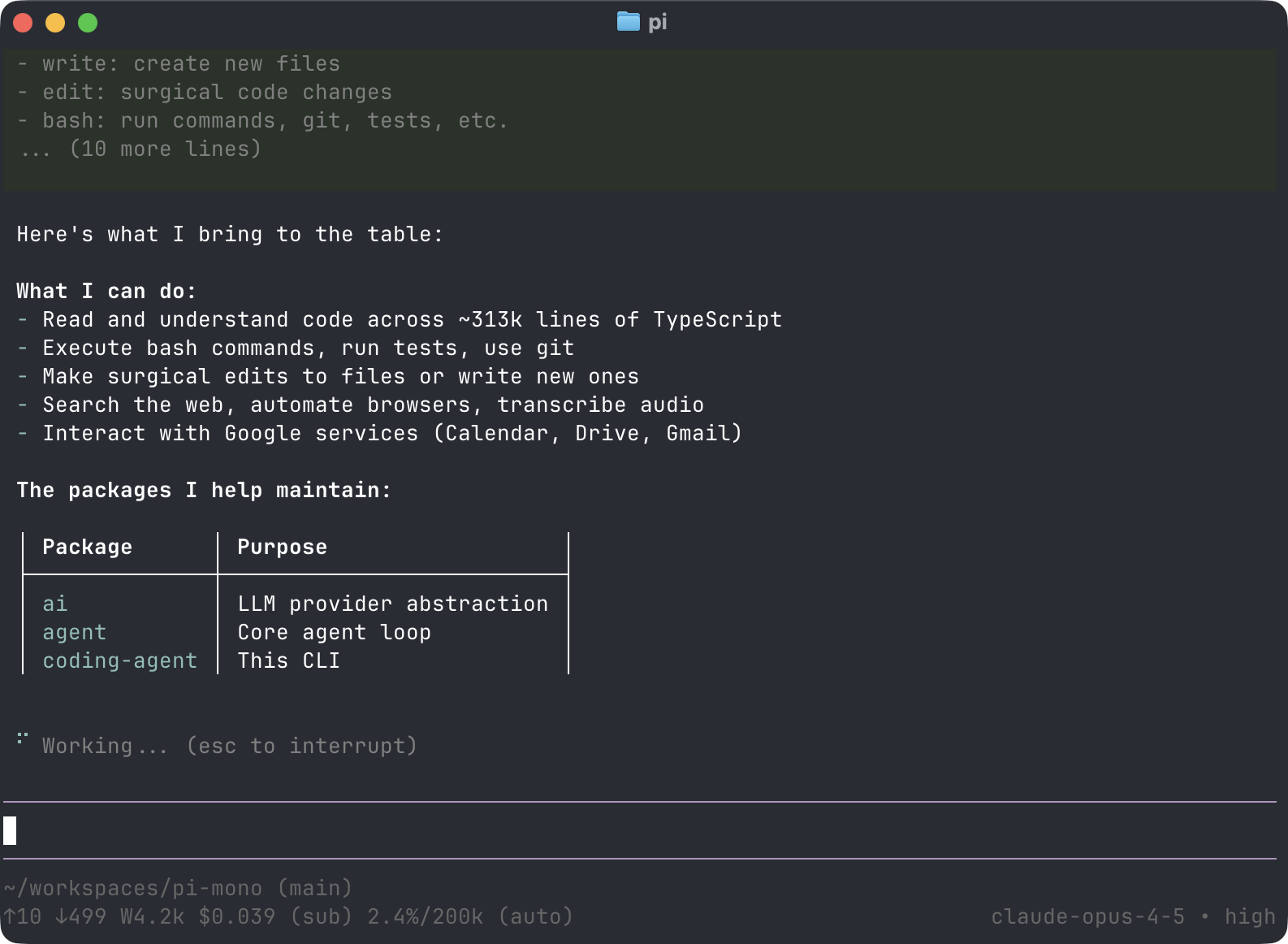
pi presents itself as a minimal terminal coding harness and highlights a key premise:
- it is meant to be adapted to your workflow
- extension points exist for tools, commands, prompts, UI behavior, and context
- it supports multiple execution modes (interactive / print JSON / RPC / SDK)
- provider/model coverage is broad, so you can swap without rebuilding your stack
A quick excerpt from the page captures this mindset:
“There are many coding agents, but this one is mine.”
2) The architectural idea in OpenClaw context
The essay makes the design claim sharper:
- most coding agents are capable, but
- the real difference is whether you can turn your own requirements into first-class behavior.
3) Extension as implementation surface (repo-level)
This examples path confirms the claim is not theoretical. The extension model is concrete and code-first: you can register behavior and hook lifecycle events directly.
A canonical pattern looks like this:
1
2
3
4
5
6
7
export default function (pi: ExtensionAPI) {
  pi.registerTool({ name: "deploy", ... });
  pi.registerCommand("stats", { ... });
  pi.on("tool_call", async (event, ctx) => {
    ...
  });
}
4) Practitioner test in the real world
This post reads like a field report from someone who has used many agents and keeps coming back to the same conclusion: a tool is only as useful as how much it can be reshaped to your flow.

Its key line, in spirit: if you keep fighting a default, you’re not doing your work—you’re fighting your environment.
💡 Innovation: What this means in practice
For me, the practical value is straightforward:
- MCP + sub-agent + team logic are no longer “platform constraints.” You can add those behaviors as extensions.
- Permission and governance patterns are controllable. For example, a file-write confirmation gate can be implemented directly in an extension.
- The build loop shortens. One local TypeScript file can change behavior without waiting on upstream roadmap.
- Hot reload is a force multiplier. The extension can be reloaded (
/reload) as you iterate.
Here’s how I’d summarize the difference:
- Rigid model-first agents: “use their workflow, accept gaps.”
- pi-style agents: “define your own workflow, as code.”
Practical decision checklist
When comparing coding agents, I now check these three:
- Extension surface: Can I inject custom behavior without waiting for product decisions?
- Lifecycle control: Can I interpose on calls, context passing, and compaction decisions?
- Workflow ownership: Can the team evolve the tool without a fork or long deployment path?
If the answer is yes, you get a tool that compounds over time.
Snippets (ready for quick copy)
pi.dev (official)
- Source: https://shittycodingagent.ai/
- Snippet:
"There are many coding agents, but this one is mine." - Why it matters: it explicitly frames adaptation over constraint.
OpenClaw pi essay
- Source: https://lucumr.pocoo.org/2026/1/31/pi/
- Snippet:
"Pi is interesting because workflow limits are treated as extension opportunities." - Why it matters: the article explains the design direction and long-term maintainability reason.
Extension examples
- Source: https://github.com/badlogic/pi-mono/tree/main/packages/coding-agent/examples/extensions
- Snippet:
registerTool / registerCommand / event hookextension contracts. - Why it matters: it proves the “one plugin can do a lot” claim with concrete code.
Practitioner reflection
- Source: https://jonghakseo.github.io/posts/craftsman-makes-tools/
- Snippet: “a tool should be made, not merely adopted.”
- Why it matters: it translates architecture theory into team-life behavior.
Bottom line
I’m not arguing that pi is the “best” agent for everyone. I’m arguing this:
The next productivity jump does not come from one more agent feature. It comes from owning the loop between your workflow and your tool.
When your workflow is programmable, you stop waiting for the next release and start shipping your own path.