AI
From Friction to Flow: Why Fabric is Useful for AI Content Ops
I checked Daniel Miessler’s Fabric GitHub and a March 8 Korean deep-dive to compare how a prompt-first workflow can reduce AI operating friction in daily content and development workflows.

🤔 Curiosity: Why this topic now?
When AI tools improve, workflow problems don’t disappear — they just become louder.
I noticed one practical question after watching teams move fast with LLMs:
How do we stop copying prompts everywhere and start treating them as reusable infrastructure?
I checked two concrete references today:
- Digital Bourgeois post (2026-03-08, Korean): https://digitalbourgeois.tistory.com/m/2846
- Fabric repository: https://github.com/danielmiessler/Fabric
The Korean post frames Fabric as a way to systematize prompts for day-to-day AI work, while the GitHub repo presents it as a modular, reusable framework. That overlap felt too good to ignore.
📚 Retrieve: What I pulled from each source
1) Fabric (Korean interpretation from the post)
From the post metadata and article framing, the key points are:
- AI adoption is stuck on prompt drift (same goal, many variants, no consistency).
- Fabric is positioned as an open-source prompt operations layer.
- The approach is to:
- Define reusable prompt patterns
- Organize by tasks (research, coding, writing, decision support)
- Reuse across models and contexts
That makes sense if you’re running many AI touchpoints.
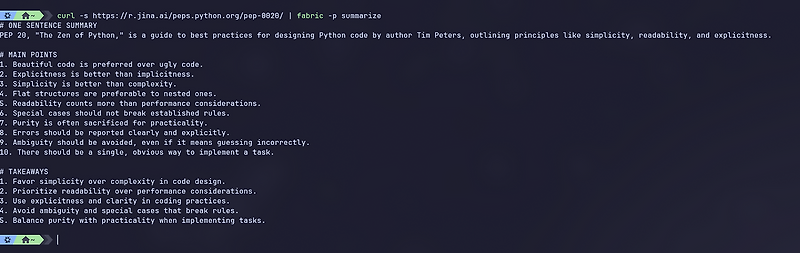
2) Fabric (GitHub)
From the repo metadata and structure, Fabric is described as:
- An open-source framework to augment humans with AI.
- A modular method for specific problem solving.
- A curated, crowdsourced prompt set that should be reusable across contexts.
Core insight from comparison
The two sources converge on one practical claim:
AI work scales only when prompts are treated like code: versioned, named, reusable, and shareable.
💡 Innovation: What I’d do with this as a shipping pattern
I’ve always preferred practical systems, not abstract advice. So I tested this idea in structure form:
1
2
3
4
5
6
7
8
9
10
11
12
13
14
15
16
17
18
19
20
21
22
23
24
25
26
27
28
29
30
31
32
33
34
35
36
37
38
39
40
# Example: lightweight prompt registry concept for a team workflow
from dataclasses import dataclass
from typing import Dict, List

@dataclass
class PromptBundle:
    name: str
    goal: str
    prompt_template: str
    constraints: List[str]

class PromptOps:
    def __init__(self):
        self.registry: Dict[str, PromptBundle] = {}

    def register(self, bundle: PromptBundle):
        self.registry[bundle.name] = bundle

    def build(self, name: str, context: Dict[str, str]) -> str:
        bundle = self.registry[name]
        prompt = bundle.prompt_template.format(**context)
        return "\n".join([
            f"Goal: {bundle.goal}",
            f"Context: {context}",
            f"Constraints: {', '.join(bundle.constraints)}",
            "---",
            prompt,
        ])

# register one reusable prompt pattern
ops = PromptOps()
ops.register(PromptBundle(
    name="fabric-style-content-summary",
    goal="Create concise summary for product/tech content",
    prompt_template="Summarize {topic} with 3 practical action points and risks.",
    constraints=["No hype", "English output", "Audience: developer", "<= 120 words"]
))

prompt_text = ops.build("fabric-style-content-summary", {"topic": "PromptOps workflow"})
print(prompt_text)
Practical workflow I’d apply
graph TD
  A[Collect useful prompts] --> B[Normalize names/tags/goal]
  B --> C[Store in shared registry]
  C --> D[Use via command wrappers or scripts]
  D --> E[Measure output quality]
  E --> F{Consistent enough?}
  F -->|No| G[Refine template and constraints]
  F -->|Yes| H[Ship and reuse]
  G --> C
Why this matters beyond writing
In a game dev/AI context, this is just as important for:
| Area | Before | After |
|---|---|---|
| Quest/dialogue drafting | One-off prompt chaos | Reusable pattern library |
| Bug triage replies | Inconsistent phrasing | Reproducible playbook prompts |
| Experiment notes | Ad-hoc summaries | Structured analysis format |
Key takeaways
- Don’t chase the latest model; stabilize the prompt interface first.
- Treat prompts like production assets (owned, reviewed, improved).
- Use metadata + structure (goal, constraints, examples) so reuse actually works.
- For a workflow blog, pair each source with a concrete image artifact so the reader can infer intent quickly.
New questions
- What’s the minimum metadata needed for a reusable prompt set?
- How do we measure quality drift per model without manual audits?
- Can we ship a CI check for prompt drift in CI/CD style?
References
- Fabric (Korean summary source): https://digitalbourgeois.tistory.com/m/2846
- Fabric (GitHub): https://github.com/danielmiessler/Fabric