AI
OpenConnector Declares Its Own Defaults Out of Scope
Source Audit of oomol-lab/open-connector: the security policy’s do-not-report list names the defaults its quickstart ships, and anonymous proxy calls outrank scoped tokens.
What does a credential gateway enforce before you configure it?
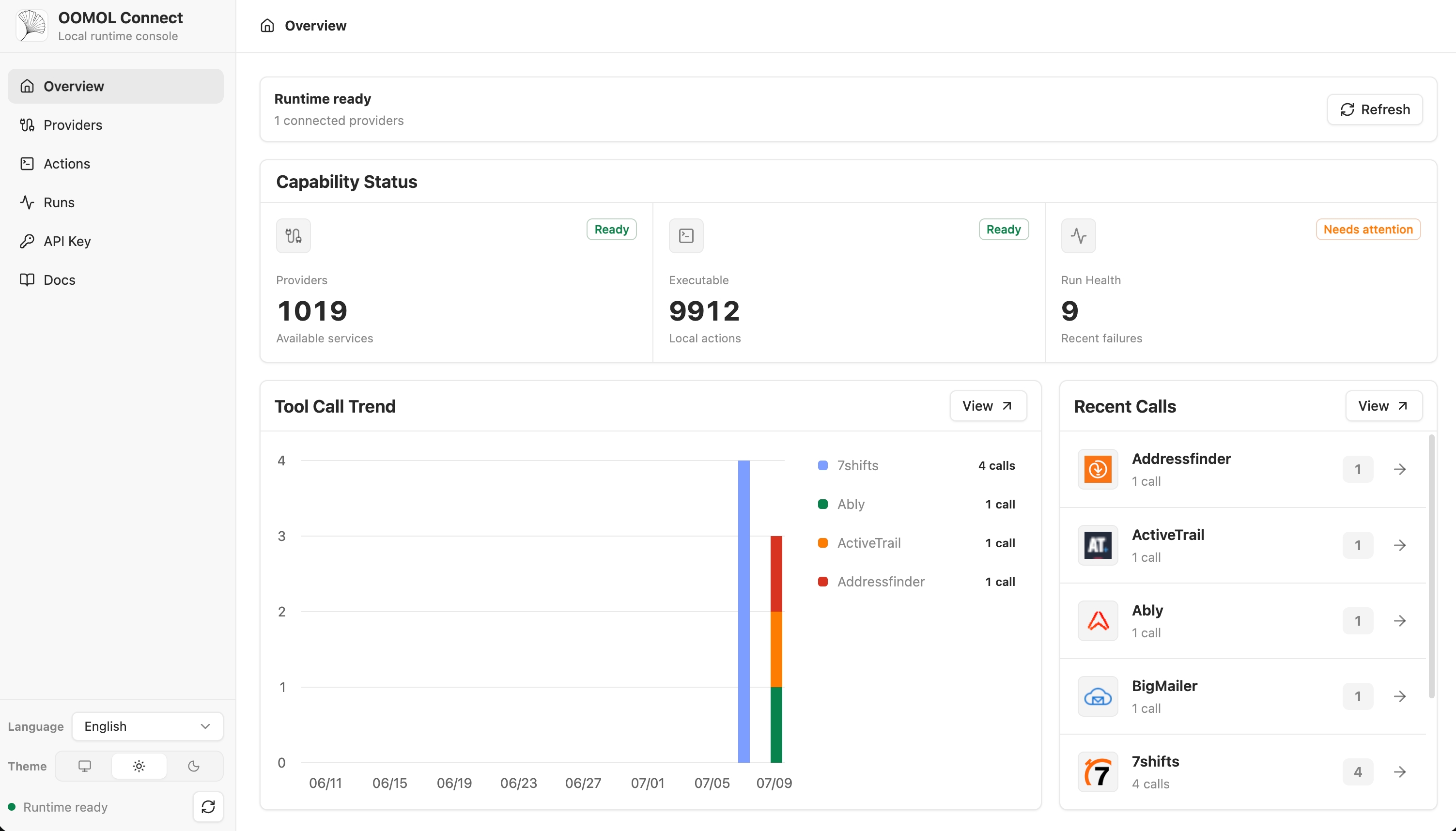
oomol-lab/open-connector is an open-source connector gateway for AI agents: connect a user’s SaaS accounts once, then expose the catalog to agents over SDK, HTTP, and MCP. It is Apache-2.0 licensed, written in TypeScript, created 2026-06-29, and at retrieval it carried 5,753 stars and 497 forks. Its hosted catalog reported 1,512 providers and 16,988 actions the same night.
The pitch is a custody boundary. The README says the project fits products where agents need durable access to user tools “without handing provider credentials to the agent process.” That sentence is the reason a gateway like this exists: the agent gets capability, the gateway keeps the secrets.
So the first question I brought to the pinned tree was not whether the boundary is well designed. It was: what does the boundary enforce on the day you first run it?
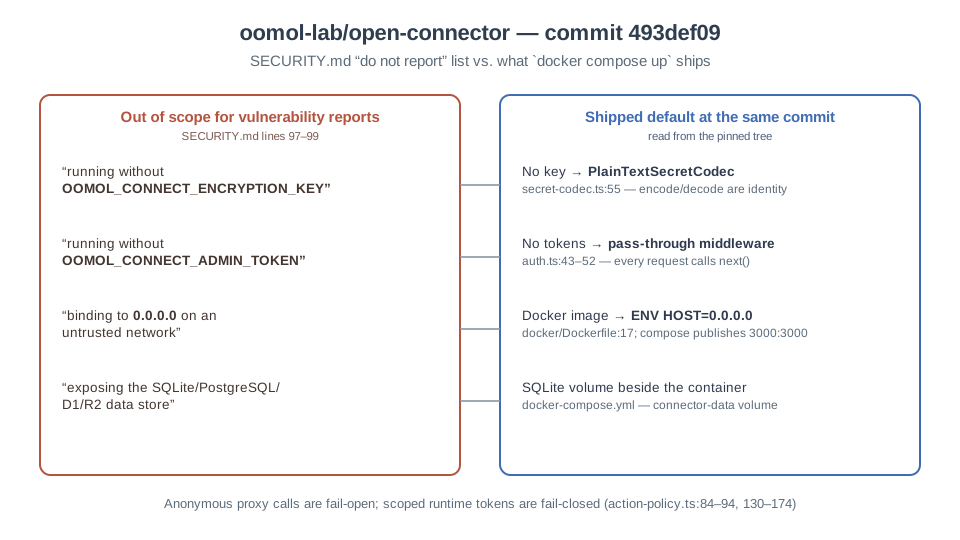
The project answers that question in an unusual place — its own security policy. SECURITY.md contains a scope section listing what not to report as a vulnerability, and one bullet excludes “insecure self-hosted configuration that this project documents how to avoid,” giving four examples: running without OOMOL_CONNECT_ENCRYPTION_KEY, running without OOMOL_CONNECT_ADMIN_TOKEN, binding to 0.0.0.0 on an untrusted network, and exposing the data store.
Each of those four examples is a code path I could go read at the pinned commit. So I did. All four are the shipped default.
Technical Analysis: Reading the four defaults the policy excludes
The mapping, before the detail:
| SECURITY.md excludes from reports | Shipped default at commit 493def09 | Where it is decided |
|---|---|---|
Running without OOMOL_CONNECT_ENCRYPTION_KEY | PlainTextSecretCodec; encode/decode are identity functions | src/server/secrets/secret-codec.ts:54-55 |
Running without OOMOL_CONNECT_ADMIN_TOKEN | Auth middleware becomes a pass-through that only calls next() | src/server/api/auth.ts:43-52 |
Binding to 0.0.0.0 on an untrusted network | Docker image pins ENV HOST=0.0.0.0; compose publishes 3000:3000 | docker/Dockerfile:17, docker-compose.yml |
| Exposing the SQLite/PostgreSQL/D1/R2 data store | SQLite in a named Docker volume beside the container | docker-compose.yml connector-data |
No admin token compiles to a middleware that waves everything through
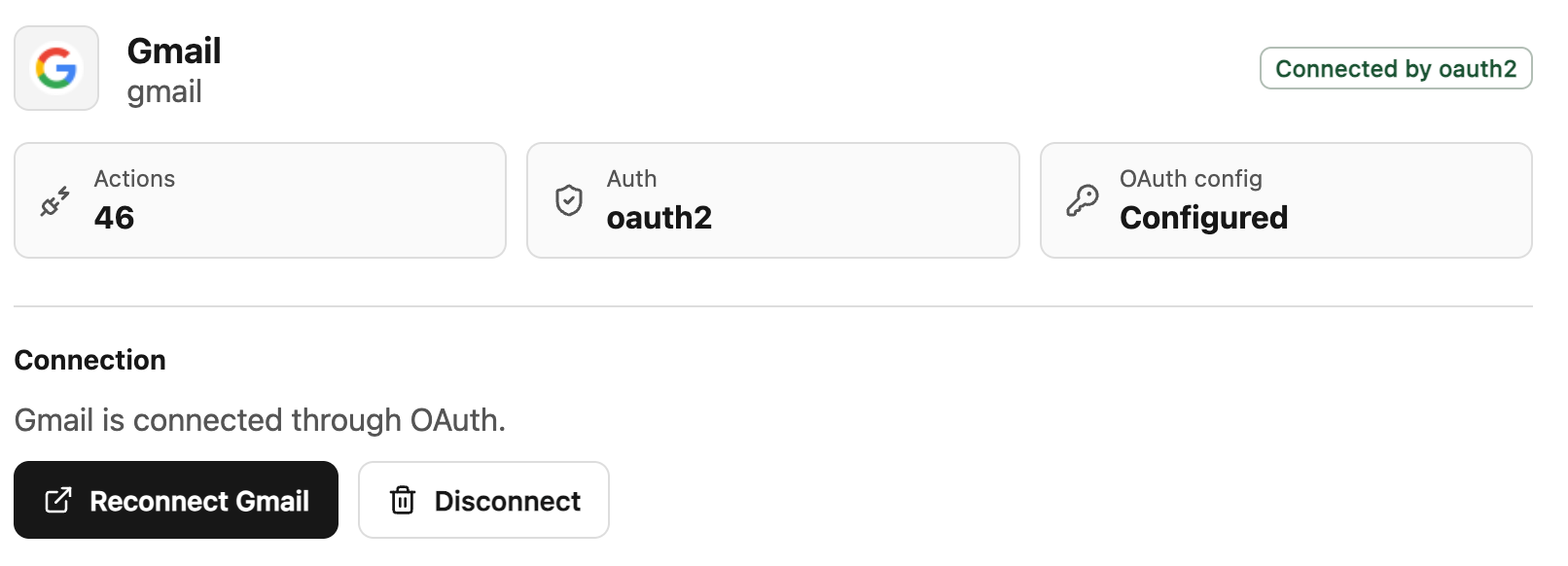
Authentication is not checked and then skipped. When no admin token, no runtime token, no stored runtime tokens, and no JWT verifier exist, createLocalAuthMiddleware in src/server/api/auth.ts returns a different function entirely — one that only calls next(). Every request to every route passes. The auth layer for the all-defaults deployment is structurally absent, not merely permissive.
SECURITY.md says this plainly: “Both admin and runtime authentication are disabled by default for local development.”
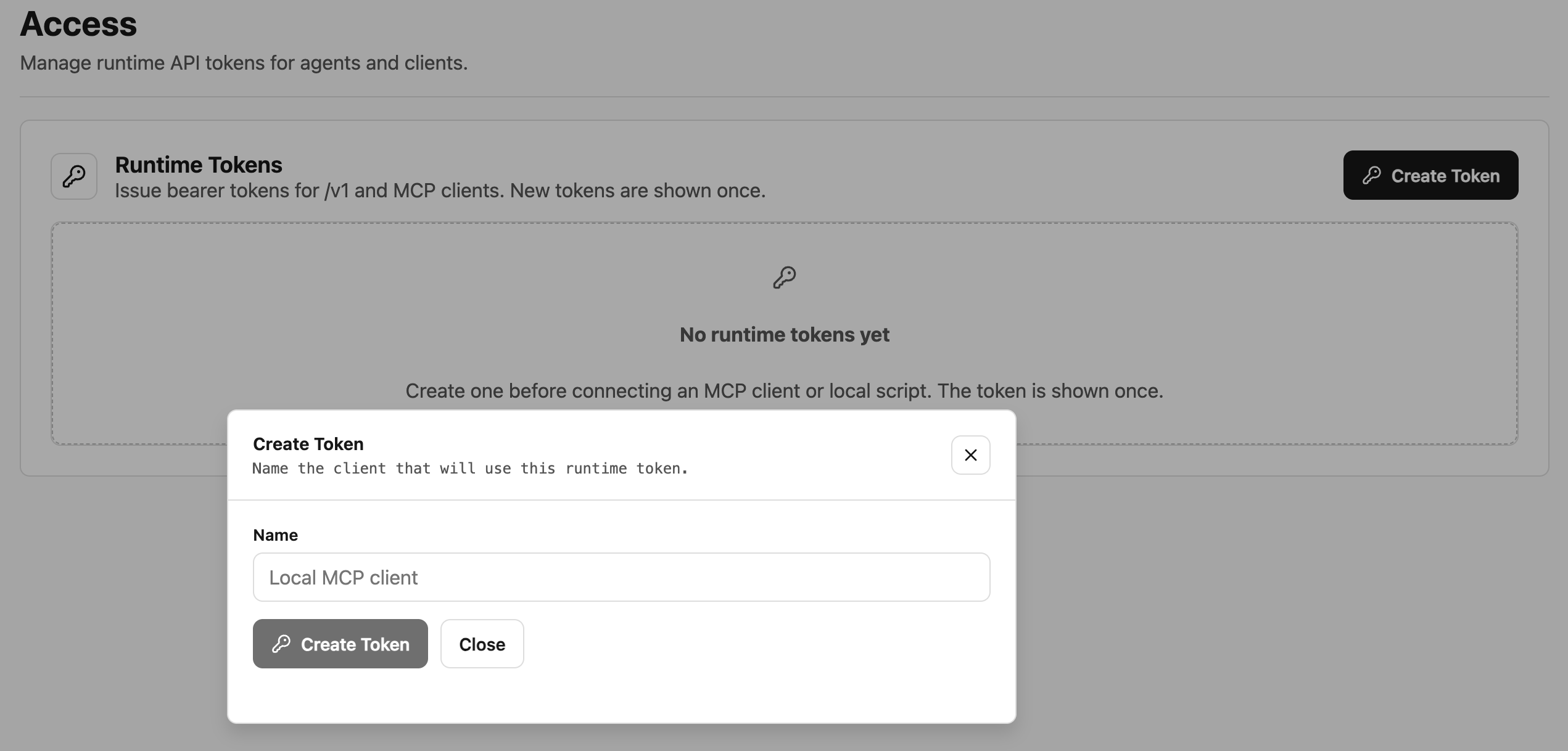
The auth code in src/server/api/auth.ts routes /mcp and /v1 into a shared runtime auth scope, so the MCP endpoint an agent host would connect to sits behind the same pass-through. Under defaults, any process that can reach port 3000 holds the full runtime surface.

No encryption key selects a codec whose encrypt is the identity function
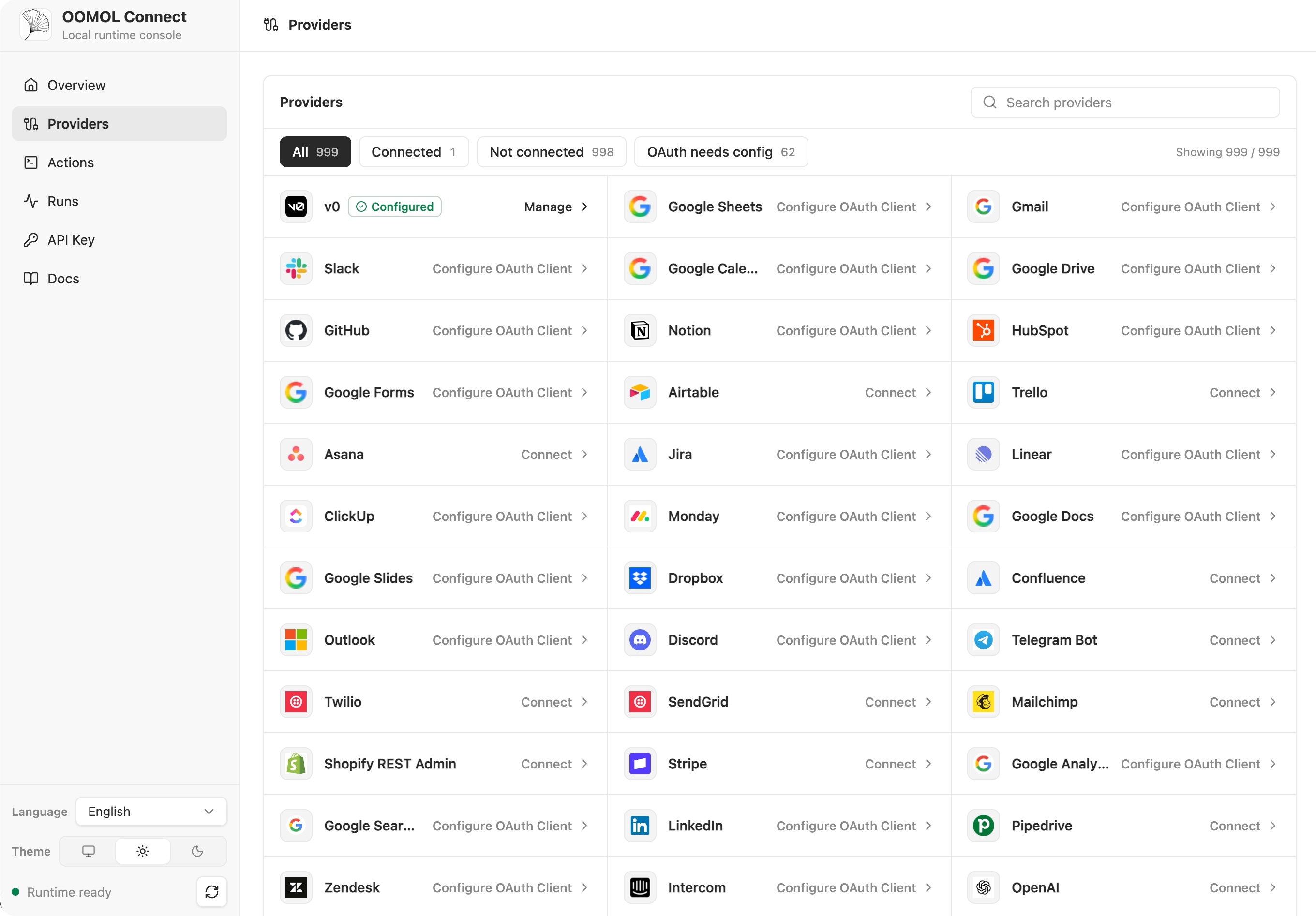
Credential storage runs through a secret codec. createSecretCodec in src/server/secrets/secret-codec.ts returns an AES-256-GCM codec when OOMOL_CONNECT_ENCRYPTION_KEY is set — and a PlainTextSecretCodec when it is not. That class’s encode and decode return their input unchanged. Stored OAuth tokens, API keys, and client secrets are persisted as the bytes you typed.
Again the documentation is candid. The hardening section states that without the key, “those payloads are stored in plaintext,” and warns that completed action responses may contain sensitive provider data.

The recommended install path is the wide-open one
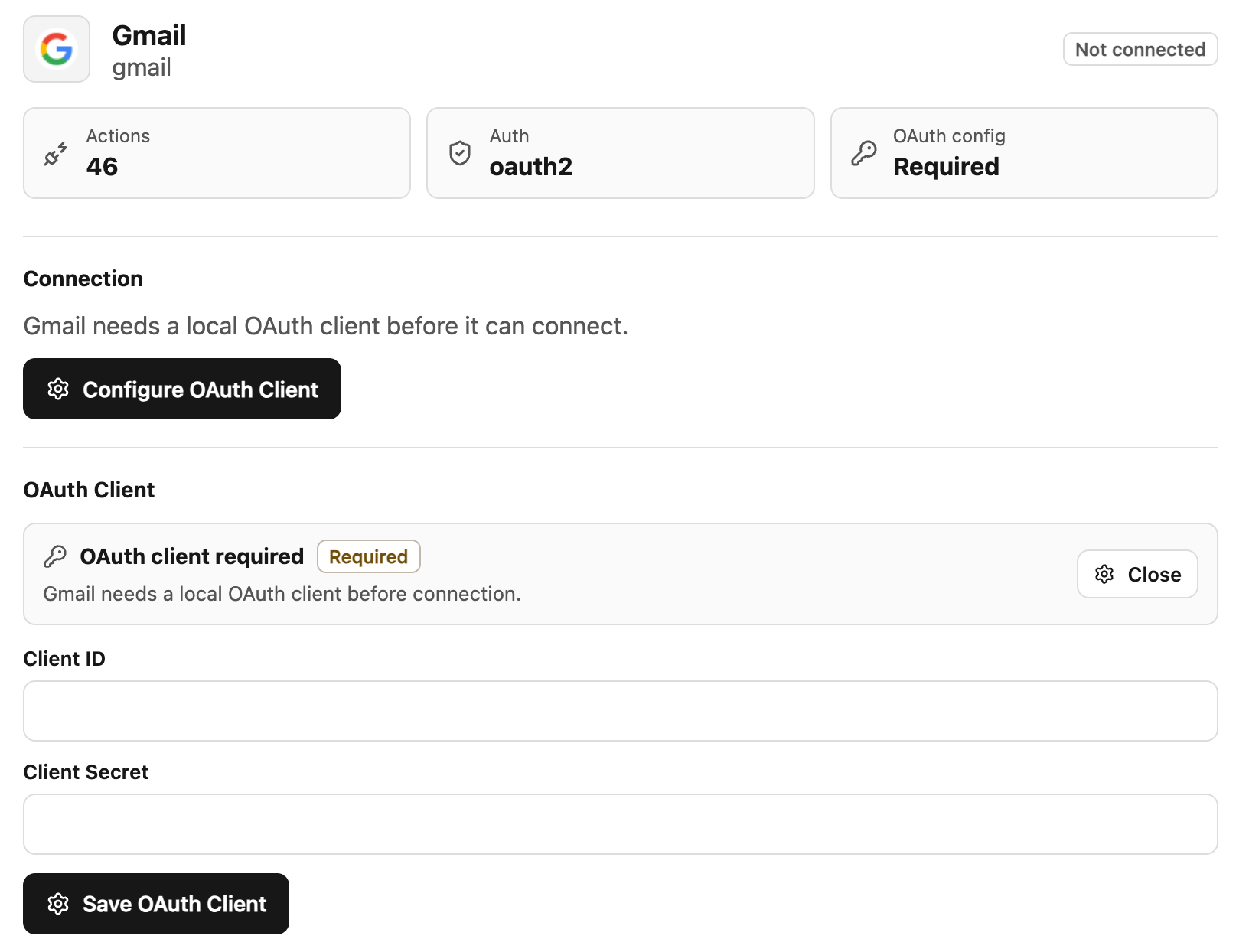
The Node entrypoint defaults its bind address to 127.0.0.1 — a genuinely conservative choice. But the README’s Quick Start does not run the Node entrypoint. It runs docker compose up, and the Docker image overrides the bind with ENV HOST=0.0.0.0 at build time, which containers need for port mapping. The shipped docker-compose.yml then publishes 3000:3000 to the host and passes OOMOL_CONNECT_ENCRYPTION_KEY and OOMOL_CONNECT_ADMIN_TOKEN through as empty values.
Then the README walks you into storing a real secret. Its Connect a Provider section demonstrates the flow with a GitHub personal access token: an unauthenticated PUT /api/connections/github carrying github_pat_... in the body. No admin token has been introduced yet; no encryption key has been mentioned.
The longer quickstart repeats the shape at document scale. In the 210-line docs/quickstart.md, the step that stores a GitHub PAT sits at line 63. OOMOL_CONNECT_ENCRYPTION_KEY first appears at line 178, and OOMOL_CONNECT_ADMIN_TOKEN at line 188 — the hardening lives in the final fifth of the document, after every credential-storing step it would have protected.


The policy engine’s failure direction depends on who is asking
The sharpest thing I found is not a missing control. It is an asymmetry between two callers of the same control.
/v1/proxy/:service forwards requests to provider API endpoints beyond the curated action catalog, with the stored credentials attached server-side. SECURITY.md describes its default honestly: “every proxy is allowed until one of those variables restricts it, and the Action variables do not restrict it.”
Now read the policy engine in src/core/action-policy.ts. The token-scoped proxy rules are only installed when a token is present. A persistent runtime token with an empty allowedProxies grant is denied every proxy — deny-by-default, exactly what you want. But when no token exists at all, that check is skipped, the deployment and runtime layers hold no lists, and evaluateProxy returns allowed.
Put those together under the shipped defaults and the capability ordering inverts: the caller who presents a deliberately scoped credential gets fail-closed proxy access, while the caller who presents nothing gets fail-open access to every proxy in the catalog. The operator who does the extra work of minting a scoped token builds a fence around that token — and the anonymous surface beside it stays open until an environment variable closes it.

What this does to the custody claim
The README’s boundary — agents get capability, not credentials — survives at the byte level under defaults. The connection management API is written not to echo stored secrets back; its serializer comment says it adds “stored account metadata without exposing credentials,” and that matches the code below it.
But custody is not only about bytes. Under the all-defaults deployment, any process that can reach the port — including the agent process the boundary was drawn against — can use every stored credential’s full capability through unauthenticated action runs and fail-open proxies. The secret stays in the store; everything the secret can do walks out.

Reading scope boundaries as configuration documentation
The pattern worth carrying out of this tree is that a security policy’s scope section can be read as a map of what the project already knows its defaults do. OpenConnector’s maintainers did not hide any of this. The startup logs warn three separate times on an all-defaults boot — admin auth disabled, runtime auth disabled, encryption disabled. The hardening guide is detailed and accurate against the code. The out-of-scope list exists precisely because the project understands these configurations are reachable.
That is what makes the overlap worth naming. Declaring documented misconfiguration out of scope is normal vulnerability-triage practice, and projects cannot fix user-owned deployment choices. But when the excluded configurations and the quickstart output are the same configurations, the scope boundary stops being a filter for user error and starts describing the product’s own first-run state. A researcher who reproduces exactly what docker compose up plus the README’s own curl examples produce has, by the policy’s text, nothing reportable.
If you are evaluating a credential gateway for an agent stack — this one or any of its category — three checks fall out of this audit directly:
- Find the pass-through path. Ask what the auth middleware compiles to when every credential source is absent, not what it enforces when configured. Presence-based activation means the empty configuration is its own security mode.
- Check both failure directions. A policy engine can be deny-by-default for identified callers and allow-by-default for anonymous ones at the same time. Test the request that carries nothing, not only the token you scoped.
- Walk the quickstart in order. The state your store is in when the first real secret lands is decided by everything the quickstart said before that step, not by the hardening section after it.
I ran the same default-versus-documentation question against an agent orchestrator in my earlier CLI Agent Orchestrator audit, where authentication was likewise off by default and the load-bearing switches were environment-variable presence checks. And the failure-direction asymmetry has a cousin in my SkillHub audit, where a security gate keyed on scanner availability rather than scanner findings. Two data points are not a law, but the shape repeats: in agent infrastructure, the distance between the architecture diagram and the first-run deployment is where the custody claims go to be tested.
Limitations
This audit reads one pinned commit, 493def09, and two bounded live API responses; later commits may change any default named here. I did not deploy the gateway or exercise the proxy against live providers — every behavioral claim is bound to the code path quoted, not to a runtime observation. The project’s documentation is unusually candid about each individual default, and the localhost-first framing is a real mitigation for the Node path; my findings concern the composition of defaults along the documented Docker quickstart, not concealment. The out-of-scope practice itself is common across open-source security policies, and nothing here asserts bad faith by the maintainers.
Key Takeaways
- The out-of-scope list is the default configuration. The four example configurations SECURITY.md excludes from vulnerability reports — no encryption key, no admin token, 0.0.0.0 binding, an exposed data store — are what the pinned tree ships when you follow the README’s
docker compose up. - Absent credentials disable the middleware, not just the check. With no tokens configured, the auth layer returns a pass-through function, and the plaintext codec stores secrets as typed — both selected by presence checks, both warned about at startup, neither enforced against.
- Anonymous callers outrank scoped tokens on the proxy surface. Runtime tokens get deny-by-default proxy grants; the tokenless default gets allow-by-default. If you deploy this gateway, set
OOMOL_CONNECT_ADMIN_TOKEN,OOMOL_CONNECT_ENCRYPTION_KEY, and either a proxy allowlist orOOMOL_CONNECT_BLOCKED_PROXIES="*"before the first credential is stored, and treat the quickstart’s hardening section as step one rather than an appendix.
New Questions
- How many of the category’s other gateways — Pipedream, Composio, and the self-hosted alternatives OpenConnector names as comparisons — show the same overlap between their vulnerability-scope exclusions and their quickstart output?
- Would a first-run wizard that refuses to store the first credential until an admin token and encryption key exist measurably change adoption, or is the frictionless quickstart load-bearing for a project at this stage?
- When an MCP host connects to a gateway like this, should the host itself verify it presented a token and refuse an endpoint that accepted it anonymously?
References
- oomol-lab/open-connector at 493def09 — audited tree: README, SECURITY.md, docs/quickstart.md, docker-compose.yml
- SECURITY.md scope section — out-of-scope list and hardening guidance
- src/server/api/auth.ts — pass-through middleware and auth scopes
- src/server/secrets/secret-codec.ts — codec selection
- src/core/action-policy.ts — proxy policy evaluation
- GitHub REST API repository object and live catalog endpoint — metadata and counts at retrieval
Editorial method: claims in this article point to primary documentation, pinned source code, runnable checks, or dated measurements, with AI-assisted research under the site's evidence-gated policy. How this site verifies claims and discloses AI assistance · Report a correction.
Working on something like this?
I take a small number of paid, scoped reviews: AI agent/RAG architecture diagnosis, Unity CI & build-automation audits, and multimodal QA design review. Each one ends in a written findings document.
Work with me