Agent/Orchestration
MCP Toolbox for Databases: A Single Backend for Secure Agentic SQL
Why Google’s open-source MCP Toolbox simplifies database tools for AI agents—connections, auth, observability, and schema-aware SQL in one place.
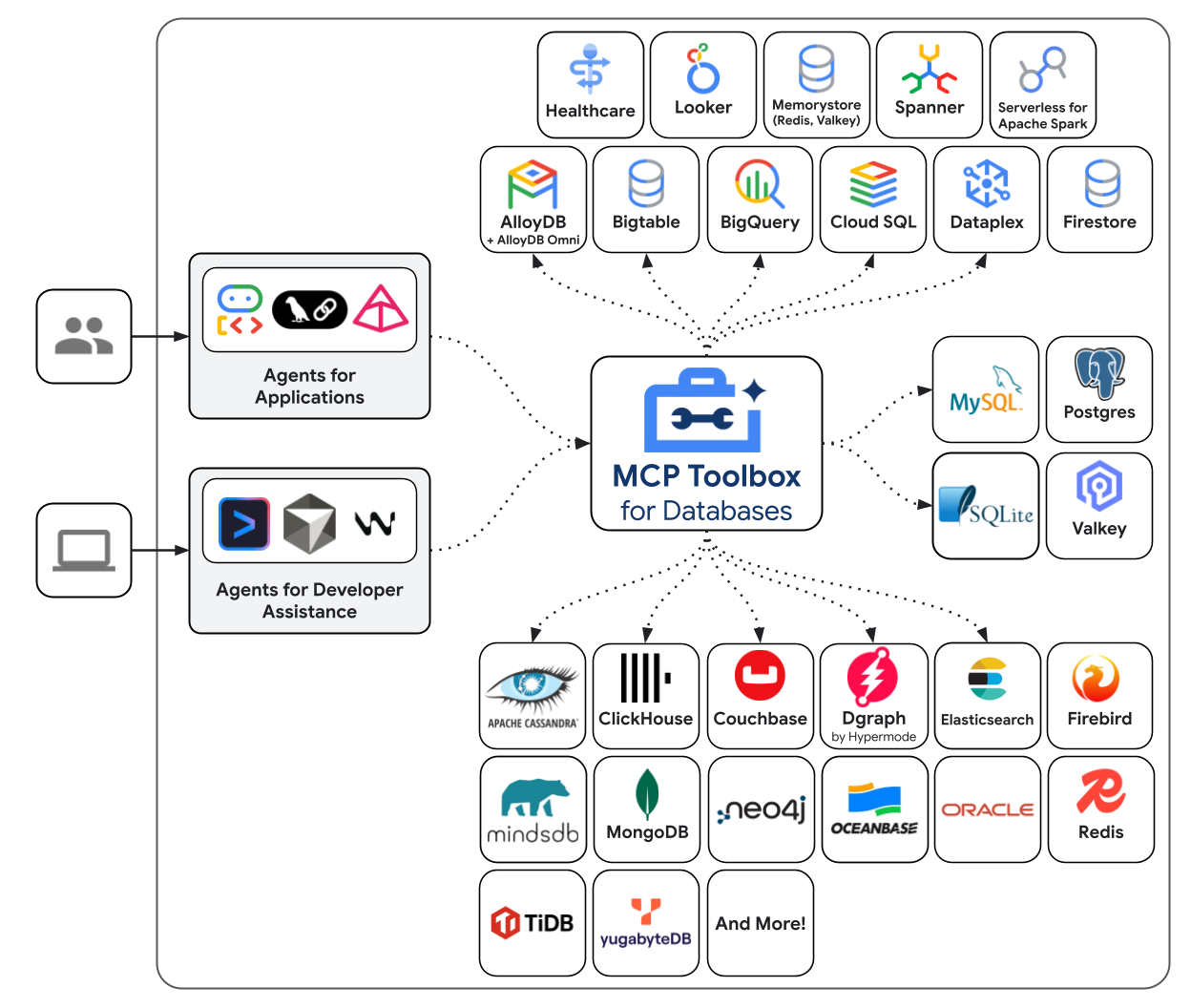
🤔 Curiosity: Why do database tools for agents need a backend?
In production, database access isn’t just SQL—it’s auth, pooling, schema context, and safety. Agents are great at generating queries, but bad at consistently enforcing security and observability. Google’s MCP Toolbox for Databases takes a strong stance: centralize the hard parts so agents can focus on intent.
Question: Can a single MCP backend become the standard “control plane” for safe, schema‑aware agentic SQL?
📚 Retrieve: What the repo and docs actually ship
What it is
- Open‑source MCP server for databases
- Handles connection pooling, authentication, and schema‑aware tool execution
- Built for AI agents and compatible across Python, JS, Go, and popular frameworks
- Beta (expect breaking changes before v1.0)
Why Toolbox (from the docs)
- <10 LOC to define tools (declarative)
- Performance: pooling + fast queries by default
- Security: integrated auth
- Observability: built‑in OpenTelemetry tracing
- DB support: Postgres, MySQL, Cloud SQL, and more
General architecture
Toolbox sits between your orchestration layer and your database as a control plane:
graph LR
  A[Agent / App] --> B[MCP Toolbox]
  B --> C[(Database)]
  B --> D[Tool Definitions]
  B --> E[Auth + Pooling]
  B --> F[OpenTelemetry]
Quickstart (non‑production)
1
npx @toolbox-sdk/server --tools-file tools.yaml
Running from binary
1
./toolbox --tools-file "tools.yaml"
SDKs (examples)
Python core
1
2
3
4
from toolbox_core import ToolboxClient

async with ToolboxClient("http://127.0.0.1:5000") as client:
    tools = await client.load_toolset("toolset_name")
JavaScript core
1
2
3
4
import { ToolboxClient } from '@toolbox-sdk/core';

const client = new ToolboxClient('http://127.0.0.1:5000');
const tools = await client.loadToolset('toolsetName');
💡 Innovation: How I’d use this in a game pipeline
1) Safe live‑ops queries for non‑engineers
Let PMs and analysts ask natural‑language questions, while Toolbox ensures:
- read‑only access
- consistent pooling
- audit trail + tracing
2) Schema‑aware tooling for agents
Toolbox can keep agents aligned with real schemas, reducing hallucinated table names.
3) Observability by default
With OTel built‑in, we get:
- per‑query tracing
- cost visibility
- incident forensics
Example: A “Live‑Ops Health” toolset
1
2
3
4
5
6
7
8
9
10
# tools.yaml

toolsets:
  liveops_health:
    - name: active_players
      description: "Daily active users by region"
      query: "SELECT region, COUNT(DISTINCT user_id) AS dau FROM sessions WHERE date = CURRENT_DATE GROUP BY region;"
    - name: purchase_errors
      description: "Payment error counts"
      query: "SELECT error_code, COUNT(*) FROM payments WHERE status='error' GROUP BY error_code;"
Key Takeaways
| Insight | Implication | Next Steps |
|---|---|---|
| Central control plane simplifies agent SQL | Safer access with less boilerplate | Define standard toolsets |
| Schema‑aware tools reduce hallucination | Higher trust in agent outputs | Connect Toolbox to IDEs |
| Observability is built‑in | Debugging becomes first‑class | Adopt OTel dashboards |
New Questions
- How do we benchmark agent SQL quality across models?
- What’s the right governance model for toolset changes?
- Can we layer cost budgets per toolset?
References
- Repo: https://github.com/googleapis/genai-toolbox
- Docs: https://googleapis.github.io/genai-toolbox/getting-started/introduction/
- Release notes: https://github.com/googleapis/genai-toolbox/releases