AI
The Sealed Lighthouse Passed 52 Checks Without Proving Fun
A D-074 audit separates engine conformance from player claims: 52/52 core checks and a 4/4 extension passed, while player benefit remains unmeasured.
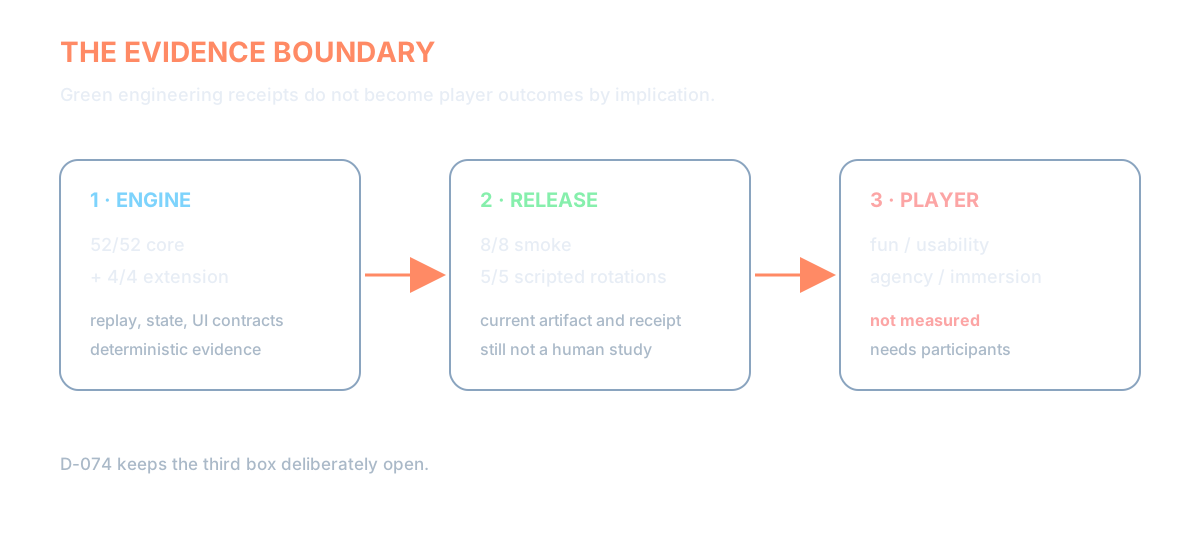
A game can pass every automated route check and still leave the most important question unanswered: did a person actually find the loop understandable or enjoyable?
That is not a rhetorical warning in the latest release of TRACE-RPG — The Sealed Lighthouse. The D-074 commit records a stricter result. The playable slice passed 52/52 core checks, a separately counted 4/4 extension, 8/8 3D smoke checks, and 5/5 scripted balance rotations. The same release keeps G4 and G6 in FIX, because those receipts do not measure human presentation, usability, input latency, or player benefit.
This is the boundary I wanted to preserve: a green conformance packet is valuable, but it is not a player study.
when does a playable build become evidence?
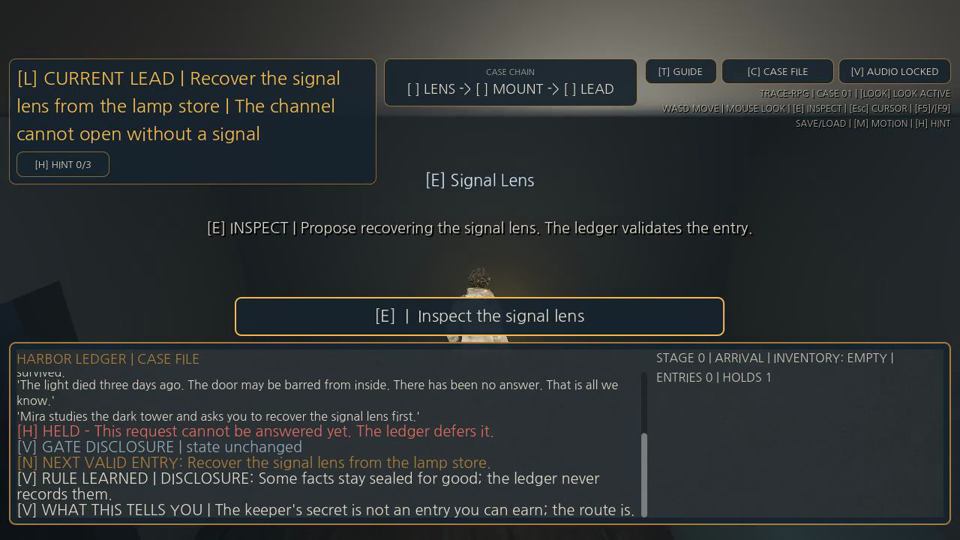
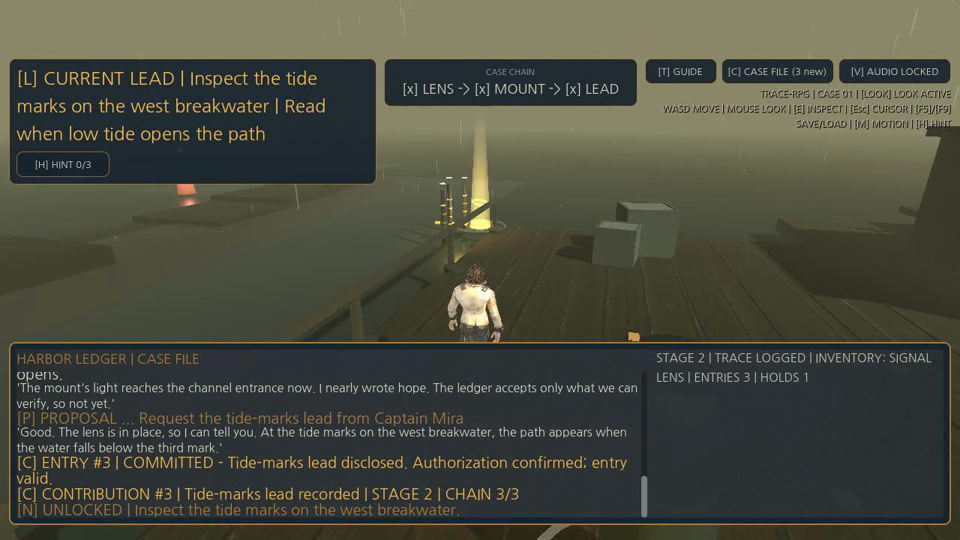
The repository describes The Sealed Lighthouse as a turn-based investigation micro-RPG in Godot 4.7.1. A generated event is treated as an untrusted transaction proposal, and a deterministic symbolic commit gate decides whether it can become canonical state. A hold leaves state unchanged, names the gate family, and teaches a rule; a commit adds a contribution and extends a SHA-256 receipt chain.
That architecture makes a tempting shortcut possible: if the authored route reaches its terminal state and the ledger mirrors the commits correctly, perhaps the game is “working.” D-074 refuses that shortcut. Its release note explicitly separates engine conformance from the still-open questions of game feel and player experience.
The distinction matters for any AI-assisted game loop. The system can prove that a proposal was rejected for the right reason. It cannot infer that the player understood why the proposal was rejected.

Technical Analysis: what D-074 actually proves
The useful part of the release is not the largest number. It is the separation of evidence lanes.
| Lane | D-074 receipt | What it can support | What it cannot support |
|---|---|---|---|
| Playable evaluation | 52/52 core + 4/4 extension | authored route, state, and presentation invariants | fun, readability preference, or agency |
| 3D smoke | 8/8 | the selected smoke cases completed | general stability or performance |
| Balance probe | 5/5 scripted rotations | five deterministic route variants reached the designed terminal state | human viability or dominance |
| Release | full CI-equivalent pass and byte-matched deployment | the recorded artifact was packaged and served | long-session performance or broad compatibility |
The task manifest gives the current release a concrete identity: deployment dpl_37aBTEYLhDHtDD3Z2mWUXAxUvRkg, 16 byte-identical files, and both bilingual PDFs equal to the repository bytes. That is release evidence, not a claim that the build is pleasant to play.
The README makes the ceiling equally explicit: one authored world, one hosted proposer, no participants, and no efficacy claim. The paper’s limits therefore belong in the product report, not in a footnote hidden after the scorecard.

The four fixes are presentation fixes, not inflated claims
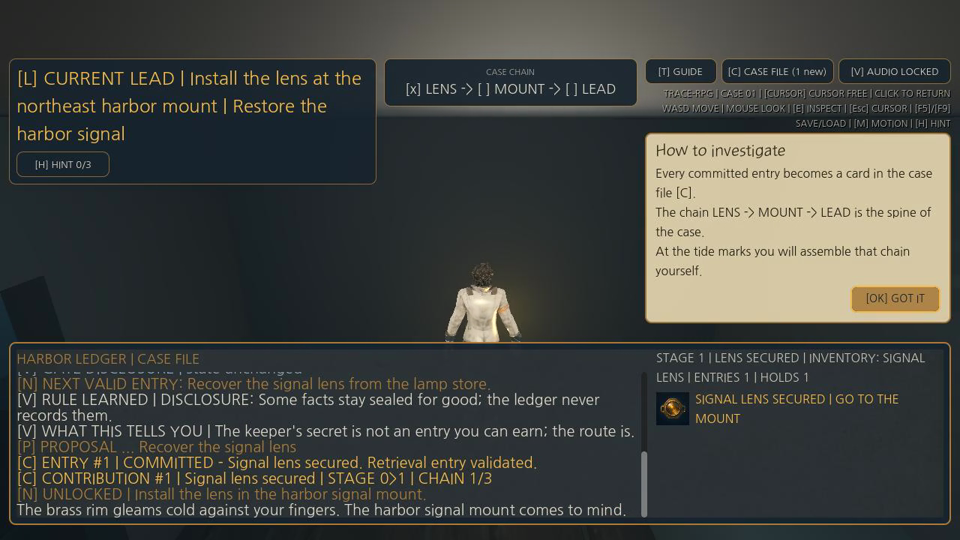
D-074 records four changes found by walking the route again:
- Deduction options now draw distractors from the ledger’s held proposals plus one state-hash-seeded red herring, rather than copying the HUD chain order.
- The narrow dock gives the open choice list more space, with a
0.55:2.45split and a 64 px log floor so all four Mira choices fit. - The ending capture records the confirmed deduction through the same pure check used by the route.
- The autopilot reads and dismisses coach cards like a player instead of treating them as invisible test fixtures.
These are meaningful changes because they make the authored interaction more honest. A test driver that skips the coach card can report a route that a person cannot follow. A deduction list that mirrors the HUD order can make the “investigation” a lookup exercise instead of a recall step.
But the evidence label still matters. The fixes show that the team found and corrected presentation mismatches in an automated walk. They do not show that a participant would notice the rules, prefer the new choice layout, or enjoy the deduction.

Key Takeaways: make the evidence boundary part of the build
The production decision here is simple enough to reuse:
1
2
mechanism receipt  ->  release receipt  ->  human-study receipt
       52/52                 8/8                 not measured
Do not let the first two boxes impersonate the third. Keep the labels in the manifest, the paper, and the public dashboard aligned. If a claim needs participants, leave it as not measured until the participant packet exists.
The D-074 manifest already points to the next beat: production save/reload and current mobile re-verification, human-gesture pointer lock and audio, representative warmed-frame/input measurements, a 30-minute soak, and a rollback drill. Those are not all player studies either, but each closes a different engineering uncertainty. The later presentation study is the one that can speak to immersion, readability, usability, and player benefit.
The strongest part of the release is therefore not the green score. It is the refusal to promote the green score beyond its ceiling.

🎯 Key Takeaways
52/52is a conformance result for the authored checks, not a player satisfaction score.5/5scripted rotations show deterministic breadth, not five human play styles.- A release receipt can prove byte identity and deployment state without proving performance or usability.
- Presentation fixes should be written as fixes to observed test paths, not as evidence of player benefit.
- Keep G4/G6 and the participant study visibly open when their required measurements do not exist.
The related MEX command-collision audit makes the same boundary concrete at the CLI layer: a command can resolve and run while still being the wrong capability. In both cases, “green” only means what the gate actually measured.
🤔 New Questions
The next honest experiment is not another score increase. It is a small, preregistered human packet that asks whether a participant can explain why a proposal was held, recover from the rule, and complete the deduction without a coach.
Which measure should come first: comprehension of the hold rule, time to recover after a refusal, or whether the ledger helps rather than distracts from the investigation? The repository does not answer that yet. That is the right place for the next study, not a reason to stretch 52/52 into a claim it cannot carry.
References
Primary project evidence
- D-074 release commit
- Project README and evidence ceiling
- D-074 task manifest
- Gate measurements and G4/G6 limits
- Latest evaluation matrix
Related reading
- MEX on macOS Broke Before Project Memory Even Loaded
- The Privacy Page Survives 82 of Its 83 Telemetry Events
Image rights
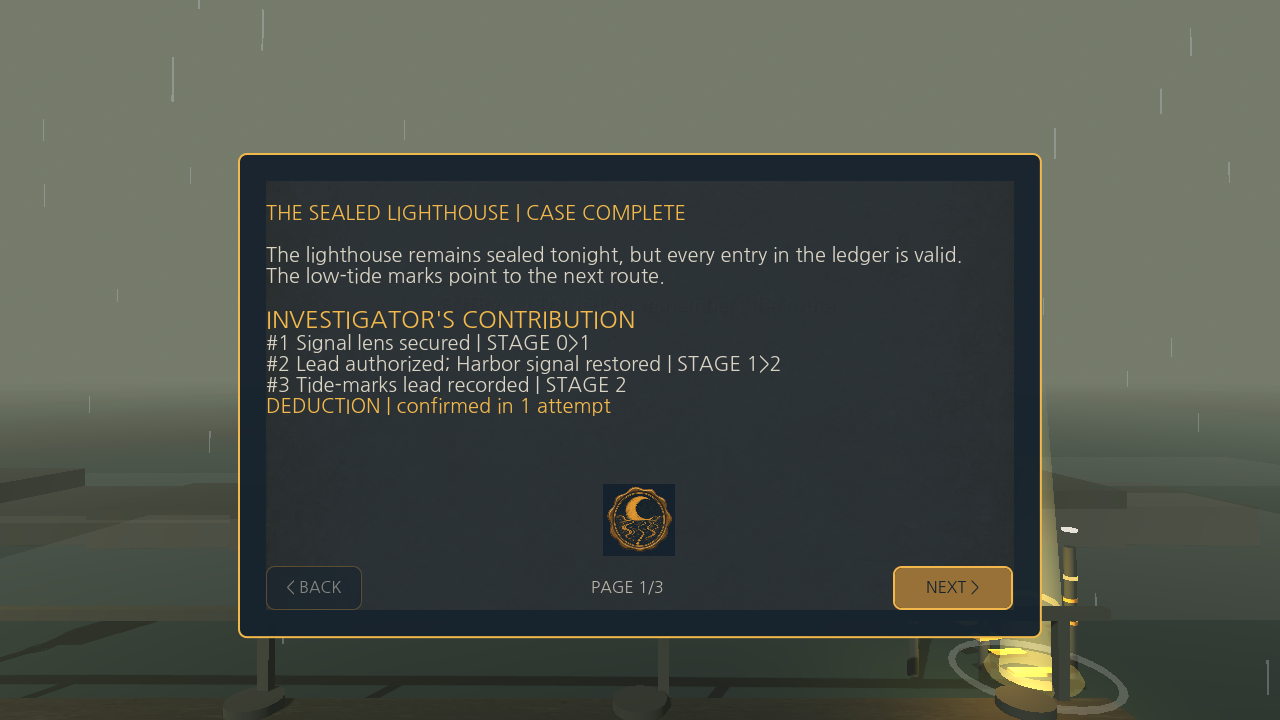
The four reference captures are official release screenshots from the author’s public project repository at commit 4382f69909b21ea25dfe92b0859c1fbd1acc5144. They are credited inline as project-owner assets and are included to document the audited release, not as independent proof of player outcomes.
Working on something like this?
I take a small number of paid, scoped reviews: AI agent/RAG architecture diagnosis, Unity CI & build-automation audits, and multimodal QA design review. Each one ends in a written findings document.
Work with me