AI
Godot Avoidance Stops Forwarding Velocity After Arrival
Godot 4.7.2 gates avoidance velocity on a submitted target. A pinned source audit traces the arrival reset and separates route, steering and body movement.
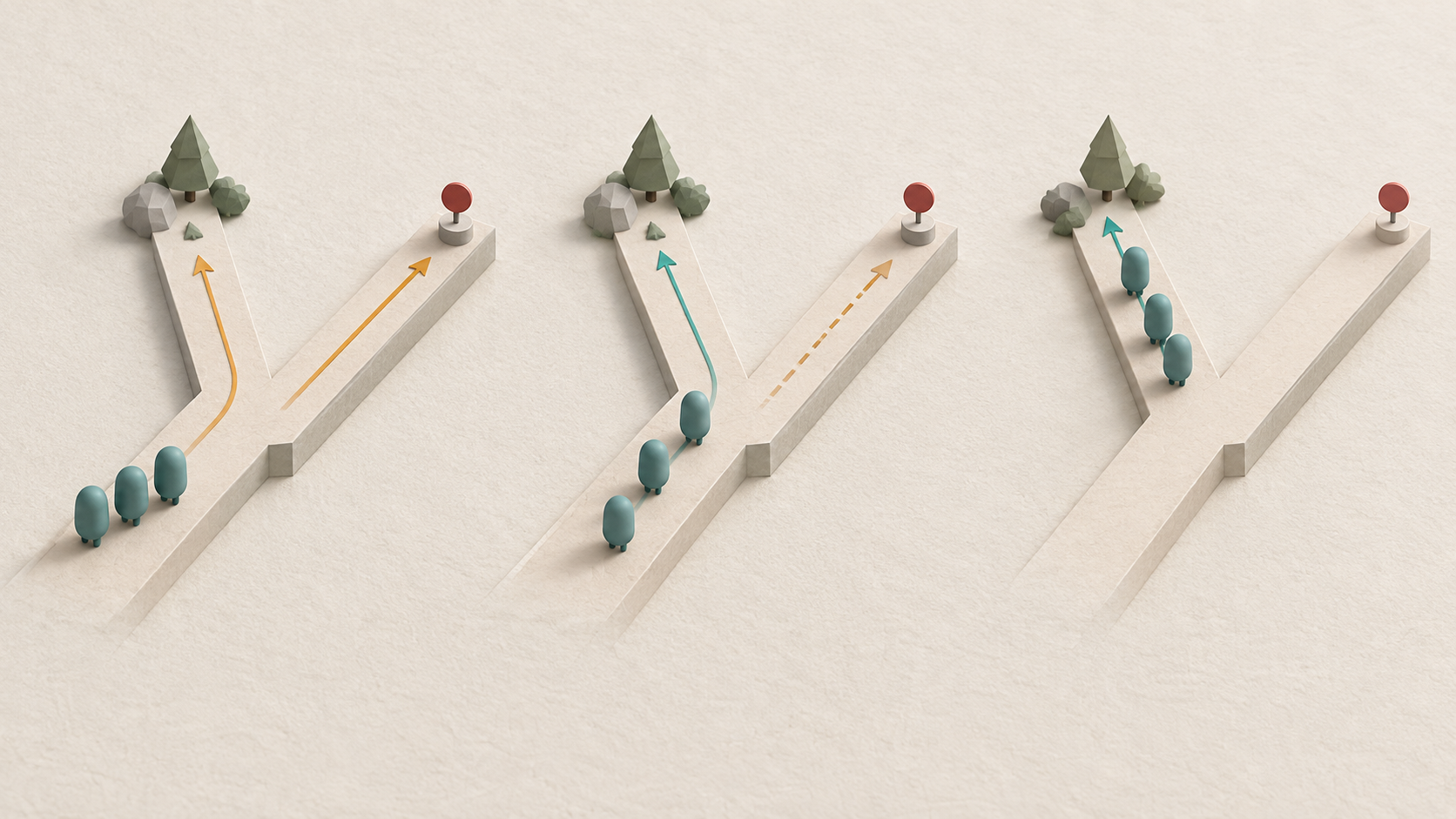
🤔 Curiosity: Why does avoidance go quiet after arrival?
A character can keep receiving movement intent while the navigation agent stops forwarding desired velocities to avoidance. The setter still accepts a vector, but the inspected forwarding branch is gated by target submission.
This is a source-level finding, not a reported runtime bug. I inspected Godot source at ed1daf0bf001b61586d9930840f2f1394092c079 (4.7.2 stable) and the matching 4.7 docs snapshot at 6d86d7c7f3b8f4f56c71e113022d72fe80b2c84d. These are separate engine and documentation pins. No project was run and no benchmark or measured jitter is claimed.
Editorial method: AI assisted the research and draft under the evidence-gated editorial harness; an independent evidence review checked the pinned sources. No human review, Godot runtime test, or first-hand production result is claimed.
📚 Retrieve: Technical Analysis of the controller handoff
The documented navigation pattern has three owners. A path query provides the next position; the game script turns that into desired movement; then the character body applies movement. Godot explicitly says the navigation system never moves the agent’s parent. For CharacterBody3D, the official example connects velocity_computed, submits desired velocity when avoidance is enabled, and in the callback assigns the resulting safe velocity to the body before move_and_slide().
That handoff matters because set_velocity() is not a movement command. In the pinned NavigationAgent3D implementation it stores the supplied vector and marks velocity_submitted. During internal physics processing, the agent forwards it to NavigationServer3D only when it has a parent and target_position_submitted is true. The code also checks avoidance_enabled before the server call. In 2D avoidance mode it may retain the vertical component separately and submit the horizontal plane. The RVO implementation describes the supplied velocity as a suggestion, not a promise: simulation tries to fulfill it.
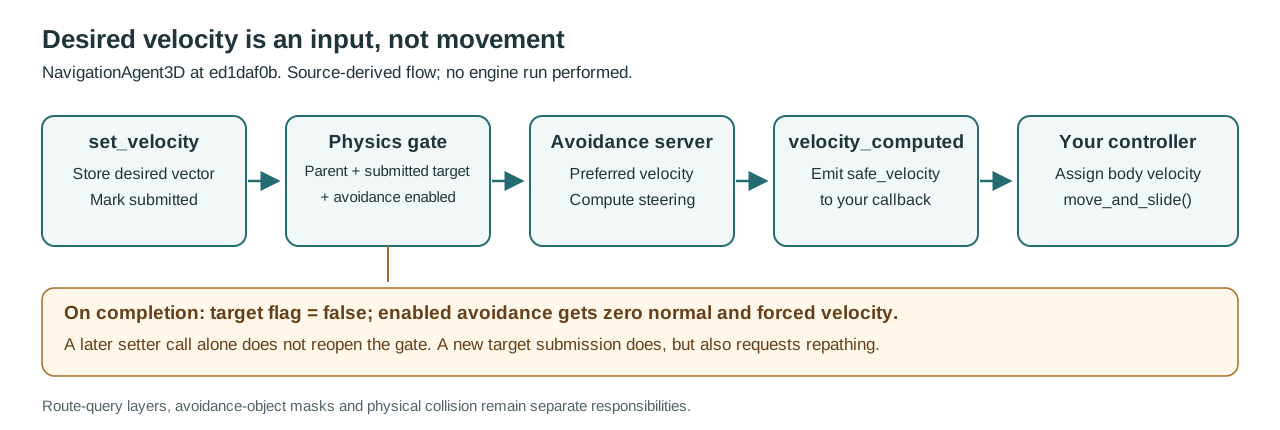
The original diagram is explanatory, not a runtime trace. It separates route target, desired velocity, safe velocity, and parent-body movement. The project remains responsible for body motion; the agent does not move its parent.
The lifecycle edge appears at arrival. _transition_to_navigation_finished() marks navigation finished and clears target_position_submitted. When avoidance is enabled, it also updates the server position, submits zero normal and forced avoidance velocities, and clears stored vertical velocity before emitting navigation_finished. Separately, set_velocity() can still store a later vector and mark it submitted. But the internal physics forwarding branch is nested under the target-submitted condition. The source-level deduction is conditional: after the completion transition, later set_velocity() calls alone do not enter that inspected forwarding branch until a target is submitted again. This does not mean the solver has shut down, nor does it establish what every other code path or custom integration does.
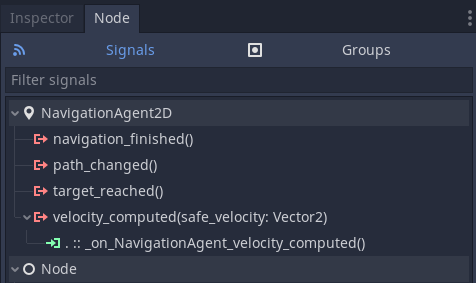
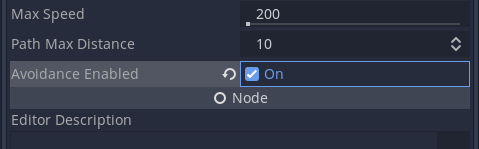
The documentation adds a second condition that is useful when avoidance is used without route following: a target_position is still required, or the documented safe_velocity result is always zero. The source trace gives that requirement a concrete submission gate; it does not turn the docs’ statement into proof that all avoidance-only setups behave identically. For an ordinary path-following actor, the documented loop checks is_navigation_finished() early, calls get_next_path_position() once per physics frame while active, derives a desired velocity, and stops querying after completion.
A safe integration sketch is therefore lifecycle-aware rather than a keepalive loop:
1
2
3
4
5
6
7
8
9
10
11
12
13
14
15
16
func _physics_process(delta):
    if NavigationServer3D.map_get_iteration_id(navigation_agent.get_navigation_map()) == 0:
        return
    if navigation_agent.is_navigation_finished():
        return

    var next_position = navigation_agent.get_next_path_position()
    var desired = global_position.direction_to(next_position) * movement_speed
    if navigation_agent.avoidance_enabled:
        navigation_agent.set_velocity(desired)
    else:
        _on_velocity_computed(desired)

func _on_velocity_computed(safe_velocity: Vector3):
    velocity = safe_velocity
    move_and_slide()
This is a compact reading aid for the official CharacterBody3D example, not a tested drop-in controller. In a game with separate states, the controller should decide whether arrival means stop, idle, or accept a new command; the source evidence supports explicitly submitting a new target when navigation should resume, not silently keeping the old target alive by re-querying after completion.
A 3D actor can still use the 2D avoidance mode. The documented use_3d_avoidance switch selects xz-plane avoidance or xyz avoidance; those modes run in separate avoidance simulations, so agents split between them do not affect one another.
Three boundaries that look like one
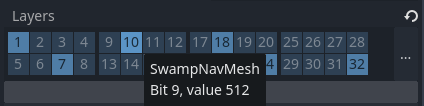
Route selection, avoidance steering, and body collision are separate concerns. Navigation layers select which navigation meshes a path query considers. Avoidance layers and masks select which avoidance objects participate in avoidance calculations. The docs state avoidance has no navigation-mesh or physics-collision information and does not affect pathfinding. So changing a route-layer selection is not a way to tune who avoids whom, and an avoidance result is not a guarantee of physical collision-free movement.
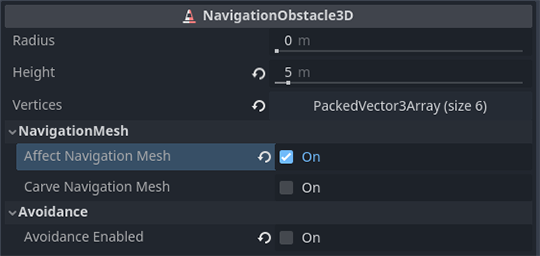
Obstacles add another boundary. affect_navigation_mesh and carve_navigation_mesh control how an obstacle participates in navigation-mesh baking; that is distinct from its avoidance behavior. The obstacle tutorial says static outline obstacles work only with 2D avoidance. Dynamic radius obstacles are soft “please move away” constraints and are not reliable in crowded or narrow spaces. Neither statement proves that a particular obstacle bake succeeded or that bodies collide successfully in a running scene.
Why identical-target resubmission is not the fix
It may seem natural to call set_target_position() every frame so the target flag remains set. The implementation explicitly does not compare target equality: each setter call stores the target, marks it submitted, and requests repathing. That makes identical-target resubmission a repath request, not a neutral keepalive. It does not prove a path is recomputed immediately, or that repeated calls cause measurable cost or jitter; those outcomes were not measured here.
The practical controller choice is narrower: submit a destination when a command or state transition actually requests navigation, then follow the documented active-path loop and treat navigation_finished as a lifecycle event. If the actor should resume movement, explicitly decide and submit the next target. If it should remain arrived, do not mistake continued desired-velocity updates for a route lifecycle. A useful follow-up would record target submission, callback delivery, completion, and body velocity across arrival and a subsequent command, then compare a new target with repeated identical-target calls.
For that follow-up, first decide what the profiler should measure: Godot Physics Time and the Slowest Step is a useful controller-measurement companion. When comparing editor imagery with actual behavior, Godot Editor Preview Is Not Runtime Evidence offers a different caution about interpreting configuration views. Here, the screenshots document settings and signal hookup only; they do not stand in for a game run.
💡 Innovation: Make the handoff observable
For a controller review, observe four boundaries: target submission, desired velocity, velocity_computed, and parent-body movement. This separates calculated intent, forwarded intent, and applied movement without claiming these observations diagnose every navigation issue.
A focused test can observe desired-velocity submission and callback during an active path, completion, and a subsequent target. Avoidance-only use still needs a target position according to the docs. Until run, the post-arrival explanation remains a conditional deduction from pinned 4.7.2 source, not a reproduced symptom or a claim about all releases.
🎯 Key Takeaways
set_velocity()stores controller intent; the inspected forwarding path also requires a parent, a submitted target, and enabled avoidance.- Arrival clears the target-submitted flag and, when avoidance is enabled, resets normal and forced avoidance velocities. Later setter calls alone therefore do not pass through the inspected forwarding branch until a target is submitted again. This is a source-level inference.
velocity_computedis a steering result for the controller to consume. The parent body remains responsible for movement, includingmove_and_slide()in the officialCharacterBody3Dexample.- Do not use repeated identical-target calls as a keepalive: the setter requests repathing even when the target is unchanged. No cost or jitter magnitude was measured.
- Navigation layers, avoidance masks, mesh baking, avoidance obstacles, and physics collision solve different parts of the problem.
🤔 New Questions
- In a minimal Godot 4.7.2 scene, does callback delivery resume immediately after a new target is submitted following
navigation_finished? - Which controller state should own target submission when an arrived actor may idle, accept a new command, or continue moving?
- What does a bounded comparison of one-time target changes and per-frame identical-target submissions show in a real profiler, with scene, frame count, and engine build recorded?
References
Engine source
- Godot
NavigationAgent3D, commited1daf0, especiallyset_velocity, internal physics processing, target submission, and navigation-finished transition. Godot version file at the same commit identifies 4.7.2 stable. - Godot RVO
NavAgent3D, commited1daf0, preferred-velocity comment and assignment.
Official documentation, 4.7 snapshot
- Using NavigationAgents: path following, avoidance, signal connection, target requirement, and CharacterBody3D example.
- Using NavigationLayers: route-query layer masks.
- Using NavigationObstacles: obstacle baking and avoidance constraints.
- Godot docs content license: tutorial content outside
classes/is CC BY 3.0 with attribution to Juan Linietsky, Ariel Manzur and the Godot community.
Working on something like this?
I take a small number of paid, scoped reviews: AI agent/RAG architecture diagnosis, Unity CI & build-automation audits, and multimodal QA design review. Each one ends in a written findings document.
Work with me