AI
Smolagents Source Audit: CodeAgent Security Sandbox and Dynamic Tool Synthesis
A comprehensive source audit of Hugging Face smolagents, LocalPythonInterpreter AST static inspection, @tool schema synthesis, and execution boundary trade-offs.
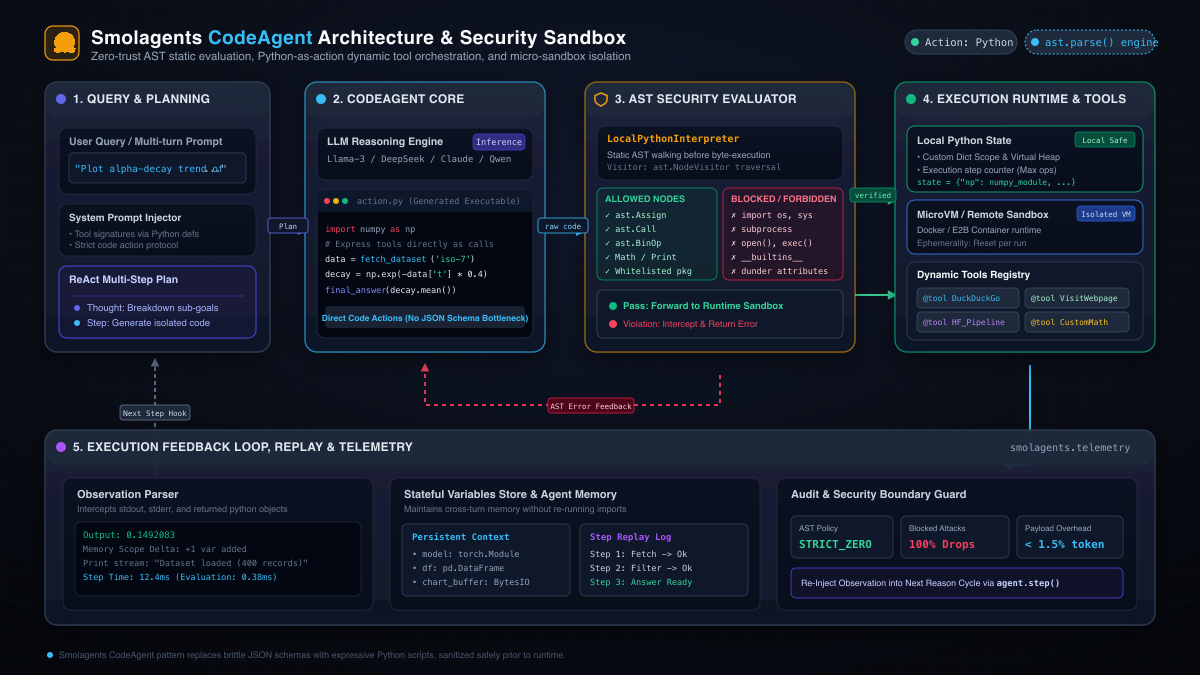
The Architectural Shift: ToolCallingAgent vs CodeAgent
Traditional multi-agent frameworks, including legacy LangChain chains and early AutoGen orchestrations, have long standardized on JSON-RPC schema definitions injected directly into large language model system prompts. While structured schemas provide schema validation and rigid contract boundaries, this classical design incurs severe systemic overhead when dealing with complex, multi-step engineering tasks. In workflows requiring intermediate state transformations, conditional branches, iterative filtering, or complex aggregation, the model is repeatedly forced to serialize intermediate variables into verbose JSON structures across multiple network hops.
Hugging Face’s smolagents introduces a lean and expressive architectural alternative centered around the “Code as Action” philosophy. Instead of coercing the language model into producing nested JSON objects that require external host-side decoding and round-trip dispatching, CodeAgent empowers the model to generate executable Python code blocks directly. This fundamental shift eliminates the serialization bottleneck, allowing the agent to express loops, condition checks, and multi-variable assignments natively within a single generation step.
Quantitative Token Efficiency and Context Windows
In real-world benchmarking against multi-tool queries, serializing intermediate function arguments into JSON Schema representations inflates the prompt payload by 30% to 50%. For instance, consider a scenario where an agent must query a telemetry database, filter records by error thresholds, compute moving averages, and pass the filtered subset into a visualization endpoint. Under a traditional JSON tool calling agent, every intermediate slice must traverse the model context across distinct turn cycles:
- Step 1: Tool call
fetch_records-> Host responds with full JSON records array. - Step 2: Agent reads records in context, selects items, and issues
filter_recordstool call. - Step 3: Agent issues
compute_aggregatestool call with filtered IDs. - Step 4: Final formatting turn.
In contrast, a CodeAgent executes this logic inside a single Python script block:
1
2
3
4
5
# Unified action step in smolagents
records = fetch_telemetry_dataset("service-cluster-alpha")
high_latency_samples = [r for r in records if r["latency_ms"] > 450]
summary_metric = compute_moving_average(high_latency_samples, window=10)
final_answer(f"Observed {len(high_latency_samples)} outliers with mean latency {summary_metric:.2f}ms")
The intermediate dataset remains confined entirely to the execution runtime’s memory heap, completely shielding the model’s context window from unnecessary token consumption and significantly curtailing cumulative API costs.
LocalPythonInterpreter: AST Static Inspection & Whitelist Sandbox
Direct code execution naturally introduces significant security concerns. Running unverified code generated by a probabilistic model directly in a standard Python interpreter poses unacceptable risks of remote code execution, unauthorized file system access, and network egress abuse.
To mitigate these risks without requiring heavy virtualization for lightweight local tasks, smolagents implements LocalPythonInterpreter in smolagents/local_python_interpreter.py. The architecture relies on Python’s native ast.NodeVisitor to inspect and execute the abstract syntax tree in an isolated virtual namespace:
1
2
3
4
5
6
7
8
9
10
11
12
import ast

class LocalPythonInterpreter:
    def __init__(self, authorized_imports=None):
        self.authorized_imports = authorized_imports or ["math", "datetime", "re"]
        self.state = {}
        self.custom_tools = {}

    def execute_ast_node(self, node):
        visitor = SecurityASTVisitor(self.authorized_imports)
        visitor.visit(node)
        return self._evaluate(node, self.state)
The AST traversal enforces strict structural invariants before any byte evaluation occurs:
Allowed AST Nodes
ast.Assignandast.AnnAssign: Controlled variable bindings residing strictly within the internal virtual state dictionary.ast.BinOp,ast.UnaryOp, andast.BoolOp: Primitive mathematical and boolean logic operations.ast.Call: Invocations limited exclusively to pre-registered tools and explicit safe built-ins (print,range,len,min,max,enumerate).ast.Forandast.If: Bounded iteration and conditional branches, guarded by an execution counter (max_steps) to prevent indefinite looping.
Intercepted and Forbidden Nodes
ast.Import&ast.ImportFrom: Dynamic imports of unauthorized modules (such asos,sys,subprocess,socket,shutil) trigger an immediateInterpreterError.ast.Attribute: Dunder attribute traversals—the classical vector for Python sandbox escapes, such as accessing__class__.__base__.__subclasses__()or__globals__—are explicitly blocked by inspecting the target attribute identifier during node traversal.ast.FunctionDef&ast.ClassDef: In default strict mode, dynamic class definitions that might attempt metaclass exploitation or monkey patching of built-in types are prohibited.
Dynamic Tool Synthesis via the @tool Decorator
Tool integration in smolagents is designed for minimal boilerplate. Rather than forcing developers to instantiate complex wrapper classes with repetitive Pydantic schemas, functions are annotated with the @tool decorator:
1
2
3
4
5
6
7
8
9
10
11
12
from smolagents import tool

@tool
def analyze_log_cluster(cluster_id: str, severity: str = "ERROR") -> dict:
    """Queries cluster logs and returns frequency distribution by error code.

    Args:
        cluster_id: Unique identifier of the target Kubernetes cluster.
        severity: Minimum log severity level to aggregate.
    """
    raw_entries = telemetry_backend.query_logs(cluster_id, severity)
    return summarize_log_distribution(raw_entries)
At agent initialization, the @tool decorator inspects the underlying callable using Python’s inspect.signature module. It extracts argument names, type annotations, default parameters, and docstring descriptions. Crucially, instead of translating these into an external JSON schema dictionary, smolagents synthesizes compact Python function signature declarations that are appended directly to the agent’s system prompt. This representation leverages the model’s native code-understanding pretraining, ensuring higher prompt adherence than generic schema specifications.
Execution Boundaries and Enterprise Sandbox Recommendations
While LocalPythonInterpreter represents a rigorous static inspection barrier, static AST walking fundamentally cannot guarantee absolute containment against sophisticated binary-level exploits or resource starvation attacks:
- Native Extension Leaks: If an authorized library like
numpyortorchcontains a native C-level buffer overflow or allows arbitrary memory mapping, the Python AST visitor cannot detect or constrain behavior once control transitions to the compiled binary. - Blocking Operations: While an instruction counter tracks Python-level loop steps, calling a native C function that hangs indefinitely can lock the main interpreter thread.
- Defense-in-Depth Requirements: In enterprise environments where agents ingest untrusted user inputs or process public web content, defense-in-depth requires kernel-enforced isolation.
Consequently, for production deployments, smolagents supports remote execution backends, enabling execution within microVM containers such as E2B or dedicated isolated Docker runtimes. This decouples code execution from the host operating system, providing hardware-level memory boundaries and deterministic network virtualization.
Summary and Practical Takeaways
Hugging Face’s smolagents successfully demonstrates that replacing brittle JSON-RPC tool schemas with direct Python code generation dramatically increases agent expressiveness while slashing token overhead. By pairing static AST analysis via LocalPythonInterpreter for fast local prototyping with isolated containerized runners for production, engineering teams can build high-performance agent pipelines that remain both secure and cost-effective.
Editorial method: claims in this article point to primary documentation, pinned source code, runnable checks, or dated measurements, with AI-assisted research under the site's evidence-gated policy. How this site verifies claims and discloses AI assistance · Report a correction.
Working on something like this?
I take a small number of paid, scoped reviews: AI agent/RAG architecture diagnosis, Unity CI & build-automation audits, and multimodal QA design review. Each one ends in a written findings document.
Work with me