AI
LlamaIndex Workflows Source Audit: Event-Driven Multi-Agent State Machines
A technical source audit of run-llama/llama_index Workflows (commit 8d39c01b), evaluating event-driven async queue routing, ctx.collect_events fan-in synchronization barriers, and context checkpointing.
The Architectural Limits of Static Graph Abstractions in Agentic Systems
In the evolution of multi-agent software engineering, developers have predominantly relied on graph-based abstractions: Directed Acyclic Graphs (DAGs) and explicit StateGraphs. In these paradigms, an application is modeled as a collection of fixed nodes connected by predetermined edges. While suitable for linear data pipelines and rigid state transitions, graph abstractions strain under the dynamic realities of production autonomous agents.
Real-world agent interactions rarely follow static topological paths. A research coordinator agent may inspect an ambiguous user query and dynamically fan out three parallel search tasks across heterogeneous APIs. Asynchronously, those three tasks complete at unpredictable intervals and must be gathered through a deterministic synchronization barrier before a summarizer agent can execute. If an unexpected error or missing parameter occurs, the pipeline must dynamically route into an interrogation sub-loop without rewiring the global graph structure.
The release of the Workflows runtime within the LlamaIndex framework (pinned to commit 8d39c01b1a457ee8c1b923984faefea6db467888, MIT/Apache-2.0) resolves this tension by abandoning static graph topology in favor of a pure event-driven asynchronous state machine.
%%{init: {"flowchart": {"useMaxWidth": false}}}%%
flowchart TD
    subgraph Ingress ["Workflow Ingress"]
        StartTrigger["Workflow.run(query=...)"]
        StartEventNode["StartEvent Enqueued into asyncio.Queue"]
    end

    subgraph Dispatcher ["Event-Driven Dispatcher Core"]
        Queue["Internal Event Loop Queue"]
        TypeRouter["Type-Hint Signature Matching Engine"]
    end

    subgraph StepHandlers ["Decorated Step Handlers"]
        StepA["@step def query_planner(ev: StartEvent)"]
        StepB1["@step def search_worker_1(ev: PlanEvent)"]
        StepB2["@step def search_worker_2(ev: PlanEvent)"]
        BarrierJoin["@step def synthesizer(ev: ResultEvent)"]
    end

    subgraph Egress ["Workflow Completion"]
        StopEventNode["StopEvent(result=...) Emitted"]
        FinalReturn["Async Caller Receives Resolved Value"]
    end

    StartTrigger --> StartEventNode
    StartEventNode --> Queue
    Queue --> TypeRouter

    TypeRouter --> StepA
    StepA -.->|Fan-Out Multiple Events| Queue
    TypeRouter --> StepB1
    TypeRouter --> StepB2

    StepB1 -.->|Emit ResultEvent| Queue
    StepB2 -.->|Emit ResultEvent| Queue

    TypeRouter --> BarrierJoin
    BarrierJoin -->|ctx.collect_events barrier satisfied| StopEventNode
    StopEventNode --> FinalReturn

    style Ingress fill:#f8fafc,stroke:#38bdf8,stroke-width:2px,color:#111827
    style Dispatcher fill:#faf5ff,stroke:#a855f7,stroke-width:2px,color:#111827
    style StepHandlers fill:#f0fdf4,stroke:#22c55e,stroke-width:2px,color:#111827
    style Egress fill:#fff7ed,stroke:#f97316,stroke-width:2px,color:#111827
Deconstructing the Event-Driven Runtime Mechanics
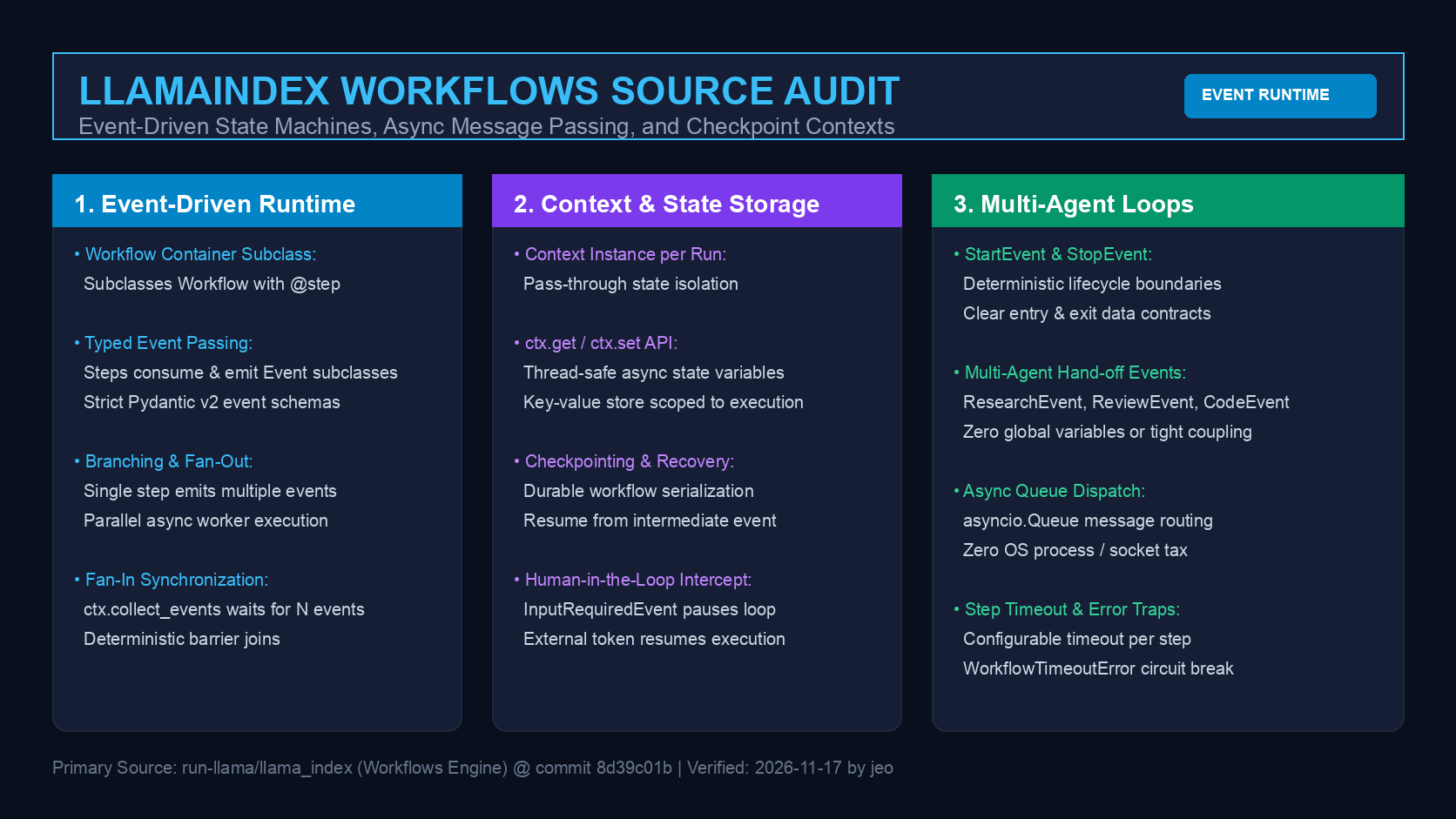
In LlamaIndex Workflows, an agentic application subclasses the base Workflow container. Steps are declared using the @step decorator. Instead of specifying which step precedes or follows another, steps declare the input Event types they consume and return the Event instances they produce.
1. Type-Inferred Dispatch
The internal dispatch engine is backed by Python’s native asyncio.Queue. When a workflow begins via await workflow.run(query="..."), the runtime constructs a StartEvent and enqueues it.
The dispatcher inspects registered @step methods at module load time. When an event arrives on the queue, the dispatcher matches the event’s Python class against the type annotations of all registered steps. Any step matching the incoming event signature is dispatched as an asynchronous coroutine task.
This decouples steps completely: a planning step does not know whether one, five, or zero workers will consume its output event. New capabilities are plugged in simply by adding a step that subscribes to an existing event type.
2. Deterministic Fan-In with ctx.collect_events
In distributed agent topologies, coordinating parallel asynchronous sub-tasks is a notorious source of race conditions and memory leaks. Workflows solves this through its native ctx.collect_events synchronization barrier:
1
2
3
4
5
6
7
8
9
10
11
12
13
14
15
16
17
from llama_index.core.workflow import Workflow, Event, StartEvent, StopEvent, step, Context

class ResearchResultEvent(Event):
    source: str
    content: str

class ResearchWorkflow(Workflow):
    @step
    async def gather_data(self, ctx: Context, ev: ResearchResultEvent) -> StopEvent | None:
        # Wait until 3 parallel research events have been delivered
        events = ctx.collect_events(ev, [ResearchResultEvent] * 3)
        if events is None:
            return None  # Barrier not yet satisfied; yield execution

        # All 3 events collected deterministically
        aggregated = "\n".join([e.content for e in events])
        return StopEvent(result=aggregated)
The Context object maintains an in-memory event buffer scoped to the active execution run. Until the exact required quantity of events has accumulated, ctx.collect_events returns None, quietly yielding execution. Only when the final event arrives does the method return the complete list, triggering downstream synthesis in a single atomic invocation.
Context Checkpointing, State Scoping, and Human-in-the-Loop
A major pitfall of agent orchestration frameworks is state leakage: when multiple concurrent user sessions share agent memory, mutable variables contaminate concurrent requests.
Workflows enforces strict scoping boundaries through its execution-bound Context:
- Execution-Scoped Key-Value Store: Calling
await ctx.set("user_id", "123")andawait ctx.get("user_id")provides thread-safe state access guaranteed to remain isolated to the specific workflow execution. - Durable Checkpointing: Because all state transitions are mediated by discrete, serializable
Eventobjects, the runtime can write the event log to disk or PostgreSQL. If a container dies mid-execution, the workflow reconstructs its state by replaying previous events up to the failure point. - Human-in-the-Loop Pausing: By emitting an
InputRequiredEvent, the workflow enters a suspended state, serializing its context and freeing execution threads. When an operator submits the required approval token viaHumanResponseEvent, the workflow resumes seamlessly without holding live socket connections open.
This clean separation of state and execution mirrors the non-invasive container isolation we audited in CanyonOS Multi-Agent Scaling and the robust process boundaries explored in Browser Use Cloud Boundaries.
Architectural Comparison Across Multi-Agent Orchestrators
| Architectural Metric | LangGraph (StateGraph) | CrewAI | LlamaIndex Workflows |
|---|---|---|---|
| Control Abstraction | Explicit state transition graph | Role-based sequential crew | Event-driven async state machine |
| Node Binding | Nodes connected by explicit edges | Sequential / hierarchical manager | Type-hinted event queue matching |
| Fan-In Coordination | Conditional edge routing | Manager agent polling | Built-in ctx.collect_events barrier |
| State Paradigm | Centralized state dictionary reducer | Shared task context memory | Scoped Context store + event replay |
| Runtime Overhead | Graph compilation overhead | High prompt token overhead | Sub-millisecond asyncio coroutine dispatch |
| Extensibility | Requires updating graph topology | Fixed agent role structure | Add @step subscribing to any Event |
Key Takeaways
- Event-Driven Over Graph Topology: Modeling agent workflows as asynchronous event queues eliminates fragile node-and-edge wiring while providing natural support for non-linear, dynamic multi-agent loops.
- Deterministic Synchronization: The
ctx.collect_eventsbarrier solves parallel fan-out and fan-in data joins without custom locks, semaphores, or race conditions. - Isolated Context State: Scoping state to an explicit
Contextinstance prevents memory leaks across concurrent requests while enabling durable disk checkpointing and fault-tolerant crash recovery. - Native Human-in-the-Loop: Suspending workflows via
InputRequiredEventallows long-running governance and human approval loops without keeping expensive server threads active.
Open Questions
- Distributed Event Queue Backends: While in-process
asyncio.Queuedelivers sub-millisecond dispatch on a single node, how will Workflows scale across distributed Kubernetes worker pods using Redis or Kafka event brokers without increasing serialization latency, as explored in FastMCP In-Memory Transports? - Event Schema Evolution: In production pipelines with long-running checkpoints, how can teams handle backward-incompatible migrations to Pydantic event schemas without invalidating persisted in-flight workflows?
- Automated Deadlock Detection: If an upstream step fails to emit the expected number of events required by
ctx.collect_events, what automated timeout policies should garbage-collect the stalled barrier?
References
- LlamaIndex Core Workflows Repository — Canonical upstream repository, commit
8d39c01b1a457ee8c1b923984faefea6db467888. - LlamaIndex Workflows Documentation — Official guides covering Workflow, Context, Event subclasses, and human-in-the-loop patterns.
- Python Asynchronous I/O Documentation — Reference for coroutine scheduling and event loop primitives.
Editorial method: claims in this article point to primary documentation, pinned source code, runnable checks, or dated measurements, with AI-assisted research under the site's evidence-gated policy. How this site verifies claims and discloses AI assistance · Report a correction.
Working on something like this?
I take a small number of paid, scoped reviews: AI agent/RAG architecture diagnosis, Unity CI & build-automation audits, and multimodal QA design review. Each one ends in a written findings document.
Work with me