Agent/Orchestration
SIMA 2: When AI Agents Learn to Play, Reason, and Improve in Virtual Worlds
DeepMind’s SIMA 2 integrates Gemini models to create AI agents that don’t just follow instructions—they reason, converse, and self-improve in 3D game environments. A deep dive into the future of embodied AI and gaming companions.
🤔 Curiosity: Can AI Agents Become True Gaming Companions?
What if playing a game with an AI wasn’t about giving commands to a robot, but collaborating with a companion who understands context, reasons about goals, and learns from mistakes?
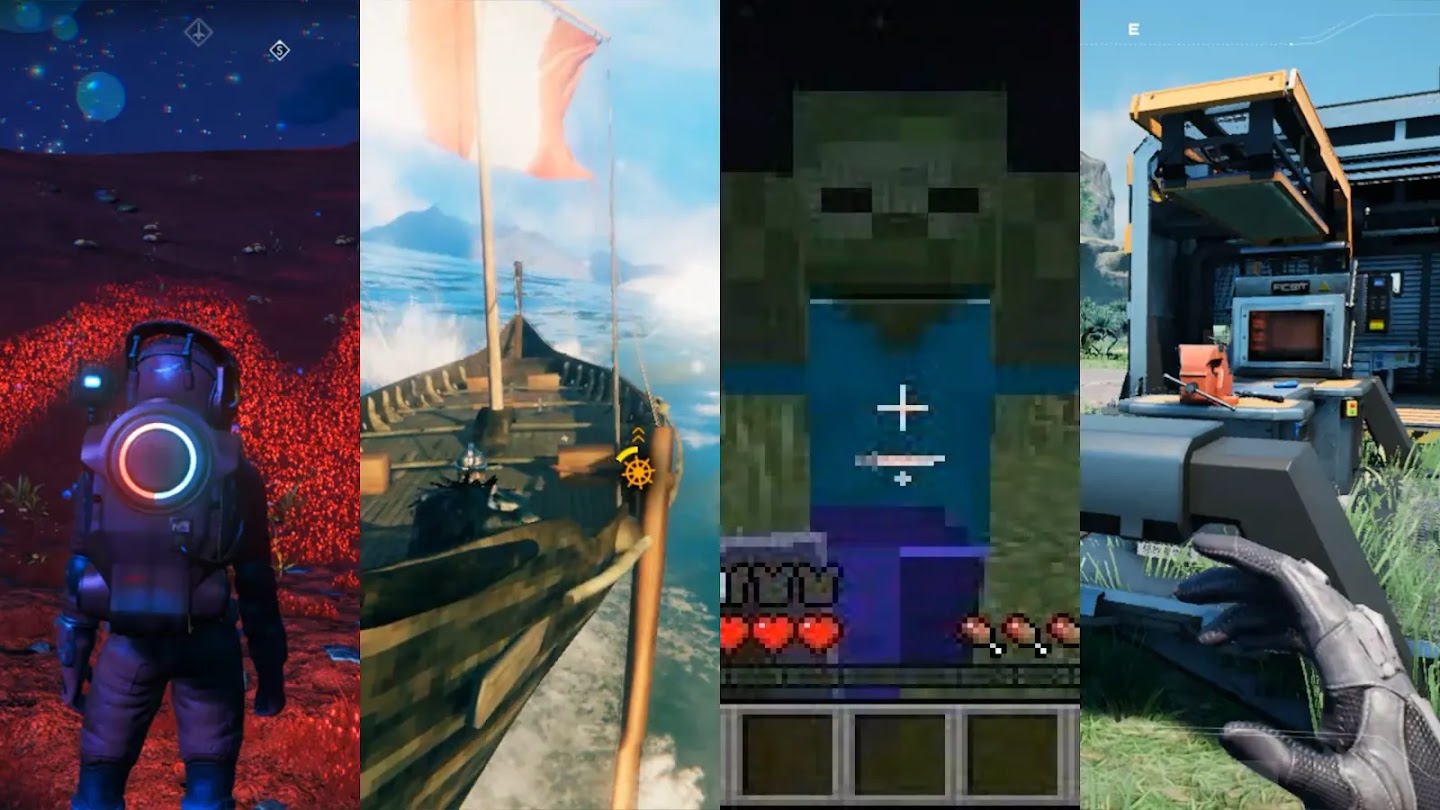
Curiosity: While most game AI systems follow pre-scripted behaviors or simple instruction-following, what would it take for an AI to truly understand game worlds, reason about complex goals, and improve itself over time?
Last year, DeepMind introduced SIMA (Scalable Instructable Multiworld Agent), a generalist AI that could follow basic instructions across diverse virtual environments. It was impressive—600+ language-following skills across commercial games—but it was still fundamentally a command executor, not a thinking partner.
SIMA 2 changes everything. By integrating Google’s Gemini models as the agent’s core reasoning engine, SIMA 2 evolves from an instruction-follower into an interactive gaming companion that can:
- Reason about complex goals and break them into steps
- Converse with users, explaining its actions and answering questions
- Self-improve by learning from its own failures without human intervention
As someone who’s built AI systems for games, this represents a fundamental shift. We’re not just scaling up instruction-following—we’re witnessing the emergence of embodied AI agents that think, learn, and collaborate.
The question: How does integrating a world-class reasoning engine (Gemini) transform an AI agent’s capabilities in 3D virtual worlds? And what does this mean for the future of game AI, robotics, and AGI?
📚 Retrieve: Understanding SIMA 2’s Architecture
From SIMA 1 to SIMA 2: The Gemini Integration
SIMA 1’s Limitations:
SIMA 1 was trained on human demonstration videos with language labels, learning to map instructions like “turn left” or “climb the ladder” to actions. It operated like a person playing a game—looking at the screen and using virtual keyboard/mouse controls, without access to underlying game mechanics.
The Problem:
- Could follow simple, direct instructions
- Struggled with abstract or complex goals
- No ability to reason about why it was doing something
- Limited generalization to unseen games
- No conversational capability
SIMA 2’s Innovation:
graph TB
    subgraph SIMA1["SIMA 1 Architecture"]
        I1[Language Instruction] --> P1[Instruction Parser]
        P1 --> A1[Action Executor]
        A1 --> G1[Game Environment]
        G1 --> O1[Observation]
        O1 --> A1
    end

    subgraph SIMA2["SIMA 2 Architecture"]
        I2[Language/Image/Emoji Input] --> G2[Gemini Reasoning Engine]
        G2 --> R2[Goal Decomposition]
        R2 --> P2[Action Planning]
        P2 --> A2[Action Executor]
        A2 --> G3[Game Environment]
        G3 --> O2[Observation]
        O2 --> G2
        G2 --> C2[Conversation/Explanation]
    end

    style G2 fill:#ff6b6b,stroke:#c92a2a,stroke-width:3px,color:#fff
    style R2 fill:#4ecdc4,stroke:#0a9396,stroke-width:2px,color:#fff
    style C2 fill:#ffe66d,stroke:#f4a261,stroke-width:2px,color:#000
Key Architectural Changes:
Gemini as Core Reasoning Engine: Instead of direct instruction-to-action mapping, SIMA 2 uses Gemini to understand high-level goals, reason about the environment, and plan multi-step actions.
Multimodal Understanding: Accepts text, images, sketches, and even emojis as input—understanding “🏠” means “go to the house” or interpreting a drawn arrow as a navigation command.
Conversational Interface: Can explain its actions, answer questions, and discuss its reasoning process with users.
Self-Improvement Loop: Uses Gemini to generate training data from its own failures, creating a self-reinforcing learning cycle.
The Power of Reasoning: Beyond Instruction-Following
SIMA 1 Example:
1
2
3
User: "Find a campfire"
SIMA 1: [Wanders randomly, doesn't understand context]
Result: ❌ Failure
SIMA 2 Example:
1
2
3
4
5
6
7
8
User: "Find a campfire"
SIMA 2: [Reasons: "Campfires are typically in outdoor areas,
        often near settlements or survival locations. I should
        look for smoke, light sources, or wooden structures."]
        [Plans: "1. Scan environment for visual cues
                2. Navigate toward likely locations
                3. Verify it's a campfire"]
Result: ✅ Success
The Difference: SIMA 2 doesn’t just execute commands—it understands intent, reasons about context, and plans multi-step solutions.
Training Data: Human Demonstrations + Gemini-Generated Labels
SIMA 2’s training combines:
| Data Source | Contribution | Example |
|---|---|---|
| Human Demonstrations | Ground-truth action sequences | Video of player completing “build a house” |
| Gemini-Generated Labels | Rich semantic understanding | “The player is gathering resources to construct a shelter” |
| Self-Generated Experience | Learning from failures | SIMA 2’s own failed attempts, labeled by Gemini |
Key Insight: By using Gemini to generate labels, DeepMind can create richer training data that captures not just what actions were taken, but why they were taken and how they relate to goals.
💡 Innovation: Three Breakthrough Capabilities
1. Reasoning: From Commands to Goals
What Changed:
SIMA 2 can now handle abstract, high-level instructions that require reasoning:
1
2
3
4
5
6
7
8
9
10
11
12
13
14
15
16
17
18
19
20
21
22
23
24
25
26
27
28
29
30
31
32
33
34
35
36
37
38
39
40
41
42
43
44
45
46
47
48
49
50
51
52
53
54
55
56
57
58
59
60
61
62
63
64
65
66
67
68
# Conceptual representation (not actual API)
class SIMA2Agent:
    """
    Curiosity: Can an AI agent reason about abstract goals?
    Retrieve: Gemini provides world-class reasoning capabilities
    Innovation: Goal-oriented action planning in 3D environments
    """

    def __init__(self, gemini_model):
        self.reasoning_engine = gemini_model
        self.action_executor = ActionExecutor()
        self.memory = WorkingMemory()

    def execute_goal(self, user_instruction: str, game_state: GameState):
        """
        Execute a high-level goal by reasoning about steps

        Args:
            user_instruction: "Find a campfire and cook food"
            game_state: Current game observation

        Returns:
            Action sequence with reasoning trace
        """
        # 1. Understand the goal
        goal_understanding = self.reasoning_engine.understand(
            instruction=user_instruction,
            context=game_state
        )
        # Output: "User wants to locate a campfire, then use it to cook food"

        # 2. Decompose into sub-goals
        sub_goals = self.reasoning_engine.decompose(goal_understanding)
        # Output: ["Find campfire", "Navigate to campfire",
        #          "Interact with campfire", "Cook food"]

        # 3. Plan actions for each sub-goal
        action_plan = []
        for sub_goal in sub_goals:
            actions = self.reasoning_engine.plan(
                goal=sub_goal,
                current_state=game_state,
                available_actions=self.action_executor.get_actions()
            )
            action_plan.extend(actions)

        # 4. Execute with monitoring
        for action in action_plan:
            result = self.action_executor.execute(action, game_state)
            game_state = result.new_state

            # Check if sub-goal achieved
            if self.reasoning_engine.check_goal_completion(
                sub_goal, game_state
            ):
                continue  # Move to next sub-goal
            else:
                # Re-plan if goal not achieved
                action_plan = self.reasoning_engine.replan(
                    failed_goal=sub_goal,
                    current_state=game_state
                )

        return {
            'success': True,
            'reasoning_trace': goal_understanding,
            'action_sequence': action_plan
        }
Real-World Impact:
In testing, SIMA 2 successfully handles instructions like:
- “Build a shelter before nightfall” (requires time awareness, resource gathering, construction planning)
- “Find the highest point and survey the area” (requires spatial reasoning, navigation, exploration)
- “Gather materials to craft a weapon” (requires understanding crafting systems, resource locations, tool requirements)
2. Generalization: Zero-Shot Performance on New Games
The Generalization Challenge:
One of the hardest problems in game AI is transfer learning—can an agent trained on Game A perform well on Game B without retraining?
SIMA 2’s Results:
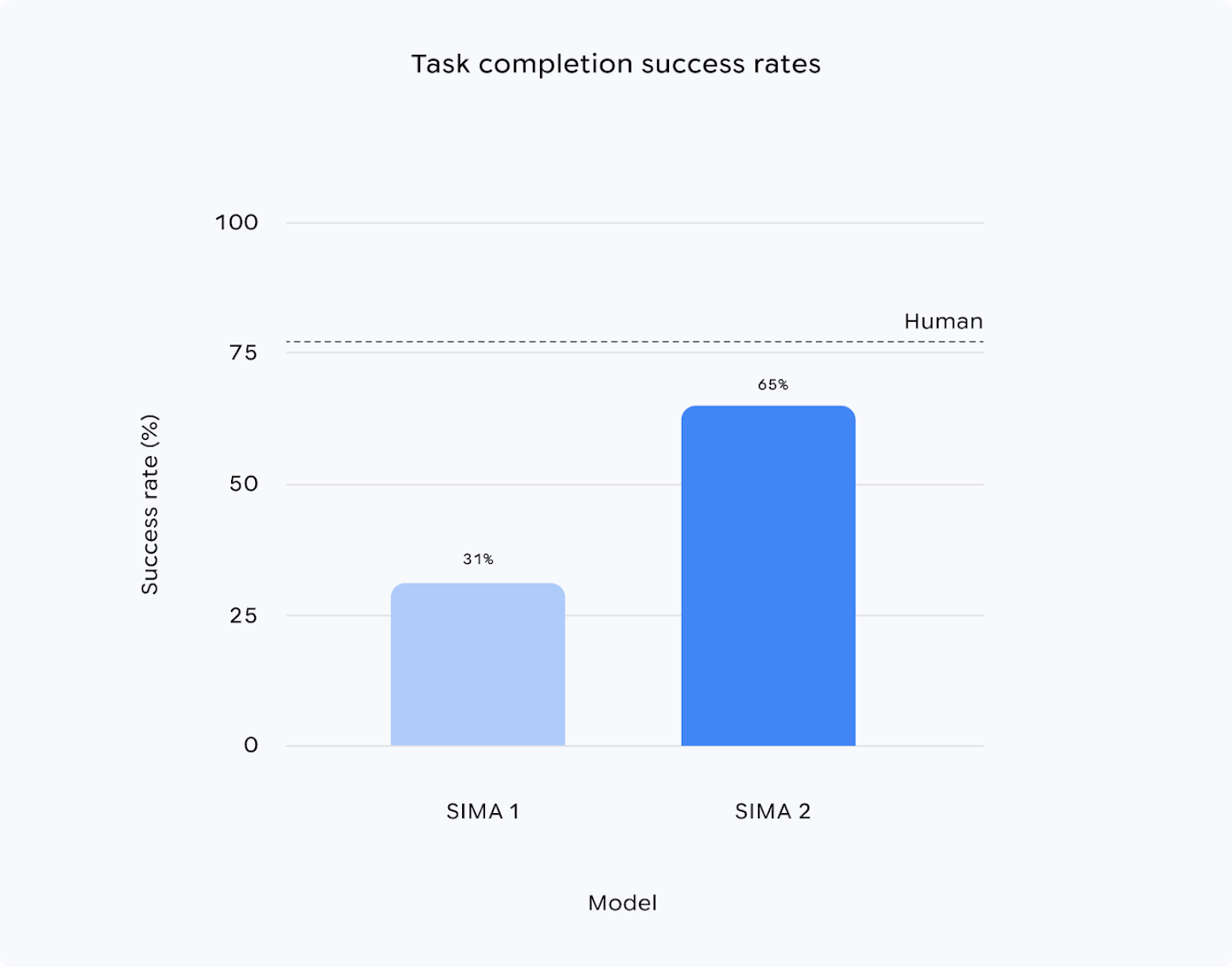
| Metric | SIMA 1 | SIMA 2 | Human Baseline | Gap Closed |
|---|---|---|---|---|
| Training Games | Baseline | +X% | 100% | ~60% |
| Unseen Games (ASKA) | ~20% | ~65% | 100% | +45% |
| Unseen Games (MineDojo) | ~25% | ~70% | 100% | +45% |
| Complex Instructions | ~30% | ~75% | 100% | +45% |
Key Insight: SIMA 2 closes ~60% of the gap to human performance on training games and demonstrates strong zero-shot generalization to completely new games.
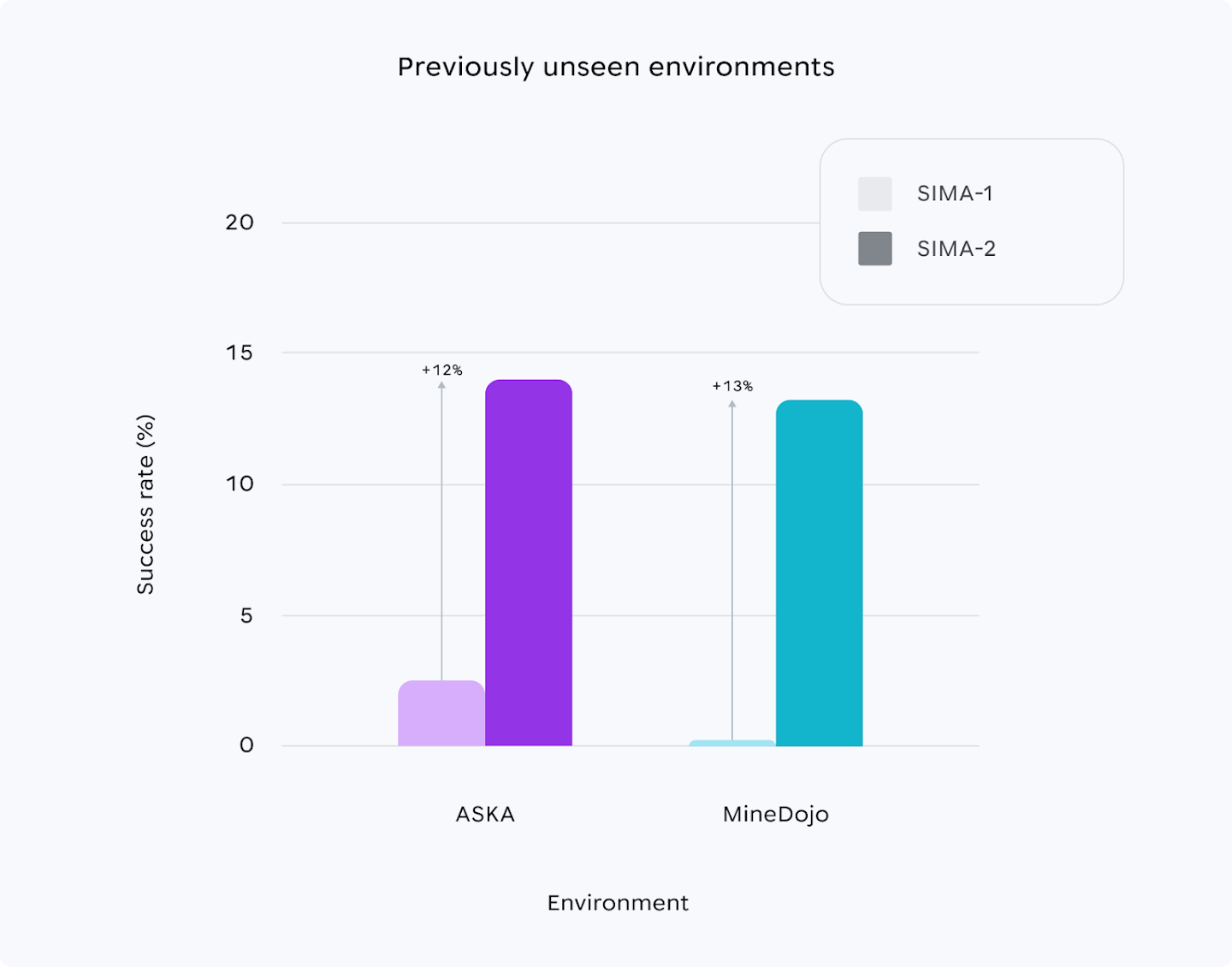
Why This Matters:
The ability to transfer concepts across games (e.g., “mining” in one game → “harvesting” in another) is foundational to human-like generalization. SIMA 2 demonstrates that reasoning-based agents can achieve this transfer, not just pattern-matching systems.
3. Self-Improvement: Learning from Failure
The Self-Improvement Cycle:
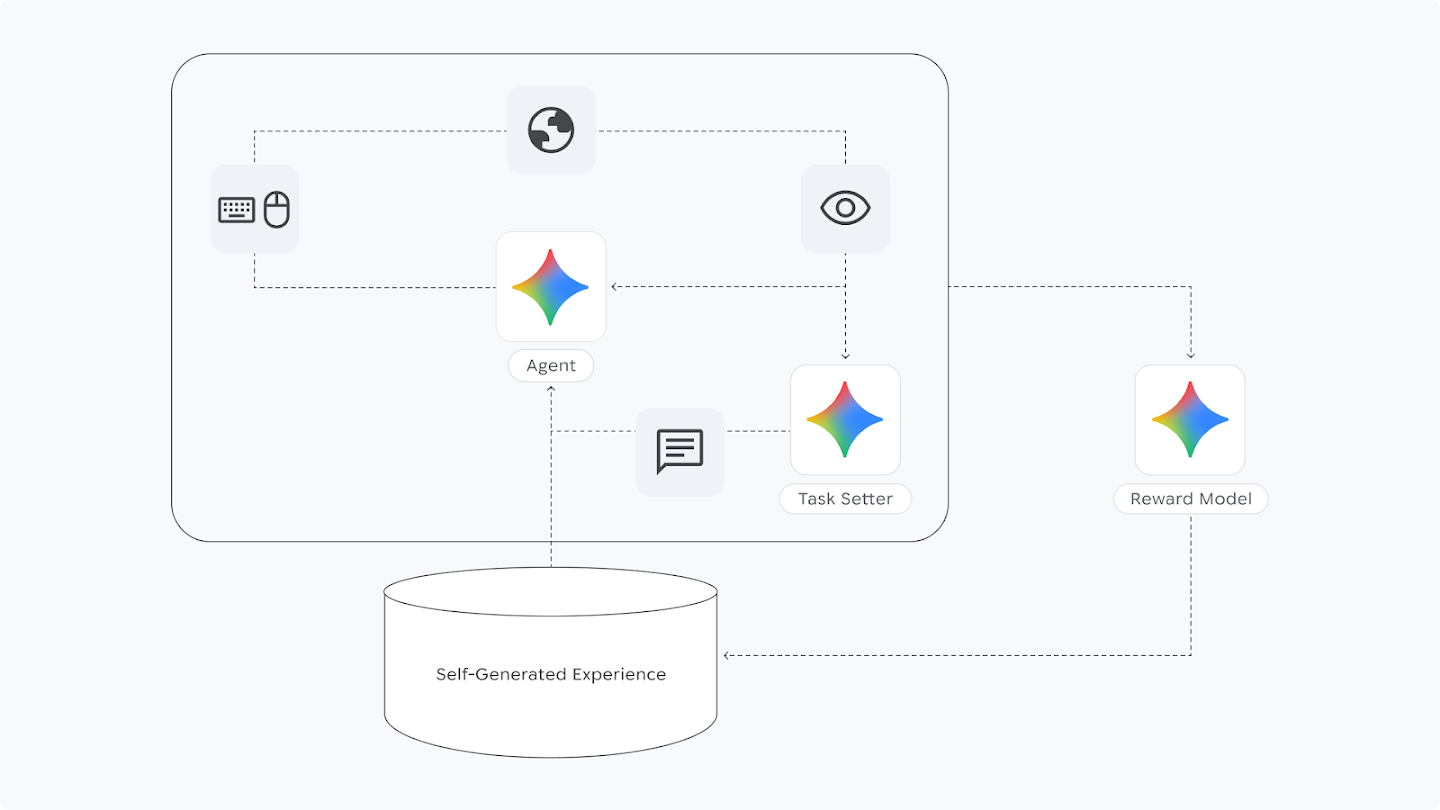
sequenceDiagram
    participant User
    participant SIMA2 as SIMA 2 Agent
    participant Gemini
    participant ExperienceBank as Experience Bank

    User->>SIMA2: Give task instruction
    SIMA2->>Gemini: Request initial plan + reward estimate
    Gemini->>SIMA2: Plan + expected reward
    SIMA2->>SIMA2: Execute actions
    SIMA2->>SIMA2: Task fails

    Note over SIMA2: Self-Reflection Phase
    SIMA2->>Gemini: Analyze failure, generate labels
    Gemini->>SIMA2: Failure analysis + improved strategy
    SIMA2->>ExperienceBank: Store self-generated experience

    Note over ExperienceBank: Training Data Augmentation
    ExperienceBank->>SIMA2: Use for next training iteration
    SIMA2->>SIMA2: Improved performance on similar tasks
How It Works:
- Initial Attempt: SIMA 2 receives a task and Gemini provides an initial plan with reward estimate
- Failure Analysis: If the task fails, Gemini analyzes what went wrong and generates improved strategies
- Experience Storage: The failure analysis becomes training data in the experience bank
- Iterative Improvement: Subsequent training iterations use this self-generated experience, improving performance on similar tasks
Key Innovation: SIMA 2 can improve on previously failed tasks entirely independently of human-generated demonstrations. This creates a self-reinforcing learning loop.
Production Implications:
For game developers, this means:
- Reduced Training Data Needs: Agents can generate their own training data
- Faster Iteration: Agents improve without waiting for human demonstrations
- Better Generalization: Self-generated failures cover edge cases humans might miss
Multimodal Understanding: Beyond Text
SIMA 2 accepts diverse input modalities:
| Input Type | Example | Use Case |
|---|---|---|
| Text | “Build a house” | Standard instructions |
| Images | Screenshot of a location | “Go to this place” |
| Sketches | Drawn arrow on screen | Spatial navigation |
| Emojis | 🏠 → “Go to house” | Quick commands |
| Multiple Languages | “Construye una casa” | International users |
Why This Matters:
Multimodal understanding makes AI agents more accessible and intuitive. Players can communicate naturally, using whatever modality feels most appropriate for the situation.
🎮 Production Applications: What This Means for Game Developers
1. AI Companions in Games
Traditional NPCs:
- Pre-scripted dialogue trees
- Limited interaction depth
- No learning or adaptation
SIMA 2-Style Companions:
- Natural language conversations
- Context-aware responses
- Learning from player behavior
- Dynamic goal planning
Example Use Case:
1
2
3
4
5
6
7
8
9
10
11
12
13
14
15
16
17
18
19
20
21
22
23
24
25
26
27
28
29
# Conceptual game integration
class GameCompanion:
    def __init__(self):
        self.sima2_agent = SIMA2Agent(gemini_model)
        self.player_context = PlayerContext()

    def interact(self, player_message: str):
        """
        Player: "I need to find the ancient temple"
        Companion: "I can help! Based on the map, the temple
                   is likely in the northern mountains. Should
                   I scout ahead while you gather supplies?"
        """
        # SIMA 2 reasons about player's goal
        goal = self.sima2_agent.understand_goal(player_message)

        # Plans collaborative actions
        plan = self.sima2_agent.plan_collaboration(
            player_goal=goal,
            companion_capabilities=self.get_capabilities()
        )

        # Converses naturally
        response = self.sima2_agent.generate_response(
            plan=plan,
            context=self.player_context
        )

        return response
2. Procedural Content Testing
The Problem:
- Procedurally generated levels need testing
- Manual playtesting is expensive and slow
- AI testers often miss edge cases
SIMA 2 Solution:
- Agents can test levels with human-like reasoning
- Can identify issues humans might miss
- Self-improving test coverage over time
3. Adaptive Difficulty and Tutorials
Dynamic Tutorial System:
- SIMA 2 can observe player struggles
- Generates contextual hints based on reasoning
- Adapts tutorial pace to player skill
4. Multi-Agent Gameplay
Collaborative AI Agents:
- Multiple SIMA 2 agents can collaborate
- Each agent reasons about team goals
- Emergent cooperative behaviors
graph TB
    subgraph MultiAgent["Multi-Agent Collaboration"]
        P[Player] --> A1[Agent 1: Scout]
        P --> A2[Agent 2: Builder]
        P --> A3[Agent 3: Gatherer]

        A1 -->|"Found resources"| G[Shared Goal Planner]
        A2 -->|"Needs materials"| G
        A3 -->|"Gathered items"| G

        G -->|"Coordinate actions"| A1
        G -->|"Coordinate actions"| A2
        G -->|"Coordinate actions"| A3
    end

    style G fill:#ff6b6b,stroke:#c92a2a,stroke-width:3px,color:#fff
📊 Technical Deep Dive: Architecture and Training
SIMA 2 Architecture Overview
graph TB
    subgraph Input["Multimodal Input"]
        I1[Text Instructions]
        I2[Images/Sketches]
        I3[Emojis]
        I4[Game Observations]
    end

    subgraph Processing["Gemini Reasoning Engine"]
        G1[Goal Understanding]
        G2[Context Analysis]
        G3[Action Planning]
        G4[Failure Analysis]
    end

    subgraph Execution["Action Execution"]
        E1[Action Selection]
        E2[Game Interaction]
        E3[Observation Processing]
    end

    subgraph Learning["Self-Improvement"]
        L1[Experience Bank]
        L2[Failure Analysis]
        L3[Training Data Generation]
    end

    subgraph Output["Output"]
        O1[Actions]
        O2[Conversations]
        O3[Explanations]
    end

    Input --> Processing
    Processing --> Execution
    Execution --> Processing
    Execution --> Learning
    Learning --> Processing
    Processing --> Output

    style Processing fill:#ff6b6b,stroke:#c92a2a,stroke-width:3px,color:#fff
    style Learning fill:#4ecdc4,stroke:#0a9396,stroke-width:2px,color:#fff
Training Pipeline
Phase 1: Human Demonstration Learning
- Collect human gameplay videos with language labels
- Train initial action prediction model
- Establish baseline performance
Phase 2: Gemini Integration
- Integrate Gemini for goal understanding
- Fine-tune on human demonstrations + Gemini-generated labels
- Enable reasoning capabilities
Phase 3: Self-Improvement
- Deploy agent in games
- Collect failure cases
- Use Gemini to analyze failures and generate training data
- Iteratively improve
Key Technical Innovation:
The combination of human demonstrations (ground truth) and Gemini-generated labels (semantic understanding) creates richer training data than either alone.
🎯 Key Takeaways
| Insight | Implication | Next Steps |
|---|---|---|
| Reasoning enables goal-oriented behavior | Agents can handle abstract, complex instructions | Explore reasoning-based game AI architectures |
| Gemini integration closes human performance gap | Foundation models can be powerful reasoning engines for embodied AI | Evaluate other foundation models for game AI |
| Self-improvement reduces training data needs | Agents can generate their own training data | Implement self-improvement loops in production systems |
| Multimodal understanding improves accessibility | Players can interact naturally with AI companions | Design multimodal interfaces for game AI |
| Generalization enables zero-shot transfer | Agents trained on one game can perform in others | Build generalist game AI systems |
Why This Matters for Game Developers
As someone who’s shipped AI-powered games, here’s what excites me:
- Natural AI Companions: Players can have meaningful conversations with AI characters, not just scripted dialogues
- Reduced Development Costs: Self-improving agents need less manual tuning and training data
- Better Player Experience: AI that understands context and reasons about goals feels more intelligent and helpful
- New Gameplay Possibilities: Multi-agent collaboration, dynamic tutorials, procedural content testing
The Catch: SIMA 2 is still research—it’s not a production-ready SDK. But the principles (reasoning-based agents, self-improvement, multimodal understanding) are applicable now.
What I’d Try First:
- Integrate a reasoning layer (like GPT-4 or Claude) into existing game AI systems
- Experiment with self-improvement loops for NPC behavior
- Build multimodal interfaces (text + image + emoji) for player-AI interaction
🤔 New Questions This Raises
Scalability: Can SIMA 2’s architecture scale to real-time game environments with 60+ FPS requirements?
Cost: Gemini API calls for every action decision—how do we optimize for production cost while maintaining reasoning quality?
Latency: Reasoning takes time. How do we balance thoughtful planning with responsive gameplay?
Multi-Agent Coordination: How do multiple SIMA 2 agents coordinate when they have conflicting goals or need to share resources?
Safety and Alignment: How do we ensure reasoning-based agents don’t exploit game mechanics or behave in unintended ways?
The Robotics Connection: SIMA 2 is trained in virtual worlds—how well will these capabilities transfer to real robots?
Next Experiment: Build a prototype game AI companion using GPT-4 as the reasoning engine, measuring player satisfaction and system performance compared to traditional scripted NPCs.
References
Original Article:
Video Demonstration:
DeepMind Research:
Embodied AI & Game AI:
- Embodied AI: A Survey (2023)
- Language Models as Zero-Shot Planners (2022)
- Voyager: An Open-Ended Embodied Agent with Large Language Models (2023)
- Game AI Pro Series
Multi-Agent Systems:
- Multi-Agent Reinforcement Learning: A Selective Overview
- Cooperative Multi-Agent Control Using Deep Reinforcement Learning
Self-Improvement & Meta-Learning:
Foundation Models for Robotics:
- RT-2: Vision-Language-Action Models Transfer Web Knowledge to Robotic Control
- PaLM-E: An Embodied Multimodal Language Model
Game Development Integration:
Related Projects:
- Voyager: Minecraft AI Agent
- MineDojo: Minecraft Research Platform
- AI2-THOR: Interactive Household Environments
Industry Analysis:
Working on something like this?
I take a small number of paid, scoped reviews: AI agent/RAG architecture diagnosis, Unity CI & build-automation audits, and multimodal QA design review. Each one ends in a written findings document.
Work with me