LLM/Model & Papers
Top LLM Papers of the Week: November Week 2, 2025
A curated selection of the top 10 LLM research papers from November Week 2, 2025, covering agent memory evaluation, multilingual tokenization, RAG optimization, multimodal models, domain-specific LLMs, and multi-agent systems.
🤔 Curiosity: What Are the Latest Breakthroughs in LLM Research?
What if we could systematically evaluate hallucinations in agent memory systems? What if tokenizers could be optimized for specific language families? What if RAG systems could cache intelligently to reduce latency by 80%?

Curiosity: Every week brings new breakthroughs in LLM research. What are the most impactful papers this week, and how do they advance the state of the art?
This week’s top LLM papers showcase significant advances across multiple domains: from evaluating hallucinations in agent memory systems to optimizing RAG caching, from building massive multimodal models to creating domain-specific LLMs for traditional medicine. Each paper addresses critical challenges in building production-ready AI systems.
The question: What are the key innovations this week, and how do they contribute to the broader landscape of LLM research and applications?
📚 Retrieve: Top 10 LLM Papers of the Week
[1] Evaluating Hallucinations in Agent Memory
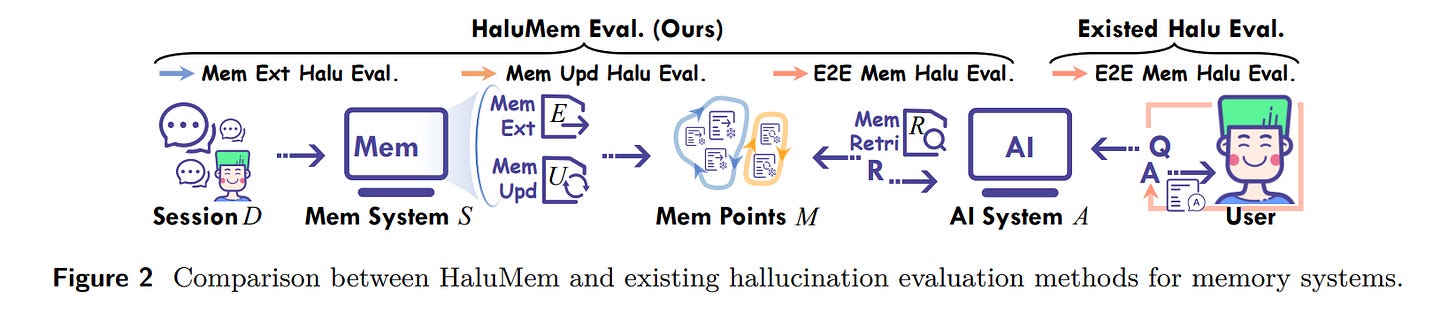
HaluMem: The First Operation-Level Benchmark for Agent Memory Hallucinations
Key Innovation:
HaluMem introduces the first operation-level benchmark designed to evaluate hallucinations within AI agent memory systems. Unlike previous end-to-end evaluations, HaluMem diagnoses hallucination origins across distinct stages: memory extraction, updating, and question answering.
Key Features:
- Two large-scale datasets: HaluMem-Medium and HaluMem-Long
- Over 15k annotated memory points and 3.5k questions from user–AI multi-turn dialogues
- Over 1 million tokens per user in long-context evaluation
- Fine-grained metrics assess accuracy, omission, and hallucination rates per stage
- Highlights cumulative and amplifying effects of memory hallucinations
Why This Matters:
Agent memory systems are critical for long-term interactions, but hallucinations can compound over time. HaluMem provides the tools to systematically identify and address these issues at each stage of the memory pipeline.
Paper: Evaluating Hallucinations in Agent Memory (arXiv:2511.03506)
[2] Tokenizer for Indic Multilingual LLMs
IndicSuperTokenizer: State-of-the-Art Tokenization for Indic Languages
Key Innovation:
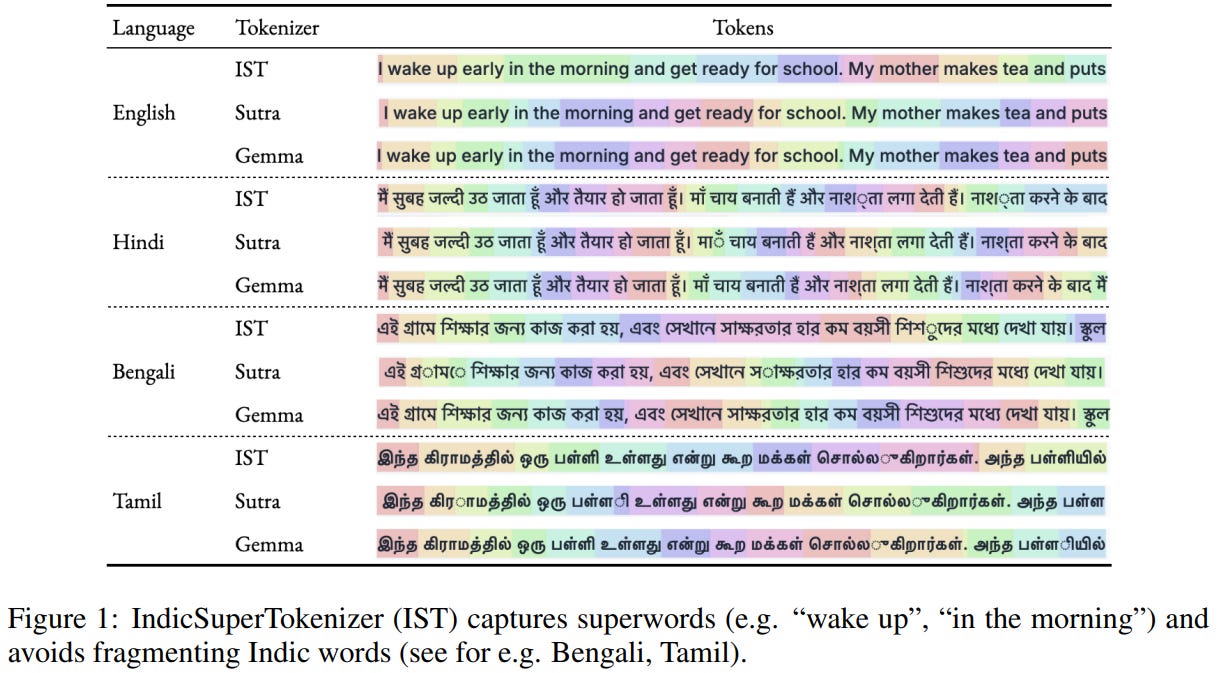
IndicSuperTokenizer, developed by Krutrim AI, integrates subword and multi-word tokenization with language-specific pre-tokenization, ensuring more linguistically aligned and semantically compact tokens across 22 Indian languages, English, and code.
Key Features:
- Combines subword and multi-word (“superword”) learning stages
- 39.5% better fertility than LLaMA-4 and 18% over Sutra
- Regex-based and morphology-aware pre-tokenization for Indic scripts
- Trained on 10GB multilingual corpus with a 200K shared vocabulary
- Improves inference throughput by 44% while maintaining task accuracy
Why This Matters:
Tokenization quality directly impacts model efficiency and performance. For multilingual models, language-specific tokenization is crucial. IndicSuperTokenizer demonstrates significant improvements for Indic languages, which are underrepresented in most tokenizers.
Paper: Tokenizer for Indic Multilingual LLMs (arXiv:2511.03237)
[3] Agent RAG Cache Mechanism
ARC: Dynamic Caching for RAG Agents
Key Innovation:
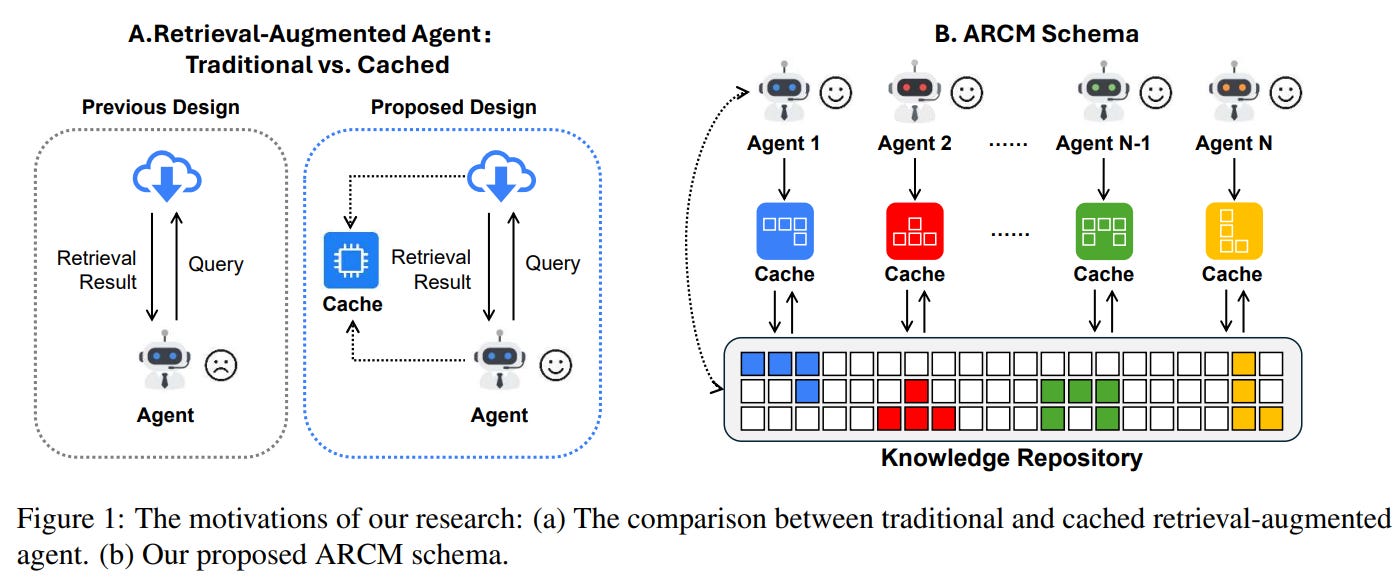
ARC (Agent RAG Cache Mechanism) is a novel caching framework designed to make RAG agents more efficient by dynamically maintaining small, high-value corpora specific to each agent’s needs. Unlike traditional key-value caches, ARC integrates both query dynamics and embedding-space geometry.
Key Features:
- Combines query frequency with embedding-space hubness
- Annotation-free and dynamically self-updating cache mechanism
- Reduces retrieval latency by up to 80%
- Maintains semantic centrality using rank-distance frequency (DRF)
- Achieves high efficiency with minimal storage (0.015% of corpus)
Why This Matters:
RAG systems often struggle with latency when searching large corpora. ARC demonstrates that intelligent caching can dramatically improve performance while maintaining retrieval quality, making RAG systems more practical for production use.
Paper: Agent RAG Cache Mechanism (arXiv:2511.02919)
[4] LongCat-Flash-Omni Technical Report
560B Parameter Open-Source Omni-Modal Model
Key Innovation:
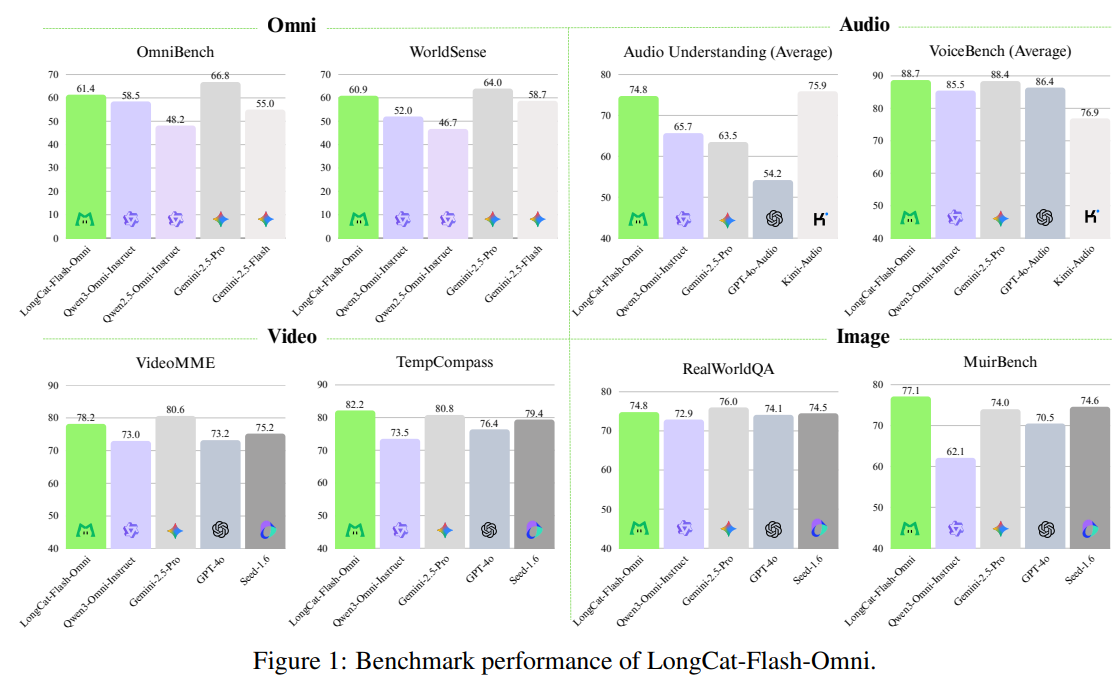
LongCat-Flash-Omni, by Meituan, is a 560-billion-parameter open-source omni-modal model designed for real-time audio-visual interaction and multimodal understanding. It unifies text, image, audio, and video processing within a single framework using a Shortcut-connected Mixture-of-Experts (ScMoE) architecture.
Key Features:
- Uses modality-decoupled parallelism for 90% text-model throughput
- Integrates synchronized chunk-wise audio-visual streaming mechanism
- Employs early-fusion progressive multimodal pretraining pipeline
- Supports 128K token context for long-term multimodal reasoning
- Only 27B parameters activated during inference (despite 560B total)
- Open-sourced for research via Hugging Face and GitHub
Why This Matters:
Multimodal models are becoming increasingly important, but they’re often inefficient. LongCat-Flash-Omni demonstrates how MoE architectures can enable massive models while maintaining inference efficiency, making large-scale multimodal AI more accessible.
Paper: LongCat-Flash-Omni Technical Report (arXiv:2511.00279)
[5] Large Language Model for Ayurveda
AyurParam: Domain-Specific LLM for Traditional Medicine
Key Innovation:
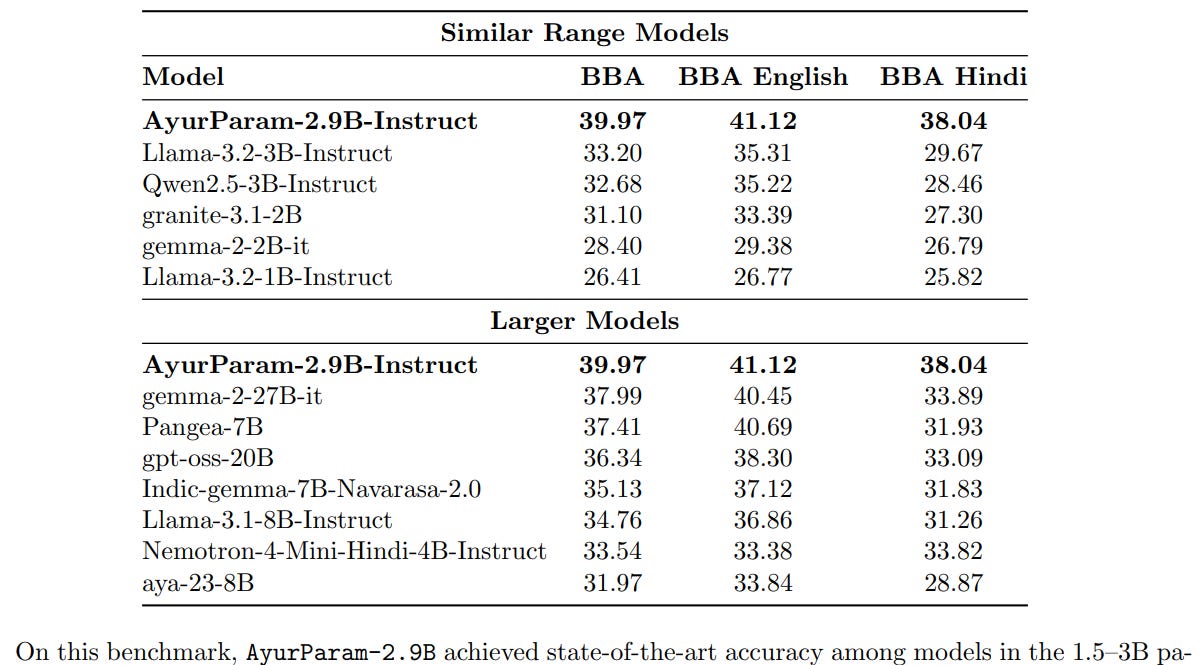
AyurParam is a state-of-the-art bilingual LLM designed specifically for Ayurveda, fine-tuned from Param-1-2.9B using a rigorously curated corpus of classical texts and clinical manuals in both English and Hindi. It integrates context-aware reasoning, factual Q&A, and domain-aligned instruction tuning.
Key Features:
- Trained on 4.75M bilingual grounded Q&A pairs
- Covers 15+ Ayurvedic domains from classical compendia
- Achieves 39.97% accuracy on BhashaBench-Ayur benchmark
- Excels in multiple-choice and reasoning-intensive questions
- Built with strict ethical and license compliance standards
Why This Matters:
Domain-specific LLMs are crucial for specialized fields like medicine, law, and science. AyurParam demonstrates how to build high-quality domain-specific models while maintaining ethical standards, opening the door for more specialized AI applications.
Paper: Large Language Model for Ayurveda (arXiv:2511.02374)
[6] Tool-to-Agent Retrieval
Unified Retrieval Framework for Multi-Agent Systems
Key Innovation:
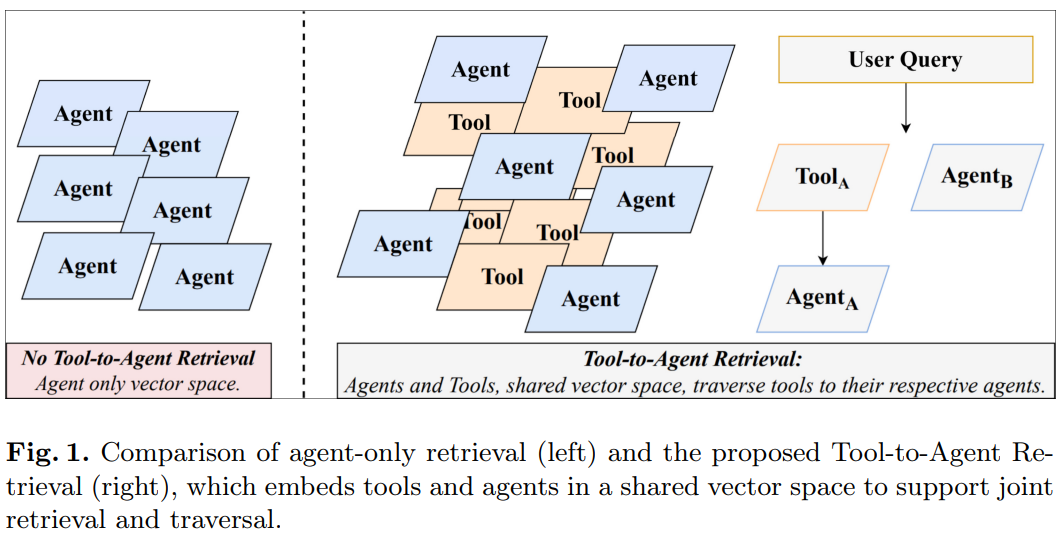
Tool-to-Agent Retrieval introduces a unified retrieval framework that embeds both tools and their parent agents in a shared vector space, connected through metadata relationships. This approach bridges fine-grained tool capabilities and high-level agent contexts.
Key Features:
- Embeds tools and agents in a unified vector space
- Links entities through explicit metadata relationships
- Enables granular tool- and agent-level retrieval
- Achieves +19.4% Recall@5 improvement over baselines
- Proven stable across eight different embedding models
Why This Matters:
As multi-agent systems become more complex, efficient routing becomes critical. Tool-to-Agent Retrieval enables more accurate and scalable routing in LLM multi-agent systems, improving overall system performance.
Paper: Tool-to-Agent Retrieval (arXiv:2511.01854)
[7] Long-Term Memory in LLMs
BEAM & LIGHT: Evaluating and Enhancing Long-Term Memory
Key Innovation:
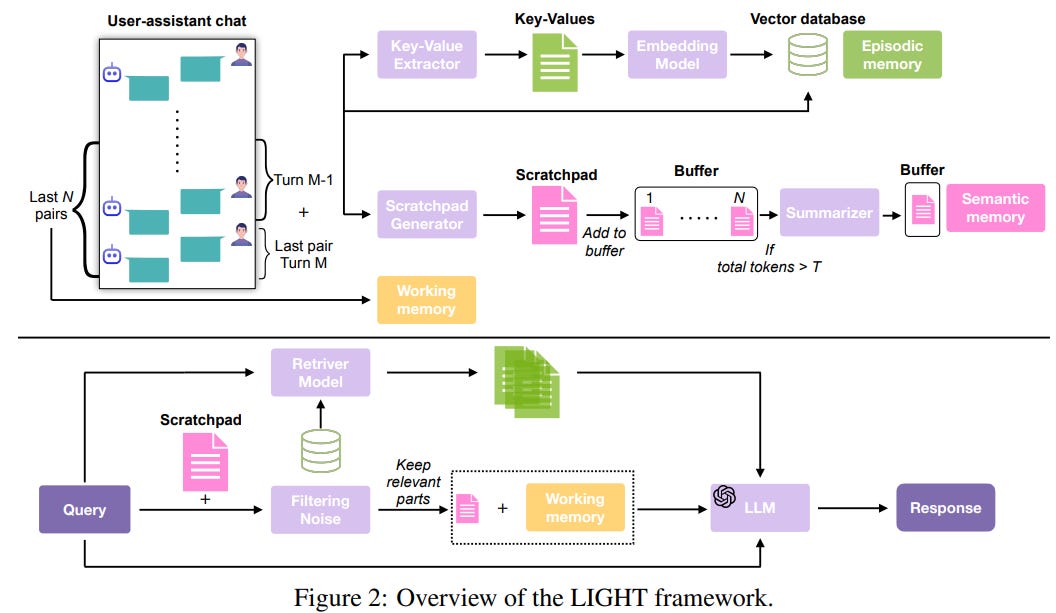
BEAM & LIGHT is a unified effort to evaluate and enhance the long-term memory capabilities of large language models. BEAM is a large-scale benchmark featuring 100 coherent conversations (up to 10 million tokens each) with 2,000 validated probing questions. LIGHT augments LLMs with three memory systems inspired by human cognition.
Key Features:
- BEAM tests ten diverse memory abilities in LLMs
- LIGHT integrates episodic, working, and scratchpad memory modules
- BEAM conversations reach up to 10 million tokens in length
- LIGHT boosts performance by 3.5%–12.69% over baselines
- Contradiction resolution remains the most challenging ability
Why This Matters:
Long-term memory is essential for building truly intelligent agents that can maintain context across extended interactions. BEAM & LIGHT provides both evaluation tools and practical solutions for enhancing memory capabilities.
Paper: Long-Term Memory in LLMs (arXiv:2510.27246)
[8] Agentic Evaluation for Domain-Specific RAG
RAGalyst: Automated, Human-Aligned Evaluation Framework
Key Innovation:
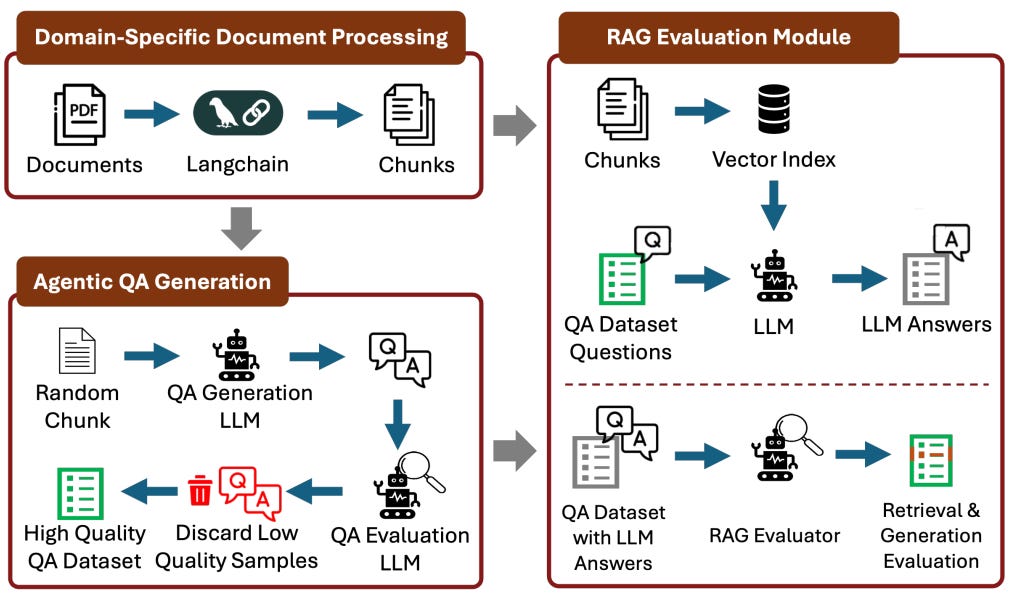
RAGalyst is an automated, human-aligned agentic evaluation framework designed to assess domain-specific RAG systems. It combines refined LLM-as-a-Judge metrics with an agentic pipeline that generates high-quality synthetic QA datasets from source documents.
Key Features:
- Introduces agentic QA generation for reliable dataset creation
- Refines LLM-as-a-Judge metrics for human-aligned scoring
- Evaluates RAG performance across multiple specialized domains
- Outperforms RAGAS in QA quality and metric reliability
- Identifies domain-specific trade-offs for optimized RAG design
Why This Matters:
Evaluating RAG systems is challenging, especially for domain-specific applications. RAGalyst provides a systematic approach to evaluation that aligns with human judgment, enabling better RAG system development and optimization.
Paper: Agentic Evaluation for Domain-Specific RAG (arXiv:2511.04502)
[9] Agents for Automated Text-to-SQL Generation
Multi-Agent Pipelines for Text-to-SQL
Key Innovation:
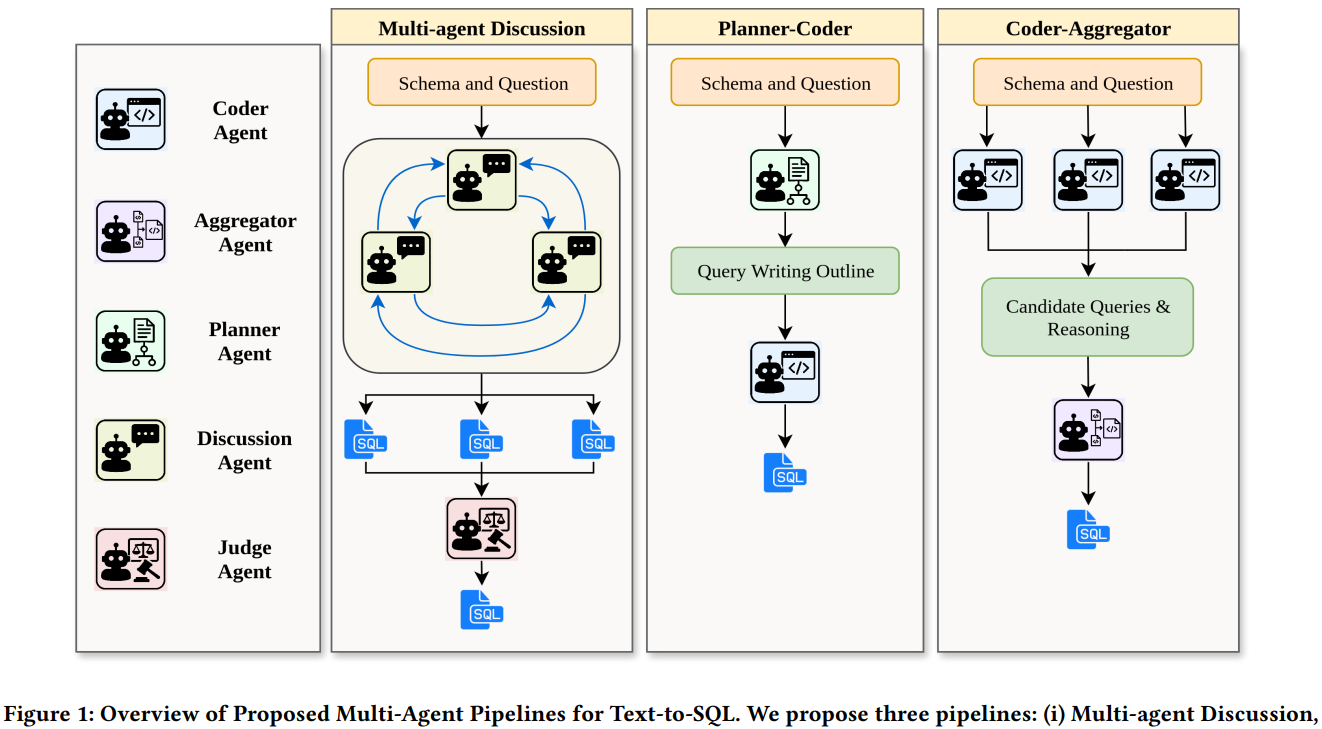
This paper introduces a comprehensive framework to evaluate and enhance how LLMs convert natural language into SQL queries. It systematically benchmarks open-source models across multiple sizes using three collaborative multi-agent pipelines: Multi-Agent Discussion, Planner–Coder, and Coder–Aggregator.
Key Features:
- Introduces three novel multi-agent Text-to-SQL pipelines
- Evaluates 24 open-source LLMs across diverse model families
- Multi-agent discussion improves small model performance by up to 10.6%
- Planner–Coder setup boosts structured reasoning and SQL accuracy
- Coder–Aggregator enhances execution reliability through consensus generation
Why This Matters:
Text-to-SQL is a critical capability for making databases accessible to non-technical users. Multi-agent approaches demonstrate that collaboration can significantly improve performance, especially for smaller models, making high-quality Text-to-SQL more accessible.
Paper: Agents for Automated Text-to-SQL Generation (arXiv:2511.04153)
[10] Multi-Agent RL Framework for Text-to-SQL
MARS-SQL: Reinforcement Learning for Text-to-SQL
Key Innovation:
MARS-SQL is a multi-agent reinforcement learning framework designed to translate natural language questions into SQL queries for complex databases. It decomposes the Text-to-SQL task into three specialized stages—grounding, generation, and validation—each handled by a dedicated agent.
Key Features:
- Three-agent system: Grounding, Generation, Validation
- Uses interactive Think–Act–Observe reasoning loop
- Trained with Group Relative Policy Optimization (GRPO)
- Achieved 77.84% BIRD and 89.75% Spider accuracy
- Validation reframed as next-token prediction task
Why This Matters:
Reinforcement learning enables agents to learn from real-time database feedback, improving performance through experience. MARS-SQL demonstrates how RL can enhance Text-to-SQL systems, achieving state-of-the-art results on challenging benchmarks.
Paper: Multi-Agent RL Framework for Text-to-SQL (arXiv:2511.01008)
💡 Innovation: Key Themes and Trends
1. Agent Memory and Long-Term Context
Trend: Multiple papers focus on improving agent memory capabilities:
- HaluMem: Systematic evaluation of memory hallucinations
- BEAM & LIGHT: Long-term memory evaluation and enhancement
- ARC: Intelligent caching for RAG agents
Insight: As agents become more capable, memory management becomes critical. These papers address different aspects: evaluation, enhancement, and optimization.
2. Efficiency and Optimization
Trend: Papers focus on making systems more efficient:
- IndicSuperTokenizer: 44% throughput improvement
- ARC: 80% latency reduction
- LongCat-Flash-Omni: Efficient MoE architecture
Insight: Production deployment requires efficiency. These papers demonstrate that optimization can yield significant improvements without sacrificing quality.
3. Domain-Specific Applications
Trend: Specialized models for specific domains:
- AyurParam: Traditional medicine
- RAGalyst: Domain-specific RAG evaluation
- Text-to-SQL: Database query generation
Insight: General-purpose models have limitations. Domain-specific models and evaluation frameworks are essential for real-world applications.
4. Multi-Agent Systems
Trend: Collaboration improves performance:
- Tool-to-Agent Retrieval: Efficient routing in multi-agent systems
- Text-to-SQL Multi-Agent: Collaborative SQL generation
- MARS-SQL: Multi-agent RL framework
Insight: Multi-agent approaches can significantly improve performance, especially for complex tasks that benefit from specialization and collaboration.
🎯 Key Takeaways
| Paper | Domain | Key Innovation | Impact |
|---|---|---|---|
| HaluMem | Agent Memory | Operation-level hallucination evaluation | Systematic debugging of memory systems |
| IndicSuperTokenizer | Tokenization | Language-specific tokenization | 44% throughput improvement |
| ARC | RAG Optimization | Dynamic intelligent caching | 80% latency reduction |
| LongCat-Flash-Omni | Multimodal | 560B MoE model | Efficient large-scale multimodal AI |
| AyurParam | Domain-Specific | Traditional medicine LLM | Specialized domain applications |
| Tool-to-Agent Retrieval | Multi-Agent | Unified retrieval framework | +19.4% Recall@5 improvement |
| BEAM & LIGHT | Memory | Long-term memory evaluation | 3.5%–12.69% performance boost |
| RAGalyst | RAG Evaluation | Human-aligned evaluation | Better RAG system development |
| Text-to-SQL Multi-Agent | Text-to-SQL | Collaborative pipelines | 10.6% improvement for small models |
| MARS-SQL | Text-to-SQL | Multi-agent RL framework | 77.84% BIRD accuracy |
Why This Week’s Papers Matter
As someone who tracks LLM research, here’s what stands out:
- Practical Focus: Many papers address production challenges (efficiency, evaluation, optimization)
- Specialization: Domain-specific models and evaluation frameworks are becoming more common
- Multi-Agent Systems: Collaboration is proving effective for complex tasks
- Memory Management: Long-term memory is a critical capability being actively researched
- Open Source: Several papers release open-source models and tools
What I’d Implement First:
- ARC caching for RAG systems (80% latency reduction is significant)
- IndicSuperTokenizer approach for other language families
- Multi-agent Text-to-SQL pipelines for database applications
- RAGalyst evaluation framework for domain-specific RAG systems
🤔 New Questions This Raises
Memory Hallucinations: How do we prevent cumulative hallucinations in long-term agent memory?
Tokenization Efficiency: Can language-specific tokenization approaches be generalized to other language families?
RAG Caching: How do we balance cache size with retrieval quality in production RAG systems?
Multimodal MoE: Can MoE architectures be further optimized for multimodal tasks?
Domain-Specific Models: What’s the trade-off between general-purpose and domain-specific models?
Multi-Agent Coordination: How do we optimize communication and coordination in multi-agent systems?
Next Steps: Explore implementations of these papers, experiment with ARC caching, and evaluate multi-agent approaches for specific use cases.
References
Original Article:
Papers:
- Evaluating Hallucinations in Agent Memory (HaluMem) - arXiv:2511.03506
- Tokenizer for Indic Multilingual LLMs (IndicSuperTokenizer) - arXiv:2511.03237
- Agent RAG Cache Mechanism (ARC) - arXiv:2511.02919
- LongCat-Flash-Omni Technical Report - arXiv:2511.00279
- Large Language Model for Ayurveda (AyurParam) - arXiv:2511.02374
- Tool-to-Agent Retrieval - arXiv:2511.01854
- Long-Term Memory in LLMs (BEAM & LIGHT) - arXiv:2510.27246
- Agentic Evaluation for Domain-Specific RAG (RAGalyst) - arXiv:2511.04502
- Agents for Automated Text-to-SQL Generation (BAPPA) - arXiv:2511.04153
- Multi-Agent RL Framework for Text-to-SQL (MARS-SQL) - arXiv:2511.01008
Related Resources: