LLM/Model & Papers
📚 "A Survey of Prompt Engineering Methods in Large Language Models" - LLM
Curiosity: What are the most effective prompt engineering techniques?
A Survey of Prompt Engineering Methods in Large Language Models
Curiosity: What are the most effective prompt engineering techniques? How can we systematically understand and apply prompt engineering methods across different NLP tasks?
This comprehensive survey is the ultimate guide to prompt engineering, providing a structured taxonomy, comprehensive vocabulary, and analysis of 58 text-only and 40 multimodal prompting techniques.
Survey Overview
graph TB
    A[Prompt Engineering Survey] --> B[44 Research Papers]
    A --> C[39 Prompting Methods]
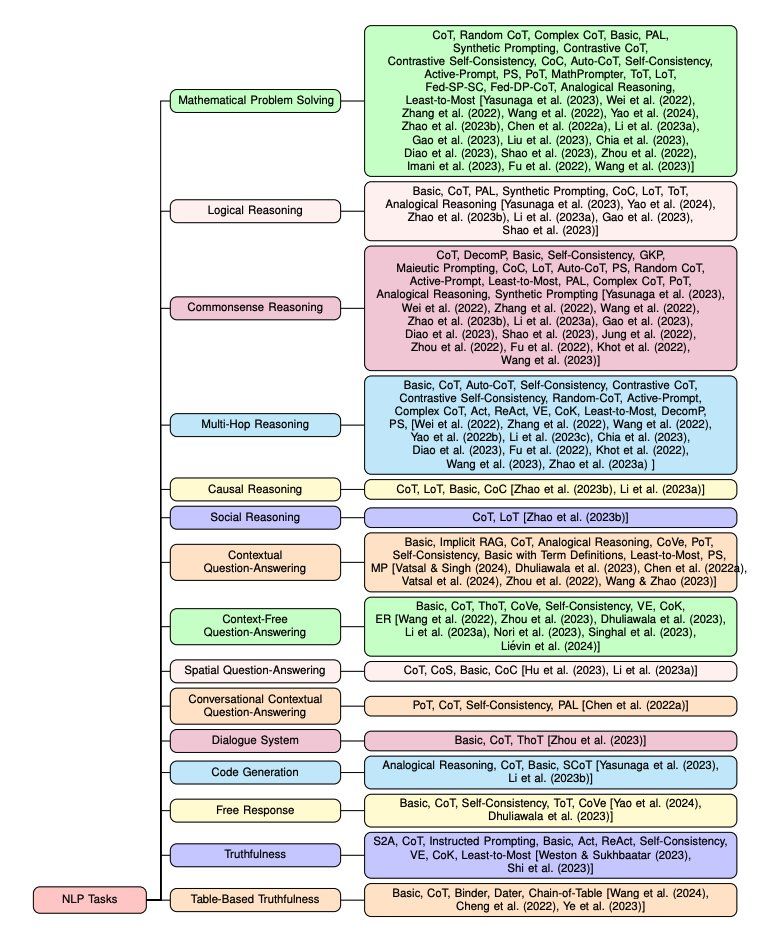
    A --> D[29 NLP Tasks]

    B --> E[Analysis]
    C --> F[Taxonomy]
    D --> G[Task Classification]

    E --> H[Structured Understanding]
    F --> H
    G --> H

    style A fill:#e1f5ff
    style H fill:#d4edda
Key Features
| Feature | Description | Impact |
|---|---|---|
| Standardization | Structured taxonomy of techniques | ⬆️ Clarity |
| Comprehensive | 39 prompting methods analyzed | ⬆️ Coverage |
| Task-Specific | 29 NLP tasks covered | ⬆️ Practicality |
| SoTA Methods | Best methods per task | ⬆️ Performance |
Survey Scope
Retrieve: Extensive analysis of prompt engineering research.
Analysis Coverage:
- 44 Research Papers: Comprehensive literature review
- 39 Prompting Methods: Diverse techniques analyzed
- 29 NLP Tasks: Wide range of applications
- 58 Text-Only Techniques: Text-focused methods
- 40 Multimodal Techniques: Cross-modal approaches
What Makes This Survey Special
Innovate: This survey provides structured understanding and standardization.
Unique Contributions:
- Standardization: Structured taxonomy of prompt engineering techniques
- Task Classification: NLP tasks organized by dataset and strategy
- SoTA Methods: Best prompting methods identified for each task
- Comprehensive Vocabulary: 33 terms defined and explained
Prompt Engineering Techniques
Text-Only Techniques (58 methods):
- Zero-shot prompting
- Few-shot prompting
- Chain-of-thought
- Self-consistency
- And 54 more…
Multimodal Techniques (40 methods):
- Vision-language prompts
- Audio-text prompts
- Cross-modal reasoning
- And 37 more…
Taxonomy Structure
graph TB
    A[Prompt Engineering] --> B[Text-Only]
    A --> C[Multimodal]

    B --> B1[Zero-Shot]
    B --> B2[Few-Shot]
    B --> B3[Chain-of-Thought]
    B --> B4[Advanced]

    C --> C1[Vision-Language]
    C --> C2[Audio-Text]
    C --> C3[Cross-Modal]

    style A fill:#e1f5ff
    style B fill:#fff3cd
    style C fill:#d4edda
NLP Task Coverage
Retrieve: 29 different NLP tasks analyzed with optimal prompting strategies.
Task Categories:
- Classification tasks
- Generation tasks
- Question answering
- Summarization
- Translation
- And 24 more…
For Each Task:
- Dataset information
- Applied prompting strategies
- SoTA methods identified
- LLM models used
Who Should Read This
| Audience | Benefit | Use Case |
|---|---|---|
| AI Researchers | Latest trends in prompting | Research and development |
| NLP Developers | Task-optimized methods | Application development |
| LLM Engineers | Systematic approaches | Production systems |
| AI Educators | Comprehensive materials | Teaching and training |
Key Takeaways
Retrieve: This survey provides a comprehensive, structured overview of prompt engineering methods, analyzing 44 papers, 39 methods, and 29 NLP tasks.
Innovate: By understanding the taxonomy and SoTA methods, you can select optimal prompting strategies for your specific tasks, improving LLM performance systematically.
Curiosity → Retrieve → Innovation: Start with curiosity about prompt engineering, retrieve insights from this comprehensive survey, and innovate by applying optimal methods to your LLM applications.
Why It Matters: Prompt engineering is essential for effectively using Claude, ChatGPT, and other LLMs. This survey helps you discover techniques you might have missed, with clear categorization for easy reference.
Next Steps:
- Read the full paper
- Explore techniques for your tasks
- Experiment with SoTA methods
- Apply to your LLM applications