Agent/Orchestration
Entire: The Assembly Line for the Agent Era
Thomas Dohmke announces Entire, a new developer platform built around agent-native SDLC, git-compatible context, and Checkpoints.
🤔 Curiosity: What breaks when agents ship faster than humans can read?
Thomas Dohmke (ex‑GitHub CEO) just launched Entire, a new developer platform designed for an AI‑first SDLC. The premise is blunt: agents can now generate code faster than humans can keep up, but our tooling—issues, PRs, and Git—was built for human‑to‑human workflows.
This post summarizes the launch blog and the community reaction, then pulls out what this means for teams shipping with agents today.
📚 Retrieve: What Entire is building
1) The platform vision
Entire wants to rebuild the developer platform for the agent era. Their platform has three parts:
- Git‑compatible database: unifies code, intent, constraints, and reasoning as versioned data
- Semantic reasoning layer: a context graph for multi‑agent coordination
- AI‑native SDLC: a lifecycle designed for human‑agent collaboration (not just humans)
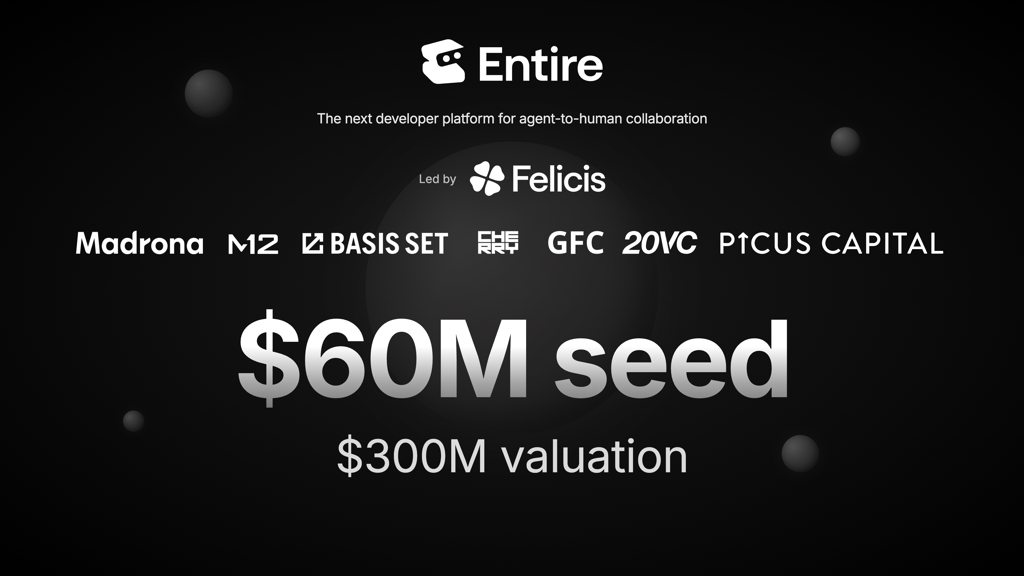
The company raised $60M led by Felicis, with Madrona, M12, Basis Set, 20VC, Cherry, Picus, GFC, plus individual investors like Gergely Orosz and Garry Tan.
2) The first product: Entire CLI + Checkpoints
Current agent sessions are ephemeral. Prompts live in terminals, reasoning lives in context windows, and none of it survives once the session ends. Git only stores diffs, not why the diffs happened.
Entire’s fix is Checkpoints:
- Every agent commit captures full session context
- Context includes prompts, tool calls, token usage, and files touched
- Stored in Git as versioned metadata on a separate branch (
entire/checkpoints/v1) - Lets you trace intent, not just diffs
Supported agents today: Claude Code and Google Gemini CLI, with Codex and Cursor planned.
3) How it works (high‑level)
- Run
curl -fsSL https://entire.io/install.sh | bash - In a repo:
entire enable - From then on, agent sessions are captured automatically
🔍 Community takeaways (from HN‑style discussion)
The Korean dev community reaction highlights three big themes:
1) Spec‑driven development is the new bottleneck Agents can generate hundreds of variants in parallel. The human job shifts to writing specs that constrain outcomes.
2) Git + PRs don’t scale for agent workflows Traditional review assumes slow, human‑paced diffs. When changes happen at agent speed, review must move from line‑by‑line to intent‑level.
3) Context durability becomes a platform primitive Without recorded prompts + reasoning, teams lose auditability, collaboration, and velocity. Checkpoints attempts to encode this as first‑class versioned data.
💡 Innovation: Why this feels like a “software assembly line”
Entire’s framing echoes industrial automation: once machines became the primary producers, the system had to be rebuilt around flow, traceability, and quality control.
Checkpoints are essentially the assembly log for agent work. The deeper the system goes (context graphs, semantic reasoning, handoffs), the more it becomes an operating system for teams + agents rather than just a tool.
If this succeeds, a future PR might look less like “a diff” and more like a traceable chain of decisions and constraints.
Key Implications
| Shift | What it means | What to try |
|---|---|---|
| Code volume explodes | Humans can’t read every diff | Review intent + constraints |
| Context is fragile | Prompts vanish without a trace | Store reasoning next to code |
| SDLC must be rebuilt | Issues/PRs aren’t enough | Experiment with spec‑driven workflows |
Final thought
Entire is betting that context is the missing layer of agentic development. If that’s right, Git‑compatible checkpoints could become as standard as commits or tests.
The bigger question: will teams adopt a new SDLC fast enough to keep up with agent speed?
References
- Launch blog: https://entire.io/blog/hello-entire-world/
- Community discussion: https://news.hada.io/topic?id=26583