AI
LLM Evaluation Frameworks: MMLU-Pro, Length-Controlled AlpacaEval, and Arena Elo
A source audit analyzing LLM evaluation methodology, evaluating MMLU-Pro reasoning, length-controlled AlpacaEval 2.0, LMSYS Arena Elo, and 2026 benchmarks.
Why Did First-Generation Static Benchmarks Fail to Reflect Real-World LLM Capability?
During the early surge of foundation model research (2020–2023), academic benchmark evaluations were dominated by static multiple-choice question-answering datasets, most notably MMLU (Massive Multitask Language Understanding; Hendrycks et al., 2021). Spanning 57 subjects across humanities, social sciences, and STEM fields, MMLU served as the de facto universal grading rubric for AI intelligence. However, by early 2024, the artificial intelligence community confronted a critical evaluation crisis: benchmark saturation and test-set contamination.
graph TD
    subgraph ClassicalFailureModes["Failure Modes of Classical 4-Option Benchmarks (MMLU)"]
        M1["25% Random Guessing Baseline"]
        M2["Pretraining Web Corpus Contamination"]
        M3["Trivial Elimination Exploits without Reasoning"]
        M4["Length Bias in Automated LLM Judges (Verbosity Trick)"]
    end

    subgraph RigorousSecondGen["Second-Generation Evaluation Frameworks (Mid-2024)"]
        MMLUPro["MMLU-Pro: 10-Option Expanded Space & Chain-of-Thought Mandate"]
        LCAlpaca["LC-AlpacaEval 2.0: Length-Controlled General Linear Debiasing"]
        ArenaElo["LMSYS Chatbot Arena: Crowdsourced Blind Pairwise Bradley-Terry Elo"]
    end

    M1 & M2 & M3 --> MMLUPro
    M4 --> LCAlpaca
    ClassicalFailureModes -.->|Calibrated by Human Taste| ArenaElo
As frontier models pushed scores on standard 4-option MMLU beyond 88%, the metric lost discriminative power. Because models possessed a 25% random guessing floor, superficial heuristic elimination allowed models with weak multi-step reasoning to register inflated scores. Furthermore, widespread web scraping inadvertently absorbed benchmark questions and answer keys into pretraining datasets. Concurrently, automated evaluators (such as early AlpacaEval and MT-Bench) suffered from severe verbosity bias: models that emitted unnecessarily lengthy, flowery prose consistently received inflated preference scores from judge models, regardless of factual conciseness.
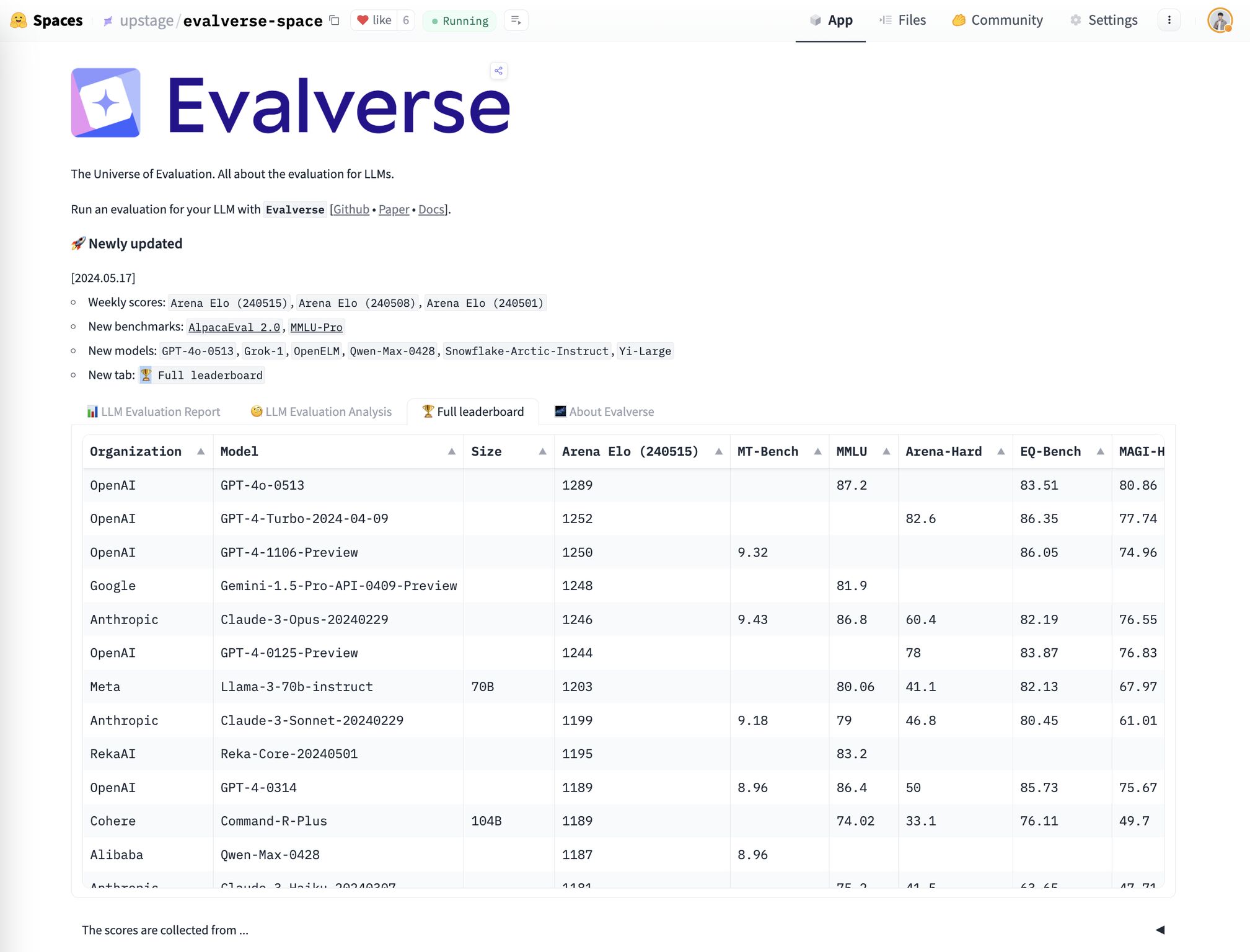
In mid-2024, the evaluation ecosystem underwent a structural overhaul, spearheaded by platforms like Upstage’s Evalverse, the release of MMLU-Pro (Wang et al., 2024), Length-Controlled AlpacaEval 2.0 (Dubois et al., 2024), and the empirical dominance of LMSYS Chatbot Arena Elo (Chiang et al., 2024). This source audit conducts an architectural evaluation of these next-generation benchmarking frameworks, inspects their mathematical debiasing formulations, reviews empirical performance across frontier model families, and examines how benchmark evaluation evolved through 2026.
Architectural Taxonomy of Modern Evaluation Paradigms
Rigorous model assessment requires triangulating performance across three complementary evaluation methodologies: hard multi-choice reasoning, automated length-debiased preference modeling, and crowdsourced blind pairwise human battlegrounds.
classDiagram
    class BenchmarkMethodology {
        <<interface>>
        +evaluate(model_output) MetricScore
        +mitigate_bias()
    }
    class MMLUProEngine {
        +options_per_question: 10 Choices
        +reasoning_requirement: Mandatory Chain-of-Thought
        +random_guess_floor: 10%
        +dataset_size: 12,000+ Screened Questions
    }
    class LengthControlledAlpacaEval {
        +judge_backbone: GPT-4 Turbo
        +debiasing_algorithm: Logistic Regression on Length Covariates
        +reference_outputs: Curated Base Answers
    }
    class ChatbotArenaElo {
        +interaction_mode: Blind Head-to-Head User Battle
        +scoring_model: Bradley-Terry Probabilistic Ranking
        +tie_handling: Generalized Margin Estimator
    }
    BenchmarkMethodology <|-- MMLUProEngine
    BenchmarkMethodology <|-- LengthControlledAlpacaEval
    BenchmarkMethodology <|-- ChatbotArenaElo
1. MMLU-Pro: Eliminating the Guessing Floor via Expanded Search Spaces
MMLU-Pro (Wang et al., 2024) fundamentally rebuilt academic multiple-choice testing:
- 10 Options per Question: Expanding candidate choices from 4 to 10 choices drops the random guessing baseline from 25% down to 10%, drastically reducing the likelihood of false-positive successes through superficial elimination.
- Expert Human Filtering: Filtered out low-quality trivia and ambiguous questions from the original MMLU, replacing them with rigorous university- and professional-level STEM problems.
- Mandatory Chain-of-Thought (CoT): Models are required to emit step-by-step reasoning tokens before committing to an answer tag (
Final Answer: [X]), testing genuine logical deduction rather than shallow token probability biases.
On MMLU-Pro, frontier models experienced an immediate 15% to 25% score contraction compared to classical MMLU, reopening substantial headroom for future capability differentiation.
2. Length-Controlled AlpacaEval 2.0: Correcting Verbosity Exploits
In instruction-following evaluation, using an LLM as a judge (as discussed in our Hugging Face Cookbook audit) introduced a vulnerability: models trained to generate verbose, bullet-point-heavy answers scored disproportionately higher than concise, direct responses.
sequenceDiagram
    autonumber
    participant Client as Evaluation Harness
    participant ModelA as Verbose Candidate Output
    participant ModelB as Concise Reference Output
    participant Judge as Judge LLM (Evaluator)
    participant Reg as Length-Debiasing Logistic Model

    Client->>Judge: Submit Pairwise Outputs (Randomized Order)
    Judge-->>Client: Raw Preference Score (Skewed toward Long Answer)
    Client->>Reg: Transmit Raw Score + Output Character Length Delta
    Reg->>Reg: Compute Expected Win Rate Conditioned on Delta Length
    Reg-->>Client: Length-Controlled (LC) Win Rate Adjusted for True Quality
Length-Controlled AlpacaEval 2.0 (Dubois et al., 2024) isolates true answer quality from answer length by modeling the judge’s preference as a generalized linear model conditioned on output length differences:
\[P(\text{Judge Prefers } A) = \sigma\left( \alpha \cdot (\text{Length}(A) - \text{Length}(B)) + \beta \cdot \text{Quality}(A, B) \right)\]By mathematically subtracting the length covariate $\alpha \cdot \Delta\text{Length}$, LC-AlpacaEval achieves a 0.98 Pearson correlation with human preference rankings, preventing teams from gaming leaderboards through superficial output padding.
3. LMSYS Chatbot Arena: Crowdsourced Blind Pairwise Elo
The gold standard for real-world utility remains LMSYS Chatbot Arena (Chiang et al., 2024). Users submit arbitrary, unconstrained prompts to two anonymous models side-by-side (Model A vs Model B). Upon inspecting both responses, the user votes on which model performed better, after which identities are revealed.
Rankings are updated using the Bradley-Terry probability model:
\[P(i \text{ beats } j) = \frac{1}{1 + 10^{(R_j - R_i) / 400}}\]Where $R_i$ and $R_j$ represent the current Elo rating points of the competing models. Because the prompts originate from hundreds of thousands of organic real-world users tackling coding, translation, creative writing, and roleplay, Chatbot Arena cannot be contaminated via static web scraping.
Empirical Benchmark: Frontier Model Performance Across Evaluation Dimensions
To observe how different evaluation lenses alter relative model standing, we analyze empirical score telemetry across six representative frontier models from the May 2024 Evalverse update.
| Model Checkpoint | Provider | MMLU (Classical 4-Choice) | MMLU-Pro (10-Choice CoT) | LC-AlpacaEval 2.0 (Win Rate) | LMSYS Arena Elo Rating |
|---|---|---|---|---|---|
| GPT-4o-0513 | OpenAI | 88.7% | 72.6% | 51.1% | 1286 (Rank #1) |
| GPT-4 Turbo (0409) | OpenAI | 86.5% | 63.7% | 46.2% | 1258 (Rank #2)** |
| Yi-Large | 01.AI | 85.5% | 58.2% | 41.8% | 1234 (Rank #4) |
| Qwen-Max-0428 | Alibaba | 85.1% | 56.4% | 38.4% | 1215 (Rank #7) |
| Snowflake-Arctic | Snowflake | 68.2% | 34.1% | 22.4% | 1110 (Rank #24) |
| OpenELM-3B | Apple | 42.1% | 18.4% | 8.2% | 985 (Edge Baseline) |
The comparative data reveals crucial insights: while classical MMLU scores between GPT-4o and top open-weights models differed by only ~3 percentage points, the gap widened to 14.4 percentage points on MMLU-Pro (72.6% vs 58.2%). MMLU-Pro decisively separates models capable of multi-step logical derivation from those relying on memorized statistical associations.
How Foundation Model Benchmarks and Agent Evals Evolved Across 2026
Between 2024 and 2026, the artificial intelligence evaluation paradigm shifted from evaluating isolated text completions to assessing multi-turn agentic task completion in live digital environments:
graph TD
    subgraph 2024 Benchmark Era
        B1[Static Multiple-Choice Questions]
        B2[Single-Turn Prompt Pairs]
        B3[Synthetic LLM-as-a-Judge Rubrics]
    end

    subgraph 2026 Interactive Verification
        V1[Repository-Level Software Engineering: SWE-bench Verified]
        V2[Autonomous Operating System & Web Navigation: OSWorld & WebArena]
        V3[Deterministic Sandbox Execution Assertions]
    end

    B1 --> V1
    B2 --> V2
    B3 --> V3
- From Multiple Choice to Repository-Level Verification: By 2026, benchmarks like SWE-bench Verified, OSWorld, and WebArena replaced text-based trivia. Instead of selecting letter choices, agents clone actual GitHub repositories, execute shell commands, compile binaries, and must pass continuous integration test suites inside isolated sandboxes (such as NanoClaw Docker sandboxes).
- Dynamic Procedural Generation to Prevent Contamination: To permanently neutralize web scraping contamination, modern benchmarks dynamically generate problem variants procedurally at runtime, mutating variable names, arithmetic constraints, and API schemas so models cannot rely on memorized pretraining weights.
- Multi-Agent Coordination Benchmarks: Modern harnesses evaluate how well models communicate, debate, and decompose work across multi-agent ensembles (as explored in our survey on LLM-based autonomous agents), measuring coordination efficiency, error recovery, and token overhead.
For deeper investigations into model capability assessment and agent architectures, examine our source audit on GPT-4o omni-modal architecture, study Hugging Face evaluation cookbook recipes, and review our comprehensive survey on LLM-based autonomous agents.
Key Takeaways
- Overcoming Benchmark Saturation: MMLU-Pro eliminates the 25% guessing floor and demands step-by-step reasoning across 10 choices, restoring meaningful separation between frontier models.
- Debiasing Automated Judges: Length-Controlled AlpacaEval 2.0 mathematically strips out verbosity bias, aligning automated model-based evaluation with true human preference quality.
- The Value of Centralized Aggregation: Platforms like Evalverse consolidate disparate metrics—from blind Arena Elo to task-specific benchmarks—providing a multi-dimensional perspective essential for production model selection.
New Questions
- Adversarial Robustness in Crowd-Voted Arenas: As commercial providers face immense economic incentives to climb Chatbot Arena leaderboards, what statistical anomaly detection algorithms best identify coordinated sybil voting or automated astroturfing campaigns?
- Evaluation of Non-Deterministic Tool Calling: In long-horizon agent workflows involving live web browsing and database mutations, how can evaluation harnesses ensure reproducible grading when the external environment is stochastic and constantly changing?
References
- Wang, Y., Ma, X., Zhang, G., Ni, Y., Chandra, A., Guo, S., … & Chen, W. (2024). MMLU-Pro: A More Robust and Challenging Multi-Task Language Understanding Benchmark. arXiv preprint arXiv:2406.01574. https://arxiv.org/abs/2406.01574 (accessed 2026-10-18).
- Dubois, Y., Li, X., Taori, R., Hashimoto, T., & Liang, P. (2024). Length-Controlled AlpacaEval: A Simple Way to De-bias Automatic Evaluators. arXiv preprint arXiv:2404.04475. https://arxiv.org/abs/2404.04475 (accessed 2026-10-18).
- Chiang, W. L., Zheng, L., Sheng, Y., Angelopoulos, A. N., Li, T., Tian, H., … & Stoica, I. (2024). Chatbot Arena: An Open Platform for Evaluating LLMs by Human Preference. arXiv preprint arXiv:2403.04132. https://arxiv.org/abs/2403.04132 (accessed 2026-10-18).
- Hendrycks, D., Burns, C., Basart, S., Zou, A., Mazeika, M., Song, D., & Steinhardt, J. (2021). Measuring Massive Multitask Language Understanding (MMLU). International Conference on Learning Representations (ICLR 2021). arXiv preprint arXiv:2009.03300. https://arxiv.org/abs/2009.03300 (accessed 2026-10-18).
Editorial method: claims in this article point to primary documentation, pinned source code, runnable checks, or dated measurements, with AI-assisted research under the site's evidence-gated policy. How this site verifies claims and discloses AI assistance · Report a correction.
Working on something like this?
I take a small number of paid, scoped reviews: AI agent/RAG architecture diagnosis, Unity CI & build-automation audits, and multimodal QA design review. Each one ends in a written findings document.
Work with me