AI
LocalCowork: A No‑Cloud Agent That Finally Feels Instant
LFM2‑24B‑A2B hits ~385ms tool dispatch on a MacBook with 67 tools and 14.5GB memory — all local, zero network calls.
🤔 Curiosity: The Question
Most local agents fail for a simple reason:
they can understand the request, but they can’t pick the right tool fast enough to feel instant.
So we pushed the whole stack onto a laptop:
- LFM2‑24B‑A2B running locally
- 67 tools across 13 MCP servers
- Zero network calls
The question was simple:
What happens when tool selection is sub‑second and private by default?
📚 Retrieve: The Knowledge
What LocalCowork is
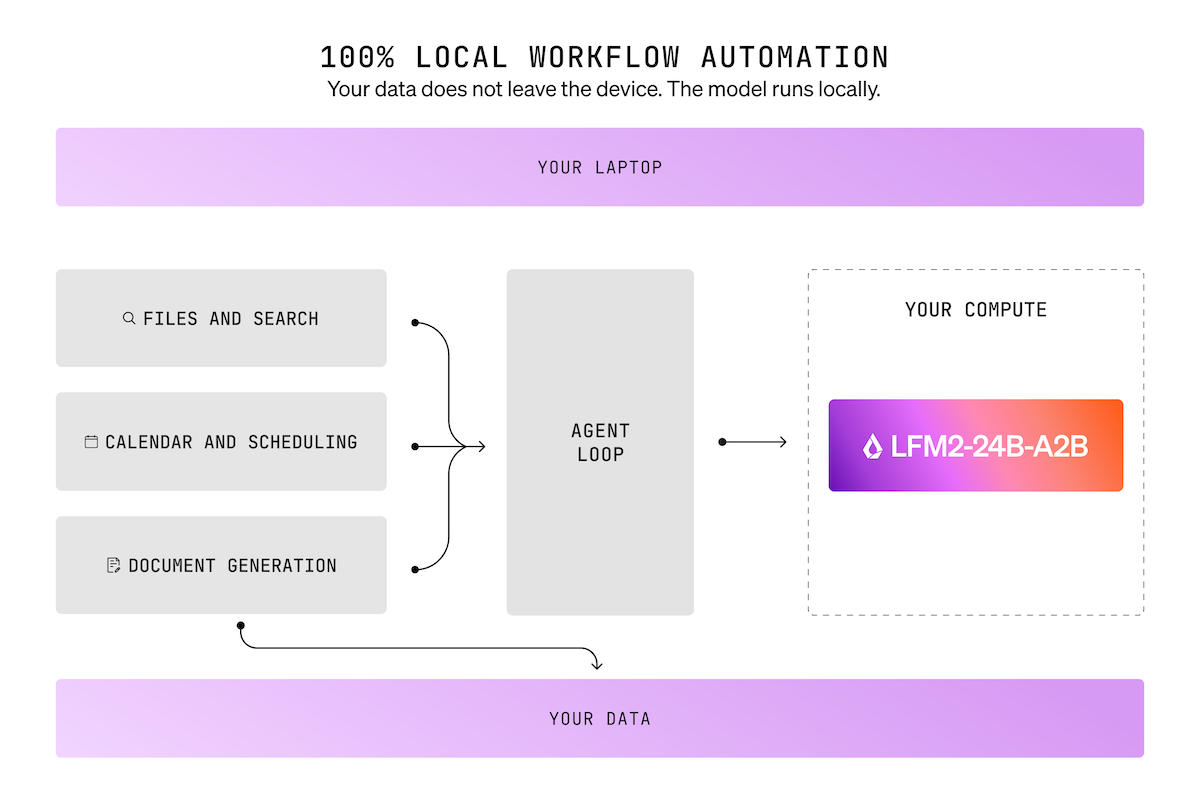
LocalCowork is an open‑source desktop agent that runs entirely on‑device:
model + tools + data, with no cloud, no API keys, no data egress.
The blog post outlines the exact setup:
- Apple M4 Max, 36GB unified memory
- LFM2‑24B‑A2B (MoE, ~2B active params)
- ~14.5GB memory footprint
- ~385ms average tool‑selection latency
The tool surface (why this matters)
It isn’t a toy set. The benchmark uses 67 tools across 13 MCP servers:
- filesystem, document, OCR, security, audit
- knowledge/RAG, meeting, system, clipboard
- calendar, email, task, data, screenshot pipeline
The repo exposes a tool registry contract (MCP tool schema).
This is a real harness surface, not an ad‑hoc prompt list.
Real workflows tested
A full pipeline ran locally: 1) Search receipt images 2) OCR + parse vendor/items/total 3) Detect duplicates 4) Export CSV 5) Flag anomalies 6) Generate reconciliation report
That’s a multi‑step, multi‑tool workflow without a single outbound API call.
Benchmarks (from the report)
| Model | Active Params | Tool Accuracy | Latency | Multi‑step |
|---|---|---|---|---|
| LFM2‑24B‑A2B | ~2B (MoE) | 80% | 390ms | 26% |
| Gemma 3 27B | 27B | 91% | 24,088ms | 48% |
| Mistral‑Small‑24B | 24B | 85% | 1,239ms | 66% |
| Qwen3‑32B | 32B | ~70% | 28,385ms | — |
The key takeaway: speed is the product.
💡 Innovation: The Insight
Why this changes the local‑agent story
The model isn’t just smart — it’s fast enough to keep the loop tight.
That’s the real unlock for local agents:
- Low latency → low correction cost
- Private by default → safe for real workflows
- Tool registry contract → maintainable harness
What I’d build with this
1) Local QA assistant
Scan builds, diff logs, generate reports — no data leaves the studio.
2) Producer ops agent
Docs + calendar + audit logs, all offline‑capable.
3) On‑device compliance workflows
If your studio handles sensitive IP, this is the path.
Key Takeaways
| Insight | Implication | Next Step |
|---|---|---|
| Sub‑second tool dispatch is the product | UX beats raw IQ | Optimize tool routing |
| MCP tool registry is a harness contract | Scaling becomes possible | Standardize tool schemas |
| Local‑first = real privacy | Enables regulated workflows | Ship on‑device pilots |
New Questions This Raises
- Can multi‑step success move past 26% with better confirmation loops?
- What’s the minimal tool set for “instant” UX?
- How do we design audits that humans actually read?
References
- Liquid AI blog: https://www.liquid.ai/blog/no-cloud-tool-calling-agents-consumer-hardware-lfm2-24b-a2b
- LocalCowork cookbook: https://github.com/Liquid4All/cookbook/tree/main/examples/localcowork
- LFM2‑24B‑A2B model: https://huggingface.co/LiquidAI/LFM2-24B-A2B-Preview
- MCP: https://modelcontextprotocol.io/