LLM/Model & Papers
Building LLaMA 4 from Scratch: Understanding Mixture-of-Experts Architecture
A deep dive into implementing LLaMA 4’s Mixture-of-Experts (MoE) architecture from scratch using PyTorch. Learn how MoE enables efficient scaling to hundreds of billions of parameters while maintaining inference speed.
🤔 Curiosity: How Do We Scale LLMs Without Proportional Compute Costs?
What if we could build a language model with hundreds of billions of parameters, but only activate a small fraction of them for each input? What if we could achieve GPT-4-level performance at roughly half the inference cost?
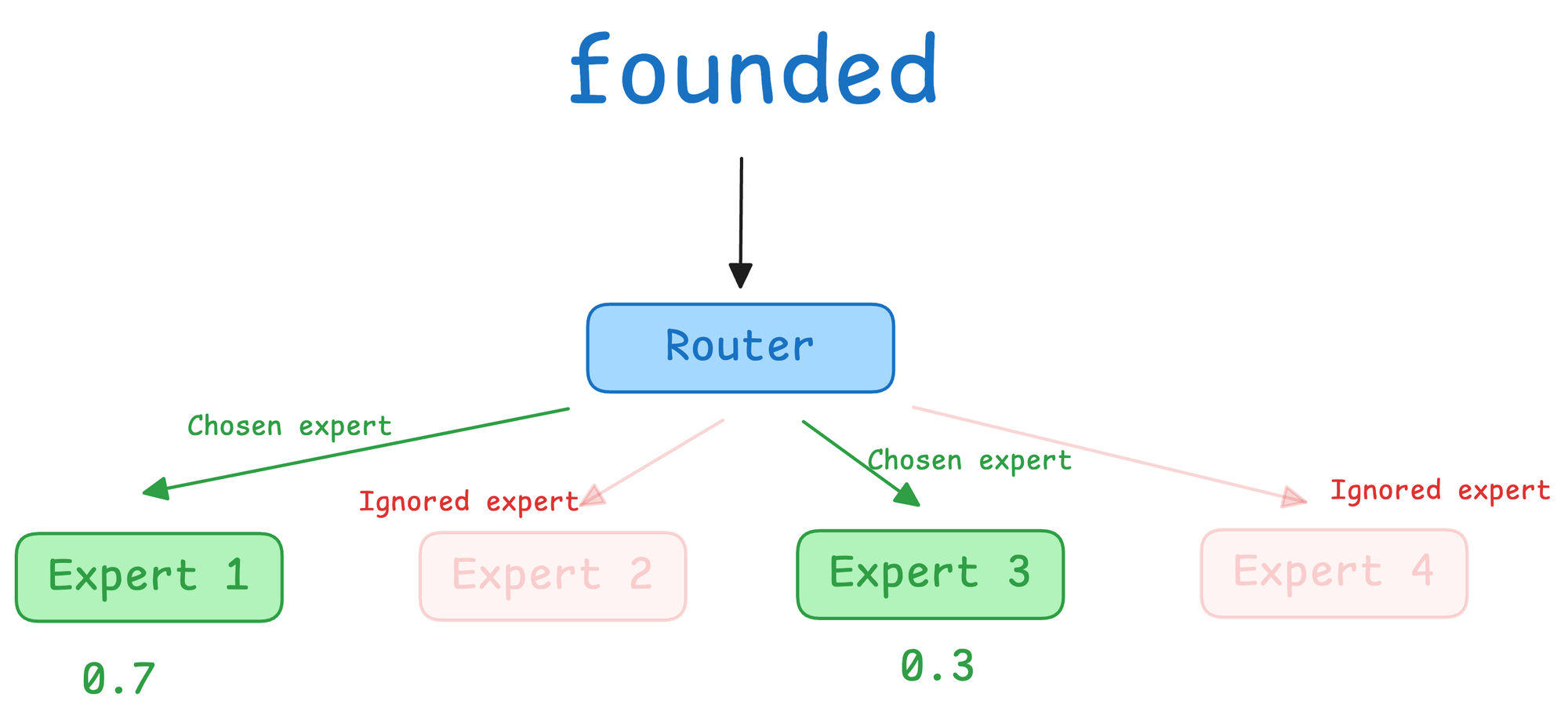
Curiosity: Traditional Transformers activate all parameters for every token. But what if we could create a “team of specialists” where only relevant experts activate per token? How would that change the efficiency equation?
Meta’s LLaMA 4 has sparked significant conversation, not just because of its performance, but because of how it achieves that performance. Unlike previous generations, LLaMA 4 doesn’t rely solely on the classic Transformer architecture. Instead, it uses a Mixture-of-Experts (MoE) approach, activating only a small subset of expert subnetworks per token.
The result: LLaMA 4 Maverick uses 128 experts but activates just a few per token, achieving GPT-4-level performance at roughly half the inference cost.
The question: How does MoE actually work under the hood? And can we build a miniature, interpretable version from scratch to truly understand the mechanics?
As someone who’s built production ML systems, I’ve always been fascinated by architectures that break the “bigger model = more compute” paradigm. MoE represents one of the most promising approaches to scaling model capacity without proportional compute requirements.
📚 Retrieve: Understanding Mixture-of-Experts Architecture
Why Mixture-of-Experts for LLMs?
The Scaling Problem:
Large Language Models have grown massively in size, reaching tens or even hundreds of billions of parameters. The traditional approach:
- More parameters → Better performance
- But also: More parameters → Proportional increase in compute
The MoE Solution:
Instead of every part of the model being active for every input, MoE networks activate only a subset of “expert” sub-networks for each token. This means:
- Only a fraction of the model’s parameters are used for each forward pass
- Reduced computation cost while preserving performance
- Scale model capacity without proportional increase in compute
| Approach | Parameters | Active per Token | Compute Cost |
|---|---|---|---|
| Standard Transformer | 70B | 70B (100%) | High |
| MoE (128 experts, top-2) | 70B | ~1.1B (1.6%) | Low |
| Performance | Similar | Similar | 50% cost reduction |
How Do MoEs Work?
The Core Idea:
Think of a standard Transformer as a single-agent system—one really smart generalist doing everything. MoE is the multi-agent version of model design:
- Instead of one generalist, you build a team of specialists
- Each expert specializes in different types of tasks
- A router decides which expert(s) should handle each input token
- Only the most relevant experts are activated based on the task
graph TB
    subgraph Standard["Standard Transformer"]
        I1[Input Token] --> FF1[Single Feed-Forward Network]
        FF1 --> O1[Output]
    end

    subgraph MoE["Mixture-of-Experts"]
        I2[Input Token] --> R[Router/Gate]
        R -->|Select Top-K| E1[Expert 1]
        R -->|Select Top-K| E2[Expert 2]
        R -->|Select Top-K| E3[Expert 3]
        R -->|Select Top-K| E4[Expert 4]
        E1 -->|Weighted Combine| O2[Output]
        E2 -->|Weighted Combine| O2
        E3 -->|Weighted Combine| O2
        E4 -->|Weighted Combine| O2
    end

    style R fill:#ff6b6b,stroke:#c92a2a,stroke-width:3px,color:#fff
    style E1 fill:#4ecdc4,stroke:#0a9396,stroke-width:2px,color:#fff
    style E2 fill:#4ecdc4,stroke:#0a9396,stroke-width:2px,color:#fff
Key Components:
- Experts: Multiple feed-forward networks (usually 4-128 experts), each smaller than a standard FFN
- Router (Gate): A small neural network that produces scores for each expert
- Top-K Selection: Only the top-K experts (typically 2-4) are activated per token
- Weighted Combination: Expert outputs are combined using router scores
The Router Mechanism
How Routing Works:
1
2
3
4
5
6
7
8
9
10
11
12
13
14
15
16
17
18
19
20
21
22
23
24
25
26
27
28
29
30
31
32
33
34
35
36
37
38
39
40
41
42
43
# Conceptual router implementation
class MoERouter:
    """
    Curiosity: How does the router decide which experts to activate?
    Retrieve: Router learns to assign tokens to specialized experts
    Innovation: Sparse activation enables efficient scaling
    """

    def __init__(self, num_experts: int, top_k: int = 2):
        self.num_experts = num_experts
        self.top_k = top_k
        self.gate = nn.Linear(hidden_dim, num_experts)

    def forward(self, token_embedding: torch.Tensor) -> Tuple[torch.Tensor, torch.Tensor]:
        """
        Route token to top-K experts

        Args:
            token_embedding: [batch_size, hidden_dim]

        Returns:
            expert_scores: [batch_size, num_experts] - softmax scores
            expert_indices: [batch_size, top_k] - indices of selected experts
        """
        # 1. Compute scores for each expert
        logits = self.gate(token_embedding)  # [batch_size, num_experts]

        # 2. Add noise during training (prevents expert collapse)
        if self.training:
            noise = torch.randn_like(logits) * 0.1
            logits = logits + noise

        # 3. Select top-K experts
        top_k_scores, top_k_indices = torch.topk(logits, k=self.top_k, dim=-1)

        # 4. Set non-selected experts to -infinity (for softmax)
        mask = torch.full_like(logits, float('-inf'))
        mask.scatter_(1, top_k_indices, top_k_scores)

        # 5. Apply softmax to get probabilities
        expert_probs = F.softmax(mask, dim=-1)

        return expert_probs, top_k_indices
Example:
For the token “was” in the sentence “Facebook was founded”:
- Router examines the token embedding
- Produces scores: [0.1, 0.7, 0.05, 0.15] for 4 experts
- Selects top-2: Expert 1 (0.7) and Expert 3 (0.15)
- Only these two experts process the token
- Outputs are combined with weights 0.7 and 0.15
Training Challenges and Solutions
Challenge 1: Expert Collapse
Problem: During training, one expert might get selected repeatedly, leaving others under-trained.
Solution:
- Add noise to router logits during training (encourages exploration)
- Top-K masking: Set non-selected expert logits to -infinity before softmax
Challenge 2: Load Balancing
Problem: Some experts may process more tokens than others, leading to uneven training.
Solution:
- Token capacity limit: Limit the number of tokens each expert can process
- Overflow handling: If an expert reaches capacity, route to the next best expert
1
2
3
4
5
6
7
8
9
10
11
12
13
14
15
16
def load_balance_loss(expert_usage: torch.Tensor, num_experts: int) -> torch.Tensor:
    """
    Encourage uniform expert usage

    Args:
        expert_usage: [num_experts] - count of tokens processed by each expert

    Returns:
        Load balancing loss (higher = more imbalanced)
    """
    # Coefficient of variation
    mean_usage = expert_usage.mean()
    std_usage = expert_usage.std()
    cv_squared = (std_usage / mean_usage) ** 2

    return cv_squared
💡 Innovation: Building LLaMA 4 from Scratch
Architecture Overview

Complete MoE Transformer Architecture:
graph TB
    subgraph Input["Input Processing"]
        T[Text Input] --> TK[Tokenizer]
        TK --> E[Embedding Layer]
    end

    subgraph Layers["MoE Transformer Layers"]
        E --> L1[Layer 1]
        L1 --> L2[Layer 2]
        L2 --> L3[Layer N]
    end

    subgraph Layer["Single MoE Layer"]
        IN[Input] --> ATT[Multi-Head Attention<br/>+ RoPE]
        ATT --> ADD1[Add & Norm]
        ADD1 --> MOE[MoE Block]
        MOE --> ADD2[Add & Norm]
        ADD2 --> OUT[Output]
    end

    subgraph MoEBlock["MoE Block Detail"]
        MOE_IN[Input] --> ROUTER[Router]
        ROUTER -->|Top-K| EXP1[Expert 1]
        ROUTER -->|Top-K| EXP2[Expert 2]
        ROUTER -->|Top-K| EXP3[Expert 3]
        ROUTER -->|Top-K| EXP4[Expert 4]
        EXP1 --> COMBINE[Weighted Combine]
        EXP2 --> COMBINE
        EXP3 --> COMBINE
        EXP4 --> COMBINE
        COMBINE --> MOE_OUT[Output]
    end

    L3 --> LM[Language Model Head]
    LM --> PROBS[Output Probabilities]

    style ROUTER fill:#ff6b6b,stroke:#c92a2a,stroke-width:3px,color:#fff
    style MOE fill:#4ecdc4,stroke:#0a9396,stroke-width:2px,color:#fff
Implementation: Core Components
1. Character-Level Tokenization
1
2
3
4
5
6
7
8
9
10
11
12
13
14
15
16
17
18
19
20
21
22
class CharacterTokenizer:
    """
    Simple character-level tokenizer for educational purposes
    In production, use SentencePiece or BPE tokenizers
    """

    def __init__(self, text: str):
        # Build vocabulary from unique characters
        self.chars = sorted(list(set(text)))
        self.vocab_size = len(self.chars)

        # Create mappings
        self.char_to_idx = {ch: i for i, ch in enumerate(self.chars)}
        self.idx_to_char = {i: ch for i, ch in enumerate(self.chars)}

    def encode(self, text: str) -> List[int]:
        """Convert text to token indices"""
        return [self.char_to_idx[ch] for ch in text]

    def decode(self, indices: List[int]) -> str:
        """Convert token indices to text"""
        return ''.join([self.idx_to_char[idx] for idx in indices])
2. Rotary Positional Embeddings (RoPE)
1
2
3
4
5
6
7
8
9
10
11
12
13
14
15
16
17
18
19
20
21
22
def apply_rotary_pos_emb(q: torch.Tensor, k: torch.Tensor,
                         freqs: torch.Tensor) -> Tuple[torch.Tensor, torch.Tensor]:
    """
    Apply rotary positional embeddings to queries and keys

    RoPE encodes position information by rotating the query/key vectors
    in the complex plane, allowing the model to understand relative positions
    """
    # Reshape for complex multiplication
    q_complex = torch.view_as_complex(q.reshape(*q.shape[:-1], -1, 2))
    k_complex = torch.view_as_complex(k.reshape(*k.shape[:-1], -1, 2))

    # Apply rotation
    freqs_cis = torch.polar(torch.ones_like(freqs), freqs)
    q_rotated = q_complex * freqs_cis
    k_rotated = k_complex * freqs_cis

    # Convert back to real
    q_emb = torch.view_as_real(q_rotated).flatten(-2)
    k_emb = torch.view_as_real(k_rotated).flatten(-2)

    return q_emb, k_emb
3. Multi-Head Self-Attention with RoPE
1
2
3
4
5
6
7
8
9
10
11
12
13
14
15
16
17
18
19
20
21
22
23
24
25
26
27
28
29
30
31
32
33
34
35
36
37
38
39
40
41
42
43
44
45
46
47
48
49
50
51
52
53
54
55
56
57
58
59
class MultiHeadAttention(nn.Module):
    """
    Multi-head self-attention with rotary positional embeddings
    """

    def __init__(self, d_model: int, num_heads: int, max_seq_len: int = 512):
        super().__init__()
        self.d_model = d_model
        self.num_heads = num_heads
        self.head_dim = d_model // num_heads

        # Q, K, V projections
        self.q_proj = nn.Linear(d_model, d_model)
        self.k_proj = nn.Linear(d_model, d_model)
        self.v_proj = nn.Linear(d_model, d_model)
        self.out_proj = nn.Linear(d_model, d_model)

        # RoPE frequencies
        self.register_buffer('freqs', self._compute_freqs(max_seq_len))

    def _compute_freqs(self, max_seq_len: int) -> torch.Tensor:
        """Compute RoPE frequencies"""
        freqs = 1.0 / (10000 ** (torch.arange(0, self.head_dim, 2).float() / self.head_dim))
        positions = torch.arange(max_seq_len).float()
        freqs = torch.outer(positions, freqs)
        return freqs

    def forward(self, x: torch.Tensor, mask: Optional[torch.Tensor] = None):
        batch_size, seq_len, _ = x.shape

        # Project to Q, K, V
        q = self.q_proj(x).view(batch_size, seq_len, self.num_heads, self.head_dim)
        k = self.k_proj(x).view(batch_size, seq_len, self.num_heads, self.head_dim)
        v = self.v_proj(x).view(batch_size, seq_len, self.num_heads, self.head_dim)

        # Apply RoPE
        q, k = apply_rotary_pos_emb(q, k, self.freqs[:seq_len])

        # Reshape for attention
        q = q.transpose(1, 2)  # [batch, heads, seq, head_dim]
        k = k.transpose(1, 2)
        v = v.transpose(1, 2)

        # Scaled dot-product attention
        scores = torch.matmul(q, k.transpose(-2, -1)) / math.sqrt(self.head_dim)

        # Causal mask
        if mask is not None:
            scores = scores.masked_fill(mask == 0, float('-inf'))

        attn_weights = F.softmax(scores, dim=-1)
        attn_output = torch.matmul(attn_weights, v)

        # Concatenate heads and project
        attn_output = attn_output.transpose(1, 2).contiguous()
        attn_output = attn_output.view(batch_size, seq_len, self.d_model)
        output = self.out_proj(attn_output)

        return output
4. Mixture-of-Experts Block
1
2
3
4
5
6
7
8
9
10
11
12
13
14
15
16
17
18
19
20
21
22
23
24
25
26
27
28
29
30
31
32
33
34
35
36
37
38
39
40
41
42
43
44
45
46
47
48
49
50
51
52
53
54
55
56
57
58
59
60
61
62
63
64
65
66
67
68
69
70
71
72
73
74
75
76
77
78
79
80
81
82
83
84
85
86
87
88
89
90
91
92
93
class Expert(nn.Module):
    """Single expert: a feed-forward network"""

    def __init__(self, d_model: int, d_ff: int):
        super().__init__()
        self.ff = nn.Sequential(
            nn.Linear(d_model, d_ff),
            nn.GELU(),
            nn.Linear(d_ff, d_model)
        )

    def forward(self, x: torch.Tensor) -> torch.Tensor:
        return self.ff(x)


class MoEBlock(nn.Module):
    """
    Mixture-of-Experts block with router and multiple experts
    """

    def __init__(self, d_model: int, num_experts: int, top_k: int, d_ff: int):
        super().__init__()
        self.num_experts = num_experts
        self.top_k = top_k

        # Router
        self.router = nn.Linear(d_model, num_experts)

        # Experts
        self.experts = nn.ModuleList([
            Expert(d_model, d_ff) for _ in range(num_experts)
        ])

    def forward(self, x: torch.Tensor) -> torch.Tensor:
        """
        Args:
            x: [batch_size, seq_len, d_model]

        Returns:
            output: [batch_size, seq_len, d_model]
        """
        batch_size, seq_len, d_model = x.shape

        # Flatten for routing
        x_flat = x.view(-1, d_model)  # [batch * seq, d_model]

        # Router scores
        router_logits = self.router(x_flat)  # [batch * seq, num_experts]

        # Add noise during training (prevents expert collapse)
        if self.training:
            noise = torch.randn_like(router_logits) * 0.1
            router_logits = router_logits + noise

        # Top-K selection
        top_k_scores, top_k_indices = torch.topk(
            router_logits, k=self.top_k, dim=-1
        )  # [batch * seq, top_k]

        # Create mask for selected experts
        expert_mask = torch.zeros_like(router_logits)
        expert_mask.scatter_(1, top_k_indices, 1.0)

        # Softmax over selected experts only
        router_logits_masked = router_logits.masked_fill(
            expert_mask == 0, float('-inf')
        )
        expert_probs = F.softmax(router_logits_masked, dim=-1)

        # Process through selected experts
        output = torch.zeros_like(x_flat)

        for expert_idx in range(self.num_experts):
            # Find tokens routed to this expert
            expert_mask_idx = (top_k_indices == expert_idx).any(dim=-1)

            if expert_mask_idx.any():
                # Get tokens for this expert
                expert_input = x_flat[expert_mask_idx]

                # Process through expert
                expert_output = self.experts[expert_idx](expert_input)

                # Get weights for this expert
                expert_weights = expert_probs[expert_mask_idx, expert_idx:expert_idx+1]

                # Weighted contribution
                output[expert_mask_idx] += expert_weights * expert_output

        # Reshape back
        output = output.view(batch_size, seq_len, d_model)

        return output
5. Complete MoE Transformer Layer
1
2
3
4
5
6
7
8
9
10
11
12
13
14
15
16
17
18
19
20
21
22
23
24
25
class MoETransformerLayer(nn.Module):
    """Complete MoE Transformer layer"""

    def __init__(self, d_model: int, num_heads: int, num_experts: int,
                 top_k: int, d_ff: int, max_seq_len: int = 512):
        super().__init__()

        # Attention
        self.attention = MultiHeadAttention(d_model, num_heads, max_seq_len)
        self.norm1 = nn.LayerNorm(d_model)

        # MoE block
        self.moe = MoEBlock(d_model, num_experts, top_k, d_ff)
        self.norm2 = nn.LayerNorm(d_model)

    def forward(self, x: torch.Tensor, mask: Optional[torch.Tensor] = None):
        # Self-attention with residual
        attn_out = self.attention(x, mask)
        x = self.norm1(x + attn_out)

        # MoE with residual
        moe_out = self.moe(x)
        x = self.norm2(x + moe_out)

        return x
6. Complete Model
1
2
3
4
5
6
7
8
9
10
11
12
13
14
15
16
17
18
19
20
21
22
23
24
25
26
27
28
29
30
31
32
33
34
35
36
37
class Llama4MoE(nn.Module):
    """
    Miniature LLaMA 4 MoE model from scratch
    """

    def __init__(self, vocab_size: int, d_model: int = 128, num_layers: int = 4,
                 num_heads: int = 8, num_experts: int = 4, top_k: int = 2,
                 d_ff: int = 512, max_seq_len: int = 512):
        super().__init__()

        # Embedding
        self.embedding = nn.Embedding(vocab_size, d_model)

        # Transformer layers
        self.layers = nn.ModuleList([
            MoETransformerLayer(d_model, num_heads, num_experts, top_k,
                              d_ff, max_seq_len)
            for _ in range(num_layers)
        ])

        # Output head
        self.ln_f = nn.LayerNorm(d_model)
        self.head = nn.Linear(d_model, vocab_size)

    def forward(self, x: torch.Tensor, mask: Optional[torch.Tensor] = None):
        # Embedding
        x = self.embedding(x)

        # Through layers
        for layer in self.layers:
            x = layer(x, mask)

        # Output projection
        x = self.ln_f(x)
        logits = self.head(x)

        return logits
Training and Generation
Training Loop:
1
2
3
4
5
6
7
8
9
10
11
12
13
14
15
16
17
18
19
20
21
22
23
24
25
26
27
28
29
30
31
def train_moe_model(model, dataloader, optimizer, num_epochs=10):
    """Training loop with load balancing loss"""
    model.train()

    for epoch in range(num_epochs):
        total_loss = 0

        for batch in dataloader:
            inputs, targets = batch

            # Forward pass
            logits = model(inputs)

            # Cross-entropy loss
            loss = F.cross_entropy(
                logits.view(-1, logits.size(-1)),
                targets.view(-1),
                ignore_index=-1
            )

            # Add load balancing loss (simplified)
            # In practice, track expert usage and add regularization

            # Backward
            optimizer.zero_grad()
            loss.backward()
            optimizer.step()

            total_loss += loss.item()

        print(f"Epoch {epoch+1}, Loss: {total_loss/len(dataloader):.4f}")
Generation (Autoregressive):
1
2
3
4
5
6
7
8
9
10
11
12
13
14
15
16
17
18
19
20
21
22
23
24
25
26
27
28
29
30
31
def generate(model, tokenizer, prompt: str, max_length: int = 100,
             temperature: float = 1.0) -> str:
    """Generate text autoregressively"""
    model.eval()

    # Encode prompt
    tokens = tokenizer.encode(prompt)
    tokens = torch.tensor([tokens])

    with torch.no_grad():
        for _ in range(max_length):
            # Forward pass
            logits = model(tokens)

            # Get next token logits
            next_token_logits = logits[0, -1, :] / temperature

            # Sample
            probs = F.softmax(next_token_logits, dim=-1)
            next_token = torch.multinomial(probs, num_samples=1)

            # Append
            tokens = torch.cat([tokens, next_token.unsqueeze(0)], dim=1)

            # Stop if end token
            if next_token.item() == tokenizer.eos_token_id:
                break

    # Decode
    generated = tokenizer.decode(tokens[0].tolist())
    return generated
🎯 Key Takeaways
| Insight | Implication | Next Steps |
|---|---|---|
| MoE enables efficient scaling | Can build larger models without proportional compute increase | Experiment with different expert counts and top-K values |
| Router is critical | Expert selection determines model performance | Research better routing algorithms (learned routing, hash-based) |
| Load balancing matters | Uneven expert usage hurts training | Implement proper load balancing loss and capacity limits |
| Sparse activation is key | Only activating top-K experts saves compute | Optimize expert selection for production inference |
| MoE + Foundation Models = Future | LLaMA 4, Mixtral show MoE’s potential | Explore MoE for domain-specific models |
Why This Matters for Production
As someone who’s shipped ML systems, here’s what excites me about MoE:
- Cost Efficiency: 50% reduction in inference cost while maintaining performance
- Scalability: Can scale to hundreds of billions of parameters efficiently
- Specialization: Experts naturally specialize in different tasks/domains
- Flexibility: Can adjust expert count and top-K based on compute budget
The Challenges:
- Router complexity: Routing decisions add overhead
- Load balancing: Ensuring all experts train properly
- Memory: Still need to load all expert parameters (though only activate subset)
What I’d Try First:
- Build a small MoE model (4-8 experts) for a specific task
- Experiment with different top-K values (1, 2, 4)
- Measure actual speedup vs. standard Transformer
- Test expert specialization (do experts learn different patterns?)
🤔 New Questions This Raises
Optimal Expert Count: How many experts is optimal? Is there a sweet spot between specialization and routing overhead?
Dynamic Top-K: Can we learn the optimal number of experts to activate per token, rather than fixing top-K?
Expert Specialization: What do experts actually learn? Can we analyze and interpret expert specializations?
Routing Algorithms: Are there better routing strategies than learned softmax routing? (e.g., hash-based, learned hash)
MoE for Smaller Models: Can MoE benefit smaller models (<1B parameters), or is it only useful at scale?
Multi-Modal MoE: How would MoE work for vision-language models? Different experts for different modalities?
Next Experiment: Build a 4-expert MoE model on a small dataset, visualize which experts activate for different input types, and measure the actual speedup compared to a standard Transformer of equivalent capacity.
References
Original Article:
Research Papers:
- Outrageously Large Neural Networks: The Sparsely-Gated Mixture-of-Experts Layer (Shazeer et al., 2017)
- GShard: Scaling Giant Models with Conditional Computation (Lepikhin et al., 2020)
- Switch Transformers: Scaling to Trillion Parameter Models (Fedus et al., 2021)
- Mixtral of Experts (Jiang et al., 2024)
- LLaMA: Open and Efficient Foundation Language Models (Touvron et al., 2023)
MoE Architecture:
Implementation Resources:
- FairScale MoE Implementation
- Tutel: An Efficient MoE Implementation
- Megablocks: Efficient Sparse Training with Block-Structured Sparsity
LLaMA 4:
Related Models:
- Mixtral 8x7B - Mistral AI
- GLaM: Generalist Language Model (Du et al., 2022)
- PaLM: Pathways Language Model (Chowdhery et al., 2022)
PyTorch Resources:
Educational Resources: