RAG/Search
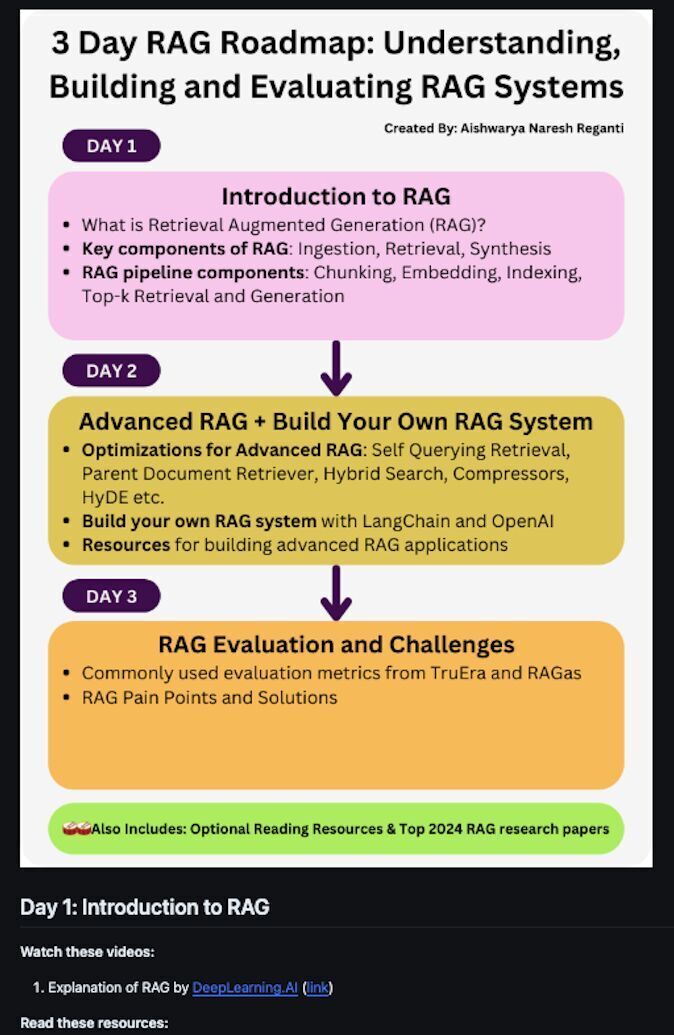
🔊 Create your own LLM RAG application in just 3 days using this hands-on roadmap crafted from the best free resources!
Curiosity: How can we build a production-ready RAG application quickly? What’s the fastest path from basics to advanced RAG implementation?
Build Your RAG Application in 3 Days: A Hands-On Roadmap
Curiosity: How can we build a production-ready RAG application quickly? What’s the fastest path from basics to advanced RAG implementation?
RAG (Retrieval Augmented Generation) has emerged as an extremely popular LLM application. Its appeal lies in its lightweight design and the simplicity of integrating it with any foundational LLM.
📖 Complete Roadmap: https://github.com/aishwaryanr/awesome-generative-ai-guide/blob/main/resources/RAG_roadmap.md
3-Day Learning Path
gantt
    title RAG Learning Roadmap (3 Days)
    dateFormat YYYY-MM-DD
    section Day 1
    RAG Basics           :a1, 2024-01-01, 1d
    Components           :a2, after a1, 1d
    section Day 2
    Advanced RAG         :b1, 2024-01-02, 1d
    Build Application    :b2, after b1, 1d
    section Day 3
    Evaluation           :c1, 2024-01-03, 1d
    Challenges           :c2, after c1, 1d
Time Commitment: 2-3 hours per day
Day 1: Introduction to RAG
Retrieve: Understand RAG fundamentals and core components.
Learning Objectives:
- ✅ What is Retrieval Augmented Generation?
- ✅ Key components: Ingestion, Retrieval, Synthesis
- ✅ Pipeline components: Chunking, Embedding, Indexing, Top-k Retrieval, Generation
Topics Covered:
| Topic | Description | Key Concepts |
|---|---|---|
| RAG Basics | What is RAG? | Retrieval + Generation |
| Ingestion | Data preparation | Document loading, preprocessing |
| Retrieval | Information retrieval | Vector search, similarity |
| Synthesis | Answer generation | LLM integration, context |
RAG Pipeline:
graph LR
    A[Documents] --> B[Chunking]
    B --> C[Embedding]
    C --> D[Indexing]
    D --> E[Vector DB]

    F[Query] --> G[Embedding]
    G --> H[Top-k Retrieval]
    E --> H
    H --> I[Synthesis]
    I --> J[Answer]

    style A fill:#e1f5ff
    style E fill:#fff3cd
    style I fill:#d4edda
    style J fill:#f8d7da
Key Components:
- Chunking: Split documents into manageable pieces
- Embedding: Convert text to vectors
- Indexing: Store in vector database
- Top-k Retrieval: Find most relevant chunks
- Generation: Create answer from context
Day 2: Advanced RAG + Build Your Own System
Innovate: Learn advanced techniques and build a complete RAG application.
Learning Objectives:
- ✅ Advanced RAG optimizations
- ✅ Build RAG system with LangChain and OpenAI
- ✅ Implement advanced retrieval techniques
Advanced Techniques:
| Technique | Description | Benefit |
|---|---|---|
| Self-Querying Retrieval | LLM-generated queries | ⬆️ Better retrieval |
| Parent Document Retriever | Hierarchical retrieval | ⬆️ Context preservation |
| Hybrid Search | Semantic + keyword | ⬆️ Retrieval quality |
| Compressors | Context compression | ⬇️ Token usage |
| HyDE | Hypothetical documents | ⬆️ Query understanding |
Building RAG System:
1
2
3
4
5
6
7
8
9
10
11
12
13
14
15
16
17
18
19
20
21
22
23
24
25
# Example: Building RAG with LangChain
from langchain.vectorstores import Chroma
from langchain.embeddings import OpenAIEmbeddings
from langchain.chains import RetrievalQA
from langchain.llms import OpenAI

# 1. Load and chunk documents
from langchain.text_splitter import RecursiveCharacterTextSplitter
text_splitter = RecursiveCharacterTextSplitter(chunk_size=1000, chunk_overlap=200)
documents = text_splitter.split_documents(load_documents())

# 2. Create embeddings and vector store
embeddings = OpenAIEmbeddings()
vectorstore = Chroma.from_documents(documents, embeddings)

# 3. Create retrieval chain
qa_chain = RetrievalQA.from_chain_type(
    llm=OpenAI(),
    chain_type="stuff",
    retriever=vectorstore.as_retriever(search_kwargs={"k": 3})
)

# 4. Query
result = qa_chain.run("What is RAG?")
print(result)
Advanced RAG Architecture:
graph TB
    A[Query] --> B[Query Rewriting]
    B --> C[Hybrid Search]
    C --> D[Semantic Search]
    C --> E[Keyword Search]
    D --> F[Retrieval]
    E --> F
    F --> G[Re-ranking]
    G --> H[Context Compression]
    H --> I[LLM Generation]
    I --> J[Answer]

    style A fill:#e1f5ff
    style C fill:#fff3cd
    style I fill:#d4edda
    style J fill:#f8d7da
Day 3: RAG Evaluation and Challenges
Retrieve: Learn how to evaluate RAG systems and address common challenges.
Learning Objectives:
- ✅ Evaluation metrics (TruEra, RAGas)
- ✅ RAG pain points and solutions
- ✅ Production best practices
Evaluation Metrics:
| Metric | Framework | Purpose |
|---|---|---|
| Faithfulness | RAGas | Factual accuracy |
| Answer Relevancy | RAGas | Answer quality |
| Context Precision | RAGas | Retrieval quality |
| Context Recall | RAGas | Coverage |
| TruEra Metrics | TruEra | Comprehensive evaluation |
Evaluation Example:
1
2
3
4
5
6
7
8
9
10
11
12
13
14
15
16
17
from ragas import evaluate
from datasets import Dataset

# Prepare evaluation dataset
dataset = Dataset.from_dict({
    "question": ["What is RAG?"],
    "contexts": [["RAG is retrieval augmented generation..."]],
    "answer": ["RAG combines retrieval and generation..."],
    "ground_truth": ["RAG is a technique that..."]
})

# Evaluate
results = evaluate(
    dataset=dataset,
    metrics=["faithfulness", "answer_relevancy", "context_precision"]
)
print(results)
Common RAG Challenges:
| Challenge | Description | Solution |
|---|---|---|
| Poor Retrieval | Irrelevant context | Better embeddings, hybrid search |
| Context Window | Limited tokens | Compression, summarization |
| Hallucination | Incorrect facts | Better retrieval, fact-checking |
| Latency | Slow responses | Caching, optimization |
| Scalability | Large datasets | Efficient indexing, sharding |
Complete Roadmap Structure
graph TB
    A[3-Day RAG Roadmap] --> B[Day 1: Basics]
    A --> C[Day 2: Advanced + Build]
    A --> D[Day 3: Evaluation]

    B --> B1[RAG Introduction]
    B --> B2[Components]
    B --> B3[Pipeline]

    C --> C1[Advanced Techniques]
    C --> C2[Build System]
    C --> C3[LangChain + OpenAI]

    D --> D1[Evaluation Metrics]
    D --> D2[Challenges]
    D --> D3[Solutions]

    E[Optional Resources] --> A
    F[Research Papers] --> A

    style A fill:#e1f5ff
    style B fill:#fff3cd
    style C fill:#d4edda
    style D fill:#f8d7da
Additional Resources
Optional Reading:
- RAG research papers
- Advanced techniques
- Best practices
- Case studies
2024 RAG Research Papers:
- Latest RAG improvements
- Novel architectures
- Evaluation methods
- Production deployments
Key Takeaways
Retrieve: This 3-day roadmap provides a structured path from RAG basics to building and evaluating production-ready applications.
Innovate: By following this roadmap, you’ll learn advanced RAG techniques, build your own system, and understand how to evaluate and optimize RAG applications.
Curiosity → Retrieve → Innovation: Start with curiosity about RAG, retrieve knowledge through the structured roadmap, and innovate by building your own RAG applications.
Next Steps:
- Follow the 3-day roadmap
- Build your RAG system
- Evaluate and optimize
- Deploy to production
Translate to Korean
RAG(Retrieval Augmented Generation)는 LLM 분야에서 매우 인기 있는 애플리케이션으로 부상했습니다.
이 게임의 매력은 경량 설계와 기본 LLM과 통합할 수 없다는 점에 있습니다.
💡 이 3일 가이드를 사용하여 RAG의 진화하는 환경과 최신 개발에 대해 알아보세요! 매일 2-3 시간을 자원에 투자하십시오.
🥁 기본 사항부터 시작하여 고급 아이디어로 이동하고, LangChain을 사용하여 앱을 빌드하고, 평가하는 방법을 배웁니다. 또한 이 분야의 최신 연구를 따라잡을 수 있는 리소스도 추가했습니다.
⛳ 1일차: RAG 소개
- 👉 검색 증강 생성이란 무엇입니까?
- 👉 RAG의 핵심 구성 요소: Ingestion, Retrieval, Synthesis
- 👉 RAG 파이프라인 구성 요소: 청크, 임베딩, 인덱싱, Top-k 검색 및 생성
⛳ 2일차: 고급 RAG + 나만의 RAG 시스템 구축하기
- 👉 고급 RAG 최적화: Self Querying Retrieval, Parent Document 👉 Retriever, Hybrid Search, Compressors, HyDE 등
- 👉 LangChain 및 OpenAI로 자체 RAG 시스템 구축 고급 RAG 응용 프로그램 구축을 위한 리소스
⛳3일차: RAG 평가 및 과제
- 👉TruEra 및 RAGas에서 일반적으로 사용되는 평가 지표
- 👉RAG의 문제점 및 해결 방법
🥁🥁로드맵에는 다음 내용도 포함되어 있습니다: Optional Reading Resources & Top 2024 RAG research papers