Development Tools/Productivity
How do computer programs run
Curiosity: What happens when we click “Run” on a program? How does the operating system transform code into executing instructions?
How Do Computer Programs Run? Understanding Program Execution
Curiosity: What happens when we click “Run” on a program? How does the operating system transform code into executing instructions?
Program execution is a complex process involving multiple layers of the operating system, from user interaction to CPU execution. Understanding this process reveals how modern computing systems work.
Program Execution Flow
graph TB
    A[User Interaction] --> B[Program Preloading]
    B --> C[Dependency Resolution]
    C --> D[Memory Allocation]
    D --> E[Runtime Initialization]
    E --> F[System Calls]
    F --> G[CPU Execution]
    G --> H[Program Termination]

    I[File System] --> B
    J[Shared Libraries] --> C
    K[Memory Manager] --> D
    L[JVM/.NET Runtime] --> E
    M[Von Neumann Architecture] --> G

    style A fill:#e1f5ff
    style B fill:#fff3cd
    style D fill:#d4edda
    style G fill:#f8d7da
    style H fill:#e7d4f8
Execution Stages
| Stage | Description | Key Components | Duration |
|---|---|---|---|
| 1. User Interaction | User initiates program | GUI, CLI | Instant |
| 2. Program Preloading | OS loads executable | File system, loader | Milliseconds |
| 3. Dependency Resolution | Load shared libraries | DLL, shared objects | Milliseconds |
| 4. Memory Allocation | Allocate memory space | Memory manager | Microseconds |
| 5. Runtime Initialization | Initialize runtime | JVM, .NET, interpreters | Milliseconds |
| 6. System Calls | Call main() function | System calls, API | Variable |
| 7. CPU Execution | Execute instructions | CPU, registers | Variable |
| 8. Program Termination | Cleanup and exit | Resource manager | Milliseconds |
1. User Interaction and Command Initiation
Retrieve: User interaction triggers the execution request through the operating system.
Methods:
- 🖱️ Double-clicking (GUI)
- ⌨️ Command line execution
- 🔗 Programmatic invocation
Example:
1
2
3
4
# User double-clicks program.py
# Operating system receives execution request
# OS identifies Python interpreter
# Process begins
2. Program Preloading
Retrieve: The operating system locates and loads the executable file into memory.
Process:
- Locate executable file in file system
- Verify file permissions
- Load file into memory
- Prepare for execution
Memory Layout:
graph LR
    A[Executable File] --> B[File System]
    B --> C[Memory Loader]
    C --> D[Memory]

    D --> D1[Code Segment]
    D --> D2[Data Segment]
    D --> D3[Stack]
    D --> D4[Heap]

    style A fill:#e1f5ff
    style C fill:#fff3cd
    style D fill:#d4edda
3. Dependency Resolution and Loading
Innovate: Modern applications require shared libraries loaded dynamically.
Dependencies:
- DLLs (Windows): Dynamic Link Libraries
- Shared Objects (Linux):
.sofiles - Frameworks (macOS):
.frameworkbundles
Example:
1
2
3
4
5
6
7
8
9
10
11
12
# Python example - dependency loading
import sys
import os

# System loads required libraries
# - Python interpreter
# - Standard library modules
# - Third-party packages
# - System libraries (libc, etc.)

print(f"Python version: {sys.version}")
print(f"Platform: {sys.platform}")
4. Allocating Memory Space
Retrieve: The operating system allocates memory regions for program execution.
Memory Regions:
| Region | Purpose | Characteristics |
|---|---|---|
| Code Segment | Executable instructions | Read-only, shared |
| Data Segment | Global/static variables | Read-write |
| Stack | Function calls, local variables | LIFO, fast |
| Heap | Dynamic memory allocation | Flexible, slower |
Memory Allocation:
1
2
3
4
5
6
7
8
9
10
11
# Example: Memory allocation in Python
import sys

# Stack allocation (automatic)
def function():
    local_var = 42  # Stack
    return local_var

# Heap allocation (dynamic)
dynamic_list = [1, 2, 3]  # Heap
print(f"Memory size: {sys.getsizeof(dynamic_list)} bytes")
5. Initializing the Runtime Environment
Retrieve: Runtime environments initialize resources needed for program execution.
Runtime Examples:
- JVM (Java): Java Virtual Machine
- .NET Runtime: Common Language Runtime
- Python Interpreter: CPython, PyPy
- Node.js: V8 engine
Initialization Steps:
graph TB
    A[Runtime Startup] --> B[Load Runtime Libraries]
    B --> C[Initialize Garbage Collector]
    C --> D[Set Up Thread Pool]
    D --> E[Initialize I/O Systems]
    E --> F[Ready for Execution]

    style A fill:#e1f5ff
    style F fill:#d4edda
6. System Calls and Resource Management
Innovate: The program entry point (main) begins execution, making system calls as needed.
System Calls:
- File operations
- Network communication
- Process management
- Memory management
Example:
1
2
3
4
5
6
7
8
9
10
# Program entry point
def main():
    # System calls happen here
    file = open("data.txt", "r")  # System call: open()
    data = file.read()            # System call: read()
    file.close()                  # System call: close()
    print(data)                   # System call: write()

if __name__ == "__main__":
    main()  # Entry point called
7. Von Neumann Architecture
Retrieve: The CPU executes instructions stored in memory following the Von Neumann architecture.
Architecture Components:
graph LR
    A[CPU] --> B[Control Unit]
    A --> C[ALU]
    A --> D[Registers]

    E[Memory] --> F[Instructions]
    E --> G[Data]

    B --> H[Fetch]
    H --> I[Decode]
    I --> J[Execute]
    J --> K[Write Back]

    style A fill:#e1f5ff
    style E fill:#fff3cd
    style H fill:#d4edda
Execution Cycle:
- Fetch: Get instruction from memory
- Decode: Understand instruction
- Execute: Perform operation
- Write Back: Store results
8. Program Termination
Retrieve: Cleanup phase releases resources and returns control to the operating system.
Cleanup Tasks:
- Close file descriptors
- Free network resources
- Release memory
- Clean up temporary files
- Return exit code
Example:
1
2
3
4
5
6
7
8
9
10
11
12
import atexit

def cleanup():
    print("Cleaning up resources...")
    # Close files, connections, etc.

atexit.register(cleanup)

# Program execution
print("Program running...")

# When program ends, cleanup() is called automatically
Complete Execution Timeline
gantt
    title Program Execution Timeline
    dateFormat X
    axisFormat %L ms

    section User
    Click/Command           :0, 1
    section OS
    Load Executable        :1, 5
    Resolve Dependencies   :6, 10
    Allocate Memory        :11, 2
    section Runtime
    Initialize Runtime     :13, 5
    section Program
    Execute Main           :18, 100
    section Cleanup
    Terminate              :118, 2
Key Takeaways
Retrieve: Program execution involves eight key stages: user interaction, preloading, dependency resolution, memory allocation, runtime initialization, system calls, CPU execution, and termination.
Innovate: Understanding program execution helps optimize performance, debug issues, and design efficient applications by knowing how the operating system manages resources.
Curiosity → Retrieve → Innovation: Start with curiosity about how programs run, retrieve knowledge about execution stages, and innovate by optimizing each stage for better performance.
Next Steps:
- Study operating system internals
- Learn about memory management
- Understand system calls
- Optimize program startup time
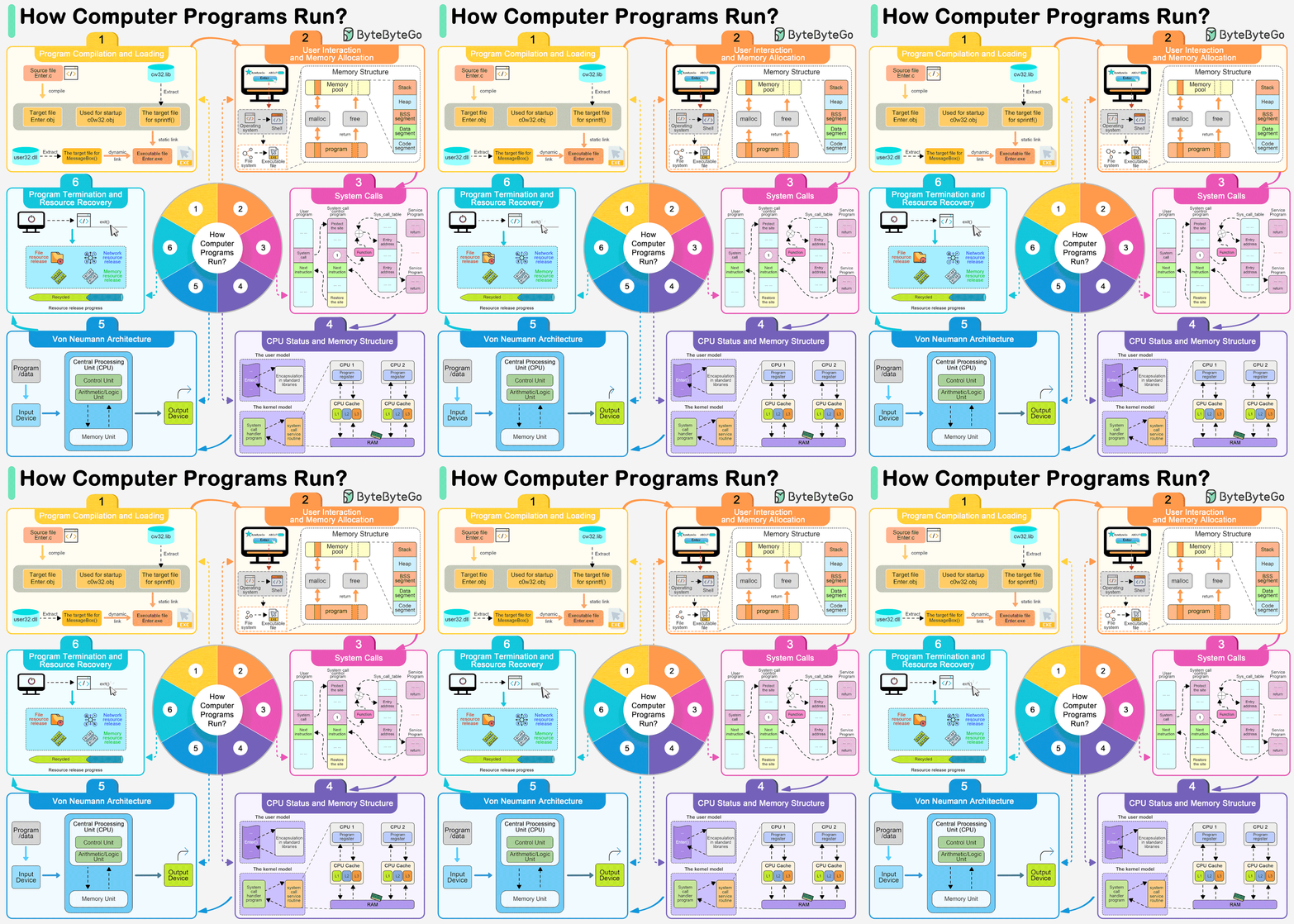
Translate to Korean
컴퓨터 프로그램은 어떻게 실행될까요?
다이어그램은 단계를 보여줍니다.
🔹 사용자 상호 작용 및 명령 시작
프로그램을 두 번 클릭하면 사용자가 그래픽 사용자 인터페이스를 통해 응용 프로그램을 시작하도록 운영 체제에 지시할 수 있습니다.
🔹 프로그램 사전 로딩
실행 요청이 시작되면 운영 체제는 먼저 프로그램의 실행 파일을 검색합니다.
운영 체제는 파일 시스템을 통해 이 파일을 찾아 실행을 준비하기 위해 메모리에 로드합니다.
🔹 종속성 해결 및 로드Dependency resolution and loading
대부분의 최신 응용 프로그램은 DLL(동적 연결 라이브러리)과 같은 여러 공유 라이브러리에 의존합니다.
🔹 메모리 공간 할당
운영 체제는 메모리 공간 할당을 담당합니다.
🔹 런타임 환경 초기화
메모리를 할당한 후 운영 체제 및 실행 환경(예: Java의 JVM 또는 .NET Framework)은 프로그램을 실행하는 데 필요한 다양한 리소스를 초기화합니다.
🔹 시스템 호출 및 리소스 관리
프로그램의 진입점(일반적으로 ‘main’이라는 함수)은 프로그래머가 작성한 코드의 실행을 시작하기 위해 호출됩니다.
🔹 폰 노이만 아키텍처
Von Neumann 아키텍처에서 CPU는 메모리에 저장된 명령을 실행합니다.
🔹 프로그램 종료
결국 프로그램이 작업을 완료하거나 사용자가 응용 프로그램을 적극적으로 종료하면 프로그램은 정리 단계를 시작합니다. 여기에는 열려 있는 파일 디스크립터를 닫고, 네트워크 리소스를 확보하고, 메모리를 시스템에 반환하는 것이 포함됩니다.