Infrastructure/System
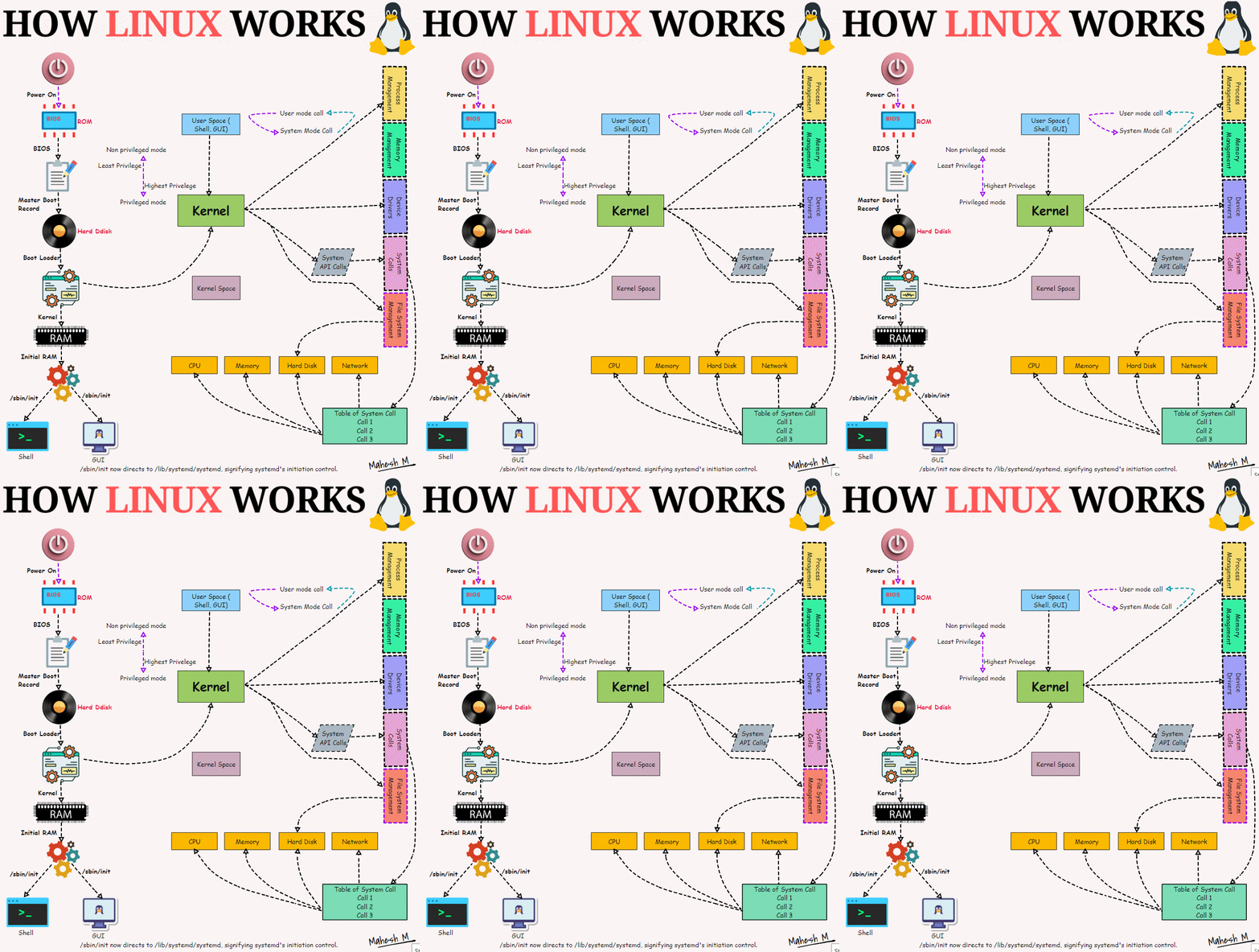
Watch the concept🔥🤔, how Linux🐧 works
Curiosity: How does Linux boot and operate? What are the key components and processes that make Linux work?
How Linux Works: A Comprehensive Guide
Curiosity: How does Linux boot and operate? What are the key components and processes that make Linux work?
Linux is a powerful, open-source operating system that manages hardware resources and provides a platform for applications. This guide breaks down the key components and processes involved in how Linux works.
Linux Boot Process Overview
graph TB
    A[Power On] --> B[BIOS/POST]
    B --> C[Boot Loader]
    C --> D[MBR]
    D --> E[Linux Kernel]
    E --> F[Init Process]
    F --> G[User Space]

    G --> H[Applications]
    G --> I[Shell/GUI]

    style A fill:#e1f5ff
    style E fill:#fff3cd
    style G fill:#d4edda
Linux System Architecture
graph TB
    A[User Space] --> B[System Calls]
    B --> C[Kernel Space]

    C --> D[Process Management]
    C --> E[Memory Management]
    C --> F[File System]
    C --> G[Device Drivers]

    D --> H[CPU Scheduling]
    E --> I[Virtual Memory]
    F --> J[File Operations]
    G --> K[Hardware]

    style A fill:#e1f5ff
    style C fill:#fff3cd
    style K fill:#d4edda
Linux Boot Process Components
| Component | Function | Description |
|---|---|---|
| Power On | System initialization | Computer is powered on |
| BIOS/ROM | Hardware check | Performs POST, loads bootloader |
| Boot Loader | Kernel loading | Loads Linux kernel from disk |
| MBR | Boot information | Contains bootloader and partition table |
| Kernel | Core OS | Manages hardware and system resources |
| Init Process | Process management | First process (PID 1) |
| User Space | Application layer | Where applications run |
1. Power On ⚡
Retrieve: The boot process begins when the computer is powered on.
- System initialization starts
- Hardware components are activated
- Power-On Self Test (POST) begins
2. BIOS (Basic Input/Output System) & ROM 💻
Retrieve: BIOS performs initial hardware checks and loads the bootloader.
Function:
- Firmware Program: Stored in ROM chip
- POST: Checks basic hardware functionality
- Bootloader Loading: Loads the bootloader from storage
Process:
graph LR
    A[BIOS] --> B[POST]
    B --> C{Hardware OK?}
    C -->|Yes| D[Load Bootloader]
    C -->|No| E[Error Message]

    style A fill:#e1f5ff
    style D fill:#d4edda
3. Boot Loader 🔄
Retrieve: The bootloader loads the Linux kernel into memory.
Function:
- Small program that loads the Linux kernel
- Reads kernel from hard disk
- Transfers control to the kernel
Common Bootloaders:
- GRUB (Grand Unified Bootloader)
- LILO (Linux Loader)
- systemd-boot
4. Master Boot Record (MBR) 💾
Retrieve: MBR contains boot information and partition table.
Function:
- First sector of the hard disk
- Contains bootloader code
- Includes partition table
- Points to active partition
5. Kernel 🧠
Innovate: The kernel is the core of Linux, managing all system resources.
Key Responsibilities:
| Responsibility | Function | Impact |
|---|---|---|
| Hardware Management | Manages CPU, memory, devices | System operation |
| Security | Enforces permissions, isolation | System protection |
| Resource Allocation | CPU scheduling, memory allocation | Performance |
| System Calls | Interface for applications | Application support |
Kernel Components:
graph TB
    A[Linux Kernel] --> B[Process Management]
    A --> C[Memory Management]
    A --> D[File System]
    A --> E[Device Drivers]
    A --> F[Network Stack]

    B --> B1[CPU Scheduling]
    B --> B2[Process Creation]

    C --> C1[Virtual Memory]
    C --> C2[Page Management]

    style A fill:#e1f5ff
    style B fill:#fff3cd
    style C fill:#d4edda
6. User Space (Applications) 💼
Retrieve: User space is where applications run, isolated from the kernel.
Characteristics:
- Isolated from kernel for security
- Runs user applications
- Examples: web browsers, word processors, games
- Protected by kernel security mechanisms
User Space vs Kernel Space:
| Aspect | User Space | Kernel Space |
|---|---|---|
| Access | Limited | Full system access |
| Isolation | Process isolation | Direct hardware access |
| Security | User permissions | Root privileges |
| Examples | Applications | Device drivers, kernel modules |
7. System Calls 📞
Retrieve: System calls provide the interface between user space and kernel.
Function:
- Applications request kernel services
- Examples: file operations, process creation, network communication
- Bridge between user and kernel space
Common System Calls:
| System Call | Function | Example |
|---|---|---|
| open() | Open file | File access |
| read() | Read data | File reading |
| write() | Write data | File writing |
| fork() | Create process | Process creation |
| exec() | Execute program | Program execution |
System Call Flow:
graph LR
    A[Application] --> B[System Call]
    B --> C[Kernel]
    C --> D[Hardware]
    D --> C
    C --> B
    B --> A

    style A fill:#e1f5ff
    style C fill:#fff3cd
    style D fill:#d4edda
8. Process Management 🔄
Innovate: The kernel manages all running processes efficiently.
Functions:
- Process Creation: fork(), exec()
- Resource Allocation: CPU time, memory
- Scheduling: Determines which process runs
- Termination: Cleanup when processes end
Process States:
| State | Description |
|---|---|
| Running | Currently executing |
| Ready | Waiting for CPU |
| Blocked | Waiting for I/O |
| Zombie | Terminated, waiting for parent |
9. Memory Management 🧠
Retrieve: The kernel manages system memory efficiently.
Functions:
- Allocation: Allocates memory to processes
- Virtual Memory: Maps virtual to physical addresses
- Page Management: Handles memory pages
- Swapping: Moves data to disk when needed
Memory Management Concepts:
graph LR
    A[Virtual Memory] --> B[Page Table]
    B --> C[Physical Memory]
    C --> D[RAM]
    C --> E[Swap Space]

    style A fill:#e1f5ff
    style C fill:#fff3cd
    style D fill:#d4edda
10. Device Drivers 🖥️
Retrieve: Device drivers enable kernel communication with hardware.
Function:
- Software programs for hardware communication
- Translate kernel requests to hardware commands
- Handle hardware-specific operations
Driver Types:
- Character devices (keyboard, mouse)
- Block devices (hard drives, SSDs)
- Network devices (Ethernet, Wi-Fi)
11. File System Management 🗄️
Retrieve: The kernel manages file organization and storage.
Functions:
- Organizes files on storage devices
- Handles file operations (create, read, write, delete)
- Manages directories and permissions
- Provides file system abstraction
Common File Systems:
- ext4 (Extended File System 4)
- XFS (High-performance file system)
- Btrfs (Copy-on-write file system)
- ZFS (Advanced file system)
12. Shell (or GUI)
Retrieve: Shell and GUI provide user interfaces to interact with Linux.
Shell (Command-Line Interface):
- Text-based interface
- Users type commands
- Examples: bash, zsh, fish
- Powerful for automation
GUI (Graphical User Interface):
- Visual interface with icons and windows
- User-friendly interaction
- Examples: GNOME, KDE, XFCE
- Easier for beginners
Shell vs GUI:
| Aspect | Shell | GUI |
|---|---|---|
| Interface | Text commands | Visual elements |
| Efficiency | Fast for experts | Easy for beginners |
| Automation | Excellent | Limited |
| Resource Usage | Low | Higher |
Key Takeaways
Retrieve: Linux boot process involves BIOS, bootloader, kernel loading, and initialization. The kernel manages hardware, processes, memory, and provides system calls for applications.
Innovate: Understanding Linux architecture helps in system administration, troubleshooting, and optimizing performance. The separation between kernel and user space provides security and stability.
Curiosity → Retrieve → Innovation: Start with curiosity about how operating systems work, retrieve knowledge of Linux components and processes, and innovate by applying this understanding to system administration and development.