Data Science/Algorithms
How to prepare for a Google interview?
A structured guide to preparing for Google technical interviews, covering coding rounds, system design, behavioral questions, and study strategies.
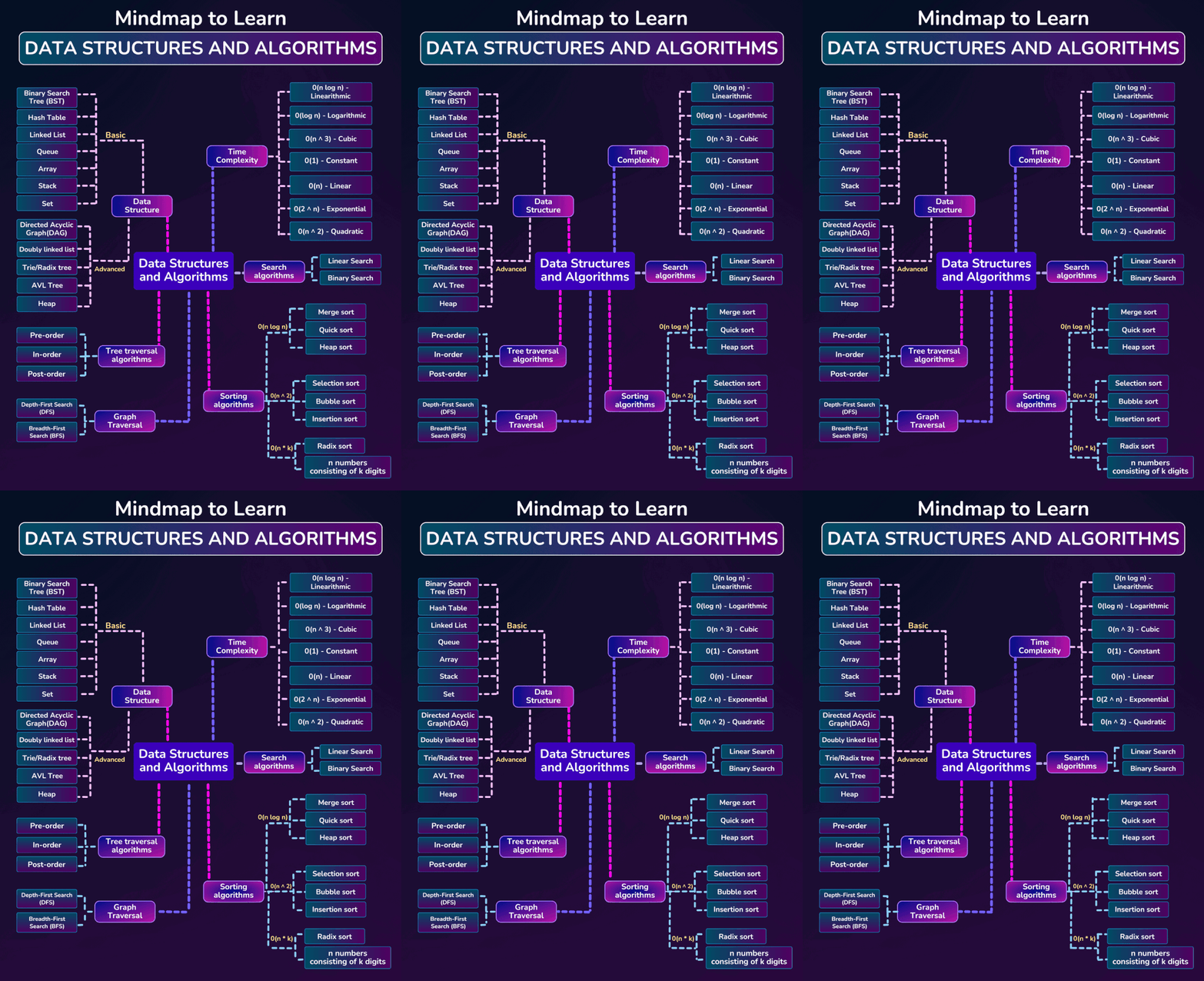
How to Prepare for a Google Interview: A Systematic Approach
Curiosity: How can we systematically prepare for technical interviews at top tech companies? What knowledge should we retrieve to maximize our chances of success?
Preparing for a Google interview requires a structured approach that combines fundamental knowledge, problem-solving skills, and consistent practice. This guide will help you retrieve the essential concepts and innovate your preparation strategy.
Interview Structure Overview
graph TB
    A[Google Interview Process] --> B[Coding Rounds<br/>3-5 rounds]
    A --> C[Googleyness Round<br/>1 round]

    B --> B1[Leetcode Easy/Medium]
    B --> B2[Leetcode Hard<br/>At least 1 round]
    B --> B3[System Design<br/>For senior roles]

    C --> C1[Culture Fit]
    C --> C2[Behavioral Questions]
    C --> C3[Problem-Solving Approach]

    style A fill:#e1f5ff
    style B fill:#fff3cd
    style C fill:#d4edda
Interview Requirements
| Role Level | Coding Rounds | Problem Difficulty | Time per Round |
|---|---|---|---|
| Internship | 3-4 rounds | Medium to Hard | 45 minutes |
| Entry Level (L3) | 3-5 rounds | At least 1 Hard | 45 minutes |
| Mid Level (L4) | 4-5 rounds | Hard + System Design | 45-60 minutes |
| Senior (L5+) | 5+ rounds | Hard + Architecture | 60 minutes |
Key Insight: For internships and entry-level roles (L3), Google typically conducts 3-5 coding rounds followed by 1 round focused on Googleyness. To ace a Google coding round, you need to be prepared to solve a Leetcode hard problem with working code in 45 minutes.
Preparation Roadmap
Phase 1: Foundation - Data Structures
Master these fundamental data structures first:
| Data Structure | Key Concepts | Practice Resources | Link |
|---|---|---|---|
| Stack | LIFO, push/pop, applications | GeeksforGeeks | Link |
| Heap | Min/Max heap, priority queue | GeeksforGeeks | Link |
| Queue | FIFO, enqueue/dequeue, BFS | GeeksforGeeks | Link |
| Graphs | Adjacency list/matrix, traversal | GeeksforGeeks | Link |
Sample Implementation:
1
2
3
4
5
6
7
8
9
10
11
12
13
14
15
16
17
18
19
20
21
22
23
24
25
26
# Stack implementation
class Stack:
    def __init__(self):
        self.items = []

    def push(self, item):
        self.items.append(item)

    def pop(self):
        if not self.is_empty():
            return self.items.pop()
        return None

    def is_empty(self):
        return len(self.items) == 0

    def peek(self):
        if not self.is_empty():
            return self.items[-1]
        return None

# Usage example
stack = Stack()
stack.push(1)
stack.push(2)
print(stack.pop())  # Output: 2
Phase 2: Core Algorithms
Build proficiency in these essential algorithms:
| Algorithm | Time Complexity | Use Cases | Practice Resources |
|---|---|---|---|
| Sorting | O(n log n) average | Array manipulation | Link |
| BFS | O(V + E) | Level-order traversal, shortest path | Link |
| DFS | O(V + E) | Tree/graph traversal, backtracking | Link |
BFS Implementation:
1
2
3
4
5
6
7
8
9
10
11
12
13
14
15
16
17
18
19
20
21
22
23
24
25
26
27
28
29
30
from collections import deque

def bfs(graph, start):
    """Breadth-First Search implementation"""
    visited = set()
    queue = deque([start])
    visited.add(start)
    result = []

    while queue:
        node = queue.popleft()
        result.append(node)

        for neighbor in graph.get(node, []):
            if neighbor not in visited:
                visited.add(neighbor)
                queue.append(neighbor)

    return result

# Example usage
graph = {
    'A': ['B', 'C'],
    'B': ['D', 'E'],
    'C': ['F'],
    'D': [],
    'E': [],
    'F': []
}
print(bfs(graph, 'A'))  # Output: ['A', 'B', 'C', 'D', 'E', 'F']
Phase 3: Language Proficiency
Choose your language and master it:
- C++ 17: Excellent for STL (Standard Template Library)
- Optimized implementations for arrays, sorting, stacks, heaps, queues
- Strong performance for competitive programming
- Python: Great for rapid prototyping
- Clean syntax, extensive libraries
- Good for system design discussions
- Java: Enterprise-friendly
- Strong typing, good for large codebases
- Extensive standard library
Key Practice: Write as much code as possible. Translating thoughts into code should become second nature.
Phase 4: Advanced Data Structures
Move to more complex structures:
| Structure | Key Properties | Practice Resources |
|---|---|---|
| Trees | Hierarchical, recursive properties | Link |
| Deque | Double-ended queue | Link |
| Sets | Unique elements, O(1) lookup | Link |
| Maps | Key-value pairs, hash tables | Link |
Phase 5: Problem-Solving Techniques
Master these essential patterns:
| Technique | Description | Practice Resources |
|---|---|---|
| Sliding Window | Fixed/variable window size | Link |
| Binary Search on Answer | Search in solution space | Link |
| Matrix Traversal | 2D array problems | Link |
| Topological Sort | DAG ordering | Link |
Sliding Window Example:
1
2
3
4
5
6
7
8
9
10
11
12
13
14
15
16
17
18
19
20
def max_sum_subarray(arr, k):
    """Find maximum sum of subarray of size k"""
    if len(arr) < k:
        return 0

    # Calculate sum of first window
    window_sum = sum(arr[:k])
    max_sum = window_sum

    # Slide the window
    for i in range(k, len(arr)):
        window_sum = window_sum - arr[i - k] + arr[i]
        max_sum = max(max_sum, window_sum)

    return max_sum

# Example
arr = [1, 4, 2, 10, 2, 3, 1, 0, 20]
k = 4
print(max_sum_subarray(arr, k))  # Output: 24
Phase 6: Dynamic Programming
Dynamic Programming deserves a dedicated study plan:
graph LR
    A[DP Problems] --> B[1D DP]
    A --> C[2D DP]
    A --> D[String DP]
    A --> E[Tree DP]

    B --> B1[Fibonacci]
    B --> B2[Climbing Stairs]

    C --> C1[Grid Problems]
    C --> C2[LCS]

    D --> D1[Palindrome]
    D --> D2[Edit Distance]

    style A fill:#e1f5ff
    style B fill:#fff3cd
    style C fill:#d4edda
    style D fill:#f8d7da
    style E fill:#e7d4f8
DP Pattern Recognition:
- Optimal Substructure: Solution contains optimal solutions to subproblems
- Overlapping Subproblems: Same subproblems solved multiple times
- Memoization/Tabulation: Store results to avoid recomputation
Study Schedule Recommendation
| Week | Focus | Daily Practice | Goal |
|---|---|---|---|
| 1-2 | Data Structures | 2-3 problems | Master basics |
| 3-4 | Algorithms | 3-4 problems | Understand patterns |
| 5-6 | Problem Techniques | 4-5 problems | Recognize patterns |
| 7-8 | Dynamic Programming | 3-4 problems | Master DP |
| 9-10 | Mock Interviews | 2-3 problems | Time management |
| 11-12 | Review & Hard Problems | 2-3 problems | Confidence building |
Key Takeaways
Retrieve: Google interviews require strong fundamentals in data structures, algorithms, and problem-solving techniques. Systematic preparation is essential.
Innovate: Create a personalized study plan based on your current level. Focus on weak areas while maintaining strength in fundamentals.
Curiosity → Retrieve → Innovation: Start with curiosity about interview success, retrieve knowledge from practice problems, and innovate your problem-solving approach through consistent practice.
Next Steps: Evaluate where you are in your preparation journey and use this guide to create your personalized roadmap. Follow for more tips on mastering Data Structures and Algorithms (DSA).