AI
GitNexus: Zero‑Server Code Intelligence for Agent‑Safe Refactors
A local‑first knowledge‑graph engine that gives AI agents architectural context—without shipping your code to a server.
🤔 Curiosity: The Question
Every time I let an agent touch a real codebase, I hit the same wall: agents miss call chains, break dependencies, and ship edits blind. The model isn’t the real bottleneck—the context is. I wanted a tool that can build architectural context locally and keep it trustworthy.
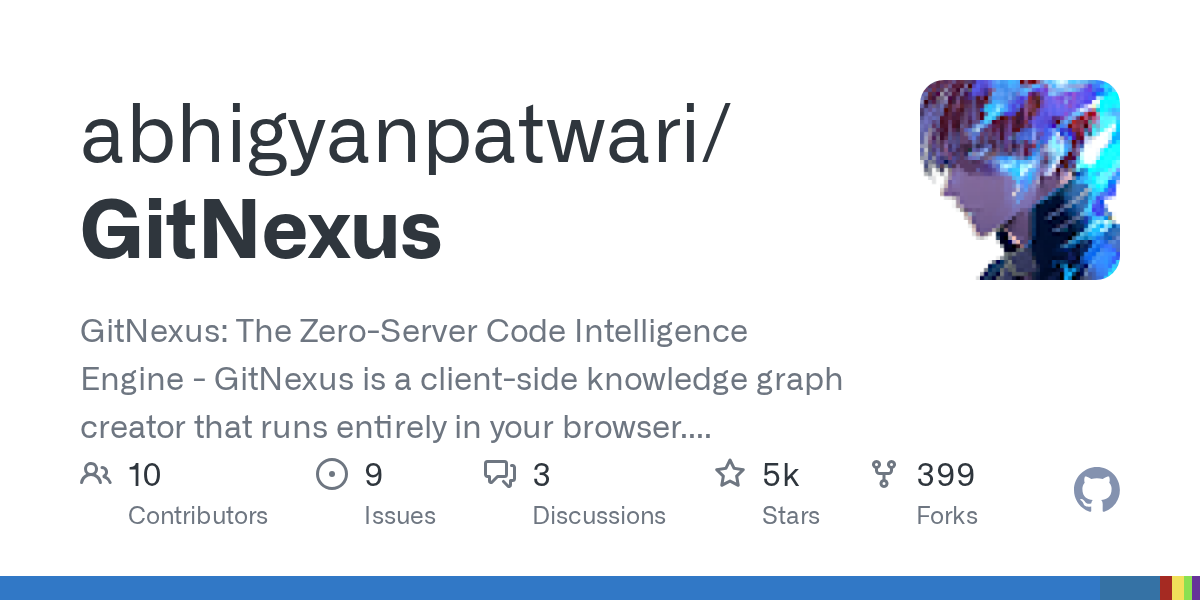
That’s why GitNexus stood out: a zero‑server, in‑browser knowledge‑graph engine for code intelligence—designed to make agents reliable without sending code anywhere.
📚 Retrieve: The Knowledge
What GitNexus is
From the repo:
- Indexes any codebase into a knowledge graph (dependencies, call chains, clusters, execution flow)
- Runs locally in your browser or CLI (no server required)
- Exposes context via MCP tools so agents can query architecture
TL;DR: it’s a deep, local graph layer that gives agents the missing context they need to edit safely.
Two Ways to Use It
| Mode | What it is | Best for |
|---|---|---|
| CLI + MCP | Local index + MCP server | Daily dev, reliable agent edits |
| Web UI | Browser graph explorer + chat | Quick repo exploration |
The bridge mode (gitnexus serve) connects CLI‑indexed repos to the web UI without re‑uploading.
MCP tools that matter
GitNexus exposes 7 tools (via MCP):
list_repos— discover indexed reposquery— hybrid search (BM25 + semantic)context— symbol‑level 360° viewimpact— blast‑radius analysisdetect_changes— diff → process impactrename— multi‑file coordinated renamecypher— raw graph queries
That tool surface is what turns a “chatty agent” into a safe refactorer.
Quick start (core flow)
1
2
3
4
5
6
7
8
# index your repo
npx gitnexus analyze

# setup MCP once
npx gitnexus setup

# run MCP server
npx gitnexus mcp
💡 Innovation: The Insight
Why this matters for AI × Games
Game codebases are full of hidden dependencies (content pipelines, runtime hooks, asset graphs). If an agent can’t see those, it can’t ship safely. GitNexus makes the “invisible graph” explicit—and that changes what kinds of automated edits are actually safe.
How I’d use it in production
1) Pre‑commit impact checks on gameplay systems
2) Automated refactor planning before large content migrations
3) Agentic code reviews with blast‑radius reports
New Questions This Raises
- Can a local graph become the source of truth for code review automation?
- What’s the minimal graph schema that still enables safe refactors?
- How do we benchmark agent safety with graph‑aware tooling?
References
- GitNexus repo: https://github.com/abhigyanpatwari/GitNexus
- GitNexus Web UI: https://gitnexus.vercel.app
- npm package: https://www.npmjs.com/package/gitnexus
- License: https://polyformproject.org/licenses/noncommercial/1.0.0/