AI
The New MCP Roadmap - Reading the Protocol's Five Bets on Agentic Infrastructure
MCP just published an updated roadmap: sessions are gone, transports are unifying on HTTP, and agent identity is now a first-class priority. Here’s what each of the five areas means if you’re shipping agent-powered tools.
🤔 Curiosity: What Does a Protocol Prioritize When Agents Stop Being Chatbots?
Every game studio I’ve worked at eventually learns the same lesson about infrastructure: the protocol you standardize on decides what you can build two years later. Pick a netcode model that assumes short sessions, and long-running co-op raids become a rewrite. Pick an asset pipeline that assumes humans click buttons, and automation becomes a hack.
That’s why I read protocol roadmaps the way other people read patch notes. The Model Context Protocol (MCP) team — David Soria Parra and Den Delimarsky, the lead maintainers — just published an updated roadmap covering the next specification release and beyond, developed together with the Core Maintainers and community Working Groups.
MCP has quietly become the seam layer for agent tooling — including the Unity CLI agents and telemetry pipelines I’ve been experimenting with on this blog. So the question I brought to this roadmap:
Which assumptions about “agents” is the protocol betting on — and do those bets match what production agentic workloads actually look like?
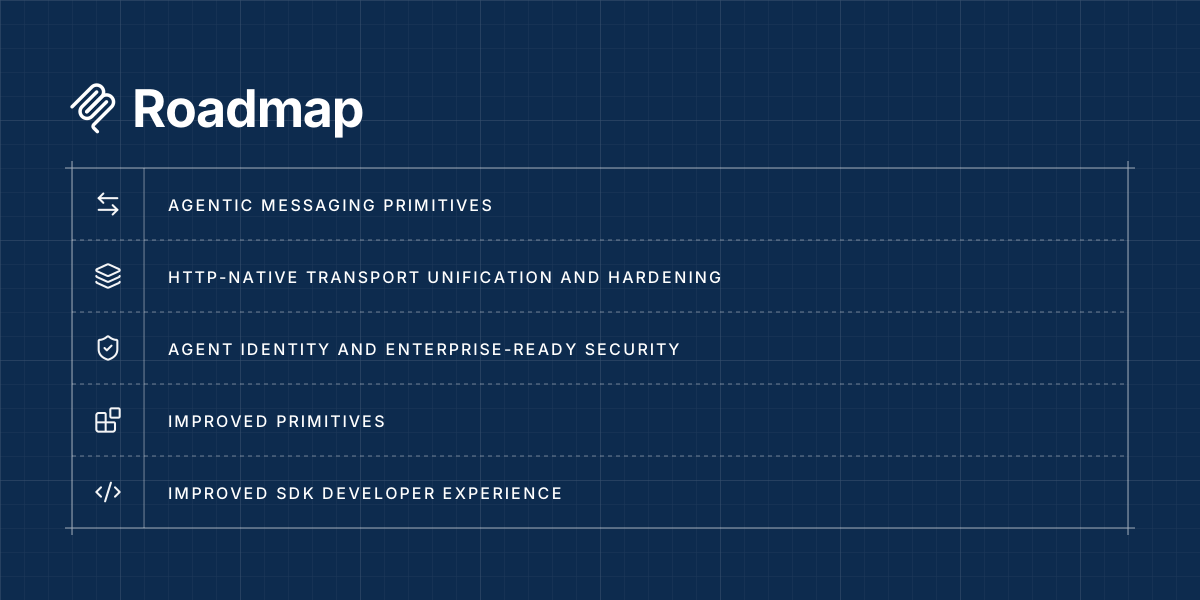
The five priority areas of the new MCP roadmap. Source: blog.modelcontextprotocol.io
📚 Retrieve: What Shipped, and What’s Next
Looking back: the 2026-07-28 release did surgery, not patches
The previous roadmap (March) named four priorities: transport evolution and scalability, agent communication, governance maturation, and enterprise readiness. Five months later, the bulk of the work landed in the 2026-07-28 specification release, and some of it is genuinely structural:
| Change | SEP | Why It Matters |
|---|---|---|
| Protocol-level sessions and init handshake removed | SEP-2575, SEP-2567 | Servers scale horizontally without holding state — MCP servers become boring, load-balanceable HTTP workloads |
server/discover endpoint | — | Clients learn supported versions/capabilities before connecting |
| Cacheable list results (TTL) | SEP-2549 | Stop re-fetching tool catalogs on every connection |
| Tasks moved to an official extension | SEP-2663 | Long-running work reworked from early-adopter feedback |
| Multi Round-Trip Requests (MRTR) | SEP-2322 | Replaces server-initiated requests, so elicitation works on stateless servers |
| Enterprise-Managed Authorization now stable | extension | Issuer validation, issuer-bound client credentials, CIMD as preferred client registration |
Governance matured too: a formal Contributor Ladder, Working Groups triaging SEPs in their own areas, and a proper feature lifecycle and deprecation policy. The Server Card Working Group is defining .well-known metadata so servers can be discovered and reasoned about without connecting to them.
Retrieve: Killing protocol sessions is the same architectural move game backends made a decade ago — push state out of the connection layer so any node can serve any request. MCP just crossed that line.
The five new priority areas
The new roadmap organizes work into five areas, each owned by named Core Maintainers and one or more Working Groups:
graph TB
    R[MCP Roadmap 2026H2] --> A[1. Agentic Messaging<br/>Primitives]
    R --> B[2. HTTP-Native Transport<br/>Unification & Hardening]
    R --> C[3. Agent Identity &<br/>Enterprise Security]
    R --> D[4. Improved Primitives]
    R --> E[5. SDK Developer<br/>Experience]

    A --> A1[Server-initiated events:<br/>webhooks & channels]
    A --> A2[Tasks extension → spec]
    B --> B1[Streamable HTTP<br/>over stdio]
    C --> C1[DPoP finalization]
    C --> C2[Workload Identity<br/>Federation + ID-JAG]
    D --> D1[One tool-result contract]
    D --> D2[Progressive discovery]
    E --> E1[Spec conformance testing]

    style A fill:#ff6b6b,stroke:#c92a2a,color:#fff
    style C fill:#4ecdc4,stroke:#0a9396,color:#fff
    style D fill:#ffe66d,stroke:#f4a261,color:#000
1. Agentic messaging primitives. Modern agentic workloads have outgrown the standard request-and-response pattern: loops run longer, servers stream results, and work needs steering mid-flight. MCP already grew Tasks, subscriptions/listen, and progress notifications — this area makes sure they compose. The concrete work: server-initiated events (webhooks and channels, so clients stop polling), a composition review across the Agents and Triggers & Events Working Groups, and maturing Tasks into the core spec.
2. HTTP-native transport unification and hardening. Since 2026-07-28, a remote MCP server is “no different from any other HTTP workload.” The plan now stretches that to local servers too — speaking Streamable HTTP over stdio — so there’s one transport story instead of two.
3. Agent identity and enterprise-ready security. This is the area I’d watch most closely. Today MCP authorization assumes a person approving access in a browser. But callers increasingly are agents running as cloud workloads with their own identity, acting for an absent user, or delegating narrower authority to sub-agents. The roadmap commits to: finalizing DPoP (RFC 9449) adoption, an opinionated path through Workload Identity Federation and the ID-JAG grant behind Enterprise-Managed Authorization, and deeper engagement with the IETF OAuth and WIMSE working groups — explicitly “built on existing standards rather than pasted API keys and long-lived tokens.”
4. Improved primitives. Two honest admissions here. First, a tools/call response can carry the same output in multiple forms, and servers can’t know which form a client will show the model — so they’re standardizing one clear contract. Second, scale: connecting to a server with a hundred tools means the model pays for that whole surface before the user asks anything, and tool selection degrades as the list grows. The answer is progressive discovery — a small entry point that reveals more of the catalog as the conversation narrows.
5. Improved SDK developer experience. Ergonomics, conformance testing, and documentation quality — with a telling justification: many developers now build MCP clients and servers by pointing an agent at the libraries, so clear APIs and accurate docs decide whether generated code works.
How proposals get prioritized
SEPs inside these five areas get expedited review. Proposals outside them aren’t auto-rejected, but scarce maintainer time goes to priority areas first. The recommended path: identify your area, raise it with the relevant Working Group, and reach the responsible maintainers on Discord. SEP-2133 even lets any WG/IG prototype in an experimental-ext- repository before filing a formal SEP.
💡 Innovation: What These Bets Mean If You Ship Agent Tooling
The pattern: MCP is converging on boring infrastructure
Read the five areas together and one theme emerges: every bet moves MCP toward existing, proven infrastructure — stateless HTTP, OAuth-family identity standards, webhooks. That’s the opposite of protocol NIH syndrome, and it’s exactly what made HTTP itself win.
| Roadmap Bet | Game/Production Analogy | What I’d Do About It |
|---|---|---|
| Stateless servers + HTTP everywhere | Dedicated game servers → autoscaling stateless services | Stop designing MCP servers around session state now |
| Server-initiated events | Push notifications vs. client polling in live ops | Design tool APIs assuming a webhook/channel path is coming |
| Agent identity (DPoP, WIF) | Per-service credentials replacing shared server keys | Audit any “one API key for the whole agent fleet” setup |
| Progressive tool discovery | Streaming open worlds vs. loading everything upfront | Restructure large tool catalogs into narrow entry points |
| Agent-readable SDK docs | — this one is genuinely new | Treat your own tool docs as model-facing UX |
Progressive discovery is the sleeper
For my own experiments — a Unity build agent exposing dozens of editor operations — the hundred-tools problem is real: context cost grows linearly with catalog size while selection accuracy drops. Progressive discovery is the protocol admitting that tool catalogs need level-of-detail, the same way open-world games never load the whole map. If you maintain a large MCP server, restructuring around a small entry surface is the highest-leverage prep work you can do today.
The identity gap is where enterprises actually stall
In my experience, agent pilots don’t die on capability — they die in security review. “The agent uses a long-lived API key that can do everything” is an instant red flag. A standardized agent-identity story (workload identity, delegation with narrower authority for sub-agents, proof-of-possession tokens) is what turns demos into deployments. MCP putting this on the roadmap with named standards bodies attached is the strongest signal in the whole document.
New Questions This Raises
- When Tasks graduate into the core spec, what does cancellation semantics look like for a half-finished agent job with side effects?
- Can progressive discovery be driven by the model’s own uncertainty — retrieve tools the way RAG retrieves documents?
- If sub-agents get delegated, narrower authority, who audits the delegation chain when something goes wrong?
- Does Streamable-HTTP-over-stdio finally make local and remote MCP servers behaviorally identical enough to test with one harness?
References
Primary Source:
- The New MCP Roadmap (blog post) — David Soria Parra & Den Delimarsky
- Live Roadmap Page
- Previous Roadmap (March 2026)
- 2026-07-28 Specification Release Notes
Specification Enhancement Proposals (SEPs):
- SEP-2575 — Stateless MCP
- SEP-2567 — Sessionless MCP
- SEP-2549 — TTL for List Results
- SEP-2663 — Tasks Extension
- SEP-2322 — Multi Round-Trip Requests
- SEP-2133 — Extensions Mechanism
Specification & Extensions:
- Request/Response Patterns · Subscriptions · Progress Notifications
- Tasks Extension Overview
- Authorization Spec · Enterprise-Managed Authorization (stability announcement)
- Tool Result Contract
Standards Bodies:
Community & Governance: