LLM/Model & Papers
The weights of our Time Series Foundation Model (TimesFM) on Hugging Face
TimesFM 1.0 weights on Hugging Face, pinned to the paper and repo: patched-decoder zero-shot forecasting, 100B pretraining time-points, and what the announcement omits.
What’s New? TimesFM weights on Hugging Face (with what the announcement omits)
The original note was a four-link announcement copy: the TimesFM 1.0 weights (google/timesfm-1.0-200m) are on Hugging Face and the code is at https://github.com/google-research/timesfm. That is accurate but not sufficient — it states no decision a reader can act on. This rewrite keeps the announcement facts and adds the missing technical substance, pinned to primary sources retrieved 2026-10-14. The post stays out of search and sitemaps under the retired contract (robots: noindex, follow, sitemap: false, ledger status retired); the remediation for AdSense here is quarantine, not indexation.
What was released
- Weights:
google/timesfm-1.0-200mon Hugging Face — the 200M-parameter TimesFM 1.0 checkpoint contemporary with this May 2024 note. - Code: https://github.com/google-research/timesfm (34.5k stars as retrieved; Apache-2.0 code license; note that TimesFM 3.0 weights later moved to a separate non-commercial license — commercial 3.0 use goes through Google Cloud services such as BigQuery ML).
- Paper: Das et al., A decoder-only foundation model for time-series forecasting, arXiv:2310.10688v4 (revised 2024-04-17, ICML 2024) — https://arxiv.org/abs/2310.10688.
What the model actually does
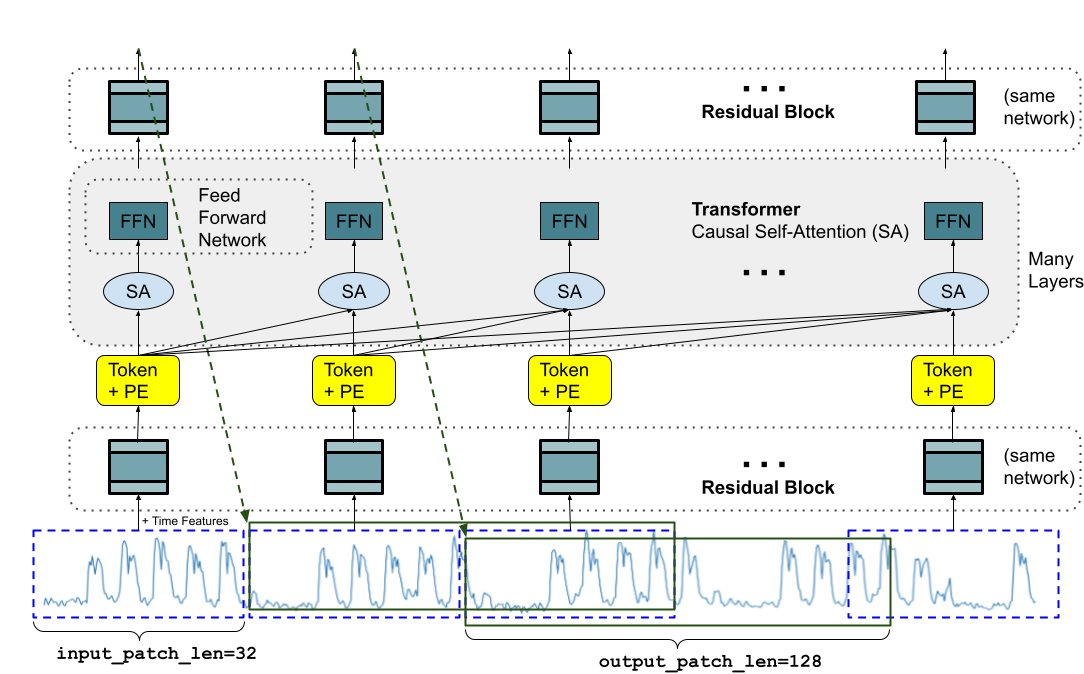
TimesFM is a patched-decoder style attention model pretrained on a large time-series corpus (the announcement cites 100 billion real-world time-points). The paper’s verified claim: out-of-the-box zero-shot forecasting across public datasets from different domains comes close to the accuracy of state-of-the-art supervised models trained per dataset, and the same model handles different history lengths, prediction lengths, and temporal granularities. That is the substance behind “impressive zero-shot performance” — one pretrained model, no per-dataset training, near-supervised accuracy.
What the announcement omits
- The 1.0 release is univariate-first. Native multivariate forecasting with past-only and past-and-future covariates arrived with TimesFM 3.0 (plus fev-bench/TIME/GIFT-Eval top ranks claimed in the repo) — do not read 3.0 capabilities back into the 1.0 weights.
- “100 billion time-points” describes pretraining scale, not a quality guarantee on any single domain. Zero-shot near-parity is dataset-dependent; the paper’s own evaluation is per-dataset.
- Serving path matters: the repo now documents PyTorch (
pip install timesfm[torch]), Apple-silicon MLX, Flax (2.5), LoRA fine-tuning examples, and BigQuery ML / Vertex Model Garden for production. The announcement’s two links alone leave a reader with no serving decision.
Trade-offs
- Use a TimesFM 1.0-class checkpoint when a single zero-shot model must cover many series without per-series training, and the series are univariate with compatible granularity.
- Prefer per-dataset supervised models or the newer multivariate/covariate-capable releases when covariates drive the forecast or when the last accuracy point on one domain matters more than generality.
- License check is part of the decision: 1.0/2.5-era weights are Apache-2.0 while 3.0 self-hosted weights carry the non-commercial license; commercial use of the newest generation belongs on authorized Cloud paths.
Limitations
- This rewrite did not re-run forecasts; paper and repo numbers are reported as verified source claims as retrieved 2026-10-14.
- The 34.5k-star / 3.3k-fork counts are live repo metadata, not evidence of forecast quality.
- Version details (2.5: 200M params, 16k context, quantile head; 3.0: multivariate) reflect the repo as retrieved; the pinned artifact for this post remains the 1.0 200M weights.
References
- Das et al., A decoder-only foundation model for time-series forecasting, arXiv:2310.10688v4 — https://arxiv.org/abs/2310.10688
- google-research/timesfm repository — https://github.com/google-research/timesfm
- TimesFM 1.0 weights,
google/timesfm-1.0-200m— https://huggingface.co/google/timesfm-1.0-200m - Original announcement post — https://twitter.com/GoogleAI
Editorial method: claims in this article point to primary documentation, pinned source code, runnable checks, or dated measurements, with AI-assisted research under the site's evidence-gated policy. How this site verifies claims and discloses AI assistance · Report a correction.